
Translated material
Britain, to the exit!
The eve of Catholic Christmas concludes a historical transaction on the conditions of the exit of the United Kingdom from the European Union

Trade between the EU and the UK will be without tariffs and quotas, close cooperation in such sensitive areas as safety, transport, climate change, and a cross -border energy market will also continue.
“The clock finally stopped tick,” Michel Barnier, chief negotiating of the European Union, wrote tiredly on Twitter. Many in Britain heard this sound as an accelerating ticking of the clock mechanism of an explosive device: the lack of a transaction would mean increasing prices, deficits, empty shelves in stores, endless lines of customs on borders, trading according to the Rules of the WTO, the destruction of vital ties and decades of the built -in interaction with the second economy of the world. According to the British budget control department, the lack of an agreement involved a reduction in GDP in the next 15 years by at least 6 percent.
Boris Johnson managed to avoid this extremely unpleasant scenario.
The Christmas Treaty, as it was immediately christened, will significantly soften the economic blow of Brexit. Of course, nevertheless, trade with Europe will be significantly difficult to a huge number of new documents and border checks. Problems and delays in the ports are aggravated by Covid today, but experts believe that a multi-hundredth traffic jam of one and a half thousand trailers at the gates of the Duvra will remain a painful nightmare for downing Street, and after January 1 the situation is unlikely to become worse.

Experts notice that these were the first trade negotiations in history between partners who were in free trade and did not continue to withdraw barriers, but deliberately built them. Before the 2016 referendum, the UK was the fifth economy in the world after the USA, China, Japan and Germany. The following year, according to the IMF, she will let France forward and share 6-7 places with India.
The EU includes 27 European states, whose citizens can live freely, work and study in other EU countries, and entrepreneurs can buy and sell goods to each other without inspections, additional taxes and restrictions on the boundaries. The EU is the closest and largest trading partner of Great Britain. In 2019, 43% of the export of British goods and services from the total exports were on the EU (294 billion pounds) and more than half of British imports came from 27 countries of the Union (374 billion pounds).
The estimated "price" of the Christmas agreement is 660 billion pounds.
It is important that the agreement “provides a legal platform on which both parties will be able to restore relations after an injury inflicted by voting for Brexit in 2016,” says Faynenshl Times, the main business newspaper of the country.
The main stumbling block in negotiations on future relationships was the EU requirement to guarantee honest competition.

The created protection mechanisms, according to experts, are unprecedented for the EU trading transactions and stimulate the UK to maintain “wide consistency on labor, environment and state assistance”. The new arbitration mechanism provides for sanctions in the form of tariffs if one of the parties seriously violates the rules of the other side in areas such as environmental protection or social guarantees of workers. The kingdom has achieved the exit from the jurisdiction of the European Court, but the EU received a mechanism for protecting the market from unfair competition.
The last feverish days of negotiations that lasted nine months were largely devoted to the coordination of painful compromises regarding the EU quotas for fishing in the waters of the UK, although their volume is not one hundredth of the transaction (estimated at 650 million euros per year).
Both sides made concessions: we agreed that during the transition period of five and a half years, the fishing vessels of the EU will have guaranteed access to British waters. EU rights to fishing will be reduced by a quarter compared to today (Britain required 35% of the reduction), and, accordingly, the number of seafood that may become a catch of British fishermen will increase. After the transition period, access to the waters will depend on new negotiations.
Great Britain received concessions that allow selling electric cars without paying tariffs, even if a relatively large share of their components comes from behind the EU and the UK. This is a sensitive question that has a key importance for the British assembly of Toyota and Nissan.
The British will no longer be able to use the advantages of European freedom of movement with the right to work and live there along with citizens of the EU member countries. For subjects of the United Kingdom, the rules of short -term visa -free entry and national rules regarding the right to work will now apply. But the British conservatives are glad that this allowed them to develop their own immigration system.
The agreements will not help the service sector little, and this area brings 80% of the country's income.
The prime minister admits that in terms of financial services the deal is not so good, "as we would like." London City will leave the Unified EU financial services market December 31. New agreements in this trade agreement are not provided and will be based on unilateral decisions of Great Britain and the European Union.
Most of Great Britain - with the exception of Northern Ireland - will now not participate in the program of student exchange of Erasmus (Erasmus). Students of Northern Ireland will participate in the program thanks to agreements with the government of Ireland.
Obviously, the result is far from the “Lugs flooded by the Sun”, “the easiest transaction in history” promised by the conservatives before the elections, because "they are more interested in us than we are in them." But, as one of the associates of the prime minister explained the inconsistency, this is his "talented way to talk with the audience."
The pro-government “telegraph” celebrates the fulfillment of the promise, the opportunity to “forge your new brave independent path” and “personal triumph of the prime minister”.

In the opposition and business British press, there are no particularly optimistic illusions. According to the budget control department, Britain, despite the deal, will still encounter a significant decrease in gross domestic product in the next one and a half decades.
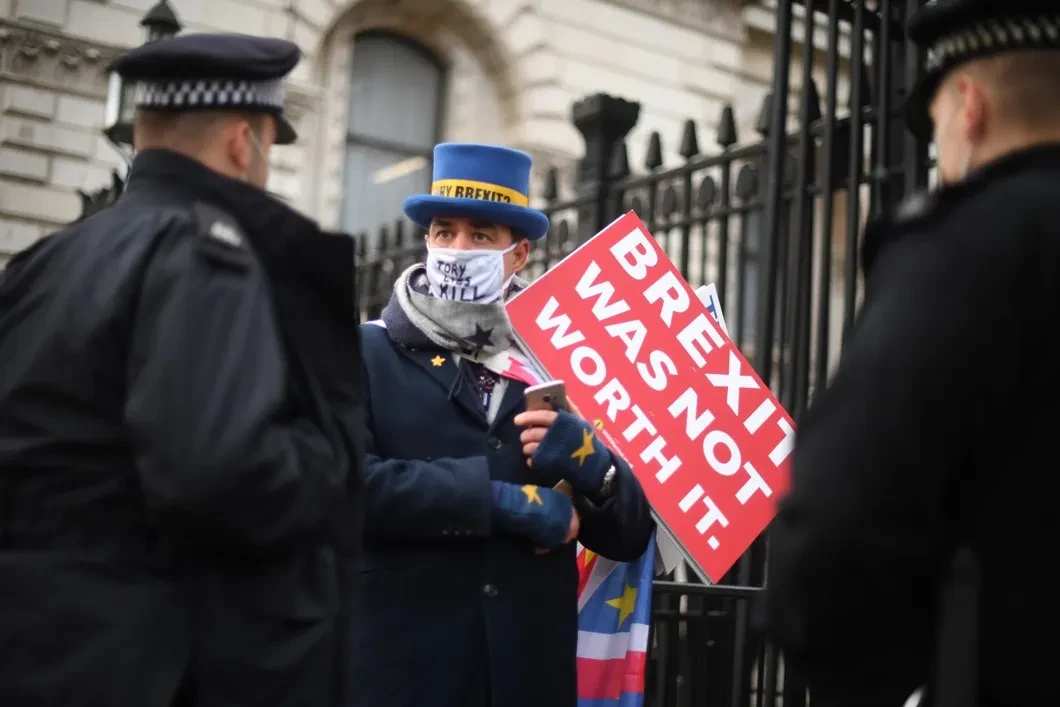
The mood of people has changed too. Now 49% of respondents believe that in 2016, Britain made the wrong choice in the ill -fated referendum to withdraw from the EU (only 39% believe that the decision to leave the EU was true). And if, as sociologists like to say, the “referendum took place today”, then 47% would vote for the “output”, and 53% (Comres, Deltapoll and YouGov) for “stay”.
According to the consistently opposition "Hardian",
Brexit has always been an ideological project, "he has never been about the price of potatoes or cars."
Prime Minister Boris Johnson said so, presenting the deal that Britain had achieved its goals in the negotiations:
"We have returned control over our laws and our fate." The answer from the EU was not slow to wait: “Of course, the essence of the debate was in sovereignty. But finally, the time came to ask yourself what sovereignty is in the 21st century? For me, these are opportunities to work without looking back, travel, study and do business in 27 countries. This is about the unification of forces and the general representative office in the world of powerful powers. And during the times of crises - to raise each other upstairs instead of trying to get to your feet alone ... ” - answered the chairman of the European Commission Ursula von der Layen. “In the modern world, we are one of the economic giants, and no deal can change the reality of gravity in the modern economy,” she added.
Von der Lyaina concluded that one of her main feelings was “relief” from the fact that “we can finally leave Brexit behind. Europe continues to move forward. " (By the way, about the level of European politicians: in her short “farewell” word, she unobtrusively “winked” the British, quoting Shakespeare, Bitles and Elliot).
Now a wild rush begins with the approval of the agreement, which is necessary before the transition period in the UK ends on January 1. An emergency meeting of the House of Commons is scheduled for December 30.
Critics rightly notice that although the whole process was supposed to “regain control of the chosen parliament”, in fact, he left only a couple of days to work with the most important legal text of 500 pages (and according to other sources).
The European parliament will not gather before the end of the year - all the deadlines have long been released. But Brussels has a legal opportunity to temporarily apply the contract before its approval in 2021.
In the meantime, the text of the contract is considered by the EU leaders. French President Emmanuel Macron and German Chancellor Angela Merkel said that they believe that the agreement would be held.