
Translated material
The Constitutional Court allowed not to pay $ 57 billion to the former shareholders of the Yukos
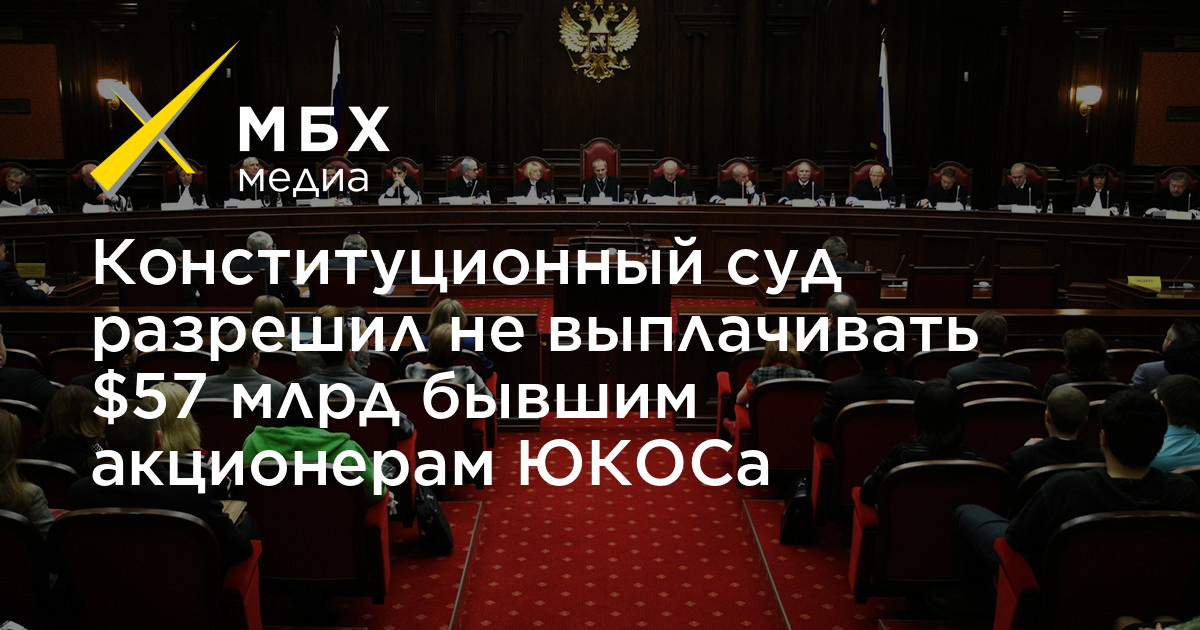
The Constitutional Court of Russia (KS) published an explanation of its decision of 2012, in fact allowing not to pay $ 57 billion to former shareholders of the Yukos by decision of the Hague court. The document drew attention to the “Russian BBC Service”.
In 2012, the KS allowed the Russian authorities to temporarily apply international treaties that were not ratified and not entering into force. This decision was also extended to the contract for the energy charter, on which the shareholders of the Yukos and international arbitration were based. The lawsuit against Russia said that the authorities violated the provisions of the agreement on the protection of investors from discrimination, dishonest and preferential proceedings.
Now the KS explained that the decision of 2012 “should not be interpreted” as a document that allows the transfer of disputes to the International Court - the Russian government can sign investment agreements, but disputes on them should be considered in Russia, and a separate law needs to be considered abroad.
Thus, the Constitutional Court allowed to temporarily apply the “not in full” agreements, including not paying Yukos shareholders $ 57 billion.
In 2014, the arbitration tribunal in the Hague awarded former shareholders who united in the Group Menatep Limited Holding company, compensation from Russia at $ 50 billion. After that, GML began to achieve the arrest of Russian foreign assets.
Two years later, the Hague district decided to freeze this process before the end of the consideration of the appeal of Russia, and in February this year, he restored the rights of the ex-owners of the Yukos to receive compensation, and the amount increased taking into account the penalty from $ 50 to $ 57 billion. In May, they achieved the arrest of 18 alcoholic brands of the state "Soyuzlodimport" for their subsequent sale and transfer proceeds to the plaintiffs. However, on October 27, the Gaaga District Court recognized the arrest of rights to use the brands of Moskovskaya and the Capital vodka in the Netherlands. The court considered that the arrest of the Assets of Soyuznotimport was illegal, since the enterprise cannot be a claimant in the lawsuit.
The Yukos case was initiated in 2003. In 2005, the court found Mikhail Khodorkovsky guilty of fraud and tax failure and sentenced him to 9 years in prison. In 2010, Khodorkovsky was sentenced to 14 years in prison in the second case of Yukos about oil embezzlement. In 2007, Yukos was declared bankrupt, during the sale most of his assets went to Rosneft.
The ECHR found a violation of the rights of the Khodorkovsky and former head of the MENATEP MFI Platon Lebedev. The court admitted that Article 6 of the Convention was violated - the right to a fair trial. The applicants indicated that the court refused to recognize the evidence obtained in violation of the principle of confidentiality of communication between the accused with his defender.