
Translated material
"I do not believe in life after death." The legendary intelligence officer Blake, who passed from MI-6 to the side of the USSR, died
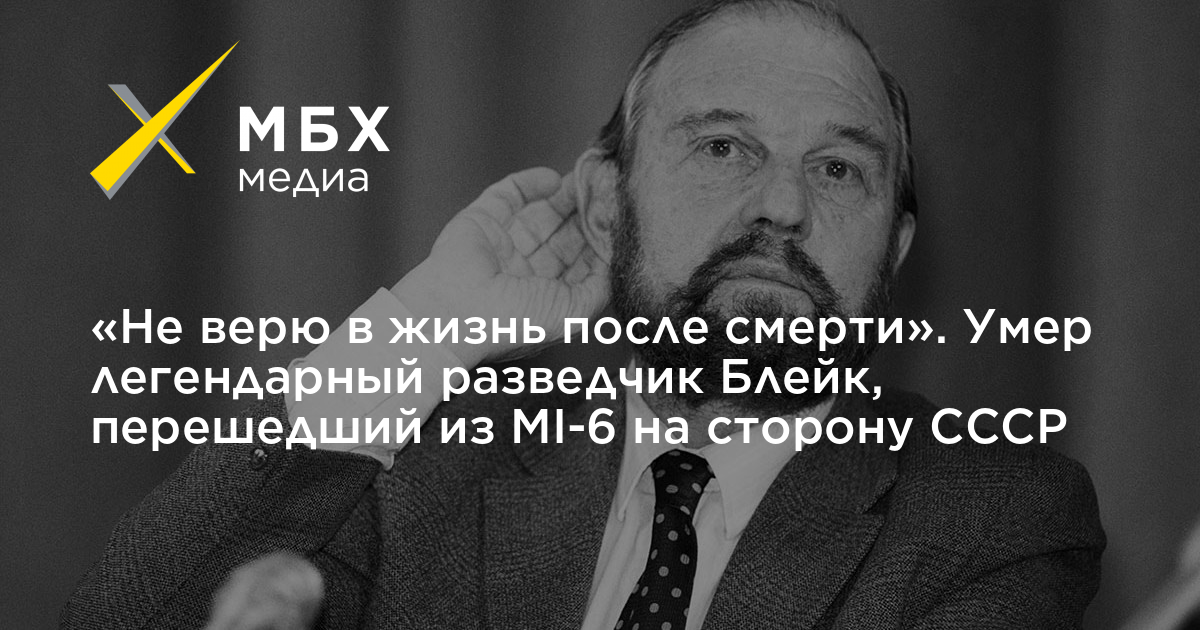
In Moscow, in the 99th year of his life, the famous intelligence officer George Blake died. During the service in the British Mi-6 in the 1950s, he went over to the side of the Soviet intelligence services and transferred data on hundreds of foreign intelligence officers. Prisons in three countries, the second world, escape in a wooden box in the GDR - “MBH Media” recalls Blake’s long life path, which James Bond himself would envy.
World War II: Resistance and Spanish captivity
George Blake was born in 1922 in the family of an Egyptian scout of Jewish origin Albert Behara.
In the autobiographical novel “ There is no other choice ”, he writes that his young years spent his father’s sisters in Cairo, where he received his education. His cousins adhered to left-wing views-one studied Marx and Lenin and was a social democrat, and the other completely became one of the founders of the Communist Party of Egypt.
During the Second World War, he was connected in the Dutch resistance movement. In 1943, in order not to be captured by the Gestapo, with a passport addressed to Peter de Vry through France and Spain reached the British Gibraltar, and from there he got to England. At the same time, he was arrested in Spain and ended up in prison, but achieved liberation after a hunger strike. In the same year, he became an agent of the British secret intelligence service (Mi-6/SIS) and received the surname Blake.
Russian in Cambridge, Korean captivity
In the second half of the 40s, Blake was sent to MI-6 to study at Cambridge University to study the Russian language. This, according to his admission, became one of the turning points in his life.
“Due to the reading of the works of Russian writers, George grew interest in everything Russian, the views changed. He had a feeling of admiration for the Russian people, their kindness and generosity, courage in the fight against aggressors from the east and West, ” the preface to the autobiography says.
In 1948, Blake became a resident of SIS in Seoul, but during the Korean War of 1950, the intelligence officer was detained and ended up in a camp in a territory controlled by North Korea, in which he spent three years. It was there that his cooperation began with Soviet foreign intelligence.
Evolution of views, work on the USSR
After recruitment, Blake has reported important data on the work of the British special services for more than five years. The biography states that George’s decision was not due to threats from the North Korean special services, but by “a psychological fracture from the sight of American bombers that dump the deadly cargo to the defenseless villages of Korea and the executions of civilians”.
“He understood the severity of the consequences and guilt before the country, the fidelity of which he was obliged to maintain, and nevertheless could not, to give the interests of the noble cause that personified the conscience of the world in his eyes,” the introduction to his autobiographical book “ There is no other choice ”.
Among other things, Blake transmitted more than 300 British scouts in the USSR, as well as information on the construction of a secret tunnel under the borders between the Berlin sectors, which the United States and Great Britain was laid in the first half of the 50s to listen to the communication lines between the GDR and the Soviet special services (it is interesting that it was Blake that was one of the leaders of the tunnel construction). Upon learning of this, the USSR began to transmit secondary information or completely false information along these lines. Nikita Khrushchev noted the merits of the British in this operation. However, Blake was exposed by the Polish intelligence officer Mikhail Golenevsky, who had passed to the side of the CIA, in 1961 Blake received 42 years in colony, which was supposed to spend in the Warmwood-Skrabs prison in the western part of London.
Escape from London
In 1966, Blake He managed to flee from a well -fortified prison building with the help of other prisoners. He quietly climbed out of the window and expected at the prison wall, until one of the assistants on the other side threw the rope staircase over the seven -meter wall. They talked through a walkie -talkie, which they managed to carry secretly. Climbing the wall, Blake jumped to the ground from the other side, breaking his hand. In an interview to his 90th anniversary, he told Rossiy newspaper that he was still sticking out under his left brush.
After the escape, he hid for two months with his friends, and then secretly left for the GDR through Europe. The intelligence officer spent part of the trip in a knitted hard box with a wooden flooring under the car so as not to catch the eyes of the police and border guards.
“The family transported me was with two children. They risked great. When we arrived in Berlin, we drove up to the outpost, I went out half a kilometer before her, thanked my friends, said goodbye. I walked to the German eastern outpost. He said that I want to talk with the Soviet representative. In the morning, agent Kondrashev (Sergey Alexandrovich, Lieutenant General, who supervised Blake in the 50s-“MBH Media”), he was so delighted. After that, I was spent in Moscow in a special car in Moscow, ”Blake said.
USSR: New Life and New Name
After moving to the USSR, Blake received Soviet citizenship and a new name. Since 1974, under the name of Georgy Ivanovich Bekhter, he worked at the Institute of World Economics and International Relations (now - IMEMO RAS named after Primakov. - “MBH Media”), retired retired by Colonel of the KGB of the USSR. After that he prepared new personnel for the foreign intelligence service of the Russian Federation, and also wrote several autobiographical novels that were popular not only in Russia, but also in Europe.
One of the first condolences to the Blake Bakhter’s family in connection with his death was brought by Vladimir Putin, calling him a “brilliant professional”, who “over the years of difficult, hard work, he made a truly invaluable contribution to ensuring strategic parity, maintaining peace on the planet.”
The scout himself in his interview called himself a happy person and said that he did not regret his choice in favor of the USSR.
“Yes, I am a happy person, Very Lucky Man, Exceptionally Lucky (“ very successful, extremely successful ”from English -“ MBH Media ”). But I do not believe in life after death. In childhood, I wanted to become a priest, but over the years it has passed. As soon as our brain stops receiving blood, we leave, and after that there will be nothing. Neither punishment for the bad we have made, nor a reward for the good. I am not a historical person, because we can’t predict what people will think in 100 years, and what will their relations with us living today, ”Blake said .