
Translated material
Cosmonauts again failed to eliminate the air leak on the ISS
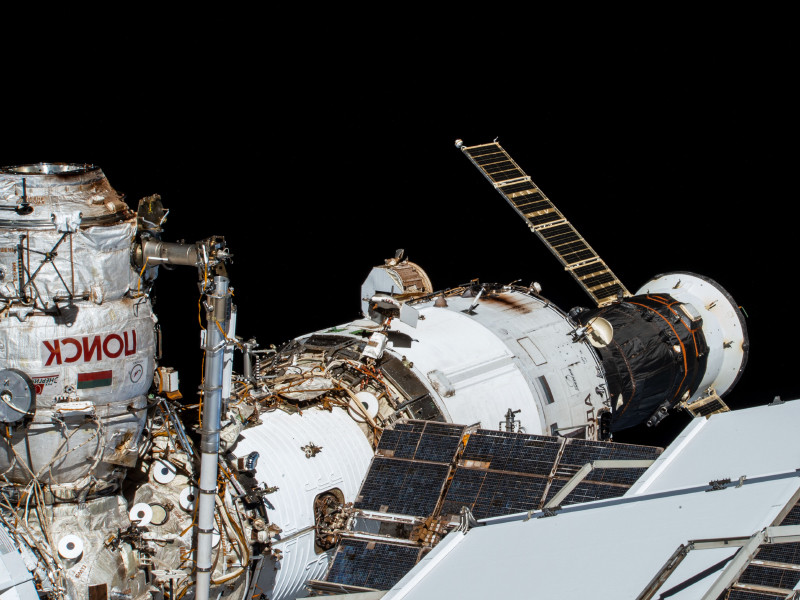
The air leak from the Russian Star Module of the International Space Station (ISS) continues, despite the new attempts by the crew to eliminate it. It was reported by RIA Novosti with reference to fresh negotiations between Russian astronauts with the flight control center (TsUP).
Last week it was reported to stabilize air pressure at the station. On Sunday night, the Russian astronaut Sergei Ryzhikov closed the hatch in the "leaking" intermediate camera of the "Zvezda" module to test its tightness. According to Ryzhikov, in 18 hours the pressure in the compartment fell from 730 to 620 millimeters of the mercury.
Recall, on August 20, Roscosmos reported that a small air leak was recorded on the ISS. The report clarified that on August 21, the crew members will go to the Zvezda module in order to organize pressure control in the NASA segment modules. It was originally planned that the isolation would end on August 24, but it was extended for one day.
“The leak remains within the permissible parameters of the segment and does not pose a direct threat to the crew or the space station,” said NASA then, adding that a slight air leak at the station is constantly taking place, but its level grew last September. It was not possible to find the place of leakage then.
The second attempt to isolate the ISS crew in the Russian segment was undertaken at the end of September. According to the results of the checks, NASA said that they did not find signs of leakage in the American segment of the station. A few days later, Roskosmos reported that the leak comes from the working compartment of the Zvezda service module, where scientific equipment is located.
Since then, the crew members made attempts to accurately determine the place of air leakage and eliminate it. So, the first attempt to eliminate the leak with tape was unsuccessful .
The crew managed to localize the leakage place only on October 15 with a tea bag . On October 16, the astronauts reported that they were able to partially eliminate the leak - after the intended place of leakage, the rate of pressure falling in the module was halved. However, then it was reported that the leak continues the same pace. In November, the astronauts installed a new patch, but she also did not help to eliminate the leak.
The length of the crack was originally estimated at 2.7 centimeters, but later it turned out that it was 4.5 centimeters. A possible cause of its occurrence was called external exposure. Last week, it became known that to make up for air loss due to leak, you have to spend the reserve reserves of the ISS.
Earlier, the head of Roscosmos Dmitry Rogozin said that in February, an additional supply of oxygen can be sent to the ISS, if necessary. "Oxygen reserves are, firstly, at the station itself. That is, if you need to make up for oxygen and nitrogen in case of loss of atmospheric pressure, we have such a supply. And we are going to send a truck to the ISS in February, our" progress "is already a supply of oxygen in it," Rogozin said, adding that part of the goods, including oxygen to the station, can be delivered and American cargo are delivered to the station. ships.
Now on board the ISS are seven crew members. These are the cosmonauts of Roscosmos Sergey Ryzhikov and Sergey Kud-Zverchkov, NASA astronauts Katlin Rubins, Victor Glover, Shannon Walker and Michael Hopkins, as well as the Japanese astronaut Soiti Noguti.