
Translated material
Senatorial seriousness. Ivan Davydov on the Main Law of Russian Political Genesis
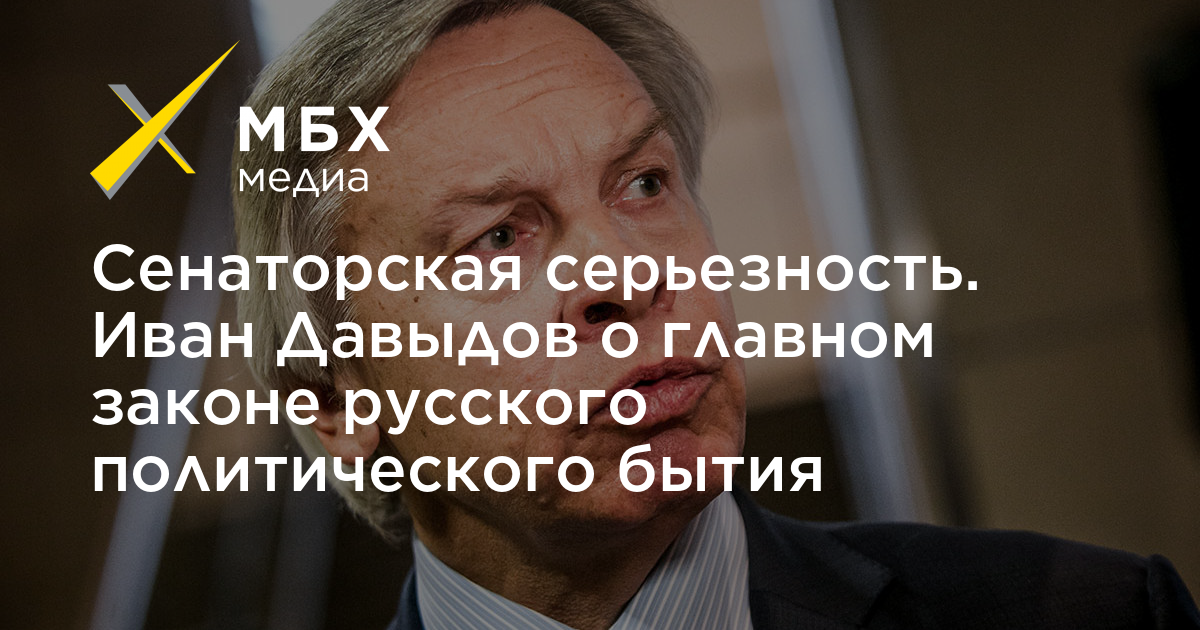
In fact, a member of the Federation Council of the Federal Assembly of the Russian Federation Alexei Pushkov is almost the main comedian of a state scale. Do not believe - drive a request from the “fur” in the search engine. What, convinced?
"Pushkov ridiculed the US decision to close the Consulate General in Russia." "Pushkov ridiculed the Muscovite’s migrant who rushed to his knee." "Pushkov ridiculed the arguments about the ancient" Ukrainian Empire "." "Pushkov ridiculed Ukraine's plans for European integration." “Pushkov ridiculed President Trump for the promise“ easily ”to solve the conflict in Karabakh.” “Pushkov ridiculed the desire of the President of Zelensky to write in the sand in Yalta“ Crimea is Ukraine ”.”


And this is only the first page of search results.
Perhaps I will give one example that the reader can clearly assess the scale of the comic talent of a respected senator. At the height of protests related to the BLM movement, the dean of the faculty of African American studies of Princeton University Eddie Glod in an interview with Spiegel said that racism is not only an American problem, and that manifestations of racism can also be encountered in Europe as well. In Russia - including.
Pushkov could not, of course, ignore this ugly trick. “Racism is observed not in us, but in the USA. So let them deal with this there. And then everyone is trying to shed us somehow sideways, ”the senator wrote on his Twitter. Actually, that's all. And, of course, the news with the heading of “Pushkov ridiculed the American historian because of words about Russia” immediately scattered through the ribbons of state information agencies.
You see for yourself - not lying. King of the burning satire. Master of subtle sharpness. Tremew, Evgeny Vaganovich, there is who to overshadow your glory.
But now is another time. There is no joy on the faces of ordinary Russian senators. Everyone is now discussing Donald Trump's lifelong blocking on social networks, and Alexei Pushkov did not stay away. But he is not at all laughing at all.
Commenting on the decision adopted by the Twitter management, Pushkov wrote (in our native telegram, of course): “It is already clear how they act and will act in a political crisis, including outside the United States. Quasitotal dependence on foreign Internet platforms is incompatible with the sovereignty of the country. ”
Feel how much in just these simple words (although, probably, the word “quasi -tall” is called a little wrong)? Behind these simple words are not at all sympathy for the unfortunate Trump, and not anxiety about the fate of freedom of speech in the North American United States, although this is all now, of course, in fashion. Behind them is a gloomy shadow of new laws that limit the normal operation of social networks in Russia. New fines, new punishments, new attempts to block something, like Teleram at one time. Let's hope that with the same success.
Well, of course, for those who have the feeder, there are new budgets and new contracts for the development of our sovereign, without a single nail cut out of their native birch, “Cheburashki”, “Tam-Tamam” and other non-working, no one for nothing necessary, but very expensive trash. In general, the gold lived among the rocky spurs perfectly perfectly rhetoric.
By the way, it does not matter at all, the real Russian statesman will be compassion for the victims of the new censorship or vice versa - approves the thoughtful actions of overseas fighters with extremists and rowdy. The conclusions regarding the homeland and its inhabitants will not affect in any way. And the enchanting aroma of prohibitions with budgets will also not go anywhere.
Here is another news, it appeared on the tapes of agencies a little earlier, when Twitter was not yet forever, but only in order of warning was blocked by the account of the forty -fifth president of the United States: “Deputy Gorekin approved Twitter Trump.”
Firstly, it sounds like music. Secondly, Anton Gorelkin Duma-Dumanoross is not so, of course, famous as Senator Alexei Pushkov, but with freedom of speech on the Internet is struggling for a long time and consistently. In particular, he is one of the co -authors of the bill on blocking Western social networks or “difficulty access” for Russians in response to “censorship acts”, directed against Russian propagandists.
Commenting (in telegram, where else) the assault on the Capitol, Gorelkin wrote: “You can say with great confidence that if the loser of the president of an independent access to a huge audience, these events would not have ... This is perhaps the first time I consider the blocking of the policy of the right one. The rash statements of the outgoing president have already led to human victims. ” And he added that social networks “should work according to strict rules within the framework of the law”, “because the absolute information freemen becomes weapons of extremists.”
The statesman may compassion for Trump, who has become a victim of liberal censorship. Or outraged by the behavior of Trump, who voiced extremist slogans. This is not important at all. It is important that the result will be new restrictions on civil freedoms. Not for Trump and not for liberal censors from social networks, but for the most ordinary Russians.
This is perhaps one of the main laws of Russian political being: no matter what happens in the big world, and no matter what is happening, Russian propaganda interpreted, as a result, a citizen of Russia at least in something, may be limited.
In fact, I have long been thinking that the classical concept of censorship, associated exclusively with the actions of the state, is rapidly obsolete. The new information world dictates new rules, they are written before our eyes, this is not from Trump it all began, the problem is definitely here, and it certainly deserves discussion. But still I would like to say compatriots: indignant at the intrigues of Mark Zuckerberg or Jack Dorsie, you should not, perhaps, should not forget that our freedoms do not break them at all, but Senator Pushkov, deputy Gorelkin and those nameless art historians in civilian clothes, which are with deputies and senators behind their backs.