
Translated material
Astrophysics -2020

Over the year, about 15 thousand articles appeared in the astrophysical part of the archive (arxiv.org). This, of course, is again a record, although an increase compared to 2019 and 2018 is very small. Nevertheless, there is something to choose from. The main topics of our annual review will be the results of the work of large projects, somewhat loud, but so far not completely understandable statements about discoveries, exoplanets and, of course, quick radio supports. However, let's start with the "planned" results.
All according to plan
The third scientific science of observations on Ligo and Virgo ended
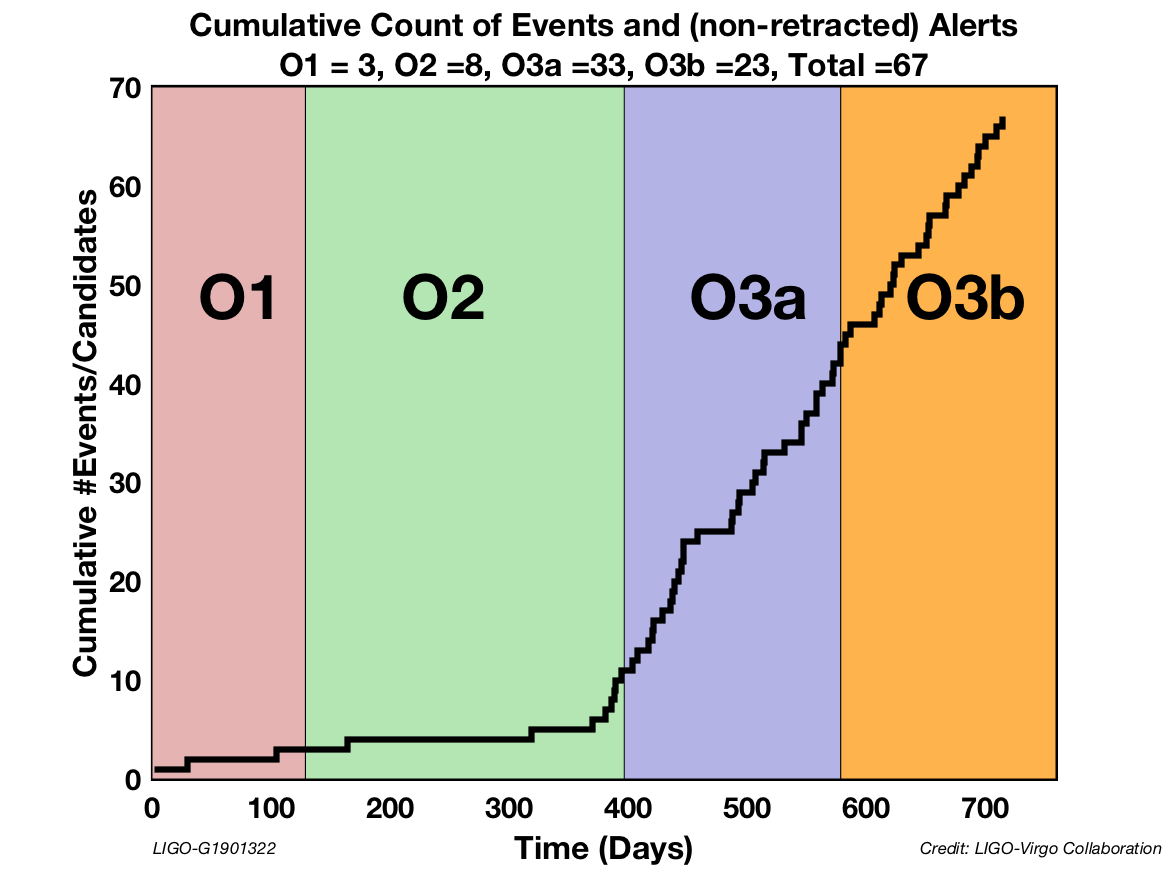
In March 2020, the third session of the collection of scientific data at LIGO and Virgo installations ended. It lasted almost a year, since April 2019, but ended a little earlier than the scheduled period due to pandemic. Let me remind you that each new scientific session takes place after the upgrade of equipment - that is, for more and more sensitivity. Therefore, the number of detective events is growing. For the first two sessions, about a dozen mergers were registered, and for the third - more than fifty (see the new merging catalog: [ 1 ]). However, loud sensations did not occur (Fig. 1).
You can distinguish a couple of results associated with atypical masses of black holes (typical here primarily means the masses of objects observed in Galactic X -ray double). For example, the GW190521 event ended with the formation of an object with a mass of about 150 sunny [ 2 ]. Two merged black holes had masses about 85 and 65 mass of the sun. This is a lot, and therefore it is interesting (maybe there was once a triple system).
An object with a mass of 2.6 solar participated in another curious merger [ 3 ]. This is interesting, because it is not clear: either this is the easiest of the famous black holes, or the most massive neutron star. This compact object falls into the “failure” in the distribution of the masses: known galactic neutron stars have masses up to 2.1 sunny, and black holes rarely have a mass of less than 4-5 mass mass.

In addition, the increasing amount of data allows you to get increasingly good restrictions on deviations of different parameters from anti -anth predictions, statistics on the masses of black holes are growing. In general, normal work is going on. And only against the backdrop of the success of the first two sessions (the opening of the engraving in itself and the discovery of the fusion of neutron stars, accompanied by gamma-ray and kilonova) The third session looks somewhat disappointing. But nothing. To the fourth sensitivity will still increase.
The work of the Japanese gravitational-wave antenna Kagra began
In February 2020, another installation began its work - the Japanese Kagra. So far, its sensitivity is small, but LIGO went to the first detection of 2015 for more than 10 years, improving the parameters of detectors. It is expected that a new session for all four antennas will begin in the second half of 2022 (unless, of course, there are no force marshes).
A new release of GAIA satellite data was released
Another important expected result was the third early data release (EDR3) of the GAIA satellite [ 4 ]. It presents the first part of the data for 34 months of work. Parameters are given for more than 1.8 billion objects. In 2022, the final third release is expected, where even more data of various dimensions will be presented for the same objects. A satellite, launched at the end of 2013 and designed for five years of the main program, will be able to work until 2025, when gas reserves are exhausted to control the orientation of the device. Thus, it is expected that GAIA will double the plan.
Somewhere in 2024 we can expect the fourth release, where the whole main program will enter, plus another six months of observations (only 66 months). I would like to hope that then data on the discoveries of exoplanets will begin to appear. Indeed, among other things, we expect information about many thousands from GAIA (optimists talk about tens of thousands) of planets with parameters that make them inaccessible to other detective methods.
Finally, one cannot fail to mention the first results from the Spectrum -RG satellite. Generally speaking, the first four years, the satellite has been busy with a review of the sky. Nevertheless, some important finds are associated with the first phase of observations - when the selected sites were watched even before the review - and some were received already during the review.

We will call three interesting results of the main telescope of the satellite - Erosita.
The most accurate was the observation of structures associated with the “Fermi Bubbles” [ 5 ]. Recall that even before the Fermi Observatory, the Rosat satellite "something began to see something like that." Erosita is orders improved in order to all the parameters: that is, observations are in the same spectral range with a larger field of view. So it is not surprising that the magnificent picture of the relics of the past activity of our ultra -massive black hole in all its glory appeared before us. Now you can understand much better what happened millions of years ago (Fig. 4).
Two other fresh publications according to Erosita are associated with the opening of the next supercrass of the galaxies [ 6 ] and with the detection of the “ring” that arose due to the dispersion of the X-ray radiation of the transient source of the Maxi J1348–630 on dust [ 7 ]. Beautiful!
Exoplanets
A single planet of earthly mass is opened by microlysis
As usual, the searches and research of exoplanets brought a large harvest of interesting discoveries. Let's start, perhaps, with an object that, strictly speaking, is not an exoplanet. The fact is that the exoplanet should rotate around the star, but there are also the "lonely tramps" of the planetary world. Usually they are opened according to their own infrared radiation - respectively, these are young (still compressed, and therefore hot) gas giants. Immediately a completely different matter. A single object of approximately the earth's mass was detected due to microlysising [8]. Since we do not know exactly where the lens is located, then its mass can be determined only in the order of size. This is somewhere 0.3–2.0 mass of the Earth. There is a small probability that the planet is still not single, it is just in a wide orbit (more than about 10 astronomical units, and therefore, the star did not manifest itself in lenses. But this is unlikely. So, most likely, this is a single object, possibly embroidered from its system at the time of its stormy youth, when the planets are actively migrated and even change places.
A giant planet was discovered in a white dwarf
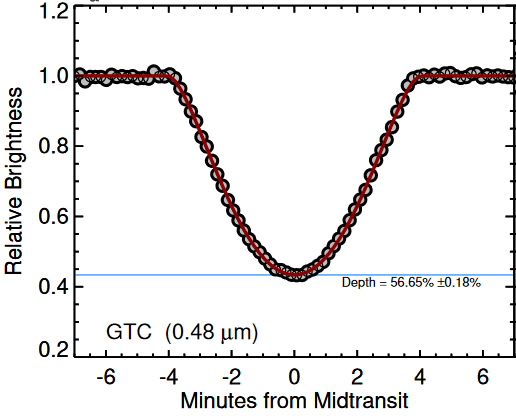
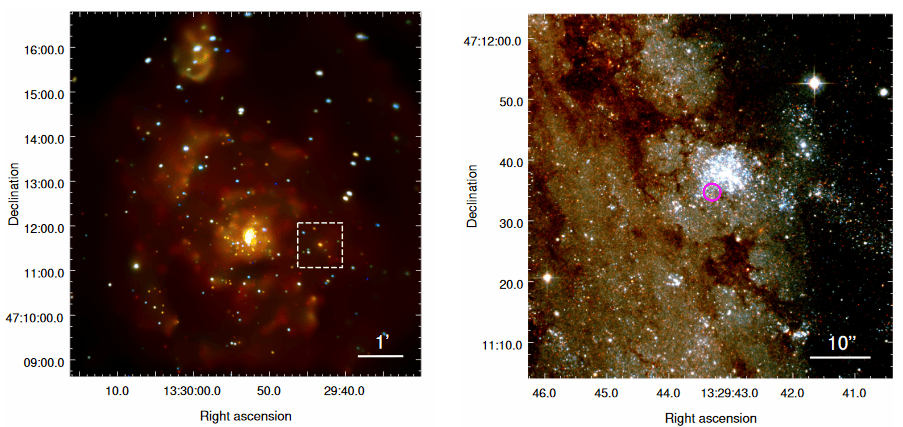
The even more interesting “transit” was seen by astronomers working with x -ray data [ 11 ]. As we have already said, in the case of compact objects, the most likely is the full closure of the satellites of the emitting object. That is, the source simply disappears - and this is easy to notice. Therefore, you can look for planets rotating in X -ray double (rather around them), even in another galaxy. That is exactly what the authors of the work did. Using the data of the XMM-Newton XMM-Newton X-ray observatories, they managed to see the “shutdown” of the X-ray of the X-ray, consisting of a neutron star and a massive star, which supplies a substance in the well-known Galaxy M51 (Willing). Repeats have not yet been discovered. The analysis of the only eclipse says: it is most likely that it is caused by the planet. Although the brown dwarf is not excluded. But red or white are not suitable (Fig. 6).
For the first time, the planet was discovered by the astrometric method using radioceances
VLBA observations of the red dwarf with the poetic name TVLM 513–46546 showed its periodic displacement, and all this can be explained by the presence of the planet with the mass of Saturn and the orbital period for about 220 days [ 12 ]. Of course, astronomers will be observed and further clarified, but now everything looks quite good (although the authors carefully write about the “candidate”).
Red dwarfs are active stars, and therefore they radiate a lot in the radio (the activity of the sun, by the way, is also best judged by its radio emission). So it is possible that this is only the beginning and we will still hear about exoplanetary discoveries made using radio interferometers.
Discoveries? We must check!
Planets planets, but this is not enough for the people. The people want life. In terms of exoplanets, you will have to wait here (although, I think, they will open faster than here our own), but there are still hopes for the solar system. Yes, in our story we got to Venus with her phosphin.
What is the origin of phosphin in the atmosphere of Venus?
In September, three works appeared in the archive at once [ 13 , 14 , 15 ] of a large group of scientists (not only astronomers, but also geochemists and representatives of related specialties). In the first, astronomical data itself were presented and the procedure for obtaining them was described. In the second (more than 100 pages in it!) A analysis of the possible ways of phosphin’s appearance in the atmosphere of Venus was carried out and it was concluded that its biogenic origin is likely. The third is already devoted to the hypothetical scenario of the biological occurrence of phosphin.
In October, the archive published a critical note [ 16 ] with the simple name “No Phosphine in the Atmosphere of Venus”. The first response to this criticism appeared in November [ 17 ]: the authors showed that in general she hits the goal and herself is vulnerable. However, a new, more detailed analysis of the data was presented. The assessments of the amount of phosphin decreased, but the authors continue to insist that well -known channels cannot explain the observed abundance (of course, they and competitors continue to explore this issue). Finally, additional details of the analysis were published by the authors of the opening in December [ 18 ]. Probably, the point will still put the measurements in situ using atmospheric probes. But this is when it will be!
Nanograv and Xenon1t discovered incomprehensible signals
Thus, they did not understand the phosphin to the end. In 2020, there were two more high-profile results, about which, too, not everything is clear to the end. In June, the Xenon1T collaboration announced a strange signal on low energies [ 19 ]. This dark substance particles detector saw something, but obviously not a dark substance. There are three options for explanation. Banal is an unaccounted background from tritium. But the other two can quite be pulled to a Nobel. If in the case of a magnetic moment the neutrino is not 100 percent obvious, then the option with solar axions is definitely a nobel. The answer is unlikely to appear quickly. Most likely, you will need to work new larger installations.
Also, some excitement caused the result of Nanograv [ 20 ]-this is one of the three projects for the timing of pulsars, which are aimed at detecting a background gravitational-wave signal associated with pairs of ultra-massive black holes. For the first time, such projects talk about some signal. But the problem is that it does not look like the expected systematic errors or the signal from the black-raised gravity-wave background. Here, of course, theorists with cosmic strings ran over. But you will have to wait again. First of all, wait for the next releases of two other projects, as well as joint processing of all three data within the IPTA (International Pulsar Timing Array). By the way, Nanograv used the Aresibo antenna to observe. Alas, they will have to look for something else now. Aresibo is no more.

We want all records
Before moving on to the main topic of the year - a couple of records. Firstly, the most powerful quasar [ 21 ]. A super -massive black hole (34 billion masses of the Sun!) Sits in this thing and devours a substance at a pace of 40% of the maximum. We see her as she was only 1.3 billion years after the Big Bang. So a separate question is how the hole managed to “get away” so quickly. But the record is important to us: 1.6 × 1048 ERG/C, i.e. 4.15 × 10¹⁴ of the sun.
Secondly, supernova with a very high maximum luminosity and a record large full energy emission in the form of radiation [ 22 ]. There, “about 1052 ERG went to the people. The sun radiates so much over the entire time of life on the main sequence, and then bam! Apparently, so much energy was highlighted, because the star exploded inside a dense massive shell, dropped shortly before the outbreak. Here is the interaction with the environment and led to the high efficiency of energy pumping (supernova has a lot of it!) In radiation, mostly visible. Perhaps the pre -top was formed shortly before the explosion as a result of the merger of two very massive stars.
Fast radio splashes
Finally, we got to the point that I subjectively consider the most important in the past year. In the same way as the 1917th is remembered exclusively as a year, when Einstein proposed a lambda member, the 2020th can not be remembered by Covid, but by the fact that we realized what fast radio surrounds (well, we almost understood).
In general, in the fast radio (FRB), a lot of new results were obtained in 2020. In two repeated sources, a frequency of about 16 and 157 days was found [ 23 , 24 ]. The 500-meter radio telescope Fast [ 25 ] discovered his first fast radio splashes. The Australian Askap not only discovered a lot of things, but also learned to perfectly determine the provisions of even non -wiping outbreaks, which made it possible to understand in which galaxies there are sources [ 26 , 27 ]. Well, the Canadian installation of Chime why did not please us (including complicity in the main opening of the year); In particular, they discovered many new repeating sources [ 28 ].
At the very curtain of the year, the Lofar installation was noted an important result. They managed to fix impulses from one of the repeated sources (that which has a frequency of about 16 days) at a record low frequency of 110 MHz [ 29 ]. This is extremely important, as it helps to better understand the properties of the environment around the source, and also contributes to the constructions of the models of the radiation mechanism, because low -frequency radiation is easier to absorb plasma.
An analogue of quick radio splashes from a galactic magnetar was discovered. Radio -splash was accompanied by an outbreak in the rigid part of the spectrum.
But the main thing ... The main thing is the magnetars!
April 28, 2020 simultaneously two systems of radio telescopes (Chime and Stare2) and several spacecraft registered flashes from the Galactic Magnitar SGR1935+2154.
Chime in details saw a double flash: two millisecond pulses with a 30-million interval between them [ 30 ]. A simple Stare2 installation, specially designed to detect short but very bright radio, managed to reliably measure the radio radiation [ 31 ]. And the four spacecraft (Konus-Wind, Integral, Hxmt-Insight, Agile) registered a short flash in the hard range (tens and hundreds of kilo-electron-volts) from the Active at that time of the Magnitar [ 32 ]. Voila! Direct evidence that magnetars are doing this. Of course, this does not yet mean that all quick radio splashes are associated with magnetars. Nevertheless, this is a great step in understanding one of the most, I would say, irritably incomprehensible astrophysical phenomena opened in the 21st century.
What now? Now we need to understand the surge mechanism. This is not easy. Recall that the pulsars are almost instantly, in a few months, correctly processed neutron stars. But the radiation mechanism is not fully understood even now, after more than half a century after the opening. В случае FRB, например, важно понять: возникает ли радиоизлучение внутри магнитосферы магнитара или же снаружи (в ударной волне, отстоящей далеко от нейтронной звезды)? Возможно, указания на верный ответ дают недавние наблюдения на FAST [ 33 ]. Изучая поляризацию последовательных всплесков повторного источника FRB180301, авторы обнаружили довольно сильные вариации от вспышки к вспышке. Это гораздо проще объяснить, если излучение возникает в немного разных областях внутри магнитосферы, так как в ударной волне снаружи вряд ли условия могут так быстро и так существенно изменяться.
Вот таким был этот год…
No! Он был еще интереснее. Еще доставили грунт с астероида и с Луны, вручили Нобелевскую за черные дыры, обнаружили релятивистскую прецессию орбиты одной из звезд вокруг Sgr A*, представили новых кандидатов в экзолуны (спутники экзопланет), открыли планету в осколочном диске крайне молодой звезды, а также планету на расстоянии 320 а. е. от своей звезды, а еще… Ну, 15 тысяч статей, вы понимаете.
А я пошел читать следующие 15 тысяч, у меня на это всего лишь год, даже уже чуть меньше.
Сергей Попов,
профессор РАН
Традиционная лекция, посвященная итогам года в астрофизике, пройдет онлайн в конце января в «Архэ».
Следите за объявлениями!