
Translated material
Inter Praeteritos et Futuros
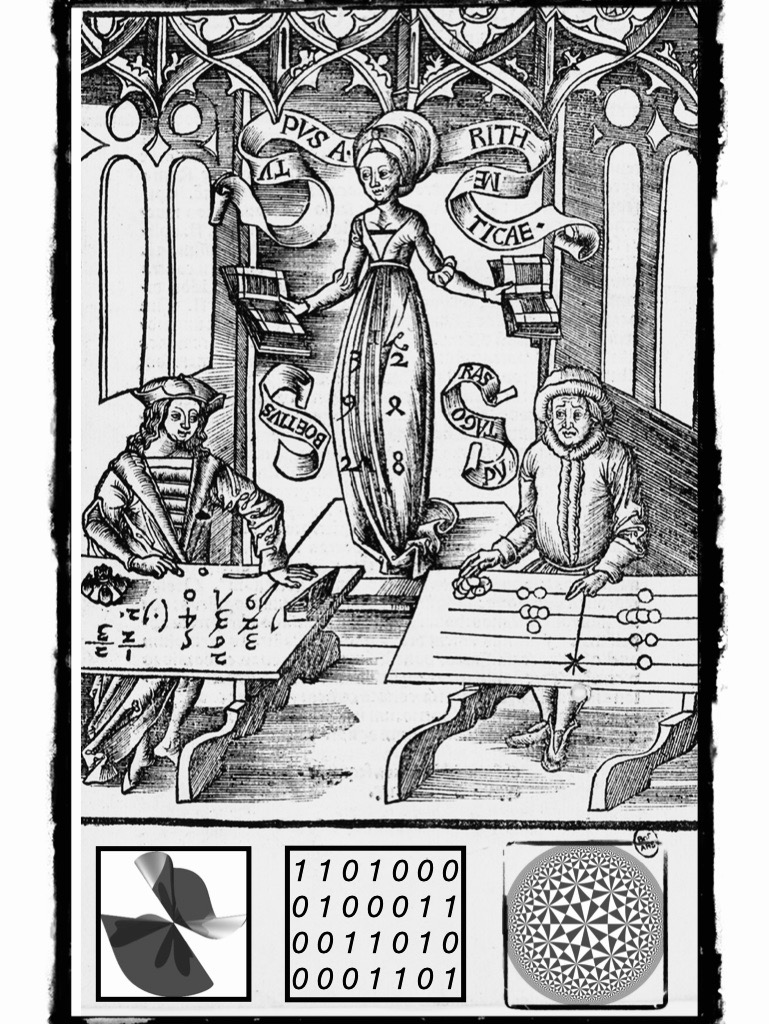 Here is the title sheet of the head of “Arithmetic” from the first printed university encyclopedia “Margarita Philosophica”, published in 1503 in Freiburg. This volumetric book (608 pages) withstood seven reprints in the first five years. In engraving, under the supervision of muse, arithmetic compete two computers. The first (Boetius) considers using numbers, the second (Pythagoras) - on Abak. XV century - the time of transition to numbers in calculations. The engraving depicts modern mathematical objects. The lines of the binary matrix encode four direct projective plane of the fan of seven points and seven lines. The lines give rise to a perfect four -dimensional hermining code in the seven -dimensional vector space above the field of two elements 0 and 1. From this object, you can begin the course of linear algebra! A group of symmetry of the Hamming code (subgroup of reversals of coordinates preserving the code) is a simple group of 168 elements. It coincides with a group of reversible binary matrices of about 3 and is a group of automorphisms of the projective complex apartment of Klein X3Y+Y3Z+Z3x = 0, which is depicted on the right as a hyperbolic symmetric mosaic. On the left is the material surface of the equation. The non -proceeding simple group of 60 elements previous in order is a group of rotations of the correct dodecahedron. She is responsible in Galois theory for insoluble equations of the fifth degree in radicals.
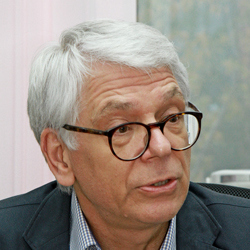
and automatic uniforms of the Higher School of Economics, Professor of the University of Lille
2020 is not the first academic year spoiled by Pandemia. Historians know that in 1830, due to an epidemic of cholera, Moscow University closed the semester, which was "an unheard of event." The state -owned students, under the threat of Karter, were forbidden to go beyond the fence on Mokhova, which did not interfere with the group of students led by Vissarion Belinsky to eradicate and have fun in the space outlined by the rector. In 1831, classes did not resume in full. Annual exams were canceled, everyone remained in the previous courses. Partly because of this story, the explosion student Mikhail Lermontov ended up in the capital's school of guards supporters ...
Universities in the world spent a difficult year, and ahead of the third unpredictable covid semester. Three distance half of the year are three quarters of the magistracy. Even more difficult with bachelors! How to continue studying in such subjects as mathematics, when a misunderstanding of a part of the material turns the subsequent sections into a magic abracadabra? Academic life is also serious problems. How not to lose the new scientific activity that has arisen in recent years?
The ancient question "What to do?" Filled with panic intonations.
All scientific life has gone from the real world to digital space with the help of Zoom and other means. No one was waiting for such a sharp turn. I can illustrate this with the example of our international laboratory of mirror symmetry and automatic forms (MLZS) in the Higher School of Economics. For almost a year now, we have not been going to forums in the usual space-time. The last normal conference was held from February 23 to 28 last year at the Sirius mathematical center in Sochi [ 1 ].
That's all! Two program conferences and the traditional school of higher scientific skills for young scientists in Moscow were canceled. But each such event is at least a year of preparation. An annual school in algebraic geometry in Novosibirsk, in which students of Siberia and the Far East met with world mathematical leaders, also had to be canceled. Unfortunately, I had to cancel the second All -Russian summer mathematical school in Voronovo in 2021. (See the first school of Algebra and Theory of numbers, held in 2019: [ 2 ].) Scientific adviser to MLZS, American mathematician Lyudmil Katsarkov organized in August together with NSU online school “Back to School!” With the hope of returning to normal full -time work in the second half of the year, but the hope was in vain. Lyudmil broke out three times to Moscow from the United States in the autumn semester, but this is a rare example when a foreign scientist was able to overcome the border difficulties that arose around the world. International scientific cooperation is suspended. The world paused.

2020 reformatted not only the work of each scientific unit. The eighth European Mathematical Congress (EMC) was canceled, which was taking place once every four years. He was moved to the summer of 2021, but after the third Lokdown in the UK, no one will guarantee that the congress will take place. Despite the delay in conducting, the EMC announced in May the award of premiums (EMS Prize) of ten outstanding young European mathematicians. One of the laureates was a researcher at Mian and a member of the MLZS Alexander Efimov [ 3 ].
The Prize of the European Mathematical Society is considered a harbinger of Fields medal - at one time it was received by twelve Fields laureates (among them Grigory Perelman, Stanislav Smirnov, Andrey Okunkov and Maxim Kontsevich). I note that Alexander Efimov is only 32 years old.
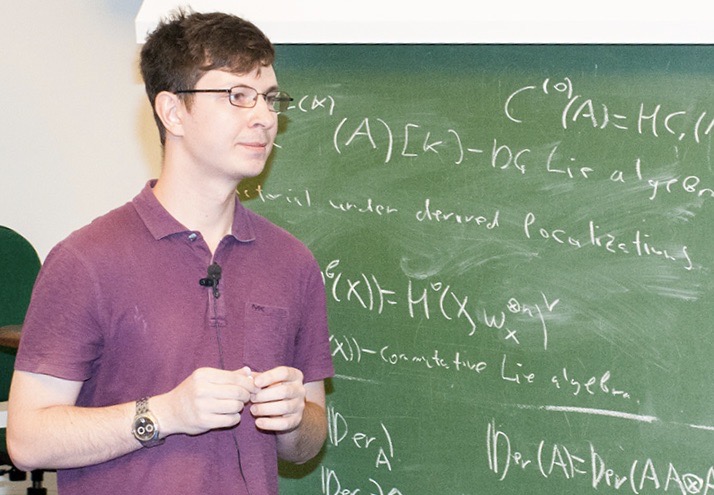
Our laboratory noted a regular final event in December, but a one-day conference on non-evident algebraic geometry dedicated to the award of the award Alexander Efimov was held in the Zoom format. I recommend to everyone (not only mathematicians and physicists) to see the report of the Russian and French mathematician, academician of the French Academy of Sciences and laureate of the prestigious prizes in mathematics and physics of Maxim Klekvich [ 4 ]. At the very beginning of his speech, he demonstrates the type of lawn before the Institute of Higher Scientific Research (IHES) near Paris. Large well -groomed lawns went to visit wild boars. So the world Lockdown literally changes the environmental picture of the scientific world.
Universities (this is a miracle of the Middle Ages) have existed for 800 years. They experienced more difficult times. Lectures of professors and group co -creation of students at different levels have always constituted the essence of university education. We can pretend that nothing happened in 2020, that the students learned everything, that scientists are found, even in Zoom, that work is going on ... Teachers with experience are remembered by Soviet correspondence departments. Now we all have become absorptions. If some university is satisfied with that old correspondence level, then you can no longer worry for it. But most teachers are shocked by the indigenous spontaneous breaking of the traditions of higher education in the past year. It is time to realize the global training Lockdown of 2020. What is this the end of the world or the discovery of a new world?
In my opinion, we work in an amazing period, comparable only with the revolution of Johann Gutenberg, when the textbooks became available to many and knowledge has gone beyond the narrow circle of initiates. To understand the scale of the first 50 years of printing (1450–1500), I note that more than 360 different editions of the Antique Latin textbook (the so-called “Donat”), at least six copyrights in mathematics and the first Encyclopedia “Margarita Philosophica” have reached this day. (Trivium + quadrium). All this led to a large -scale university reform of the 16th century.
For current students, the screen of a smartphone or tablet from childhood is more familiar than the page of the book. But this is not the main thing. The textbook has ceased to be the main tool, the main authority. Presentation, processing and classification of information has been totally changed in the process of digitalization - today they study, report and improve at all like 30 years ago. Nothing can be better than the author’s course of a famous specialist in the audience, if the harmony of science and teaching is achieved in it, everyone agrees with this. And if there is no harmony? And this is one of the easiest contradictions that inevitably arise in educational work. Modern communications make it possible to offer several copyright courses and bring them far beyond the limits of a particular university, city or country. In mathematical education, in my opinion, this is the only way of development.
Already in the 15th century, students freely moved between Bologna, Pisa, Paris, Oxford ... In Basel, in 1490- X, up to five alternative astronomy courses-the most complex university object of the time that revealed the divine ideas of the Creator of the Universe. (This explains why the works of Nikolai Copernicus, the canon of the Catholic Church, laid the foundation for the first scientific revolution.) In the 21st century, the place of a fundamental subject, uniting and formalizing all the specialties of the digital era, was occupied by mathematics. Mathematics is not only language and form, but also the very essence of digitalization and algorithmization of most modern scientific objects; Even the symbiosis of viruses and humanity has an informational nature. That is why a successful reform of higher education is impossible without restructuring mathematical teaching.
The need to teach mathematics a huge number of students has become an inevitable consequence of modern digitalization. The key contradiction of the current teaching of mathematics is that the vast majority of modern students objectively does not own numerical culture and geometric intuition, on the basis of which all standard courses of mathematics of the twentieth century were formed, focused on the training of analog engineers and their teachers of mathematics. It is this fact that explains the inaccessibility of modern general -material education even for capable students. Most engineering specialties are replaced today by IT specialties, whose mathematical needs are completely different. Mathematics itself quickly changes and acquires a new scale of applications thanks to a computer environment.
In my opinion, it is vital to form a new trend in teaching mathematics using binary-computer intuition. Such intuition (choice between options, wood search, and so on) is completely natural for students who have used tactile screens from childhood, and at the first stage it can replace the analytical and geometric culture of the past era. Then mathematics as a subject from the method of conducting and analyzing the calculations will turn into a tool for processing information. Formal-computing practice can be replaced by logical and informational, with the preservation and development of the entire content of classical mathematical education, which is completely mandatory today. New practice will allow you to differently state the material, destroy the wall of misunderstanding between the student and the teacher and set new topics for educational and research communication of mathematicians with those who study computer sciences. The creation of new basic courses is a fundamental, revolutionary task, the solution of which cannot be postponed, especially after the unique experience of 2020. Such work has already begun in different countries, in the near future it will turn into one of the main world trends. We have already proposed the concept of first courses, but it must be implemented and worked out.
It is impossible to resolve the methodological contradiction between the initial analogue approach and information-civilian problems within the framework of the university mathematical program that has developed over the past 70 years.
New courses will require a radical change in seminar material, which should turn into the most important part of the subject. I note that teaching basic mathematics at the best faculties is suffering from a complex of “bad parent” today: professors are striving for students to solve all the standard tasks that several generations have already worked before them, and that they did not manage to master the mandatory classes.
The only way out is distance, or, better to say, extracurricular methods that are quite familiar to Russian science. (For example, summer and winter student schools have become a mass phenomenon.) The average age of students of mathematical courses of the Coursera international platform is 27 years old - convincing evidence that world universities do not fully satisfy the needs of experts. I have a practical experience in conducting a permanent research course (level of diploma and graduate students) on this platform. The theme is purely theoretical and complex (arithmetic and special analytical functions), but in four years the course has mastered the 1983 listener. I will add that in Moscow, one of the mathematical capitals of the world, a similar special course can attend 20-30 students, and in other university capitals of Europe you can count on 10-15 listeners.
I foresee the objection of colleagues about the role of classical, full -time learning. The individual joint work of the master and the student was, is and will be the basis for the training of specialists of the highest level. But the beginner must still prove that he is interesting as a serious candidate for dialogue. Extracurricular, distance work will allow you to search and prepare talented students, not limited to any geographical or administrative framework. I will add that you should not overestimate the preparedness of students for purely computer life. The inability to gather at the Faculty of Mathematics of the Higher School of Economics in December 2020 forced us to hold a reporting youth conference of ten internships in the form of individual short reports in a professional studio [ 5 ]. Standing alone, without listeners, in front of the camera lens - the “black square” of the Internet, maintaining the concentration and atmosphere of a scientific report, it was not easy for many students and graduate students. Such a skill was not required to generations of the 20th century - and it is already absolutely necessary for those who were born in the 21st century. And this is another subject of training.
I will end with two important questions to the professorship and structures responsible for the development of the country.
- How to translate on a professional basis the creation of fundamentally new basic mathematical courses that do not fit and even contradict the logic of the current program?
This is not very interesting to universities for various reasons, although such scientific activity is more complicated and larger than the publication of research articles in the magazines of the first tenant. A possible audience of a “shot” mathematical course can be dozens and even hundreds of thousands of motivated listeners around the world, but its creation is a serious creative task for small high -class groups. It remains to hope for the help of large companies, for example, within the framework of guardian programs of leading universities in the country.
- How to form administrative and legal conditions to ensure that motivated Russian students can gain mandatory educational loans of their universities using everything new that can appear in the near future in the world educational space?
Mathematical education inevitably goes beyond the limits of a single university. I note that distance control over the development of educational material in mathematics no longer presents a fundamental methodological problem. Mathematics is one of the few items that requires for success only access to correctly organized information and an irresistible desire to realize it.
2020 opened the door to the online space for everyone, and no one can shut it.