
Translated material
The excuse of the genre
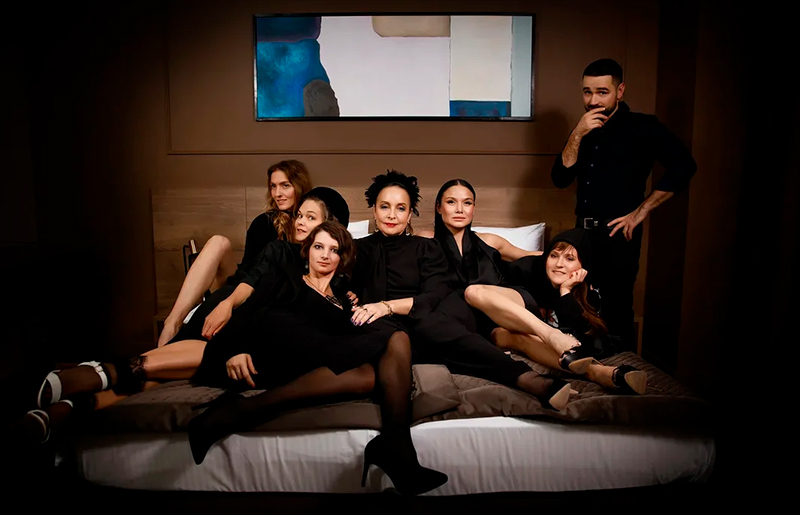
In domestic directing, Semyon Aleksandrovsky occupies a niche, mastered, oddly enough, units: he creates an intellectual product for a relatively wide public. To perceive the performances of the independent St. Petersburg “ Pop-up theater” -this is the name of the company, which the director leads with producer Anastasia Kim-usually no special background is needed. Say, their debut project -documentary “fuel” about the Russian IT visitor of David Yana -regularly bought for corporate impressions.
The fact is that with all the novelty of the receptions, Alexandrovsky does not disdain the trouble -free instruments of the old theater. Almost any of his work in recent years is primarily a fascinating story with bright heroes.
 © Dmitry Stelmakh
The premiere called “The phase of the mirror” compared to other performances “ Pop-up theater” is a rather conservative thing: to start at least with the fact that the audience see living artists, and do not listen to their voices in the headphones, as in recent projects. The director chose a format that over the past five years, it would seem, completely outlined himself - an immersion blockbuster with well -known names on the poster, but approached him as meaningfully as we still did not succeed.
The circumstances of the premiere for Russia are not yet quite common: the “mirror phase” was ordered not by the theater, not the festival or the museum, but the development company RBI , which is building elite real estate in St. Petersburg. Aleksandrovsky was provided with five rooms in the Aparto Hotel Artstudio Nevsky , he did not change the interiors. The play specifically wrote for the play by Asya Voloshina - “The phase of the mirror” became her fourth work with the director. In general, this is the usual practice of the Pop-up theater -to invite the playwright to a specific project and to share with him the decision of the future performance: Voloshina-a couple of Aleksandrovsky-it was necessary to justify both the hotel and the presence of the public in it.
 © Dmitry Stelmakh
This is what they came up with. A certain famous artist - in his image there is a little from Damien Herst, a little from Jan Fabra and a little from Banksy - died in a fire: apparently, it was suicide. His masterpieces burned with him. The only surviving work is locked in a safe, and no one has ever seen it. Judging by the will, this is a portrait of an unknown person, which the master blames in his death. She should get a treasure. The deceased, apparently, loved dramatic effects and invited not one, but five women at once - any of them could be the heiress. All of them stopped at one hotel - this was also required by the instruction.
In case the portrait turns out to be abstract, the performers gathered a commission that will listen to the stories of applicants in advance: this role, of course, lies with the audience. Guests are divided into groups of five people and visit the room behind the room. Contrary to expectations, they will meet only four heroines: in this story, only one person has a complete picture of events - one who in the smallest details planned this evening, and then once and for all defended himself from any questioning. Now we can see it only in reflections - hence, in fact, the “mirror phase”.
At all times, the theater tried to manipulate the public - but today he had another task: to push you to the realization that you are manipulated here and now.
Recently, Aleksandrovsky has been working anywhere except the theater scene. The non -standard space in its projects is more than just the background: it sets both structure and style, and often even the topic. If this is a library, as in the play “Time, which” , we will talk about time and memory, and the narrative will begin to loop between the present and the past. And if the viewer has a walk around the bars, as in the recent “Trade Union of Hell’s Workers”, the heroes will talk about the drink that played a leading role in the secret history of mankind. The scope of this hypothesis is the best suits the situation - behind the bar and you will not hear that.
What is an expensive hotel? Not just a place for an overnight stay, but a embellished replacement of the house. The hotel rooms are lifeless and beautiful - partly because they are lifeless: nothing superfluous, nothing accidental. “The phase of the mirror” is a deliberately manner of performance, and in this it imitates the space.
 © Dmitry Stelmakh
The style of Voloshina-old-fashioned, defiantly literary, with mandatory references to the classics-is suitable for this place as well as possible. The same can be said about the evening outfits of actresses, worn as if for the first time, and about their game itself. Aleksandrovsky easily achieves naturalness from artists when he needs it, but the “mirror phase” is not at all the case. The gall widow (Anna Aleksakhina), a passionate mistress (Alena Starostina), a neurostenic model (Urshula Malka), an vengeful daughter (Anna Blinova) - not so much living women as sculptural masks thought out to the smallest detail. Our group did not hear the fifth monologue performed by Laura Pitshelauri, but I suspect that there was no naturalism there either.
Here are something else about hotels: their guests look like museum exhibits, deprived of their usual environment and exhibited in the same windows. This image also influenced the play. At one time, the deceased artist collected on the banks of the corpses of marine animals and immersed in aquariums with a special solution. Equipped with motors, the bodies moved like live ones. There is a rhyme with the heroines: the culprit of events also cut them out of reality, captivated and enclosed in rooms. At the thought that the “mirror phase” will play again and again, the similarity becomes even more distinct: as if the artist stole women from time, forcing them to endlessly live the same memories.
 © Dmitry Stelmakh
More recently, having seen the words “artist” and “power” nearby, we could only think about the state hostile to the free creator. In recent years, more and more often you can hear about the authorities that they possess - or even abuse - the artists themselves: take at least disputes around the "DAU" . The new work of the Pop-up theater is inconceivable without this agenda. Obviously, the deceased master did not seduce as power as power: over women, over nature and over the time itself. Among the potential heirs, some resisted this power, others meekly accepted it - but each one or another tested it on itself.
The denouement of detective intrigue is as natural as it is unpredictable - this story could not have any other finale. If, without unnecessary spoilers, the deceased will outplay not only the women invited to them, but also the “commission”. The viewer, who imagined himself, was a detective, investigator, judge, to those who have the last word, will be just another pawn in the hands of an arrogant genius (in the text of Voloshina there are generally enough chess metaphors).
 © Dmitry Stelmakh
In fact, the “mirror phase” is the director’s auto -combination, partly in the spirit of the “glory” of Konstantin Bogomolov. At all times, the theater tried to manipulate the public - but today he had another task: to push you to the realization that you are manipulated here and now.