
Translated material
In Berlin, more than 3,000 people came out in support of Navalny. This is the most massive Russian -speaking political action in the history of the city (video)
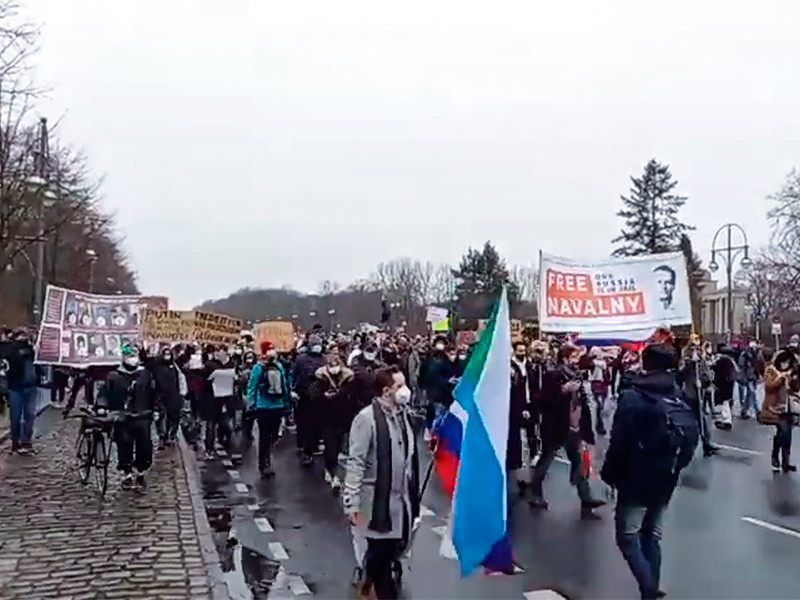
On January 23, when in Russia unprecedentedly massive protests in support of Alexei Navalny and against repression and arbitrariness of the authorities began, one of the most massive political Russian -speaking events in the recent history of the city also took place in Berlin.
According to police, in the German capital, the march in support of Navalny gathered more than 3 thousand people. The scale of the event surprised both the organizers and the police. 50 people were declared on the march, and 60 times more. The march allowed by the authorities went through the entire center of Berlin: from the department of the Chancellor past the Reichstag building to the Russian embassy on the boulevard of Unter Deninden and from there to the Brandenburg gates, Deutsche Welle reports.
The fact that the rally will become so numerous was not expected by no one, and the organizers themselves were least of all. When on January 19, activist Konstantin Sherstyuk, on the police website, filled out a rally application, he indicated his number of 50 people. Since the beginning of the march was supposed to take place in a specially protected government zone at the office of the chancellor, the action had to be coordinated in the federal Ministry of Internal Affairs - there were no problems here.
In Berlin, the action in support of Alexei Navalny gathered about a thousand participants, with the declared 50, the DW correspondent reports. They passed a procession from the department of the federal chancellor to the building of the Russian embassy. Our video from the German capital Pic.twitter.com/5nkfkwsz9j
- DW in Russian (@dw_russian) January 23, 2021
A few days later, the police contacted Konstantin and asked him to submit the concept of coronavirus safety: political actions in Germany are allowed only if masks and observance of a distance of one and a half meters are allowed. At first, Berlin streets did not even want to block the march: there was no certainty that he would gain at least 100 people.
“The basic rights of citizens are respected in Germany, despite Lockdown,” Konstantin explained the ease of coordination of the march. As a result, he set the police to a difficult task: the streets were overlapped almost during the movement of the march, the police transferred reinforcements to the city center. The police were nervous, but did not apply sanctions. The march was not dispersed even in cases where its participants clearly did not observe the rule of 1.5 meters of social distance.
There were several stops and improvised rallies on the path of movement. Sound equipment did not allow a full -fledged rally, but in this case it was not required: the purpose of the meeting was clear, the crowd chanted: "Let go." Among other slogans: “Putin - a thief”, “Russia without Putin”, the classic protest slogan “Russia will be free” and “Freedom of Julia” - after the news of the detention of Julia Navalny. They were especially loudly chanted when they passed the houses where employees of the Russian embassy live, which activist Andrei Zaitsev called the “branch of hell in Germany”.
After reaching the main street of the German capital - Unter Dennden - both the organizers and the police had to improvise to prevent traffic jams in the center of Berlin. The column stretched half a kilometer. Most of it made up Russian-speaking Berliners 20-40 years old, many came with children.
The fact that everything happens in Berlin, where all the entertainment institutions have been closed for several months, resembled the creative nature of posters. A huge flag of Free Nawalny made over the gathered a huge foil made of gold foil. There was also an eloquent poster of the "killer", which was carried by a young girl. About four hours on Berlin, the action ended at the Brandenburg Gate.