
Translated material
SpaceX set a new world record for the number of satellites brought to orbit (video)
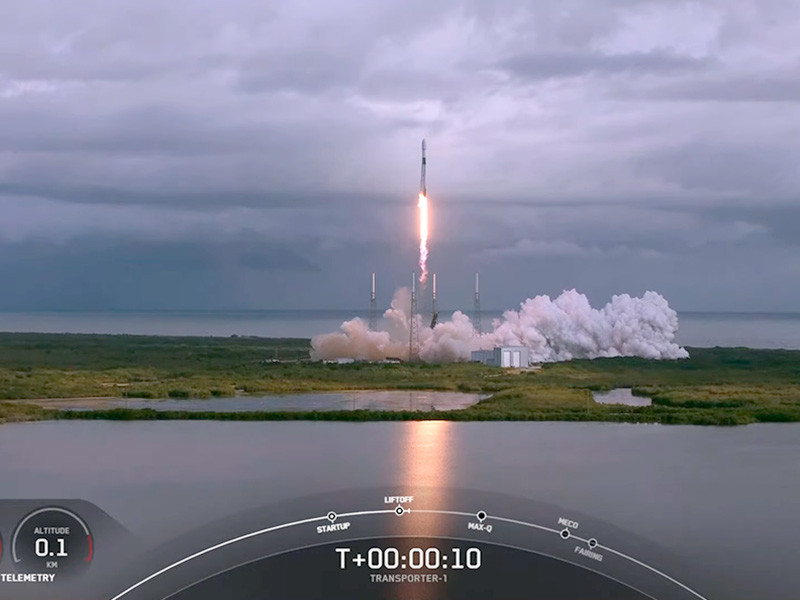
On January 24, the American space company SpaceX made a successful launch of the Falcon 9 launch vehicle, which brought 143 satellites into orbit at once, setting a new record for this indicator-the previous record was 104 satellites and was set by the PSLV-XL Indian missile in 2017. Mission broadcast, Transporter-1 which was the first for SpaceX as part of the Smallsat Rideshare program, was conducted on the SpaceX YouTube channel.
The carrier rocket with the satellite was launched from the starting complex of the SLC-40 of the US Air Force, located at Cape Kanveral, at 18 o’clock in exactly Moscow time. The separation of the first stage (the reusable accelerated block was used for the fifth time) was standardly, and after about 10 minutes the step landed on the floating platform in the Atlantic Ocean.
Falcon 9's First Stage Has Landed On the OF COURSE I Still Love You Droneship Pic.twitter.com/6gwwllixdg
- SpaceX (@spacex) January 24, 2021
An hour after the launch, the second stage of the rocket began to gradually take the satellites into orbit, and the whole process took a little more than half an hour. In particular, 48 satellites of the Remote Superdove of Superdove Planet, 17 communications satellites Kepler and 30 satellites of various customers from the USA and Europe, collected together by the German company Exolaunch, were brought into orbit, writes The Verge . The rocket also delivered a few capsules with human dust to orbit - this service is provided to customers by the CELESTIS space funeral company.
At the very end of the mission, 10 satellites of the SPACEX system of the satellite Internet STARLINK system were brought into orbit. These are the first devices of more than 1 thousand launched Starlink satellites, which were brought to the so -called polar orbit. We also note that for the output of 13 devices, SpaceX first used the third step of Sherpa-FX, developed by Spaceflightlight. This time the dispenser was used in the version without its own engines, but in the future it is planned to use versions with engines, which will turn Sherpa-FX into a full-fledged third stage of the rocket.
Deployment of 10 Starlink Satellites Confirmed
- SpaceX (@spacex) January 24, 2021
The Smallsat Rideshare program allows organizations and companies that want to launch a small satellite significantly save on its withdrawal into orbit. Typically, for such launches, light class missiles can be used that can display a small load (for example, Electron launch vehicle), or heavy missiles that can take small satellites into orbit as an additional load during the output of larger devices. The SpaceX previously decided to create a program for the withdrawal of small satellites, which would allow various customers to “book places” on Falcon 9 and pay a small share of the launch of the launch vehicle: the starting cost of the customer is 1 million US dollars.