
Translated material
Cyclone Center
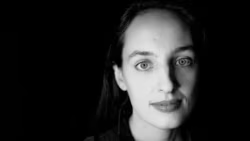
Interview with a special correspondent of Novaya Gazeta Elena Kostyuchenko . She is the author of the report “This is a storm” , the best material about the work of doctors in the first wave of the Covid-19 pandemic, the laureate of the Profession-Journalist Prize, along with the photojournalist “New” Yuri Kozyrev , with whom they entered the “Red Zone” of the 52nd hospital and spent two days there. No less outstanding material called " Rust " - about how corruption has corroded one of the budget -forming structures of the country, "Norilsk Nickel". Listen to the Vavilon Moscow Podkast and subscribe to other podcasts of Radio Liberty .
-When you went to the reception of the 52nd hospital, did you feel that you got, for example, in hell? Or where did you get? What feelings did you go there, with what fears, expectations? How did you allow you to do you? I know how difficult it is to get into this zone, the doctors are closed caste, they do not give comments, unless they are allowed from the very top. How was it all?
- It was scary to establish. It was the strongest fear, because before that I had never written about medicine, about doctors. I understood that now, when the pandemic, any text about coronavirus will read everything, and very carefully, and any mistake in this text can be replicated in some monstrous way and lead to monstrous consequences. Therefore, I was very afraid. It was more difficult for me, to be honest, with Dmitry Muratov, the editor -in -chief of Novaya Gazeta. He did not want someone to go to the Red Zone, he said that the virus is unexplored, giant risks. Then Kozyrev appeared, and I say: "Kozyrev, let's reap him on both sides."
- With Kozyrev you are partners, the last reports are the result of the tandem. Elena Kostyuchenko - text, Yuri Kozyrev - a card.
- On both sides, we surrounded Muratov and began to convince him. And in the end they convinced. And then Muratov did his editorial work, that is, he called the Department of Health and agreed. But even before I called Maryan Anatolyevna Lysenko, this is the chief physician of the 52nd hospital, and asked if she would be against it. This was my first call to her. I said that we really want to make a story about you, your doctors, your hospital. "What do you think about it?" And she said: "I think it is worth it. But you need a resolution of deposits."
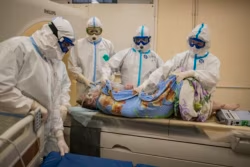
Muratov had already received permission of the depots, we came to the 52nd hospital, once again talked with Maryana Anatolyevna, already personally, with the press service, talked with other doctors, they perfectly understood what we were going to do, they were not against it. Then we were held throughout the hospital, showed, introduced to the heads of the departments.
- Have you already changed clothes at that moment?
- Yes, sure. The whole hospital is a “red zone”, therefore, when you leave the administrative building and go into the medical buildings, you must completely change clothes. We were conducted throughout the hospital, we talked with people and realized that we want to stay in the 7th Orite, and the very next day we came specifically to the 7th ith.
- What is Orit?
- Orit is the intensive care unit and intensive care. The seventh oar in the 52nd is combined with the Ecmo Center. ECMO is a machine that saturates blood with oxygen without the participation of the heart and lungs.
- Is this an alternative to Ivl, artificial ventilation of the lungs?
- Yes, but if Ivl is no longer working, not effective, then EkMo is like the last chance for a person.
- And this, as I understand it, is the development of the hospital with scientists?
-ECMO was used in transplantology before, but when the pandemic began, Mikhail Valerievich Ketskalo, the head of the Ecmo Center, insisted that EKMO be used in the treatment of severe coronaviral pneumonia. And he proved the effectiveness of this method. He, of course, is a great innovator, many owe him life. And on the second day we came and remained in the 7th Orieu up to one and a half days.
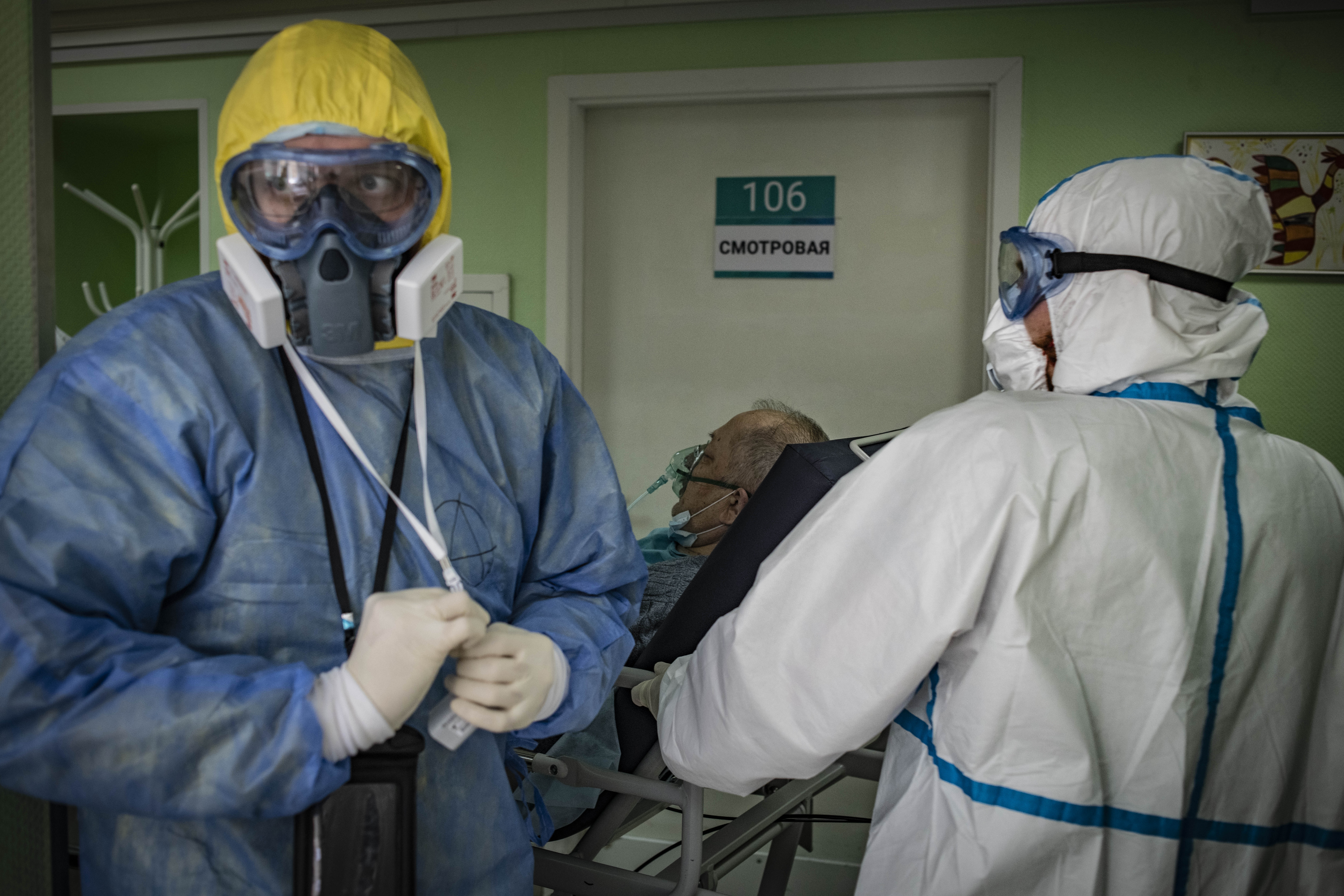
- The report begins with the fact that you describe in detail the process of changing clothes, how doctors and nurses dress in order to enter this zone. Did you manage to record what is happening, or have to hope for your own memory?
- I had notebooks with me, I always go with notebooks. The recorder was turned on all the time. Well, since I came in and left the "red zone" several times ...
- At these one and a half days?
- No, there I was entirely, but I also came to that, on the first day. After we went out and soldered, we decided to return again, we had to get the material. We returned and once again passed the dressing process. In addition, when you change clothes, you are very focused: any mistake reduces protection, increases risks. And for you, even for doctors, the doctors who change clothes are followed by special people who are on duty in the locker room and watch everything is correctly tied, in the correct sequence. Therefore, this immediately crashes into memory, what to put on.
- What is the hardest in this suit, the most uncomfortable?
- The most uncomfortable thing is that the glasses are stuck. Antifogs, anti-reciprocal sprinkles work for some time, they are not designed for 12 hours, this is a standard medical change. In the 15th hospital, for example, resuscitators are already doing differently. They put on not tight -fitting glasses, put on ordinary plastic glasses and hang a plastic shield below the chin on top, literally to the neck. And thus, the air that you exhale from the respirator does not go to glasses, does not remain, does not fog, but dissipates. This is the hardest. I was very worried about the toilet. Oddly enough, in the suit you sweat so intensively that you don’t want to go to the sign at all. I want to drink all the time, all the time thirst.
“ You describe the situation several times when one of the nurses eagerly drinks.” At what point can they undress, raise the mask, how does this happen?
-In the 52nd hospital, conditionally clean zones were organized. Right inside the "red zone" there is a space-an office that is allocated under the dining room, which is constantly shot by an alpha gun, it destroys coronavirus. To go into this space, you are doused with a special desktop. Do not undress.
- Do not undress, is it a time -consuming and taking time process?
- Yes, and most importantly, these secrets are expensive. These are costumes from personal protective equipment, Sizov. From the beginning of the pandemic, everything is very saving. Therefore, you can pour yourself with a special desktop, go out, quickly drink tea, clog up again, dousise with a desktop and go into the "red zone". This is so organized in the 52nd. But I know the hospitals where, in order to go out to drink tea, you need to completely undress, in 12 hours you are released once. Once for an hour and a half-so in the 15th hospital. I know hospitals where in 12 hours they do not let go at all.
The body is in a stressful state, there is no toilet problem. Women said that the problem with menstruation
- And if you are impatient, diapers? How to get out of doctors and nurses from this situation?
- I know only one hospital in Moscow, where they wear diapers. The body is in a stressful state, there is no toilet problem. Women said that the problem with menstruation. You won’t stop menstruation, and if you go to the “red zone”, you need to put on two pairs of panties, the largest gaskets, the largest tampons. And still there are times when you take off the suit, and there everything flowed.
- I repeat the question. Have you changed the fears with which you entered the reception department and with which you left the “red zone” after the second time?
- Yes. I am very grateful to the leadership of the 52nd hospital that they first made a viewing passage to us, although when we were led to walk and get acquainted, I honestly thought: why we go, we should already get somewhere and work somewhere. At first, when you put on this costume, just a panic, it seems to you that there is not enough air, you are not sure of your movements, you don’t understand whether you can work where to put a notebook, how to keep a recorder. And then you get used to it. I still had a fear that doctors will not talk to us, namely doctors who work with patients.
- Doctors, especially resuscitators who work in an urgent, acute situation, are quite reluctant to let any third -party observers.
- Yes, but we were lucky, we fell into a very good shift, and the chief doctor of this shift - Denis Petrovich Pavlov - was very good at us. We explained why we are here, said that "we will write about what is happening here so that people, having read this, behave more carefully and do not get to you." And this motivation was very clear to them, because even then, in the spring wave, which was not as tense as the autumn wave that is going on now, was still a shock and great stress.
- She caused a terrible burning among doctors and nurses. This is a huge challenge.
- Fighting is, it seems to me, the most serious problem that is now facing medicine. Not a lack of sizes, not a lack of drugs, but burnout. The tenth month of the pandemic, and some doctors are completely burnt out.
Work in intensive care requires inhuman not even perseverance, but stubborn
I’m not sure that at the level of the Ministry of Health or Deplation generally they think in terms such as burnout, psychological rehabilitation, and psychological stability of doctors. Work in intensive care requires inhuman not even perseverance, but stubborn. You conquer a person from death contrary to all testimonies, indicators, everything. A holistic, collected self -awareness is required.
- High concentration, high stress resistance, fast reaction - this is included in the package of a good resuscitator. Plus collective work, team.
- Certainly. When a person burns out, he can no longer with the same effectiveness, with the same return to fight for life. This is a giant problem, you need to think about it, and right now.
- Here you are standing right at the intensive care unit, judging by the fixed replicas. Sometimes your material looks like the drama of theater.doc, recalls the play "New Antigon", which was based on your records in Beslan, Beslan mothers. That is, you worked with verbatim in extreme circumstances, you simply recorded doctors' conversations during work.
- Yes. I understood that this is a unique chance, and it has a tremendous meaning that I will be able to fix and remove it from this zone. It's like flying into space. Any remark, any movement has a gigantic meaning. Therefore, I tried to fix everything, and indeed, there is a lot of direct speech, often overloaded with medical terms. And I think this is all very important.
-Have you advised the material with someone? Indeed, there are many terms. It seems that it was written by a person with a medical education who understands the technology of what is happening.
-I exchanged phones with all the doctors in the “red zone”, and then, when they left the shift, they slept, I called them and clarified some moments. While I wrote the text, I read several scientific articles, looked at how EKMO is installed, as all the cannulas, catheters are called. When I was preparing Rust, it was the same: I dug up there to people, a full production cycle in Norilsk Norkel. When I write, it is important for me to know everything thoroughly. It is not necessary to load the reader, but it is important for me to feel that I understand what is happening.
- This is evident from both of the mentioned materials. You understand the technology, not only technology, simple manipulations, but also a kind of medical logic and engineering logic.
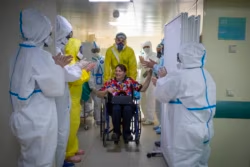
- In the Storm there is an amazing story of the senior nurse who herself fell ill and who was treated in her hospital, she first worked with covid patients. I must say that you can’t talk to patients there, they are in intensive care, in an unconscious, semi -conscious, turned off. Ask: "How do you feel?" - Absolutely impossible. And this heroine, one might say, is the only one of the patients with whom you could talk.
- Yes, she was already preparing for an extract when we met, the next day. And Yura Kozyrev and I decided to wait for the moment of her discharge and trace it until leaving the hospital. It was a very touching moment: the doctors lined up along the corridor, took off their gloves, and when she was transported by a stroller, they touched her, clapped her shoulders, hugged her. She had to be transferred to the therapeutic department before the discharge, but they were related to her so much ... Firstly, she is their employee, secondly, they fought for her life (at some point was even the question of installing ECMO, that is, this is really the last feature) that they simply did not want to let her go, wanted to bring her personally to be sure that she would come out healthy. When we met her, she sat on the bed and helped her department - she folded disposable aprons. Because there is free time, and in the girl’s department they are sewn up, you need to help them. This is very cool.
- How did Kozyrev manage to work? When I look at his pictures, I don’t understand how it is done. How could you get so close to the battlefield, I would say that is unfolding there?
- Yura knows how to become invisible. He simply becomes invisible and fits. At the same time, it does not hesitate. It is impossible to describe, I myself have been a witness more than once, but it just seems to be dissolved, it turns out here and there it does not interfere at all. Yura and I talked a lot about it and decided that it would be better to the detriment of the material, but in no case we should interfere with anything that happens in intensive care. God forbid, if we distract one of the doctors at a crisis moment, something will be missed. And I, of course, worried how it would all work out. But my task is technically easier, I stand, listen, write down, look in all eyes, and Yura needs to make a frame, stand on a specific point. And there everything is braided with wires, forced by giant cars, beds, people go at gigantic speed. But Yura, of course, is incredible, and I, in general, realized how he managed to work in wars. All his famous pictures, for which he received the World Press Photo, are made from an incredibly close distance.
- It seems that a person cannot do this. It cannot be so close to these splashes on the glasses of the resuscitator, so close to the place of a military event.
- Yes, he knows how, he succeeds.
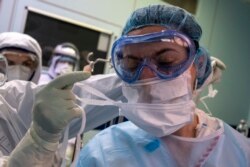
- If you go from the name "Storm": it is clear that we are talking about a cytokine storm, but this is a kind of natural storm. I would then ask: is it calm in the center of the cyclone? I know from some doctors who work in the “red zone”: “I am calmer when I am there because I know that I am protected and doing the right work.
- Yes, I also felt that. For the first time this year, I was among people who know exactly what is happening, they know for sure their place in what is happening, and they have no reflection: God, what a horror, how it happened to us, what will happen now. They have a specific task - here and now to save a particular person. And this gave me a charge of strength and optimism - it is simply a glad to be with them and understand that these guys are standing between me and death, and they will stand regardless of anything. Many readers felt the same thing, people wrote to me: "So strange - you have so much terrible in the article, and I read and feel so much hope and strength."
-You have a second series, published in November, " Night or Night-Night ." Did you go to intensive care?
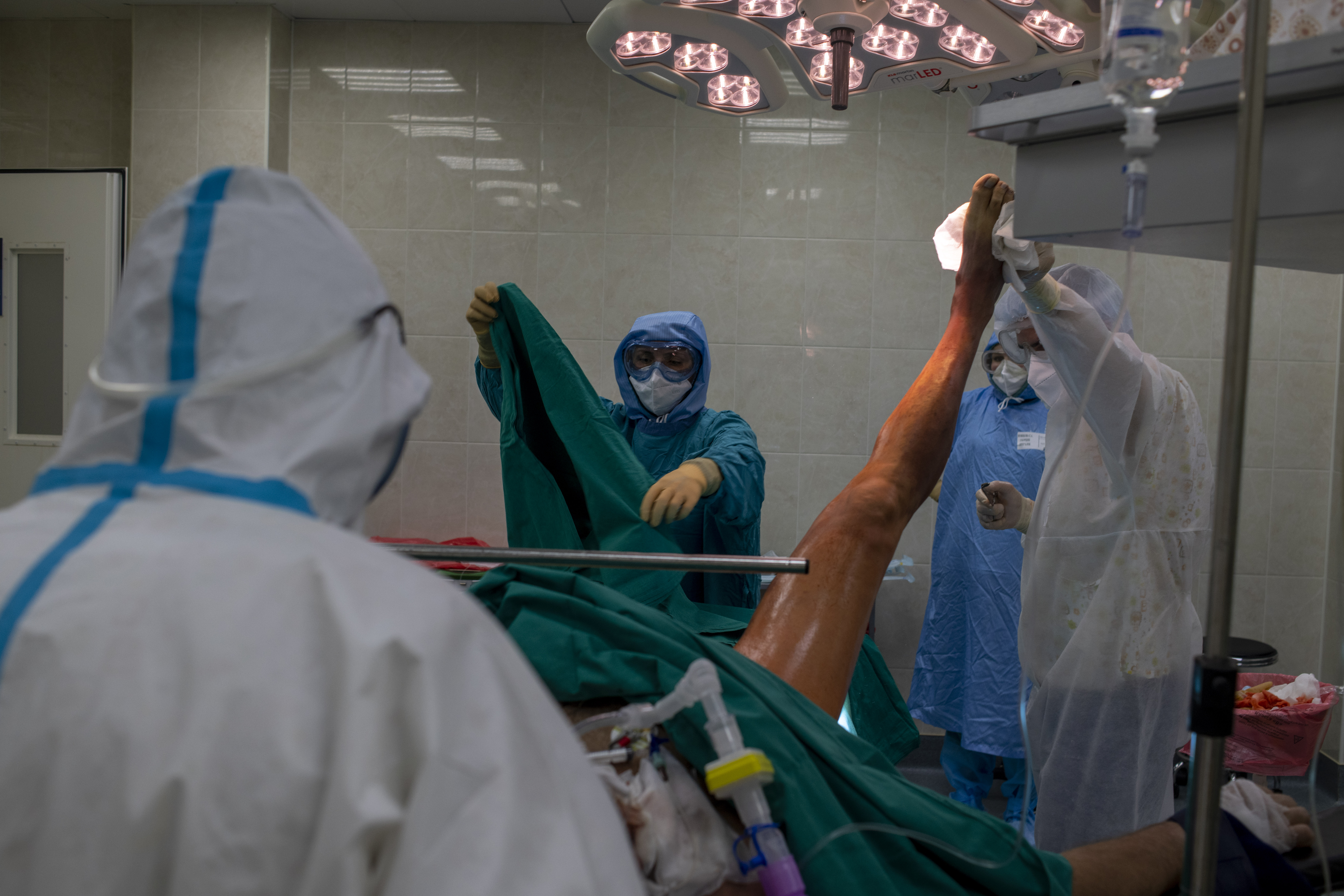
-We went to the 15th hospital, there was not only resuscitation, we spent a lot of time in surgery, now there are many Covid-worn surgery. Covid causes blood coagulation disorders, and thrombosis occurs. A thrombus is a very dangerous situation: if it enters the brain, it is a stroke; If he gets into the heart, this is a heart attack; If it falls into the lungs, this is pulmonary embolism; If he gets in the limbs, then they are just trying to get it with some vascular operations, and in bad case, necrosis and amputation. Amputations in the 15th hospital are flowing, we were present at the same time. Almost all planned operations are canceled, because the covid infection complicates the postoperative period, people recover badly, restore after operations. But we were lucky to be present during surgery on our hearts, there was a replacement of a trinuted valve, a rather emergency story, the great Bayandin operated on, and this is also an existential experience for me and for me. And of course, we watched the extreme, most terrible cases that Covid can lead to. The 15th hospital is multidisciplinary, there is the only multidisciplinary surgery in Moscow, and all co-covids with severe complications that require surgical intervention, and all comorbide patients, that is, Covid plus another disease that lead to a serious condition, is being taken there. Yes, we spent some time in intensive care, and it so happened that when we were there, the patient died there.
- You were practically witnesses to this and recorded everything in real time, this is described in the article.
- It was important for us to see and talk about what Coronavirus could lead to. In the seven months that pandemia was going on at that time, with news about the appearance of vaccines, with new treatment protocols and, of course, with the emotional fatigue that has accumulated in people, the acuteness of the reaction to coronavirus decreased very much. People stopped observing elementary measures: mask, gloves, social distance. Our task was to show the reality that people chose to forget.
Поступает пациент, ты борешься за него, он умирает, поступает следующий, ты борешься за него, он умирает, и так семь месяцев подряд
И меня совершенно поразила степень загруженности реанимации. Я понимаю, что это реанимация, это отделение больницы, где высокая смертность, но то, с чем сталкиваются врачи в реанимациях: поступает пациент, ты борешься за него, он умирает, поступает следующий пациент, ты борешься за него, он умирает, и так происходит семь месяцев подряд. Это чудовищно, и я еще раз скажу, что нам всем нужно подумать, как поберечь своих врачей, как нам помочь им справиться с тем, с чем они сталкиваются и эмоционально, и психологически.
– Одна из ваших героинь-докторов говорит: "Это война".
– У них у большинства ощущение, что они оказались на линии фронта, что это военно-полевой госпиталь. Это, конечно, удивительно, я с этим еще в Донбассе сталкивалась. Ты едешь в Дебальцево, которое только что взяли ДНР, россияне, и ты видишь людей, которые выбирают из кровавого снега рассыпанную крупу, потому что там стояли украинские войска, и у них была крупа в мешках, по позициям попали, людей убило, крупа рассыпалась, и вот женщины ходят с пластиковыми пакетиками и выбирают. Потом три часа едешь в Донецк, и там гостиница "Рамада", и в гостинице внизу бар, где девушка сидит на барной стойке, поет джаз и ест клубнику со сливками. То же самое здесь: ты видишь людей предельной степени усталости, эмоционального напряжения, вымотанности, отчаяния даже, но выходишь из больницы, и к тебе приезжает таксист без маски. Ты говоришь: "Наденьте, пожалуйста, маску". Он говорит: "Вы знаете, я не особо в это верю". И тут же стоят похоронные автобусы, я ему показываю на эти похоронные автобусы и говорю: "Вы знаете, зачем они здесь стоят? Вы знаете, что это за здание?" – "Господи, ну всегда же люди умирали. Почему вы такая нервная". И вот эта вот… не раздвоенность, а разъятость даже реальности, мне хотелось её запомнить тем, что я увидела в 15-й.
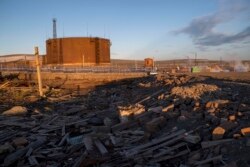
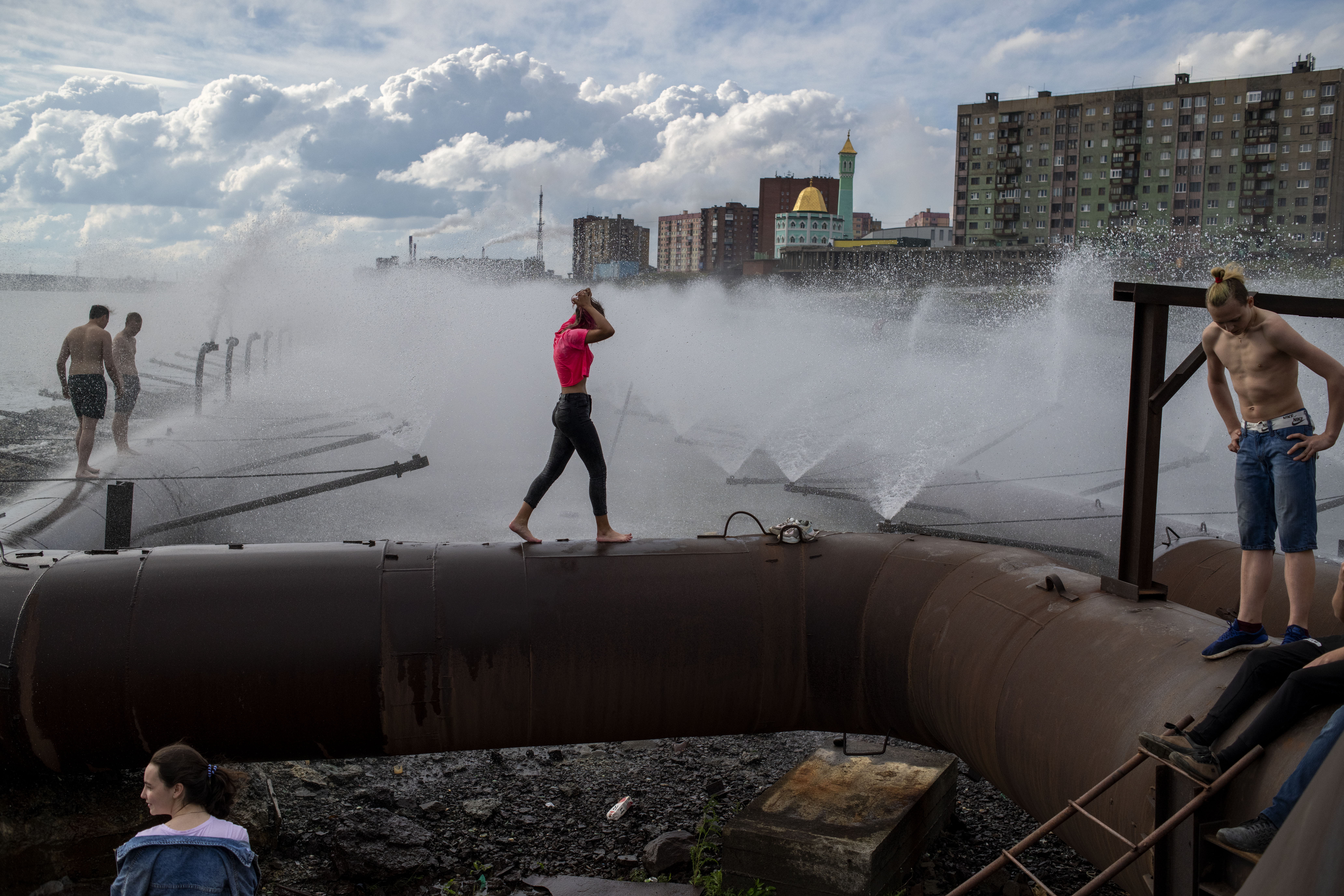
– Пример такого же рода в вашем материале "Ржавчина" – огромный контраст между проржавевшими трубами, которые и стали причиной аварии, колоссальной экологической катастрофы, с последствиями норильскому региону еще придется разбираться, сейчас идет суд против "Норникеля" от Министерства природных ресурсов…
– Они отказываются платить. Росприроднадзор подал на них в суд.
– Контраст между этими проржавевшими трубами, страшной бедностью, в которой люди живут, и офисами управляющих конторы, где стоит вода "Эвиан", все блистательно, – то, что потрясает в этом рассказе, помимо самоотверженности местных экологов и активистов, которые пытаются расследовать эту катастрофу, беду, преступление. Вам, Лена, мало беды? Почему вы поехали в Норильск? Вам не хватило ковида, извините? Это вопрос о вашем роде занятий, о сюжетах, которые часто на грани жизни и смерти.
– Это моя работа, я ее выбрала, она мне нравится, у меня получается работать в таких условиях. С Норильском было все просто – позвонил Дмитрий Муратов, наш главный редактор, и сказал, что он хочет, чтобы мы с Козыревым поехали в Норильск. И я сказала: "Да, хорошо, конечно". Мне почему-то казалось, что мы ненадолго туда едем. Я оставила кошку соседке и сказала, что вернусь через 5 дней. Мы вернулись через три недели.
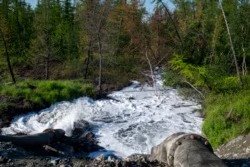
Потому что тот уровень противодействия, с которым мы столкнулись в Норильске, был запредельный. Я никогда и нигде не работала под таким давлением, я с таким не сталкивалась нигде – ни на войне, ни в Венесуэле, нигде вообще. Первую неделю у нас не получалось вообще ничего, мы назначали встречи, на встречи приходила полиция, пугали наших информантов. У нас не получилось договориться с капитанами лодки, потому что на лодку приходила ФСБ. У нас не получалось снять вертолет, потому что вертолетная компания говорила, что "с нами перестанет работать "Норникель", и мы просто умрем". Мы не понимали, откуда этот уровень противодействия, и было ощущение, что все разваливается. А потом мы узнали, что за нами с момента прилета следит и мешает работать департамент безопасности "Норникеля". И когда мы это узнали, тем более когда мы напрямую их увидели, когда они прилетели в тундру у нас изымать топливо с лодки, на которой мы все-таки вышли, чтобы взять пробы зараженной воды…
– Это кульминация вашей статьи, когда появляются эти люди, не скрываясь.
– Тогда уже стало эмоционально проще, мы собрались и доделали работу. И у нас получилось не только доказать, что разлив топлива был обусловлен не как "Норникель" говорил, таянием вечной мерзлоты и природными причинами, а именно коррупцией и ржавчиной. Ржавчиной и физической, потому что эта бочка проржавевшая, ее 14 лет по факту капитально не ремонтировали, и "Норникель" знал об этом, и ржавчиной коррупционной. Но нам удалось зафиксировать новый слив ядовитых веществ в то же самое озеро Пясино, по сути, в водную систему Таймыра, с Таларской обогатительной фабрики. И на "Норникель" было заведено еще одно уголовное дело, по которому я и Юра Козырев стали свидетелями.
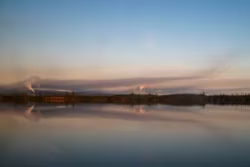
– Поразительно, что в процессе одного расследования вы натыкаетесь на другую катастрофу.
– Если бы мы остались там дольше, мы бы написали еще третий эпизод, четвертый эпизод. Насквозь коррупционная система не может управлять эффективно. Василий Рябинин, бывший глава Росприроднадзора, местный герой, который в момент разлива фиксировал происходящее, а потом, когда ему начали запрещать заниматься расследованием, записал видеообращение на ютьюбе, где подробно рассказал, кто и как скрывает масштабы катастрофы. Он говорил: "Сто журналистов приедут в Норильск – и я каждому покажу личную трубу, из которой хлещет, каждому". На самом деле катастрофа – это кульминация, но эта катастрофа растянута во времени, она происходила и происходит прямо сейчас. И это связано с тем, что Норильск отсоединен от Российской Федерации, у этой земли есть хозяева, и эти хозяева не Путин. Полиция, спецслужбы, местная администрация полностью аффилированы с "Норникелем". Я такой степени аффилированность встречала только в Кущевке, когда 20 лет бандиты правили станицей и окрестными землями. И я думаю: сколько таких мест, которые на карте помечены Российской Федерацией, но по факту ею не управляются, отдельны от нее? Их, должно быть, очень много, и это то, чем нужно заниматься, что мы должны, как журналисты, описывать, расследовать. Я не думаю, что здесь есть выбор – делать это или не делать. Как врачи должны заниматься пациентами, так мы должны заниматься такими разорванными кусками реальности, мы должны их составлять обратно.
– Елена, ваш последний материал, что вы делаете сейчас?
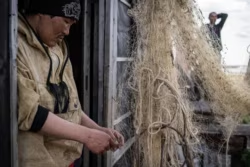
– Последняя командировка была на Таймыр, это история про народ нганасан. Их осталось 700 человек, они физически умирают по разным причинам, много самоубийств, других страшных обстоятельств. Это люди, которые пострадали больше всего от разлива топлива, потому что они живут охотой и рыбалкой, рыба исчезла из реки Пясина, где они рыбачат. Олень, на которого они охотились, три года как изменил маршрут миграции. Это народ, который стоит на краю, который убила цивилизация, к которой принадлежу я.
– Это год апокалипсиса?
– Я бы не сказала. Мы все вернулись за этот год к изначальным ценностям. Мы задумались про то, что по-настоящему важно, и важными оказались не те вещи, на которых были сосредоточены наши усилия. This is amazing. То есть чтобы близкие были живы, чтобы мы были живы, чтобы была жива природа, которая нас окружает, чтобы не было войны. А наши усилия были сосредоточены на другом, и мир как-то нам решил напомнить о том, что важно. Эта форма напоминания, конечно, была экстремальной, но по-другому, может быть, мы бы не услышали.
Фото: Юрий Козырев, "Новая газета" (С)
Podcast Babylon Moscow can be listened to on any convenient platform here . Подписывайтесь на подкасты Радио Свобода на сайте и в студии наших подкастов в telegram