
Translated material
You fell victim
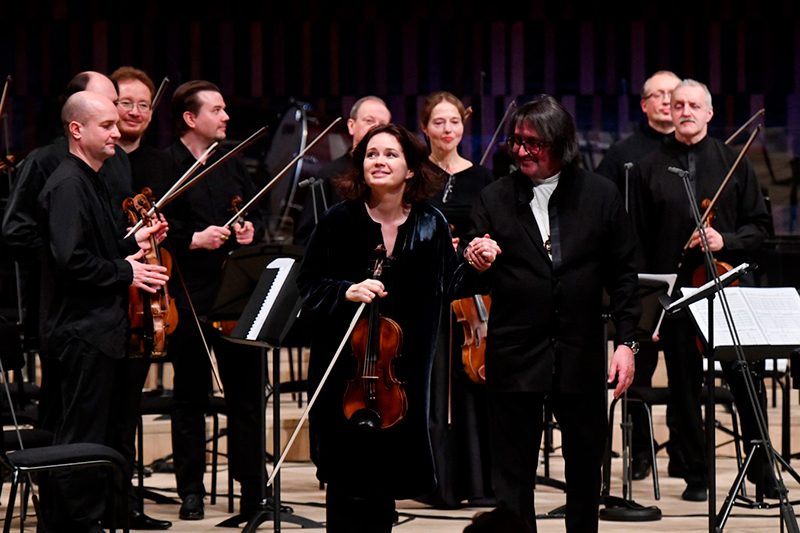
The country's chief altist, we recall, art director of 15 festivals in 8 countries of the world, has been holding its Moscow Forum for the second winter in a row, happily enlisting between the waves of coronavirus. Classical music in his program is not limited to. The genre is designated as the "Festival of Arts" and has long been worked out by the Bashmet team in Sochi . All kinds of musical and theatrical mixtures are especially cultivated. Thus, the Moscow premieres of this year is the literary and musical composition “Yesenin and Mayakovsky”, where Mikhail Porechenkov reads “Black Man” and “Cloud in Pants” to the accompaniment from Prokofiev, Shostakovich, Bartok, Schnitka and Pyotr Tchaikovsky, and the play “Date in Moscow” with freshly music of Alexander Tchaikovsky about the happy love of Yuna The provincials found by her in modern Moscow (among facial heroes, the monument to Pushkin and the Fountain "Battle" performed by the artists of the plastic theater Alisher Hasanov) are expected.
The festival takes place at Moscow sites from January 18 to February 12. Porechenkov and Khabensky, Boyarskaya and Mironov are habitually adjacent to the three Bashmet orchestras (“soloists of Moscow”, “New Russia” and the All -Russian youth symphonic orchestra), indispensable Igor Butman, eminent and non -replace the youth of the most diverse artistic inclinations, as well as with a number of residents of the musical Olympus. Until the baritone of Matthias Gern and harpist, Xavier de Mestra, who were invited to the traditional concert in honor of the Bashmet's birthday on January 24 in the Tchaikovsky Hall.
 © Julius Ivanko
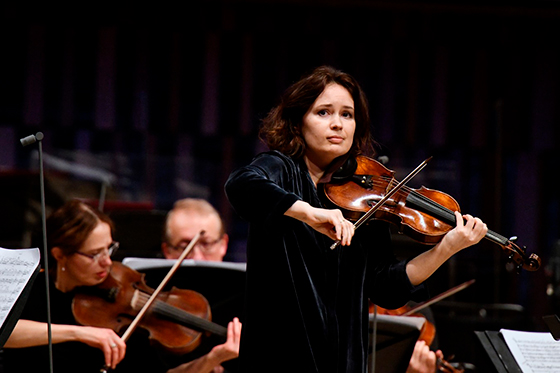
Not only in the motley program of the festival, but in general, in all the current time stopped, an amazing gift looked like another concert in Zaryadye, entitled “XX Century of Search”. Under this indisputable statement, far from the most radical works of the last century were united, reflecting, most likely, simply the wishes of soloists. The most rough and uncomfortable was the “mourning concert” for the violin and string of Karl Amadeus Hartman, written adhering to socialist views by the composer in 1939 in Nazi Germany. In 2015, Vladimir Yurovsky spoke about this music in his outstanding “military” cycle of concerts-lectures as one of the most pessimistic works of the 20th century. And the fact that the Russian revolutionary song “You fell in a victim”, dreary breaking through there in the last part, is not a hint of the Russian Revolution, but the author’s global thoughts about freedom and non -freedom. In Germany, this song became known thanks to Conductor Herman Sherhen, who got to the Russian prisoner of war camp during the First World War; He recorded it and even made a German translation of the text.
 © Julius Ivanko
In Yurovsky, Vladimir Spivakov, one of the few Russian performers of this essay, salted then. Now, under the control of the Bashmet, the Swiss Moldavian Patricia Kopachinskaya played with the “Moscow soloists” under the control of Bashmet. Pessimism and Kopachinskaya are not the closest concepts. But the violinist, like no one knows how to live, dancing and emotionally fill any, most difficult and rough, music to the edges.
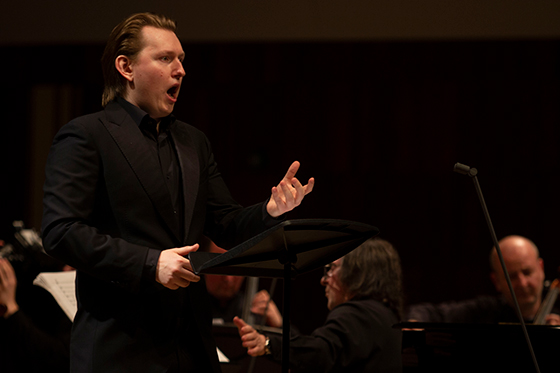
Another joy is Bogdan Volkov’s clever-tenor with the early vocal cycle of Britten “insight”, written in the same 1939 on the texts of the exemplary Enfant Terrible Artyur Rimbo. “Only I have the key to this barbaric parade”-somehow the first line of the cycle is translated. On the side of the soloist, a convincing French pronunciation, thin sarcasm and a luxurious palette of shades of voice were demonstrated, from the “soloists of Moscow” - thoroughbred fragrance of strings.
 © Yana Iksanova
In the XX century, the “king of Igor” can not do without. Igor Stravinsky in this program was presented in his neoclassist department - the “Italian suite” for the cello (soloist - Hungarian Istvan Vardai) and the chamber orchestra compiled in 1932 from the music of the earlier Pulchinell ballet. At one time, this dressing in Stravinsky in Permelezi and other 18th -century composers looked like a dangerous flirting with an anachronous consonance and caused fierce disputes. Nowadays, when neoclassicism is confused with neoclassica, it causes, rather, the sweet peace of the public and performers.
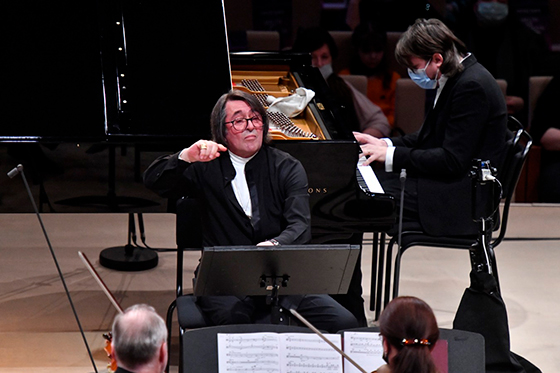
The final dessert was Ravel's leading first concert (1929–1931) . The French pianist David Fry calmly salted in the mask, Yuri Bashmet from the chamber “soloists of Moscow” moved beyond the remote control of his great symphonic “New Russia”, but led it, rather, like a small -command. An unexpected enthusiasm, standing from his chair, discovered Aram Khachaturian, who, thus, also fell into a bizarre company of composers, the XX century composers, from the Spartak Ballet, which, in the XX century, found.