
Translated material
From Vysotsky to Gilgamesh
Scientific biography of Sumerologist Vladimir Emelyanov
Doctor of Philosophical Sciences, Professor of the Department of Semitology and Hibraistics of St. Petersburg State University Vladimir Emelyanov, is known to the wide reader primarily as the author of the Gilgamesh biography, published in the ZhZL series. However, his bibliography is far from exhausted by the book about the “first wonderful person”. Gorky asked Vladimir Vladimirovich to talk about how he took up the Sumero-Akkadian civilization, about the passion for calendars of all eras and other no less heart-like things.- How did it all begin? How did you get carried away by the ancient East and how did you become a Sumerologist?
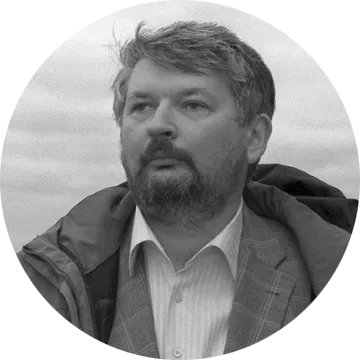 Vladimir Emelyanov
- I was always interested in the history of literature. There was such a specific historical moment when printed literature was supplemented by tape literature. And I was interested in this new poetry, especially Vysotsky. I have been doing a lot to them, oddly enough, from the age of twelve. Already at this time, typewritten collections made from Vysotsky drafts were available to me. I was engaged in poems and songs of military themes. The result of this work was the essay “Echo of the War in Vysotsky’s poetry”, which allowed me to win the 1985 All-Russian Olympiad in 1985, dedicated to the 40th anniversary of Victory.
As I studied the history of literature, I understood that the literature of oral was preceded by print literature. I became interested in folklore, but quite quickly I realized that the folklore texts, which are called ancients, are actually not ancient, they contain layers of different eras. Since these are the texts are not written, they cannot be accurately dated. Further from the sixth to the tenth grade, I began to search the area with which the oldest history of literature is associated with the method of screening. That is, the initial period of its history, when literature has already ceased to be folklore, but has not yet ceased to be literature and did not go into pure aesthetics. First of all, I realized that I would be engaged in the East, and it is in Eastern literature that the roots of literature as such will be. Then my wanderings began in various disciplines. I liked Africanism for a long time, but it was not suitable, because the only real African literature is Ethiopian, and it begins only from the 4th century AD. Then I became interested in Arabic literature. I read quite a few books on Arabicism and decided that I would enter Arabic philology. But here it turned out that Arabic literature depends on more ancient literature, Hebrew and Sumero-Akkad. And having seen that the Bible itself depends on the Sumero-Akkadian literature, I realized that it was precisely this literature that it is necessary to study, there is nothing more ancient.
So I gradually came to the conclusion that I need to be an assyriologist. The problem was that a set for Assyriology was once every five years, so I had to choose Arabic philology.
Here I want to make one note: when I was a high school student, I graduated from two small faculties - small philological and small eastern. The first was the small philological faculty. I was terribly lucky because the luminaries of Russian philology G.P. Makogonenko, G. A. Byaly, V. A. Manuilov were still alive, was in the prime of the forces of V. M. Markovich, and they gave lectures at the Small Faculty. After a year of study, I realized that I would definitely not be a Russianman or a classic philologist, my business is the East. Then, next year, I switched to the Small Eastern Department, where I studied in a group of Arabic-philologists. There I was prepared by the students A. A. Dolinina. So it was quite easy for me to enter Arabic philology with a certificate of graduation from the Small Eastern Faculty and an additional score for the Olympiad.
I acted, studied, but six months later they announced that a set of Assyriology was coming. And in my second year, I began to go parallel to the freshmen of speakers of speakers. I learned the hundred first cuneiform signs myself, and then read texts with freshmen. I thought that I would cross, but at the end of the second year I was taken into the army. I left ordinary. I was in the army for a whole year, but I didn’t lose time, but continued to engage in Akkad and Arabic and even wrote one small essay there, which later became my course work in the third year. After the year of service, all students were “amnestied”, and I immediately began to transfer to Assyriology. It was necessary to pass the difference in subjects in two years: historical disciplines and ancient languages themselves. Within three weeks, I passed twelve exams and four offset. After this session, I was no longer afraid of anything in my life.
Everyone was surprised at my transition to Assyriology, because it was not popular, everyone who did not get to more prestigious departments, such as Arabic or Chinese, was unloaded there. And when I myself began to rush there, many twisted a finger at the temple. But no one knew that Assyriology has long been the subject of my searches.
In a word, I safely transferred and got to the school of Assyriologists under the leadership of I. M. Dyakonov, where he was first taught by his students, and then he himself. It was so. An excellent teacher, R. A. Gribov, and those who went through the Gribov elementary school were invited to the University of Eastern Eastern Philology to the Institute of Oriental Studies ( now the Institute of Oriental Manuscripts of the Russian Academy of Sciences. - S. Ch .) , Belief, where Igor Mikhailovich was invited. The Higher School of Assyriology has already begun there. But why did we go to him, and he did not come to us? The fact is that Dyakonov was forbidden to teach at the university. He had some friction with the dean of our faculty and other people, he was an extremely conflict person. As a result, at the university, he became a person non grata. After all, he left in 1949, when he defeated the Department of Assyriology and Hebraistics, and has not taught since then. However, he led underground seminars. The so -called “invisible college” gathered at them, which included students, graduate students, freedoms, everyone who wanted to learn Akkadian language and wedge -painting. Igor Mikhailovich read with us an Akkadsky epic about Gilgamesh and classic Sumerian texts - the Code of Urukagina, the epic song “Gilgamesh and Huvava”. We received a luxurious Assyriological school.
The second person who also arranged such seminars was V. A. Jacobson. He taught us the laws of Hammurabi, but these were completely informal classes. We read the laws and immediately was commented on all kinds of topics, starting with the domestic and legal aspects of life and ending with religious categories. In fact, this was the introduction of ancient Mesopotamia in the whole culture of ancient Mesopotamia. If Dyakonov studied philological culture, then from Jacobson we studied cultural studies and the history of law. These researchers laid a very strong base in us, taught us to understand what is happening in the state, in society, in social psychology, collective and individual. All these general humanitarian issues were posed by them at underground seminars. The classes were serious - both at the university with Gribov and Koshurnikov, and at seminars with Dyakonov and Jacobson.
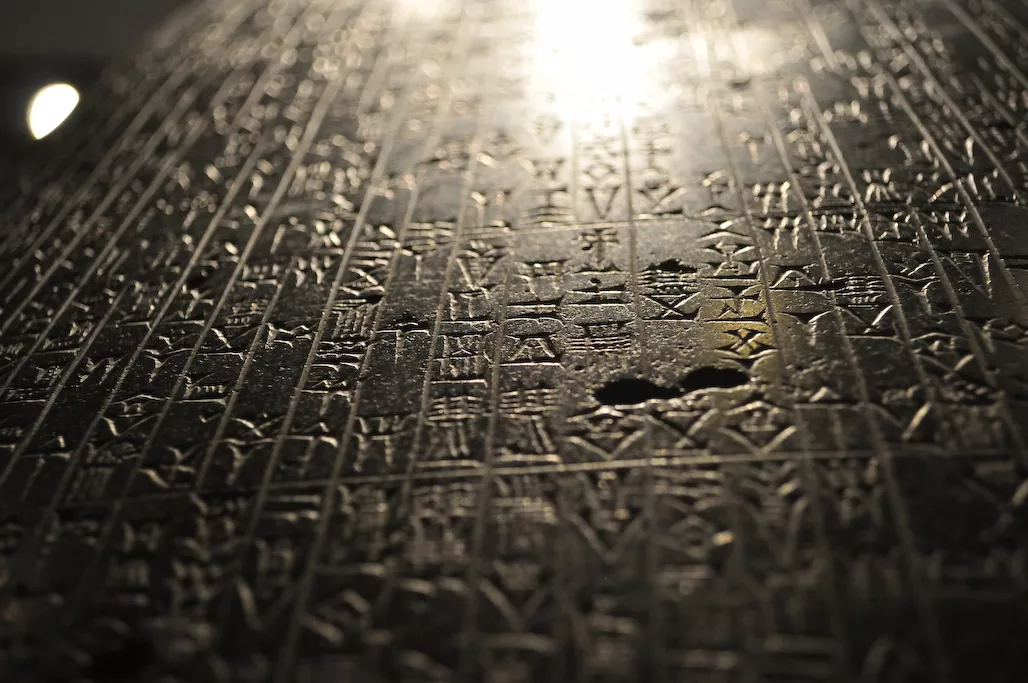 The part of the stele with the laws of Hammurabi in the Louvre. Photo: Haider Adnan/Flickr
But all this time the origins of literature occupied me, so I felt a little white broth. People who were engaged in socio-economic and socio-political history thought little about how literature develops, and even less they were interested in the history of religion. I was most interested in the worldview. After all, Akkadian literature is through and through religious, which means that I need to engage in religion. And with whom should I engage in religion? This is a rather complicated question. I met one person in my way, who was an outcast in Assyriology, but at the same time very much influenced my subsequent scientific direction - this is A. G. Kifishin. He was a wonderful Sumerologist, a student of V.V. Struve, but he did not have a relationship with Dyakonov. In addition, he did not very well be able to state his thoughts, often original, who had no analogues in science. He wandered into some jungle all the time. But I can separate the grains from the chaff. How did Kifishin affect me? I will now quote his article about the Sumerian-Walolian aesthetics in the first volume of the “History of Aesthetic Thought”, in which he expresses two extremely valuable thoughts. He says that in Sumer, the beautiful was determined by two sets of signs-essential and formal-as well as their correlation: “Sumerians distinguished two types of pleasure: experienced during eating and spiritual pleasure associated with the totem-related world of the beautiful. This division of pleasure into a carnal internal and spiritual external, from communication with the gods, is expressed in all Sumerian literature . ” This is his first thought, which was a starting point for me. And his second important thought at the end of the same article: “The huge load of the aesthetic forms of the Sumerian culture did not give the Babylonian era self -destroyed in accordance with his own, newly born ideas, which allows us to characterize the aesthetic status of Babylonian civilization as a protracted crisis of Sumerian culture . ” So I understood that the system of Sumerian values is based on the idea of external spiritual beauty, which is associated with the beauty of the essential, and this essential beauty is due to ritual behavior and consciousness; And the Babylonians turned out to be not only the heirs, but to some extent victims of the Sumerian culture, which did not allow them to become more modern. Based on these two most important ideas of Kifishin, I realized that it was necessary to engage in spiritual culture. But how?
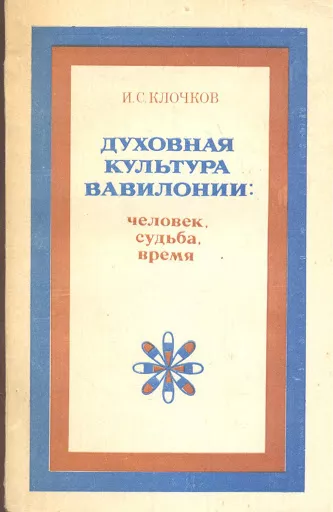 In 1983, the book of I. S. Klochkov “The Spiritual Culture of Babylonia” was published. This is a wonderful book, but Klochkov reduces the spiritual culture to ethics, to the issues of good and evil. Doing this, he brings the Sumero-Akkadian culture to the modern one as much as possible. Although it is important, it leads the wrong way. Spiritual culture begins with rituals, not ethics. So, we must understand what a ritual system of values is, we need to delve into the Sumerian categories themselves, we need to look for the Sumerians and Babylonians themselves thought about it. I began to look for a work that would contain a categorical apparatus on the example of some other culture. And I found the “History of Antique Aesthetics” by A.F. Losev. I was on the way with Losev, but not as a philosopher, but as a cultural scientist who studies ancient categories within the boundaries of the language world. He does not raise the question of what ideas are, he asks what Aidos is and what its historical development is. In this regard, I followed Losev, while realizing how my work should radically differ from his research. He developed philosophical categories, that is, those that lie only in the field of consciousness, and I do the categories that exist inside the ritual, within systemic ritual behavior; Therefore, I have to dig on the layer lower than Losev. Further it became quite easy: I realized that I was engaged in intellectual history, I am interested in the ritual, the system of values that formed the Sumerian civilization. On this road I went on.
- How did you choose a scientific topic? Why exactly the calendar?
- In 1991, Dyakonov read my thesis “Spell as part of the Sumerian rite of consecration of water”. This interested him, because he himself had just published the book “Archaic myths of the East and West”, in which he came to the conclusion that the formation of myths has a psychophysiological nature. So coincided, and he agreed to become the scientific director of my dissertation, realizing that I would write something related to religion. Although he did not recognize the word “religion”, preferring the term “social psychology”. Once he suggested that I write a “maximum detailed monologue” about the topic of the dissertation, 15–20 typewritten pages. And so I described all the aspects of what I want to study: the Mesopotamian religion, rituals and so on. Dyakonov looked and offered to create a system of causal relationships between the points of my text and try to find a link without which everyone else will not cost. In his presence, I began to cross out points depending on something. In the end, I still had a calendar.
Why exactly the calendar? I could tell you that the method of exclusion, but the truth is that from early childhood I have a specific intuition of calendar time, time synesthesia: I feel what time of the year what color has, what color every month; I clearly distinguish one point in time from another moment of time, I see its semantics. This is an innate feeling of the rhythm of time, which helps me not to make mistakes in life, history and politics. As a child, I received powerful support for this property. When I was six years old, my grandmother gave me a book by Vitaly Bianchi “Sinichkin Calendar”. From it I understood a very important thing: animals have periods when they change their behavior. In the same way in people. We will never confuse the first of May Happy New Year, our life attitudes and thoughts greatly depend on the calendar. So I got the Sinichkin Calendar and our holidays. Since then I have read many calendars. In the 70s there were tear-off calendars, which I read to the holes. I knew when someone was born, when what kind of holiday. And I can’t confuse 1789 with 1788. A certain historical mesh appeared in my head very early, in which the smallest moments of time, calendar and historical consciousness are marked. I still live with this. Therefore, there is nothing surprising in the fact that in the Sumerian-Akkadian literature I was allocated by a calendar ritual. After all, the calendar underlies all recorded ritual texts. We unknown ordinary human wedding rites, and the rituals of the sacred marriage are known. This means that the inhabitants of ancient Mesopotamia themselves paid the greatest attention to the calendar rituals, what is repeated, to which one can focus on, which forms a system of values. This so successfully coincided: my natural tendency and features of sources of Mesopotamia.
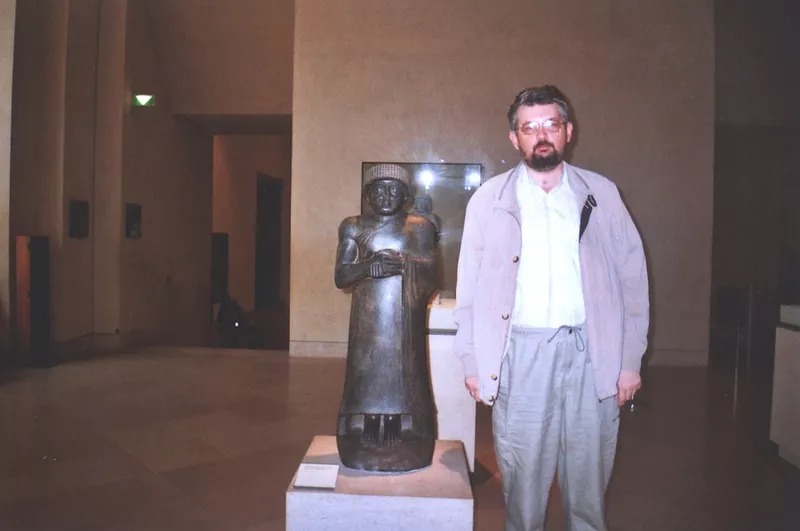 Vladimir Emelyanov next to the statue of the Sumerian ruler of Gudea in the Louvre. Photo from the personal archive of Vladimir Emelyanov
And when I began to write my dissertation in the Nippurian calendar, a new group of texts was suddenly published, which was previously known only in fragments - these are the comments of the Babylonians themselves for holidays and various ritual aspects. Then I realized how fabulously I was lucky: if earlier at my disposal there were only the mention of the calendar in literary and economic texts, now the whole commentary literature has appeared. From this I made a candidate dissertation, having come to an important conclusion in it: the Nippurian calendar system exists, it consists of four parts, it is a closed repeating cycle with its own semantics. By the way, when Dyakonov read my work, he did an amazing thing that seems to be a miracle after time: he took out four pages from the dissertation, which were dedicated to the category of ME and its connection with the spring holidays, and said: “But from this you will make a doctoral.” So it happened. It was extremely important for me to isolate the main religious Sumerian category - and this is the category of ME - and introduce it into the context of rituals. I showed that these same ME , unlike the idea, logo, etc., are associated with the spring, how the world resumes every year. I wrote a doctoral already without Dyakonov, he died in 1999, but it is surprising that he was able to predict the theme of my future doctoral dissertation on these four pages.
Dyakonov himself was mainly a man of a written word, he was a unique corrector and editor: he could find ten errors on any page on a dispute in the text. But the oral word was not his skate. He was also extremely intolerant of student errors, did not know how to explain at all. For example, he said: “As you do not know this, it is written in the German article of 1954 ...” But where are we, third -year students, know this German article? We first hear about it. And he is indignant. On the one hand, we understood that he was holding the bar high, on the other hand, it was strange. Therefore, he could not work as a teacher for a long time. He did not like mistakes, and when he was mistaken himself, he fell into a stupor. It was such a nervous reaction, he did not allow at all that somewhere he could be mistaken, he considered himself a luggage in seriousness. So it was, but the fact is that everyone makes mistakes. However, he was not a dogma, he could be convinced if you prove that he was mistaken.
When Dyakonov read his reports, he did it peculiarly: he began to read, suddenly he didn’t like something, he stopped, crossed out, and then continued to read the option that he had just inscribed. I really did not like his own texts, constantly the rules of them. Suffice it to say that he published his translation of the epic about Gilgamesh three times, and these were very different options. Such a complex personality, a person is extremely dissatisfied with his work and the works of all others. Sometimes it all ended in doctors. He was so seriously related to the case that when he once did not work on the dictionary of Afrasian languages, he already needed medications - he had a real clinical depression.
Jacobson was a completely different person, he was Socrates: he spoke much more than he wrote. Был непревзойденным, уникальным полемистом. По образованию он был юрист, к тому же спортсмен-фехтовальщик. Эта квалификация всегда сказывалась в его риторике: он необыкновенно точно отвечал на реплики оппонентов. У него был быстрый ассоциативный ум, и то, как он вел занятия по законам Хаммурапи, — отдельная история. Он не просто излагал материал, у него на ходу возникали идеи. Я понимал, что он сейчас мыслит при нас и это нужно фиксировать. Я горжусь тем, что на третьем курсе записывал за ним буквально все, что он говорил. Это были удивительные идеи, к которым западная наука пришла лет через двадцать после того, как они родились на нашем семинаре. Вдруг он неожиданно читал какое-то слово не так, как другие, видел там какое-то другое значение, а потом оказывалось, что его прочтение верно. А к тому, что он мало писал, у него было такое отношение: «Я же к этому пришел, придете и вы, зачем я это буду публиковать?»
Многие его открытия остались неизвестны за пределами небольшой комнатки, где проходили наши занятия. Спустя годы, когда я бывал на конгрессах на Западе, кто-нибудь читал доклад, я поднимал руку и говорил: «А вы знаете, профессор Якобсон к этому пришел еще в таком-то году». Более того, это опубликовано в «Кавказско-ближневосточном сборнике», изданном в Тбилиси. Коллеги разводили руками и говорили, что они не знают этого сборника, не читали. А я говорил, что приоритет в решении проблемы должен быть за профессором Якобсоном. Формально он был историком клинописного права, но на самом деле он был тончайший знаток истории культуры, в том числе духовной, и литературы. Но он никогда это не формализовал, все оставалось в разговорах.
— К вопросу об ошибках. Насколько сложно находить описки в древних текстах? Была ли кодификация нормы шумерского языка?
— Ошибок было невероятное количество, потому что не было никаких орфографических норм. Тексты записывались одновременно слогами и понятиями, это было ребусное письмо, и все зависело от квалификации писца. Писцы высшей квалификации знали множество идеограмм, они могли записать тексты, особенно религиозные тексты, иногда одними идеограммами. Это называется гетерографическое письмо, когда пишется по-шумерски, а читать надо по-аккадски. Читать трудно, но это демонстрировало то, что писцу доступно тайное знание. Остальные писали в основном слогами с минимумом идеограмм. Почерков было очень много и не было того, что мы назвали бы прописями. Если мы возьмем, например, так называемый старовавилонский курсив, то там три разных знака могут быть похожи на один. Читать и понимать такой текст довольно сложно. Часто случалось, что при переписывании старых текстов делались ошибки, потому что писец поздней эпохи уже не понимал, что писали древние, и делал удобные ему замены слов. И если исследователи не находят старые версии, то соответствующие места текста остаются темными.
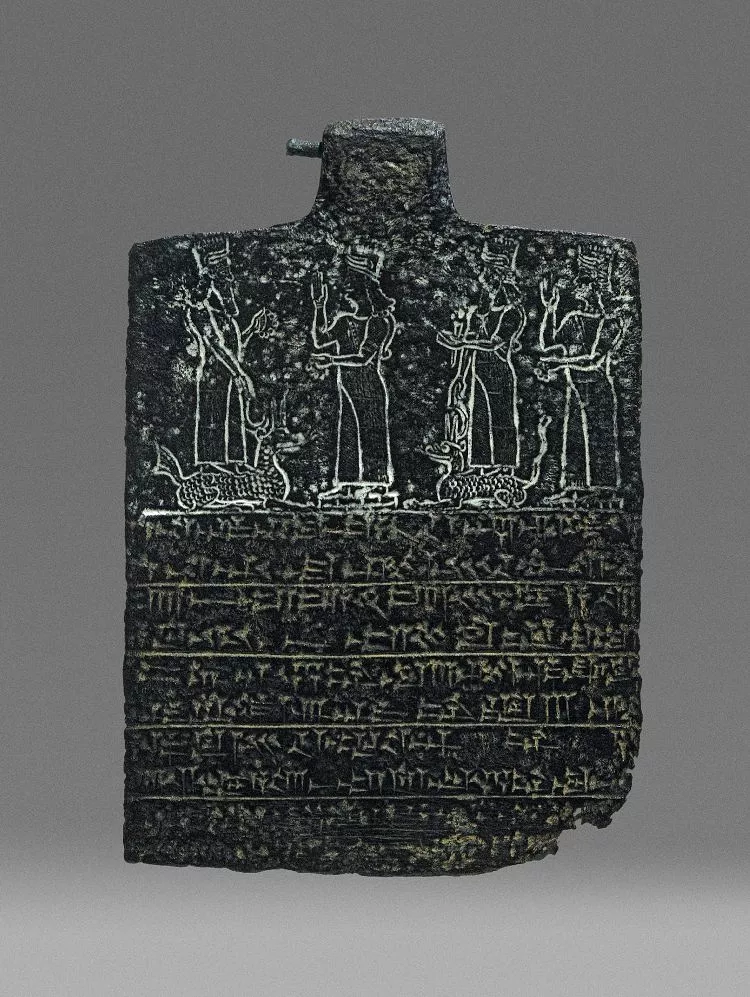 Табличка из медного сплава с изображением божеств (Мардук — крайний слева) и записью о даре храму бога Набу, 800–700 лет до н. e. Британский музей / CС BY-NC-SA 4.0
— Преподавался ли шумерский язык в те времена?
— Конечно, шумерский язык преподавался и в шумерских, и в вавилонских школах. Во-первых, до нас дошли грамматические таблицы для большинства форм шумерского языка в переводе на аккадский. Во-вторых, существуют так называемые силлабарии, которые и служат для нас источником информации как по шумерскому языку, так и по аккадскому. Таким образом, древняя филология существовала как минимум с начала II тысячелетия до н. e. На обоих языках учили читать и писать, учили большому количеству слов, выражений. Существовало преподавание специализированной лексики. Например, у нас есть словарь юридической терминологии.
— Грамотность была всеобщей?
— Четко очерченных сословий в Древней Месопотамии не было, ценз был имущественный. Поскольку обучение было платным, то оно было доступно состоятельным людям. Но бывали и такие времена, когда требовалось много учетчиков, бюрократов, и государство набирало как можно больше людей в школу, и тогда туда могли попасть дети бедняков, учащиеся за государственный счет. Но в основном дети обучались за счет своих родителей, учились и мальчики, и девочки. Гендерного неравенства не было.
— Вы говорили, что у вас все начиналось с Высоцкого, а какой у вас круг чтения за пределами востоковедения?
— Круг чтения у меня всегда был очень большой. Все началось с классики, поскольку моя мама работала в типографии и у нее был свободный доступ к собраниям сочинений, начиная с Пушкина и заканчивая Чеховым и Куприным. Я также много читал на английском языке по школьной программе: Шекспир, Бернс, Киплинг, Моэм, Лондон, Диккенс. Всю английскую классику я читал в одно время с русской. А потом, уже в старших классах, я познакомился с поэтом Виктором Кривулиным, который был репетитором по русскому языку и литературе и готовил людей на Восточный факультет. Через него для меня открылся целый пласт русской запрещенной литературы — Мандельштам, Ходасевич, Набоков, Гумилев. Он же давал мне формалистов: «Молодой Толстой» Эйхенбаума, Лермонтов с его комментариями. От него я узнал про Бахтина («Проблемы поэтики Достоевского»), Проппа и Веселовского. Своих школьных учителей я ни в чем подобном «обвинить» не могу, они были стойкие марксисты-ленинцы. Единственным исключением была наша учительница литературы И. Б. Гинзбург, которая устраивала внеклассные чтения и звала своих однокурсников по Герценовскому институту (ЛГПИ, а ныне РГПУ им. А. И. Герцена. — С. Ч. ) . У нас был поэтический вечер Александра Кушнера, несколько раз приходил Л. С. Дубшан и читал нам лекции о позднем Пастернаке, читал даже «Доктора Живаго». Это был 1985 год, какой «Доктор Живаго»? А у нас были занятия по нему, полуподпольно.
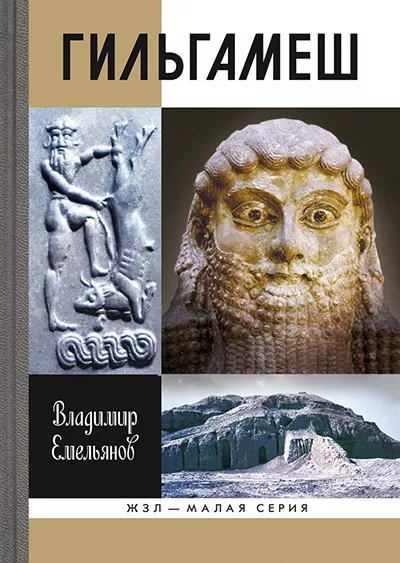 Если говорить не о художественной литературе, то с раннего детства я большой поклонник биографий. Это тоже как-то связано с чувством времени и с календарем. Я читал книги серий «Жизнь замечательных людей», «Научные биографии», биографические романы Андре Моруа. Когда у меня появилась возможность покупать книги, то я стал расставлять серию «ЖЗЛ» по хронологии. И вот теперь мне доставляет удовольствие, что вся эта серия начинается с моей книги о Гильгамеше. Раньше, видимо, нельзя поставить никого. Гильгамеш был первым в истории замечательным человеком.
До моего поступления в университет я довольно много читал, а потом у меня не стало времени на постороннюю литературу. Мы учили арабский, иврит, шумерский, аккадский, английский, французский, немецкий, были спецкурсы. Я приходил к девяти часам на первую пару, до шести у нас продолжались занятия, а с шести до девяти мы сидели в библиотеке Восточного факультета и готовились к занятиям на следующий день. Не было же ксероксов, мы сидели и от руки переписывали восточные тексты для того, чтобы подготовиться. В результате я приходил домой где-то в районе половины одиннадцатого. Какая тут литература? Для меня в студенческие годы не существовало таких имен, как московские концептуалисты, Пригов, Рубинштейн, Вс. Некрасов — я этих людей тогда не знал. Но позже я лично с ними познакомился в 1994 году. Тогда Кривулин пригласил меня на вечер московских концептуалистов в Дом журналиста. Там еще был Тимур Кибиров. Это было прекрасное выступление, перемежающееся юмором, оно оставило заметный след в моей душе. Кривулин постоянно подкидывал новые имена: Иван Жданов, Аркадий Драгомощенко, Алексей Парщиков. Всех их я узнал, когда ушла страшная учебная нагрузка.
Дело еще в том, что я сам пишу стихи и перевожу. У меня есть несколько публикаций. И если стихи я пишу всю жизнь, то переводческие успехи связаны с именем А. А. Долининой. Анна Аркадьевна вела у нас семинар по художественному переводу. Так что моя литературная подготовка связана с двумя людьми — Кривулиным и Долининой. Никаких литературных кружков я не посещал.
Какое-то время я продолжал заниматься Высоцким, у меня выходили статьи, одна из которых опубликована в бостонском альманахе «Лебедь» — «Мифологема льда в поэзии Высоцкого». Я до сих пор интересуюсь высоцковедением, но теперь слушаю и смотрю Высоцкого скорее ради эстетического удовольствия. Зато я занимаюсь другим.
У меня написана книга «Древняя Месопотамия в русской литературе». Я собрал все тексты, от древнерусской литературы до литературы начала XXI века, на тему Ассирии, Вавилона, шумеров — их сюжетов и образов. Получился довольно увесистый том — 700 страниц, — где большую часть занимают исследования, меньшую — антология. Оказалось, что каждая эпоха русской истории использовала образы Ассирии и Вавилона для своих собственных идеологических целей. У меня получилась не столько филологическая книга, сколько культурологическая. Этой темой меня зарядил в 2002 году В. Н. Топоров. Мне очень помогли многие крупные филологи-русисты, они снабжали редкими материалами, например тем, что издавалось в русской эмиграции в Харбине, о чем я знать не мог. Моя работа продолжалась в общей сложности 14 лет, это был колоссальный опыт по трансисторическому соединению двух культур — месопотамской и русской, — которые в лицо никогда друг друга не видели, но которые вступили в диалог, сперва через разные культуры-посредники, а потом и непосредственно — когда русские поэты и писатели стали читать ассириологов. Книгу сейчас рецензируют двое моих коллег, и я очень надеюсь, что к концу года она выйдет.