
Translated material
Mystery on Volkhonka
The construction, destruction and myth of the Cathedral of Christ the Savior. Underground story
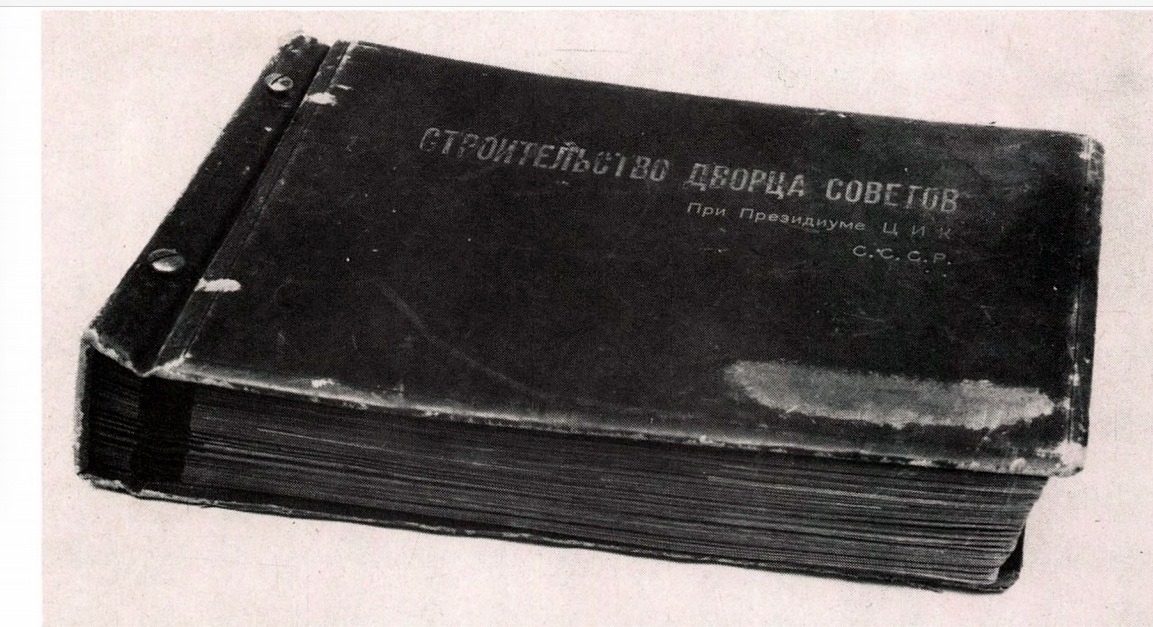
Alexander Goryanin: A year, probably in 1981, my late friend Alik Sidorov told me on the phone: "Come, worth it. Better now." It really was worth coming. It turned out that Alik bought an album from some underground scribbler-in the skin, huge-of those that are called "Transfer." On the lid was tidied:
Construction of the Palace of Soviets
Under the Presidium of C and K
S.S.S.r.
The name of the addressee someone carefully scraped off the skin, it was not clear even the number of letters. We puzzled for a long time: who scraped off? It could be someone from the Moscow or Union leadership of that time. Probably, such albums were done with a dozen, and now one sailed.
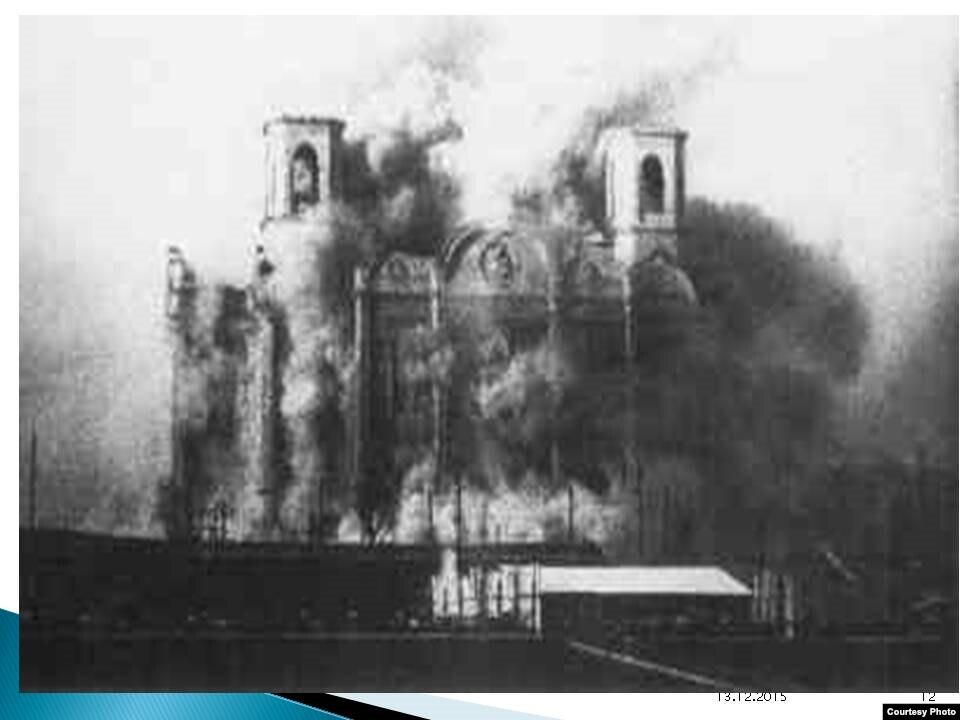
The title did not meet the content of the album, capturing no “construction of the Palace of Soviets”, but the destruction of the Cathedral of Christ the Savior. 172 photos with explanatory signatures were a step -by -step report about this vandalism. And a dozen more pictures talked about the competition of projects of the Palace of Soviets.
Knowing what we were talking about, we were still shocked. The temple was a mournful monument in memory of the victims of the twelfth year, and this is a burned, blown up and robbed Moscow, burned Smolensk, huge irrevocable human losses, approximately 300 thousand wounded and corrupted churches, burned out “Trinity Chronicle”, “Word of Igorev’s shelf”, and other irrevocable losses.
From the face of the Earth was a monument to a folk feat, the work of wonderful painters and sculptors was destroyed. There was no trace of marble plates with 22 thousand heroic names and battles, names of cavaliers of the highest awards, information about military units. Looking ahead, I’ll say that most slabs with the names of the heroes of the twelfth year were crushed, and alleys in Moscow parks sprinkled with a crumb.
And for what? For the Palace of Soviets? Suppose. For the Bolsheviks, this Babylonian tower was important as a symbol of their triumph. But who puts this, in fact, in the lowland? It’s good to stand by the river to the temple, but the hills are crowned with towers. The Bolsheviks had a choice of several hills near the city center. There is a Tagansky hill in Moscow, there is a Sretensky hill hanging over a pipe square, there is a hill between the cunning market and Khokhlovsky lane, graduates of driving schools who passed the rights an exam are remembered by his good quiet word. The Palace of Soviets on any of them would not suppress the Kremlin as ruthlessly as it is striking on large-scale drawings and layouts of the 30s.
The analysis of the temple, in which the wall thickness exceeded 3 meters, was a hellish task. Here is a signature under one of the pictures: "The mason does not take a crowbar, you need to crush one brick in a powder and beat with a chisel." Explanation: "An attempt to disassemble the temple manually at the insistence of the head of the construction department under the CEC of the USSR of the architect Kryukov." And the conclusion with the hint of the wrecking of Kryukov: "A group of retarded in technical terms of engineering personnel expressed fear that the explosive method would bring down not only the temple, but everything around them. Due to the panic they raised, samples of the temple were performed manually, which gave a negative result."
As a result, the temple was destroyed in December 1931 by a series of explosions, documented in 15 photos of the album.
It so coincided that shortly after this explosion, the bakery areas of the USSR covered a terrible deadly hunger, which lasted two years, and many perceived it as a punishment for the killing of a promise temple. And architect Kryukov Mikhail Vasilievich finished his days in Sunny Vorkuta. True, they swept it only seven years later. As the late academician of architecture Andrei Kosinsky, who was familiar to me by Tashkent, in the NKVD, in the NKVD, dawned on the NKVD, which, insisting on the dismantling of the temple manually, the pest of Kryukov, apparently hoped that the task would be considered impossible and the temple would be left alone.
It so coincided that shortly after this explosion, the baking areas of the USSR covered a terrible deadly hunger, which lasted two years, and many perceived it as a punishment for the murder of a promise church
When Alik and I were completing the album to the end, I already knew that I would not calm down until I write a book about this - immediately with the calculation of the publication after Cordon and under the pseudonym. But even if this does not come true and my work will remain the Samizdat voice of the egrass in the desert, I would not have considered this call to me with dishonor.
Alik Sidorov had established channels for sending texts to the west. This is a separate topic for another, I hope, transmission. The reset photographs were sent immediately, but somewhere got lost, reached the second time. My manuscript also left this channel later. But first it had to be written.
Time passed, the deadly deceased Brezhnev was replaced by Andropov Yu.V., supervision of citizens - so that they, like stupid children, which they did not do - immediately became more attentive. Since you write under a strange name, I told yourself, since you hide your own, hide it better. The pseudonym should pretend that he is not at all a pseudonym, but a real face. But for the overseeing behind Tamizdat, uninteresting. Let it be a woman who has long been living in the West, got there by marriage, in the USSR studied at an architect, hence interest in temple architecture. At the end of the manuscript, I gave such a certificate about this lady: Nina Ivanovna Moligne, nee Potapovich, was born during the war in Astrakhan in the family of evacuated party workers. Since the 70s, he has been living with her husband and two children in Trois-Rivières (Québec), Canada. The certificate caused yawning, it was clear that this kind woman would not write anything else.
Six months later, I had a text of about 230 thousand signs. It turned out the book, albeit small. And if with the full reproduction of photos of the album and signatures for them, then not very small. I remember I was tormented by where to start. No matter how terrible this is the documented murder of a huge temple, a man familiar with the topic only in general terms, could well say: well, there are thousands of such stories, who does not know that Soviet power destroyed the churches without an expense.
The symbolic meaning of the national shrine and the symbolic meaning of its destruction had to be conveyed to the reader
The symbolic meaning of the national shrine, and the symbolic meaning of its destruction, had to be conveyed to the reader. Therefore, I decided to start not with the demolition of the temple, but from the birth of his plan. From the "highest manifesto" of Alexander I, published in Vilna on the day of the birth of Christ on December 25 of the old style of 1812. The Russian army was then on the banks of the Neman, ready to enter Prussia after the remnants of Napoleon’s army. The manifesto ended with the words:
"In commemoration of our gratitude to the Provision of God, who saved Russia from the threatening of the death of it, we intended in the pioneer city of our Moscow to create a church in the name of the Savior of Christ. Let our Almighty begdowing this temple for many centuries, and may he smoke in it before the holy throne of God's gratitude of later clanes, along with love and imitation the affairs of their ancestors. "
The victory in the competition of many projects, which was not at all, was at all, but the novice painter Alexander Witberg, described by Herzen in the "former and thoughts": "The time of the competition came. There were many projects, there were projects from Italy and Germany, our academics presented their own. And the unknown young man presented his drawing among others. Colossal, fulfilled by religious poetry He struck the emperor of Alexander.
Victory in the competition of many projects, which was not at all with the architect, but the novice painter Alexander Witberg
However, after 10 years, not even construction, but the most difficult preparation for it, the special commission was stopped by the new emperor, Nicholas I, came to the conclusion that it was impossible to build a heavy three -tier church with a total height of the sparrow mountains, as well as the abuse of not that not that Wittberg, but by the Witim Vitberg, who was sent for this for several years in Vyatka.
Most likely, it was possible to build a temple, as the construction on the same soils 120 years later after the main building of Moscow State University (though, away from the river). I dare to think that the main reason for the refusal of the Witberg project was a belated insight, that such a grandiose temple at such a distance from the then city, and even beyond the river, will always be almost empty.
Nikolai did not refuse the idea of the promise church, but he did not declare a new competition, but he chose an architect - he became Konstantin Andreevich tone - and a place for the temple near the Kremlin. It took 48 years for construction with internal and external decoration. For the grand opening of the temple, Tchaikovsky created his famous solemn overture "1812" with a bell ringing and cannon volleys (he replaced a large suspended drum).
The consecration of the temple took place on May 26 (old style) of 1883, ten days after the coronation of Alexander III, becoming the end of coronation holidays. Until a great day, Konstantin did not live two years, but he saw his brainchild outwardly finished. For a quarter of a century, he was the "rector in terms of architecture" of the St. Petersburg Academy of Arts and often visited Moscow for the sake of author's supervision. He went back and forth from the stations built on his projects. And, probably, he visited his other Moscow buildings - the Big Kremlin Palace, the arms ward, the bell tower of Simonov of the monastery. The tone, fortunately, did not live until the time when the arrogant denial of everything he made as a “false Russian tasteless” began. The capricious critics came up with the name of the ton forms of "dry" and "cold", and the painting of the temple - "lifeless" and "anti -artistic". Purricry can be discarded about dry forms, but what can I say about painting? I myself, of course, could not see it, but I saw the frescoes of the Vladimir Cathedral in Kyiv, a masterpiece of the same style. And there and there, equivalent teams of artists worked, including, among others, in Moscow of Kramskoy, Surikov, Litovchenko, Korzukhin, Semiradsky, Makovsky, and in Kyiv - Vasnetsov, Nesterov, Vrubel, Pimonenko, Kotarbinsky, Snnovichsky. So all these aesthetic injections can be neglected.
The tone, fortunately, did not live until the time when the arrogant denial of everything he made as a “false Russian tasteless” began
True, these long -standing injections and labels added courage to the subtlers in 1931, glorifying the demolition of the temple. I quote: “What explains all rumors about the“ valuable art ”in the temple of Christ-Slover, especially dissolved during the demolition of this former temple? It is necessary to repulse attacks on the“ destruction of historical monuments ” . But the entry on the other hand: “Due to the trade interests of the exploiting classes, tsarist Russia waged a war with France ... To glorify the mass human destruction, the king of Romanov announced that a special church would be built in Moscow ... It was built on the folk bones by Nikolai Palkin and his son Alexander-fortress ... not about any“ unprecedented zeal ”from workers and peasants in the part of workers and peasants The era of the Russian-French war does not have to speak.
The fact that in the place of the Cathedral of Christ the Savior would grow up the Palace of Soviets was announced when there was not even a preliminary project. But the newspapers assured: "Construction should be completed at the end of 1933 ... The deadline for submitting projects for the competition on October 28, 1931 until 20 hours." The frivolity of the Bolshevik plans is amazing.
The Mosolovod Executive Committee received 10 days to close the temple as a cult unit, after which the same dismantling in the photographs began, he took 4 months. All valuable was removed - gilding (chemical washing gave 422 kg of gold), tons of copper, lead, bronze (only tall bronze gates, number 16, there were 800 pounds each), ten thousand square meters of mosaic from porphyry, labrador, colored marble, 300 thousand square meters of polished red granite, without the score of white marble slabs, without a score Other details of the outer and internal cladding. By the time of the explosion, the temple outside looked torn and robbed, but as a building is almost whole. The liquidation after the explosion of the Elbrus of the wreckage (out of 40 million only bricks are larger than the current, not counting everything else) lasted almost until the end of 1933, i.e. Until the moment when the palace was already supposed to support the heavens. For the building that was not yet started, they did not spare the epithets. According to the People's Commissar of Education of Lunacharsky, the palace was conceived, "to give Moscow - the Red Babber of the World, the visible architectural center." Center of the Center.
Then, a year and a half, nothing happened at the future construction site: there was no approved project. After two competitions, the project of Boris Iofan was chosen, which was 10 years old, until the mid-20s, worked in Italy with the fashionable architect Brazini, and having moved to Moscow, managed to build the famous "House on the Embankment".
In 1935, they finally began to dig a pit. In September 1937, the head of the construction of the Palace of Soviets Vasily Mikhailov was shot, and two years later the foundation of the high -altitude part of the building was completed.
In the resolution, which summarized the first round of the competition, we read: "It is advisable to avoid in the design of the building of temple motifs." Why would it? The projects of the first round (Corbusier, Hamilton, Brazini, Gropius, Zholtovsky, Alabyan, the Vesnins, Shchusev, Shchuko, Golosov brothers) did not give a reason for such warnings.
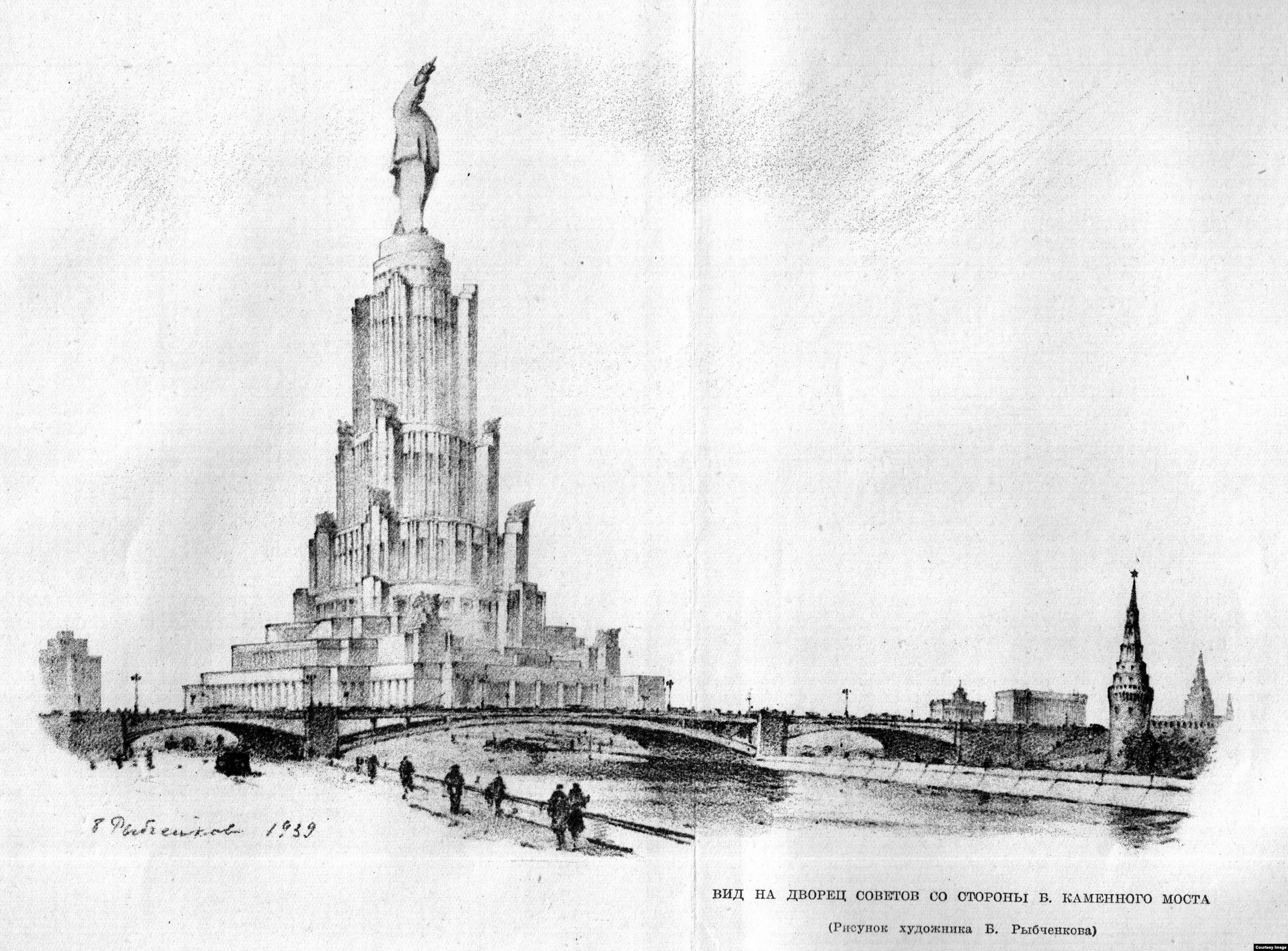
But in front of me in Moscow in 1940, Nikolai Imparov’s book “The Palace of Soviets”, where the future Soviet miracle was described as if already embroidering over the capital. The author acts as a guide: “Let's go through the square, past the sculptures of the forerunners of socialism-Saint-Simon, Fourier, Chernyshevsky and others-and we will rise along the wide front staircase to the main entrance, on the sides of which there are monuments to Marx and Engels ... Six pylons of the main entrance to the Palace of Councils were sophisticated on Kamna's oaths of the oath of a comrade Stalin ... " But these are the temple motifs!
I reveal "past and thoughts." Alexander Ivanovich Herzen leads the reader to the virtual main entrance to the temple according to the Witberg project: "The colonnade leading to the temple was decorated with statues of the Old Testament persons. At the entrance there were prophets. They stood outside the temple, indicating the path along which they did not have to go." As the utopian socialists and Marx did not have to go, to go, to go through Lenin - Stalin.
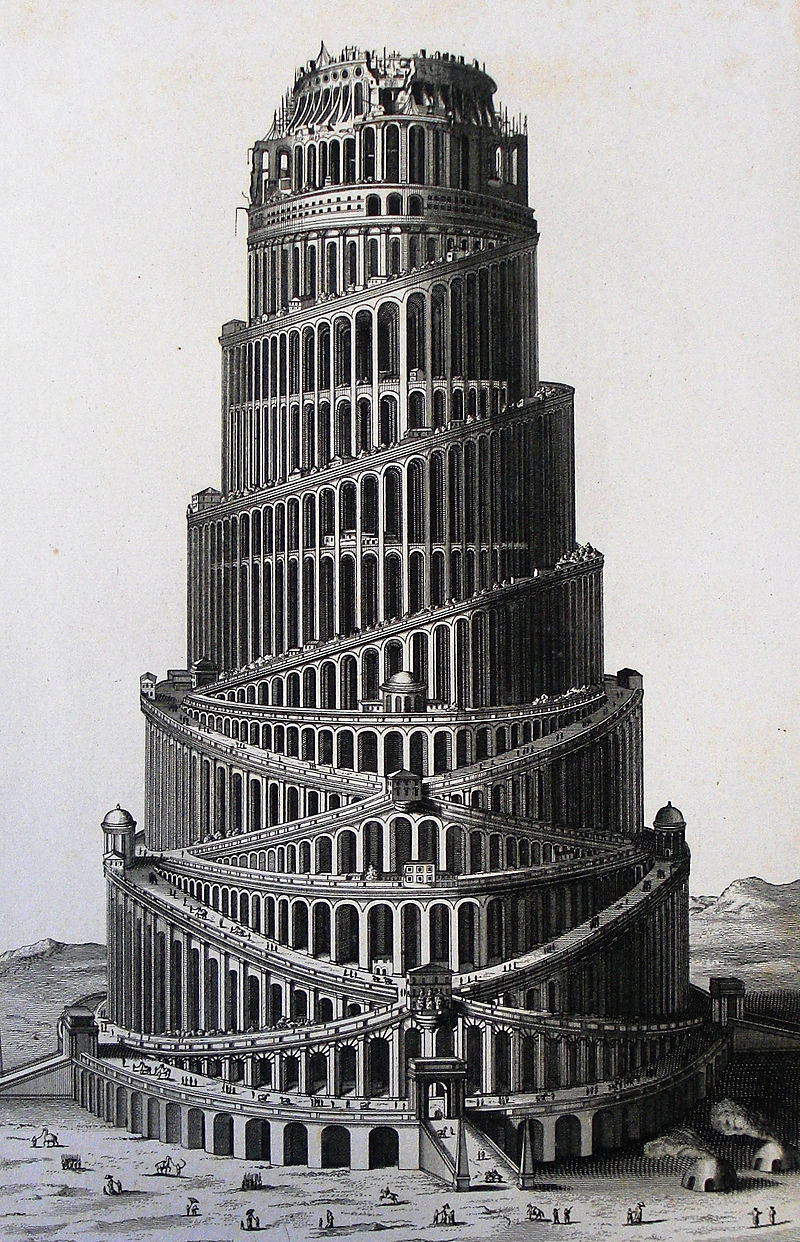
If you close the figure of Ilyich, a resemblance to the Babylonian tower is immediately discovered, which was depicted by the large and small Dutch
If you close the figure of Ilyich, a resemblance to the Babylonian tower is immediately discovered, which was depicted by the large and small Dutch. And what is the Babylonian tower, in addition to seven lines in the Old Testament? This is a real building, which was grown as archaeologists, to a height of 91 meters, the temple of the Sumerian god Marduk. Marduk defeated the world evil in the person of the goddess Tiamat, the dragon Sirrush helped him.
The idea of the Bolsheviks (conscious or not) was precisely in the sacred replacement of the temple of the Lord with his communist church. And not nearby, and not somewhere else, but in place and instead. They desperately needed a victory-symbol. Starting from the 17th year, they eradicated the remnants of all old parties, with strangling the NEP got rid of any entrepreneurs, and after conducting collectivization-and a private landowner. There was no longer any strength in the country, economically independent of the Bolshevik power. It remained to achieve the complete spiritual submission of everyone and everyone, but then the problem loomed: Bolshevism was forced to coexist with a completely different ideology - completely (albeit silently) denied it. Even the "renovationists" who were looking for cooperation with the Bolsheviks (by the way, by the way, the Patriarch of Constantinople!) - and the Cathedral of Christ the Savior was in their hands - did not cease to be believers. Vera remained frightened by force. Not militant, but reborn.
However, temples can only be erected by faith, it is better not to undertake the atheists for this. The cyclopic (and someone finds that the infernal) Palace of Soviets, if it were built, would remain not only a shameless, but also a meaningless community. Just a pedestal for Lenin, who would stand in 14-meter boots and pointed forward a 6-meter finger (measure with steps on the floor!). How were you going to fill the monstrous space with exactly one hundred floors? According to Jofan, "the Palace of Soviets is intended to serve the widest masses of workers involved in direct government." Understand what you want.
The book “The Palace of Soviets” is also dark: “The people will meet with their leader, with the heads of the party and the government. Sessions of the Supreme Council will work here. Noble people will go to Moscow from all over the country and discuss their affairs in the Palace of Soviets. There will be a state documentary archive in the same building, which contains materials on the history of the emergence and approval of Soviet power.” And that's all! Никому не было позволено огласить подразумеваемый секрет: это здание на вырост, здесь будут принимать в Союз ССР всё новые республики, ведь в наш Союз рано или поздно вступят все страны мира. Кстати, книга Атарова была подписана в печать 17 августа 1940 г., через две недели после приёма в СССР Молдавии, Латвии, Эстонии, Литвы.
Я уже заканчивал текст, когда мой добрый знакомый, журналист Володя Война дал мне почитать английский перевод мемуаров Альберта Шпеера, личного архитектора Гитлера. Кстати, ныне есть уже три русских издания, рекомендую. Гитлер обожал архитектуру до дрожи, едва ли не главной его мечтой, пишет Шпеер, было возвести в Германии самые большие сооружения в мире: центр для партийных съездов в Нюрнберге на 160 тыс. чел., стадион на 400 тыс. мест, триумфальную арку, по объёму в 49 раз больше парижской. Но главной затеей Гитлера был "Зал народа" (Volkshalle) вместимостью до 180 тысяч стоящих людей. Шпеер иронично называет его, заметьте, "местом молений". Диаметр купола из патинированной меди над ним – 250 м, высота с навершием – за 300 м. Когда все чертежи и модели были готовы, заказаны гранитные колонны в Швеции, Гитлеру сообщили (можно понять, весной 39-го), что в СССР тоже строится огромное здание для собраний. Цитирую Шпеера: "Он был глубоко уязвлён, ощущал, что у него обманом похитили славу возведения самого большого монументального здания в мире. Рука об руку с этим шла крайняя досада, что он не может приказать Сталину остановиться" .
Гитлер был глубоко уязвлён, ощущал, что у него обманом похитили славу возведения самого большого монументального здания в мире. Рука об руку с этим шла крайняя досада, что он не может приказать Сталину остановиться
Эта вспышка архитектурной ревности, не исключено, изменила ход истории. Гитлер не раз повторял, что война на два фронта самоубийственна для Германии, и пока она не имела общей границы с СССР, германо-советская война просто не была возможна. Соблазнив Сталина возвращением на российские имперские рубежи 1914 года (смысл пакта Молотова – Риббентропа для советской стороны был именно в этом), Гитлер получил протяжённую советско-германскую границу и возможность напасть. Причин для нападения у фашистского диктатора было немало, но не меньше было и причин в русский капкан не лезть. Архитектурная ревность могла поколебать эти чаши весов.
Снова цитирую Шпеера: "После начала войны с СССР я время от времени видел свидетельства того, что идея московского здания-соперника терзала Гитлера больше, чем он хотел признать.
– Теперь, – сказал он однажды, – это будет конец их громаде раз и навсегда" .
Так оно и вышло, хотя войну проиграл не СССР, проиграла Германия. Но всемирный коммунистический проект закрылся. Штаб-квартира для него стала не нужна и нежеланна. Война послужила Сталину удобным предлогом для отказа от проекта. А если вопрос о штаб-квартире когда-нибудь вновь станет актуален, это будет уже другой дворец и украшать его сверху будет уже не Ленин.
Металл каркаса, поднявшегося до уровня 7-го этажа, извлекли во время войны на оборонные нужды. Много ли его наизвлекали из бетона, нигде не упоминается, но объяснение устроило всех. А между тем в Москве и во время войны продолжали строить метро (добавилось семь станций), и металла на это ушло неизмеримо больше.
Потом москвичи помнят четверть века пустого котлована. Его яма заполнилась водой, забор начал валиться, всё зарастало травой и кустами. Вслед за мальчишками за забор стали проникать алкаши. В котлованном озере завелись рыбёшки, их стали ловить. На каждом суку висел стакан. Уже при Брежневе котлован превратили в плавательный бассейн "Москва".
Но вернусь к своей рукописи. В 83-м году её тайно передали во Францию Игорю Сергеевичу Шелковскому, парижскому редактору и издателю журнала "А-Я", органа неофициального русского искусства. Игорь приложил массу усилий, чтобы издать книгу, но задача оказалась непростой и далась не сразу. Я какое-то время продолжал гореть темой, досылал через Алика вставки и замены, но на первый план всё больше выходили другие заботы. Шли месяцы, годы, жизнь становилась всё интереснее, в конце 80-х умерла цензура, и мне подумалось, что если моя рукопись никому не интересна ТАМ, она была бы впору ЗДЕСЬ, и уже без всякого псевдонима. Но эта мысль не породила действия. У меня, как и у почти всех вокруг, сменились приоритеты.
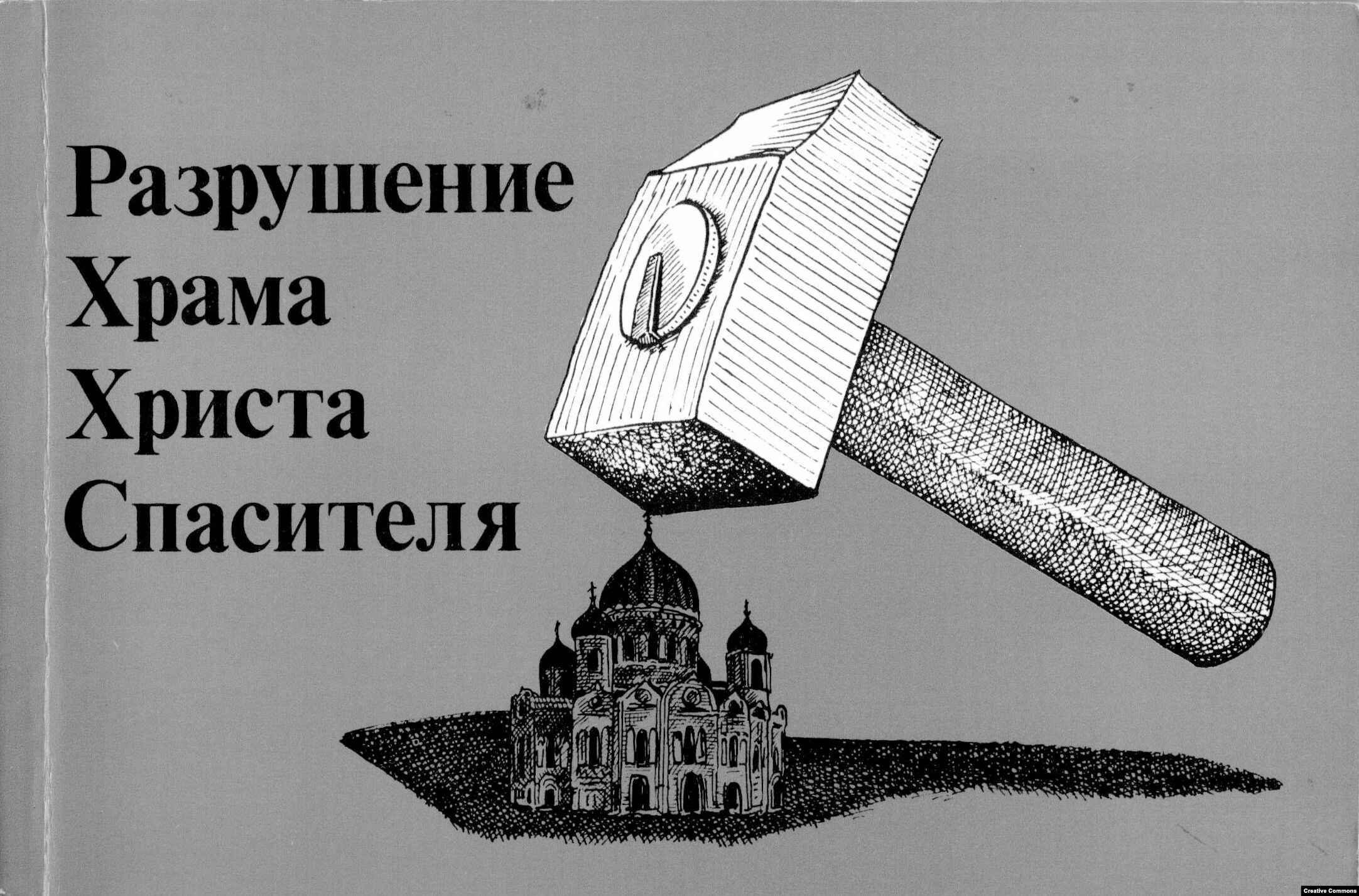
Году, кажется, в 90-м я встретил в Москве Ивана Толстого, он ещё не был штатным сотрудником Радио Свобода, но уже делал передачи как фрилансер. У него была с собой книжка горизонтального формата под названием "Разрушение храма Христа Спасителя". Далее цитирую страницу Ивана Толстого в фейсбуке: "Книжка вышла под псевдонимом Нина Потапович-Молинье (остроумная лже-биография авторессы прилагалась), с предисловием Ирины Иловайской-Альберти. Я готовил рецензию для Радио Свобода. Мой друг спросил, о чем будет мое выступление? Я показал ему труд Потапович-Молинье. Он стал листать, и ни один мускул на его лице не дрогнул. Он сознался в авторстве только после эфира" .
Издательство посчитало, что главное здесь – фотолетопись разрушения
Оказалось, книга вышла ещё в 1988 году в лондонском издательстве Overseas Publication Interchange, хозяйка которого Нина Карсов сделала это по просьбе Ирины Алексеевны Иловайской-Альберти, главного редактора парижской газеты "Русская мысль". Куски моего текста, аккуратно отмеченные то кавычками, то другим размером шрифта, были вплетены в предисловие Ирины Алексеевны. Увы, ей пришлось пожертвовать более чем 80 процентами написанного мной. Издательство посчитало, что главное здесь – фотолетопись разрушения.
Вскоре, уже в Париже, я познакомился с Ириной Алексеевной, у нас установились наилучшие отношения. Оказывается, в 70-х она долго была секретарём Солженицына в Америке, многолетняя дружба связывала её с римским папой Иоанном-Павлом. Я стал печататься в "Русской мысли", выступать в радиопередачах, которые Ирина Алексеевна вела из маленькой студии над журфаком МГУ на Моховой, прилетая для этого раз в неделю (кажется) из Парижа. Последний раз я видел её на Первом Всемирном конгрессе русской прессы летом 1999 года. "Поздравляю с храмом!" – сказала она. Как раз в эти дни в газетах замелькали фотографии воссозданного храма Христа Спасителя. Мне хотелось обсудить с ней символику события: взрывая храм, большевики как бы взрывали неправильный старый мир, но то, что им не дано было возвести взамен свой якобы правильный, совсем не случайно. Я думал спросить Ирину Алексеевну, что, по её мнению, может символизировать новое рождение храма Христа Спасителя, но, как бывает в кулуарах любого съезда, все говорили со всеми и внятная беседа не задалась.
Через полгода храм Христа Спасителя уже распахнул врата для верующих. Увы, вскоре после этого Ирины Алексеевны не стало.
Но я забежал вперёд. Второе рождение храма происходило удивительно быстро. Хотя призывы к его воссозданию просочились в советские газеты ещё в 89-м (первыми их озвучили Юрий Нагибин и Владимир Солоухин), но в реальной жизни как ни в чём не бывало действовал бассейн "Москва". Вскоре я с семьёй переехал в Малый Лёвшинский переулок и телефон там отличался от телефона бассейна на одну единицу. Не было недели, чтобы кто-нибудь не позвонил с вопросом: "Это бассейн "Москва"?" Если трубку брал я, мой собеседник слышал в ответ: "Как, вы не знаете? Бассейн "Москва" с сегодняшнего дня закрыт. Начинается восстановление храма Христа Спасителя". Порой в ответ звучали проклятья.
Последний то ли год, то ли полтора бассейн стоял уже сухой, и всё равно звонки редко, но продолжались. 1 июня 1994 года телевидение сообщило, что Московская патриархия и мэрия Москвы приняли решение о начале работ по воссозданию храма. Услышав это, моя семилетняя дочка Даша потом рассказывала кому-то из наших гостей: "Папа всё время настаивал и его послушались".