
Translated material
Ivan Ivanov-Vano
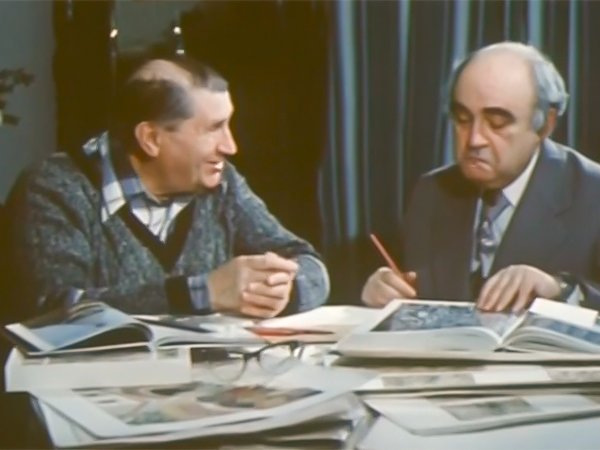
On February 8, 1900, director Ivan Ivanov-Vano, one of the founders of the Soviet animation, was born.
Personal business
Ivan Ivanov-Vano (1900-1987) was born in a peasant family of immigrants from the Kaluga province, who arrived in Moscow for workshops and settled on Manezhnaya Square, in those years inhabited by the poor. Ivan was the youngest of the four surviving children.
His father worked as a shoemaker and soon after the birth of Vano left his family. The mother of Elizaveta Mitrofanovna, an illiterate peasant woman to feed herself and washed her children and repair linen in merchant families, while taking her son with her. After some time, the boy was educated by the older sister of Evdokia. Her husband, artist Konstantin Spassky, had a great influence on him.
For a few years, Ivanov was carried away by a puppet theater, for which he painted and made scenery. I played ideas at home. The “scene” was the space of the bed of the Russian stove, the curtain - the old patchwork blanket, and the “Sofites” were church lamps and wax candles. The dolls were flat, carved from cardboard and paper.
The repertoire of the young director already made up classic works: “The Tale of King Saltan”, “The Tale of the Dead Princess and the Seven Heroes”, “Sadko”.
As a result, having graduated from only two classes of the parish school, Ivan at the age of 14 entered the Moscow School of Painting, Sculpture and Architecture (since 1920-Vhutemas), where he taught Spassky.
At first, Ivanov-Vano studied with V. A. Favorsky, then switched to the course of I. I. Mashkov. In 1923, he graduated from the school, after which Vladimir Sutheev invited him to the State School of Cinematography (now - VGIK), where a group of initiators of the Soviet multiplication, then completely young 3. Komissarenko, Yu. Merkulov and N. Kodataev moved the cut -out figures directly under the machine, making their first animated films. “There was something from the rite of initiation into Masons, mystery, darkness, anticipation of a miracle. He was given a paper blank - he himself, and allowed - himself - to remove his character on a film. On the frame. He took off, and a miracle happened: a little man, a fake, paper, drawn man twitched, waved his hands, ran. How alive. Incredible! There was no end to surprise and delight, rightly furious. <...> And in this person’s own manufacture of the character and his own animation, unexpected romance was revealed, a charm, which did not differ later, remained for life. The animation received another voluntary captive, ”wrote N. Abramova about his arrival in the animation of N. Abramova.
Then, at first, Ivanov-Vano did not think about any independent films yet-he was captured by the process of making a character and a kind of game with him in an attempt to “revive” him.
As one of the artists, Ivanov-Vano participated in the creation of the first Soviet cartoon “China on Fire” (1925). Cartoons, which Ivanov-Vano made together with fellow students at VKhUTEMAS, distinguished the special avant-garde style of those years based on the school of constructivism. Films were shot using home -made machines. In parallel with work on cartoons, Ivanov illustrated books and covers of sports magazines, painted sketches of theatrical costumes.
In 1927, Ivanov-Vano joined the team of the Studio "Interrabpofilm", where he had already professionally engaged in animation.
As an artist, he participated in the creation of one of the most famous early -Soviet films using the painted multiplication technique "Rink" (1927). He also tried himself as a director-director, shooting the cartoon "Senka African", which became the first Soviet animated film for children.
Put by Ivanov-Vano together with D. Cherkes and Yu. Merkulov in 1927 based on the tales of K. Chukovsky, the film turned out to be unusually spectacular. In it, an elephant, a crocodile and a giraffe came to life. Events struggled both on the ground and in the air, and the action was transferred from Moscow to Africa and vice versa. A special impression on the audience combined live nature, combined filming and animation.
Together with the artist Vadim Lazursky, Ivanov-Vano made a multiplier screensaver for the film comedy “Funny Guys”, which instantly became incredibly popular.
In 1936, Ivanov-Vano graduated from three-month advanced training courses at Soyuzmultfilm and soon became one of the leading directors of the studio. He also painted diaphylms - an entertainment very popular at that time.
In 1939, Ivanov was dismissed from Soyuzmultfilm for being late. Going home, he met on the road in the tram of director Lev Kuleshov, who at that time held the post of professor of VGIK. Kuleshov invited him to organize a department for the preparation of multiplier artists at the Faculty of Art Faculty of Institute. In the same year, the first year was recruited, consisting of, however, of only four people. Soon Ivanov-Vano was restored at the studio.
In 1941, after the outbreak of war, together with Soyuzmultfilm, Ivanov-Vano was evacuated to Alma-Ata, where he continued the directorial and teaching activities. In 1943, the film studio returned to Moscow, and already in 1944 a new set began at the Department of VGIK under his leadership.
In 1952, Ivanov-Vano received the title of professor. In 1951, he was accepted into the CPSU (b). In 1957 he received the title of Honored Artist of the RSFSR.
In 1960, the director left a drawn animation and switched to the unification of puppet films, where he put a number of paintings, experimenting with various techniques and styles - lubok, icon painting, fresco painting, Dymkovo toy, lace, Russian avant -garde and even stereoscopy.
In 1970, he received the State Prize of the RSFSR named after the Vasilyevs of the Vasilyevs - for the animated films “In some Kingdom ...” (1957), “Left -handed” (1964), “Seasons” (1969).
In 1985, he was awarded the title of People's Artist of the USSR.
Ivan Ivanov-Vano died on March 25, 1987 in Moscow after an illness on the basis of a nervous disease (his nerve endings were affected and the organs refused one by one). He was buried in the Novodevichy cemetery.
 Ivan Ivanov-Vano Wikipedia
What is famous
Ivan Ivanov-Vano created a domestic animation school. More than one generation of Soviet children has grown on its cartoons. As a director Ivanov-Vano set a record for the USSR the number of full-length cartoons. At the same time, most of his works were carried out based on Russian folk or literary fairy tales-“Horse-Gorbunks”, “Geese-Swans”, “The Tale of the Dead Princess and the Seven Herries”, “Snegurochka”, “Twelve months”, etc.
Many films of the director were awarded high international awards. Together with Fedor Khitruk, he often represented the Soviet Union at international meetings, in particular, in the International Association of Multiplotion Cinema (ASIFA), which was created, among other things, on his initiative.
For almost half a century he headed the workshop of the animated film at VGIK.
What you need to know about
The first full-length film “The Humpbacked Horse” (1947), shot by the director soon at the end of the war, was nominated for the Stalin Prize of the third degree, but did not like the members of the commission. But the cartoon was highly appreciated by Walt Disney, who sent him to his studios as a training manual.
Ivanov himself did not complain about the Disney type of animation and, starting with Moidodyr (1939), tried in every possible way to distance himself from him towards the classical and folk style.
Direct speech
About puppet animation : “In recent years, I realized that puppet animation is fraught with many not used opportunities. I looked closely for a very long time, looked closely, studied the method of filming and the design of the dolls, and then decided and went into the unification of puppet films. It seemed to me that it was there that I could fulfill my long -standing desire to film the “left -handed” Leskov. Of course, I could put this film in a graphic animation, but then my plan would not be fully realized. The production of a drawn film with its streaming method of work, the manufacture of several thousand drawings by different artists would not allow me to use a rich folk ornament on costumes of characters, in the scenery and in the props. Meanwhile, it was precisely in this that the peculiarity of the visual solution of the “left -hander”, which was based on the Russian lubcoc and engravings of the first half of the 19th century, was the peculiarity of the visual solution. ”
Yuri Norshtein about Ivanov-Vano's works: “From the point of view of art history mechanics, he could be called a formalist, he was not afraid to experiment. Such a directorial experiment was a horse-humpbacked horse, which became a classic. In it, Ivanov-Vano connected everything: love for Russian culture, poetry, knowledge of the profession, good possession of the whole arsenal of the animation of that time. He turned Disney technology into a powerful event - a Russian film. Here, of course, was the merit of the artist, Leo Milchin, with whom he did not part all his life, their last work was the fairy tale about King Saltan. It was an ideal tandem-an indefatigable nature, a man-warrior, a fanatic, a tyrant vano and an intellectual to the brain of bones, which did not allow himself anything superfluous, but understanding everything, sharp to the grotesque of Milchin. "
6 facts about Ivan Ivanov-Vano
- The nickname Vano, which later became part of the surname, Ivan received from his parents.
- According to the memoirs of relatives and colleagues, Ivanov-Vano was well developed physically. He was professionally fond of basketball (in 1924 he even played for the RSFSR team), boxing, football, a ball and tennis hockey.
- Ivanov-Vano loved Russian nature, knew well what different breeds of herbs and trees are called and where they grow. He was an avid mushroom picker, was fond of winter ice -fishing.
- Ivanov-Vano was awarded the Orders of Lenin (1980), the October Revolution and two orders of the Red Banner of Labor (1944; 1948).
- The director of the animated cinema Stanislav Sokolov explained the sharp change in Ivanov-Vano's interests from traditional animation to experiments with puppet films by the fact that Ivanov-Vano seriously quarreled with the administration of the film studio, transferred the heart attack and was “exiled” to the doll animation studio as an artistic director
- In 1950, Ivanov-Vano published a book about the multiplier “Drawn Film”, and after 30 years-in 1980-the Memoirs of the “Frame by the Scenes”.
Materials about Ivan Ivanovo-Vano:
Memories of contemporaries about Ivanovo-Vano
Ivan Petrovich Ivanov-Vano. Biographical certificate
Article about Ivan Ivanov-Vano on Wikipedia