
Translated material
We tear off the hat
The State Duma for a day tightened three norms at once: about rallies, “propaganda” of drugs and a “sovereign Internet”. Twist the nuts more than nowhere
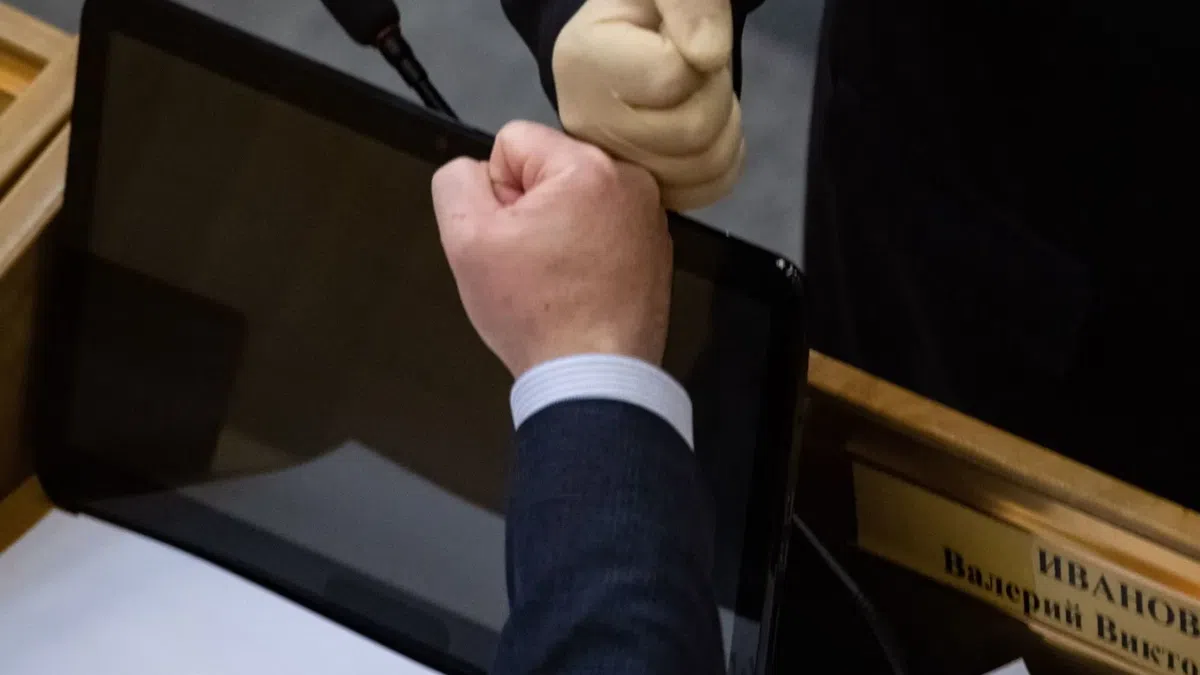
The State Duma on February 10, in the third, final reading, adopted three prohibitive bills at once - on the tightening of punishments for violations when organizing rallies, on deprivation of freedom up to 15 years for “declining to use drugs” on the Internet, as well as multimillion -end penalties for non -fulfillment by operators of the regulations of the Law on the “sovereign Internet”. How new laws will work and why the authorities are needed, the “new” asked experts.
Balance the norm
The State Duma in the third reading adopted a bill tightening the punishment for violations in the organization of rallies .
The draft amendments to the Code of Administrative Offenses at the end of November last year was proposed by Dmitry Vyatkin deputy Dmitry Vyatkin. Amendments are made in Art. 20.2 (“Violation of the established procedure for the organization, holding a meeting, rally”) and 19.3 (“Disocation of the legal order of a police officer”) are the most popular articles for Russian courts when it is necessary to punish the protesters. The day before, the deputies finally voted in order to raise fines for disobeying the police officer to four thousand rubles, and for repeated violations - up to 20 thousand rubles. According to the old norm, only 500 to a thousand rubles can be recovered for this.
The document establishes liability for violation of the procedure for financing public shares. If the state finds flaws in the collection of money for a rally, then the “violator” will have to pay a fine of 10 thousand (individuals) to 200 thousand rubles (legal entity). Vyatkin also proposed to introduce responsibility for transferring money to rallies for those who do not have the right to do this - the fine in this case varies from 10 to 100 thousand rubles. Individuals on this point can be fined from 10 to 15 thousand rubles, legal - from 50 to 100 thousand rubles.

The tightening of legislation on public events takes place before the elections or, following the results of mass protests, recalls political scientist Ekaterina Shulman . “We saw the tightening of the first type at the very beginning of the VI convocation, in 2012-2014. This is the basis of our current legislation on meetings. By 2014, the frame of repressive legislation has already been built. Then there were the most radical toughening of the Code of Administrative Offenses and the law on mass events, as well as changes in the Criminal Code. After that, everything went along the line of clarification and point twisting, ”the political scientist says, adding that the lawmaking machine works slowly and“ reacts not to what happened yesterday, but to what was the day before yesterday. ”
According to Schulman, there are no procedural innovations in the bill Vyatkin. “The Code of Administrative Offenses remains the main repressive document, fines remain the main repressive tool inside it. The term of administrative arrest is not increasing.
The idea is mainly fined is the main repressive technology of recent years.
It applies to the Code of Administrative Offenses, and, to a lesser extent, the Criminal Code. A variety of partial decriminalization of articles of the Criminal Code look in the same direction. The first cases of any violations are persecuted under the Administrative Code, and then it is most likely fines or administrative arrest. Repeated - the Criminal Code, there is a deprivation of liberty. ”
Daniil Berman’s lawyer Daniil Berman , who during the latest protests represented the interests of detained shares, shared in a conversation with the “New Gazeta” that the next tightening of norms regarding rallies was surprising, because “everything is already tightened to the last opportunity.” In his opinion, in regulatory acts there is “terrible unbalancing”: “Why doesn’t increase the punishment for violence, and is constantly growing for public events? If we compare the fines and the amount of sanctions for violation of the rules for public events with other offenses, we can be surprised that completely different punishments are imposed for more serious offenses that are incommensurable with those that exist for rallies, ”Berman expressed the opinion.
People have the right to peacefully express their opinion on the socio-political situation in accordance with Art. 31 of the Constitution, recalls the lawyer. However, according to him, “the state demonstrates the absolute absence of tolerance in the desire of people for a peaceful protest”: “And so far the state has not proved that the shares violate public order.
Twisting the nuts more incurred in people the desire to express their opinion. ”
Andrei Kolesnikov, the head of the Russian Internal Policy and Political Institutes of the Moscow Center for Carnegie, believes that the introduction of new repressive norms about rallies is part of one of the constant processes of “toughening”. “Deputies are drawn into the race of bills tightening the situation of civil society. These are their stripes on the sleeves, these are their orders and medals. They must be active. " The political scientist expressed the opinion that this is the “natural logic of the development of the authoritarian regime”, which is partly provoked by electoral campaigns. “I think the process of tightening is inevitable, despite the fact that everything has already been adjusted,” Kolesnikov noted, adding that exotic deputy initiatives often appear, up to “resolving flashlights”.
Cybernarkias
The initiators of the bill on toughening the punishment for “declining to use drugs” on the Internet was a group of deputies from “United Russia” - Natalya Poklonskaya, Vasily Piskarev, Andrei Isaev, Andrei Alshevsky, Irina Belykh, Adalbi Shkhagshev, as well as deputies from the LDPR Vadim Money and Dmitry Saveliev, deputies from the Just Russia Nikolai Nikolai Ryzhak and Alexei Chepa and Parliamentarians from the Communist Party Yuri Sinelshchikov and Rizwan Kurbanov.
Amendments are made in part 2 of Art. 230 of the Criminal Code, which establishes the punishment for "declining" to use drugs and psychotropic substances. Deputies propose to supplement the article with a new qualifying feature-"using information and communication networks, including the Internet." For committing a “crime” under this article will face imprisonment for a term of five to 10 years.
They also want to add a fourth part in the State Duma, which will introduce responsibility for declining to the use of narcotic substances, resulting in the death of two or more persons through negligence. In this case, deputies propose to deprive of freedom for a term of 12 to 15 years.
Director of the Media Protection Center* Galina Arapova noted that
Russian parliamentarians consider the Internet not good, not a tool for progress, but "evil, which must be somehow restrained."
“The whole information policy in the country that we observe is aimed at control over the Internet and to suppress the freedom of expression on the Internet,” she emphasized.
Arapova recalled that in modern society many people use the capabilities of the Internet, including state services. The state simultaneously actively introduces its services on the Internet and tries to establish additional tools for control over it, which, according to the lawyer, is a paradox and a “massive invasion of private life”.
However, the commission of a crime using the Internet cannot be considered an aggravating circumstance, Arapova continues: “The Internet is an ordinary life. The younger generation did not see anything else, it was born when the Internet was already. ”
Director of the Media Protection Center said that
When journalists talk about problems related to drug crime and drugs, "even just raising this issue as socially significant, they still risk."
At the same time, Arapova noted that journalists do not cross the line and are not engaged in drug propaganda or “declension” to use them.
New - fourth - part of Art. 230 of the Criminal Code more concerns those who are engaged in the sale of drugs, “dealers”, the lawyer continues: “I do not believe that the drugs for the sale of drugs (including in the darknet. - _ *Ed. ) _ Are unknown to law enforcement agencies if journalists were able to find them. If the state knows and does nothing - this is a problem that journalists have the right and must raise in their publications. Journalists act as such an alarm, shout that something needs to be done. <...> If part fourth will be applied to drug dealers, because of which people die, <...> then, probably, this is a reasonable tightening of responsibility. On their conscience of death of people. " Any laws that are aimed at tightening drug policy and strengthening criminal repressions are a priori harmful, Timur Madatov, lawyer Andrei Shkov * (is engaged in reducing harm among drug users).
“What is the purpose of the legislation governing a policy in relation to psychoactive substances? To make the life of people and society better. Repressive policy, police regulation measures and a forceful solution to the problem are completely ineffective. ”
The result of increased repression - in places of imprisonment, mostly people who use drugs are sitting, Madatov says.
According to the lawyer, the new bill puts it into a common trend that has existed for a long time: “Recently, we have tightened responsibility for“ propaganda ”, now inadequate terms for“ declension ”have appeared.
Madatov added that the bill is full of vague formulations, and this is the reason for the possible expansion interpretation of the law and arbitrary law enforcement, which does not indicate the high quality of the bill. "What is" declining to use "via the Internet? It is not entirely clear. If the law is accepted, it will be good soil to strengthen house impression, ”the lawyer said.
In addition to the sites in the darknet, on which the market of psychoactive substances is really developed, researchers and lawmakers are gradually starting to pay attention to the so -called drug blogger - people who tell on the Internet about their relations with prohibited substances. And here it is difficult to imagine who the new law can be directed to, Madatov continues. “If we are talking about drug blogger, ordinary users - we already have an article for propaganda, which, by the way, is also extremely harmful. The new bill is already excessive regulation. I have a concern that this is another “trimming article”, the result of which will be that the discussion of drug policy will go underground or it will not be at all. ”
Virtual batons
The authors of the bill on multimillion -dollar fines for non -fulfillment by operators of communication by the provisions of the Law on the “sovereign Internet” were made by the deputies from “United Russia” Alexander Khinshtein and Sergey Boyarsky - they propose to introduce administrative responsibility for violations of the provisions of the Law on the “sovereign Internet”.
The explanatory note states that the lack of punishment in this area "forms the possibility of non -fulfillment of the duties established in relation to them." Operators can provide incomplete information about numbers, network addresses and installation sites connected to foreign communication lines in Roskomnadzor, deputies say.
If the operator violated the rules for the installation and use of equipment necessary for “countering threats to the sustainability of the Russian Internet”, he faces a fine of 15 thousand (for officials) to 500 thousand rubles (for legal entities).
The law prescribes the norms that ensure the operational and vocational work of law enforcement agencies or “ensuring the security of the Russian Federation”-a fine for their violation can reach from three thousand (for officials) to six million rubles (for legal entities).
The amendments also establish punishment for site owners who limit the “free distribution of information in the Russian Federation”. Sanctions for this can reach from 50 thousand rubles (for individuals) to three million rubles (for legal entities). The law on the “sovereign Runet” itself entered into force on November 1, 2019. According to him, Roskomnadzor can determine the rules for routing the traffic of Russian operators through their equipment.
Active law enforcement under many laws regarding Internet regulation has not been going on in Russia for many years, the head of the Roskomsvobod public organization Artem Kozlyuk said: “Non-laws, regulations of government, regulatory documents are not prepared <...> Much cannot be implemented in practice, for example, it takes place with a“ package of Yarova ”, where there are long coordinations, how to certify the networks of the new Generations SORM, how to come up with a compression method in order to store all traffic - science, in principle, has not yet reached this. The same thing is about "sovereign Runet."
Kozlyuk recalled that the exercises on the "insulation of the Runet" have been tolerated more than once. “The new law will not be applied right here and now, but it will be another virtual club over communication operators so that they will connect the equipment that will be imposed on one or another performers faster,” he said.
New laws will burden and punish those who do not fulfill them, continues the goat. He noted that the authorities can provide operators with equipment, but it must be served, support, increase, put software on it, and this all requires large costs. Punishments for non -fulfillment of the law on sovereign Runet are also needed in order to stimulate communication operators to allocate money faster from their budget to install the so -called equipment “for the stability of the Runet and the prevention of threats”, the expert summed up.
According to the head of the Roskomvobod project, there will be a big difference between the real expenses of the operators and the fact that the state will compensate for, and "the state will impose it to compensate for the business itself": "Perhaps they will give concessions to something somewhere, or maybe not."
Kozlyuk said that fines for site owners who limit the “free distribution of information in the Russian Federation” can concern not only, for example, video blocking on YouTube, but also their trends:
“The interpretation can be as wide as possible and is not always connected with moderation, but even simply with force to introduce social networks of one or another person or one or another Gossmi in some special sections.”
The Russian authorities consider censorship to block and non -attachment to the trends of the Gossmi content on the Internet, although this is not censorship, Kozlyuk continues: “This is a moderation on a private portal.” To force such foreign companies, some of which do not even have representative offices in Russia, to cooperation - "stupid, strange, but it will happen." According to the head of Roskomsvoboda, Roskomnadzor will sue and seek multimillion -dollar fines for foreign companies, since the authorities “want to go through financial pressure”: “But we also do not forget about blocking. I won’t be surprised if large social services are included in the register of prohibited sites. ”
*introduced by the Ministry of Justice in the register of organizations performing the function of a foreign agent.