
Translated material
Beer, jealousy, stool
These are synonyms for domestic violence in Russia and the cause of the death of thousands of women. "New" talked with the authors of a revolutionary study of the problem
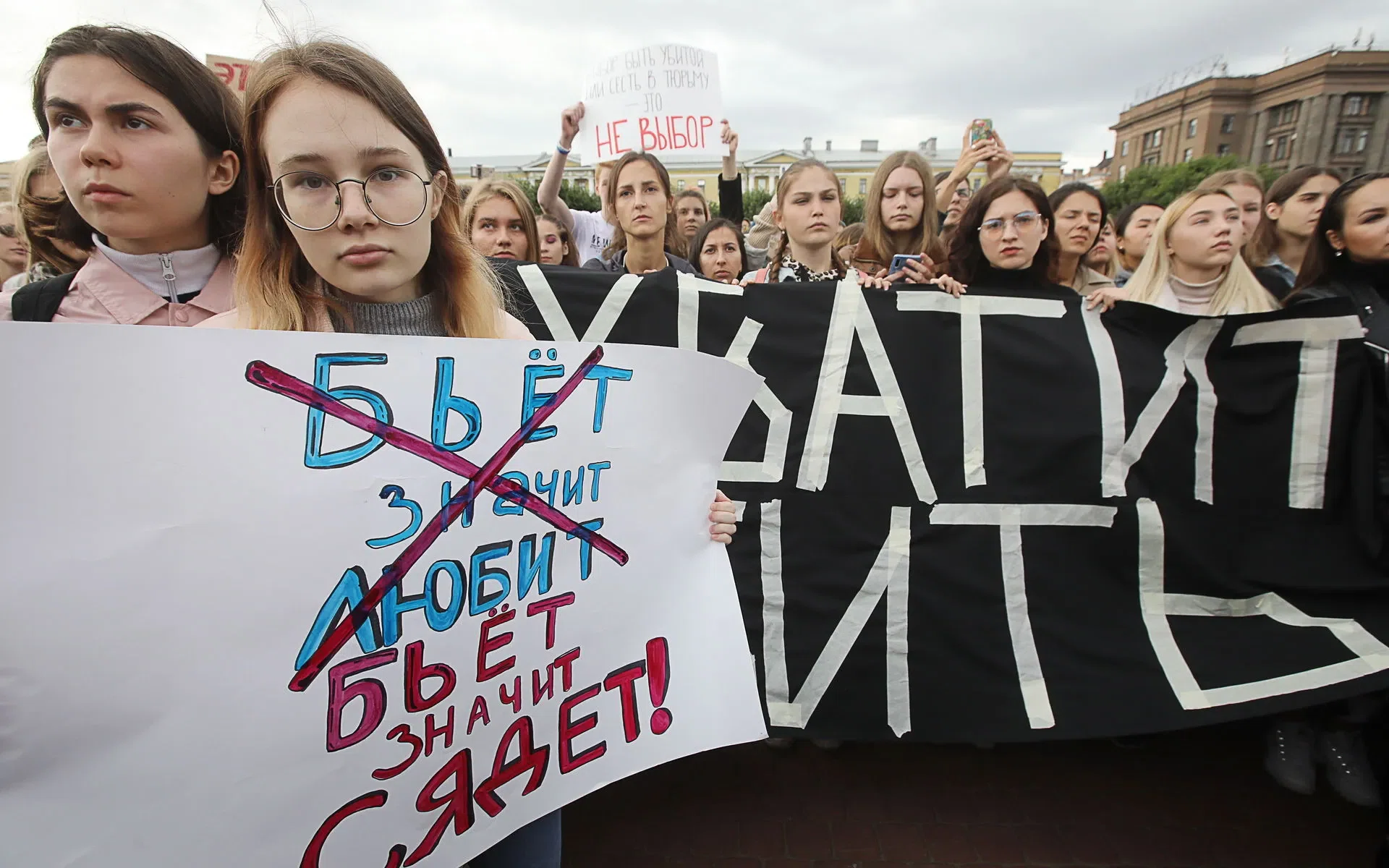
At least two -thirds of the women, whose murders were considered by Russian courts in 2018, became victims of domestic violence - the authors of the new study, employees of the women's NGOs, lawyers and data analysts came to this conclusion. The figures obtained using machine learning algorithms were significantly higher than the affordable official statistics. "New" talked with the authors of the study.
The project, which will be discussed, became the winner of the Khakaton of Novaya Gazeta and the greenhouse of social technologies "Plant-2021". The study was conducted by the team by “a close person to a loved one” (the name is a reference to the cycle of poems by the poet of Lida Yusupova “Sentences”), uniting activists and data analysis specialists.
Employees of female human rights organizations note that there is still no transparent mechanism for collecting and analyzing statistics on victims of crimes and family status. Official figures indicate the total number of women who have become victims of criminal attacks, but how many of them died in close relations is unknown.
“For example, the Ministry of Internal Affairs does not consider the victim of a family-household conflict, who was scored to death or partner,” says Alexander Graf, an employee of the female NGO consortium and the author of the project. “All this gives opponents of tightening legislation in this area to say: yes, women are killed, but family violence has nothing to do with it.”
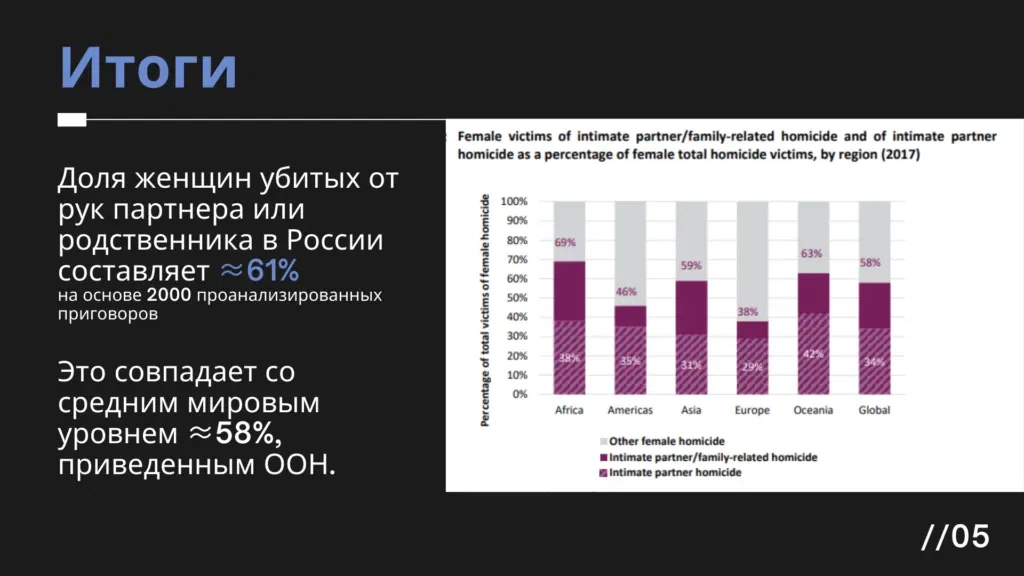
The authors of the new study analyzed the sentences of Russian courts for 2018 for the following crimes: murder (part 1 and 2 of article 105 of the Criminal Code of the Russian Federation), murder in a state of affect (Article 107) and intentional infliction of serious harm to health, which entailed by negligence the death of the victim (part 4 of article 111). The final sample on the murder of women for 2018 was about 2000 sentences. As the analysis of the texts of these court decisions showed, 61% of the total number of women were killed by partners or relatives.
“We hoped to get a percentage similar to the average in the world - this is about 58%,” continues Alexandra Count. - But Russia has never participated in such international research. In fact, we thought that the percentage would be greater. ”
How did it be?
Svetlana Zhuchkova,
Researcher and teacher of data analysis in the Higher School
“We unloaded all sentences available for 2018 from the GAS“ Justice ”system, where, in principle, we are talking about murder - so we have a base of 9,000 texts of court decisions. Of these, those where women became victims were to be taken away. This can be done on the basis of keywords, their cases and birth: for example, “died”, “death of the last”, “death of the victim” ... We compiled a list of such words and automatically filtered the sentence base. It turned out that in 2000 texts we are talking about the murders of women.
At the next stage, this sample was used to assess the share of the victims specifically from domestic violence. How did this happen? We randomly chose about 550 texts and marked them manually: we read the text of the verdict and watched if there was an indication that the killer was a victim in intimate or related relationships. If so, then such a text “1” was marked, if not - “0”. The marked texts have become the basis for the machine learning model. At the entrance, we give her marked texts, and she herself trains to identify such patterns.
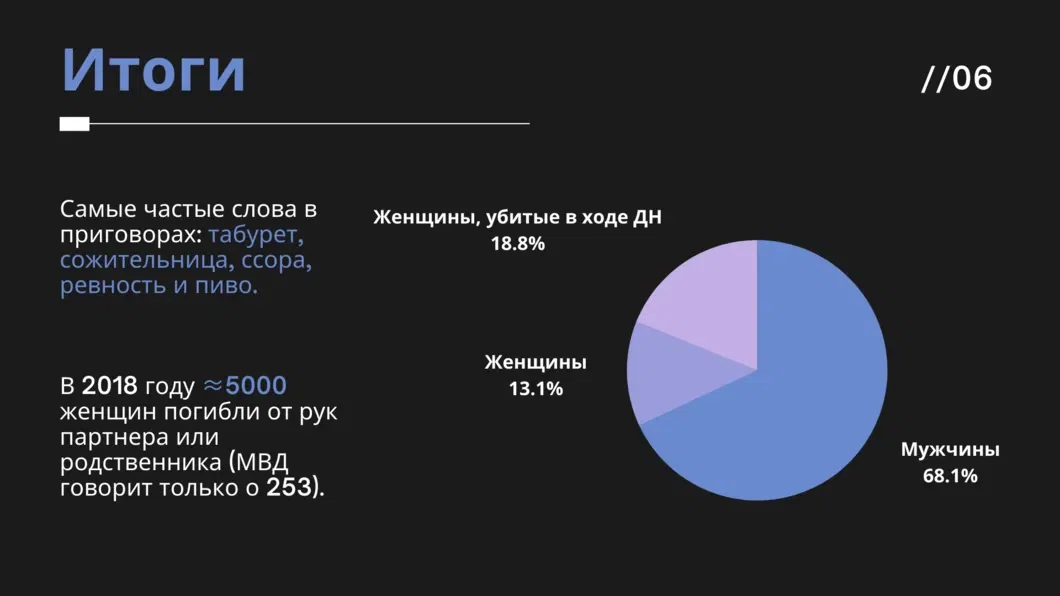
It is important to say that the algorithm builds its forecast, given the entire text as a whole. So, if the word “entrance” met in the text of the court decision, the algorithm takes a step towards the forecast that we are talking about domestic violence. If the word "duty" meets, then the forecast is changing. Such words as “beer”, “apartment”, “jealousy”, “stool” also include the forecast towards domestic violence.
Strictly speaking, out of 2000 texts, the model revealed signs of domestic violence of 75%. But we know that the algorithm tends to make mistakes, so we counted the resulting share with the adjustment and received the final figure - 61%.
What do they write in the sentences?
Sofya Rusova,
Employee of the Center for Protection of Bloody Violence for Women's NGOs Consortium, Journalist
“It is amazing with what ease and simultaneous cruelty killings often occur on the basis (as they write in sentences) of a“ sudden feeling of personal hostility. ” Although in partnerships “hostility” is probably accumulating. For example, when a woman repeatedly asks her partner to leave the apartment or offers to part, but a person clearly does not fulfill this request. At some point, he kills her.
You can separately investigate why people are able to do this. In most cases, it is clear that a person was not prepared and did not plan a crime. For example, a brother hit his sister with a screwdriver in the head and then finishes her with his feet, although according to the final examination, he was not even in a state of affect at that moment. Or the guy kills the girl for asking for cartoons on his phone. Or the husband scores his wife with a log in the yard ... And this is not some marginal stories with drunks, but ordinary average families. You understand how simple it is, and on the other hand, and on the other, how many such cases are.
From some sentences, I got the impression that the judge and investigative organs clearly sympathize with the person on the bench of the defendants. When you have a corpse for four days in the couch, then you dig it in the forest, and after eight days the police delay you - this is called "a confession." Another example: a guy and a girl were rode in a car, they supposedly had voluntary sex, and then he strangled her as a result of a quarrel. The verdict says that numerous bruises and bruises were discovered on the girl’s body, the explanation could not give the explanation. So, maybe sex was still not voluntary? But the investigation does not raise such questions at all.
Of the several hundred such stories, there was only one when a person really realized that he had committed a terrible act and tried to fix something. For the most part, the texts of court decisions show the extremely indifferent attitude of the accused to a dying person nearby. In one of the sentences, a woman lies with a knife wound and asks to call an ambulance, and her husband leaves to sleep.
How much is it in people?
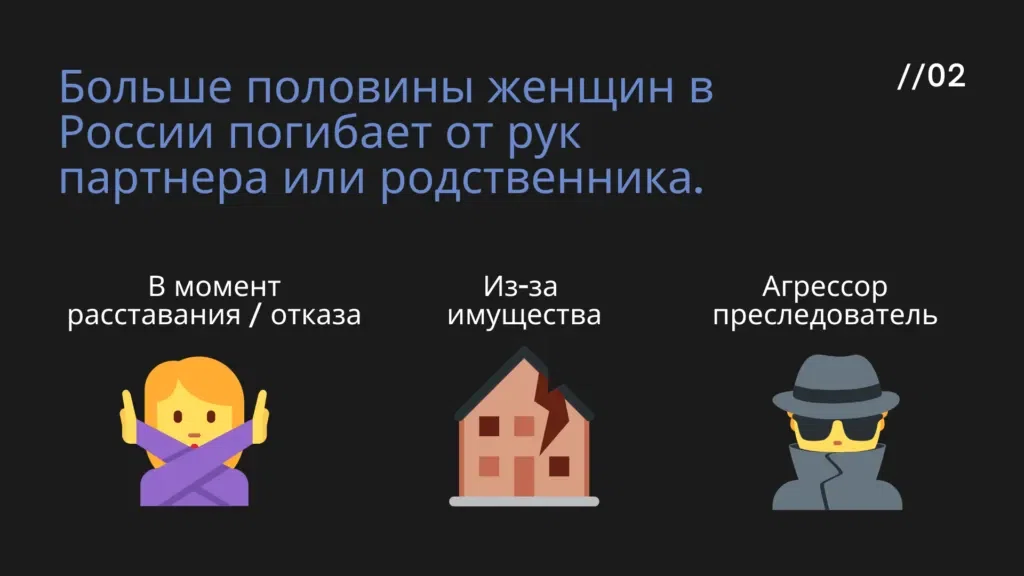
In their study, team members refer to the data of Rosstat and statistics of the Ministry of Internal Affairs. In the first case, the department calls the total number of killed women in 2018 - 8300. Thus, 5,000 women could become victims of domestic violence (the very 61%). At the same time, the Ministry of Internal Affairs calls the victims from family-household conflicts in 2018 only 253 women. How to explain such a difference in the numbers obtained?
“In fact, now we have no answer to this question,” says the lawyer, member of the team of Marie Davtyan. - We do not know the methodology of calculating the Ministry of Internal Affairs. Moreover, one of the requests of researchers from St. Petersburg State University to the Ministry of Internal Affairs replied that there are simply no methods. It turns out that in our country, in principle, there is no normal reliable statistics. ”
Now, when the researchers have an algorithm trained on court sentences at the disposal, the team “close to a loved one” intends to continue the work that has begun on Hakaton.
“When human rights activists previously published their statistics, they told us that it is irrelevant, because it takes into account only those women who are being addressed to us,” says Alexandra Graf. - Now we have a specific method that can be used at least every year. But the most important thing is that our project revealed to most people a view of the real “statistical cloak” on this topic. ”
The team is a “close face of a loved one”: Marie Davtyan, Alexandra Count, ____ofya Rusova, __c__tlna Zhuchkova, Mikhail Timoshatov, Alisa Kustikova (team curator).