
Translated material
“I am a witness!” Who helps police officers falsify criminal cases for drugs?

 Illustration: Natalya Yamshchikova
“I am a witness!” Who helps police officers falsify criminal cases for drugs?
Journalists from “Important Stories” and “Medusa” found more than 140 “regular” witnesses who testified in Moscow courts on “narcotics” charges. These are acquaintances of police officers or those who are dependent on them. Despite the gross violation of the law, judges sent hundreds of people to jail.
In May 2018, 35-year-old Natalia Goloborodko contacted the drug control department of the Internal Affairs Directorate for the Western Administrative District (ZAO) to “expose a trafficker of prohibited substances.” The police decided to conduct a “test purchase”: Goloborodko was offered to buy the substance from a dealer under the supervision of operatives. She agreed. The police found two witnesses, and together they went to the house of the unemployed Nikolai Grigoriev, the same “salesman.” As soon as the deal took place, operatives detained the seller. At the police station, money allegedly received from Goloborodko for drugs was seized from Grigoriev, and MDMA, amphetamine and hashish were found in his apartment, again in the presence of witnesses. Nikolai Grigoriev was accused of two counts of drug sales and one attempted sale. During the preliminary investigation, he confessed to everything.
But in court, Grigoriev did not admit guilt and explained that he testified under pressure from the police, and Goloborodko slandered him. He said that he knew her, but did not sell her amphetamine. The money that the police allegedly gave to Goloborodko to buy drugs, having previously copied the serial numbers of the bills, according to Grigoriev, was planted on him by operatives. Nikolai’s mother and sister said in court that they “did not assume that he was involved in selling drugs.” The only eyewitnesses to the crime were police officers, witnesses and buyer Natalia Goloborodko. On August 1, 2019, the Kuntsevsky District Court found Nikolai Grigoriev guilty and sentenced him to 11 years in a maximum security colony.
Before the sentencing, Grigoriev was transported in a paddy wagon along with other defendants. Among them, he recognized a dark-haired man - a witness who, during that same “test purchase,” was supposed to act as an independent observer, monitor the actions of police officers, and make sure that no one planted anything on the suspect. He turned out to be 38-year-old Mikhail Rakhmankin, who at that time had already been convicted twice for selling drugs on a large and significant scale.
Grigoriev realized that the witness in his case was a fake. Subsequently, he sat with him in the same pre-trial detention center and was also awaiting trial.
As an investigation by “Important Stories” and “Medusa” showed, Grigoriev’s case is a drop in the ocean of falsification of criminal cases under “narcotic” articles. We analyzed tens of thousands of sentences passed in Moscow and found more than 140 “regular” witnesses - familiar operatives, drug addicts or people with previous convictions. Police officers used these people to fabricate criminal cases. Subsequently, despite the protests of lawyers, judges sent hundreds of defendants in these cases to prison for many years.
“Forced to help imprison innocent people”
“When Grigoriev told me that he had met an attesting witness in his case in a paddy wagon, I began to look through all the names of the attesting witnesses in the Moscow City Court database. And it turned out that the previously convicted Mikhail Rakhmankin himself is now under investigation for the illegal sale of drugs on a large scale. As did the second witness. How can they be independent? - Grigoriev’s lawyer Andrei Tolstykh tells reporters.
Mikhail Rakhmankin was not only convicted twice: a month before Grigoriev’s arrest, he acted as a buyer in another case. He is currently serving a sentence in prison for drug trafficking. According to Ekaterina Selivanova from the Andrei Rylkov Foundation for the Promotion of Health and Social Justice, where the detainee Mikhail Rakhmankin turned for protection, evidence of his guilt was the testimony of police officers and a drug buyer detained the day before, as well as video footage from a camera near the metro. Rakhmankin and the defense insisted that it was impossible to identify anyone in the recording, but in court one of the police officers said that he recognized Rakhmankin in the video after checking the image with a photocopy of his passport.
“I know that he contacted the Department of Internal Security [Moscow City Internal Affairs Directorate], tried to cooperate with them, said that he had something to tell about the employees of the Department of Internal Affairs in the ZAO. He hoped that they [the CSS] would be able to somehow influence his case and he would be given a shorter sentence. But this did not happen, he received 11 years,” said Ekaterina Selivanova.
The second witness in the case, Dmitry Chuprin, also served as a buyer and witness in other cases under “narcotic” charges, and after participating in the Grigoriev case, he was himself detained by the same police officers. They found amphetamine in his hood: allegedly Chuprin himself “put” it there “for the purpose of personal use.”
Another witness, Hakob Khachatryan, told the court that on the night when Grigoriev was detained, he was at a gas station in the Moscow region. There, police officers approached him and asked him to go with them to the area of the Simferopol highway, so that in the forest belt, together with operatives and the suspect Grigoriev himself, look for “stashes” ( stashes of drugs that dealers leave for buyers . - Ed. ), which he allegedly laid for the purpose of sale. Khachatryan did not refuse the police, although he was actually going to a friend’s birthday party. He told “Important Stories” that he agreed to become a witness “due to his upbringing,” since he “studied at the Russian Academy of Civil Service” and for him “it was something akin to duty.” When asked if Khachatryan was already familiar with the police, he replied that he was not.

But, judging by the text of the verdict in another case, a week before the incident at the gas station, Khachatryan had already met with the same operatives. His testimony states that he passed by the Internal Affairs Directorate of the Joint Administrative District, where police officers approached him and asked him to be a witness during the search of the apartment and the personal search of the detainee. Khachatryan agreed. Six months later, he acted as a witness at least twice more—on November 1st and 3rd, 2018. The same operatives of the Internal Affairs Directorate for the Closed Joint-Stock Company worked on cases involving Khachatryan as a witness: Maxim Umetbaev, Egor Farmanin, Denis Konovalov and Akbar Sergaliev. When asked by journalists how Khachatryan, working with the same police officers, could not know them, he did not answer.
The buyer from the Grigoriev case, Natalia Goloborodko, with whose voluntary statement it all supposedly started, on the contrary, did not hide her acquaintance with the police officers. According to the version that she outlined in a statement to the Internal Security Department of the Moscow Main Internal Affairs Directorate, on May 19, 2018, at half past seven in the evening, Natalia was beaten near her house, and then dragged to her car by two police officers, one of them was Yegor Farmanin. In the car they allowed her to make one call. Natalia called her friend - another detective, Maxim Umetbaev. According to Goloborodko, he drove up to the place, talked with Farmanin for 10 minutes and took her to the Department of Internal Affairs in the Kuntsevo district. There they found amphetamine in her purse.


“The criminal investigation officers, taking advantage of the fact that the article and the threat of imprisonment were hanging over me, began to persuade me to assist them and cooperate with them. They told me directly that if I refused, I would be imprisoned, and if I agreed, I would remain free. <...> I agreed. Maxim Umetbaev was in charge of all this. He told me that I should testify against Nikolai Grigoriev, and also help in some other matter. I agreed because I have a child, a minor son,” Goloborodko wrote in a statement.
According to her, the police “fabricated all the materials regarding Grigoriev.” “I understand that if I do not report the criminal actions of employees of the Internal Affairs Directorate in the closed joint-stock company, I will be forced to ‘help’ them put innocent people in prison,” wrote Goloborodko.
Already during the appeal, Grigoriev’s lawyer Andrei Tolstykh drew the court’s attention to the fact that Goloborodko was a provocateur, and the witnesses Rakhmankin and Chuprin were informants for operatives. “We weren’t even allowed to question Rakhmankin in court. I assume that he was more categorical and could have said something wrong. The judge cynically told us to our faces: “Find for yourself where he is and ensure his appearance.” I again went to the court’s website and saw that the same judge extended Rakhmankin’s period of detention literally on the eve of our hearing. And now he’s inviting us to look for him ourselves,” says the lawyer.
Support those who are not afraid to tell the truth about the work of Russian courts and police. Your donation will help us continue to write about violations of the law.Support “Important Stories”The judge of the first instance, Sergei Astakhov, considered that “the defense’s opinion that witnesses who were dependent on the police officers participated in the personal search is not supported by anything.” And when Grigoriev’s case was considered in the court of appeal, operative Umetbaev and four other employees of the Internal Affairs Directorate for the closed joint-stock company were already suspended from work - because of the accusation in falsifying the case of Meduza journalist Ivan Golunov. As a result, Grigoriev was acquitted on appeal in two out of three cases. Instead of 11 years in a maximum security colony, which he was threatened with for selling drugs, Grigoriev was sentenced to six years and six months. Lawyer Andrei Tolstykh does not rule out that the court could reconsider the decision because of the high-profile Golunov case.
“If I act as an attesting witness, the police will thank me”
On June 6, 2019, a year after the detention of Nikolai Grigoriev, employees of the Internal Affairs Directorate for ZAO Igor Lyakhovets and his former subordinates Maxim Umetbaev, Roman Feofanov, Denis Konovalov and Akbar Sergaliev detained Meduza journalist Ivan Golunov. Drugs were planted in his backpack and then in his apartment. The witnesses who were present during operational search activities (OPM) did not see any violations.
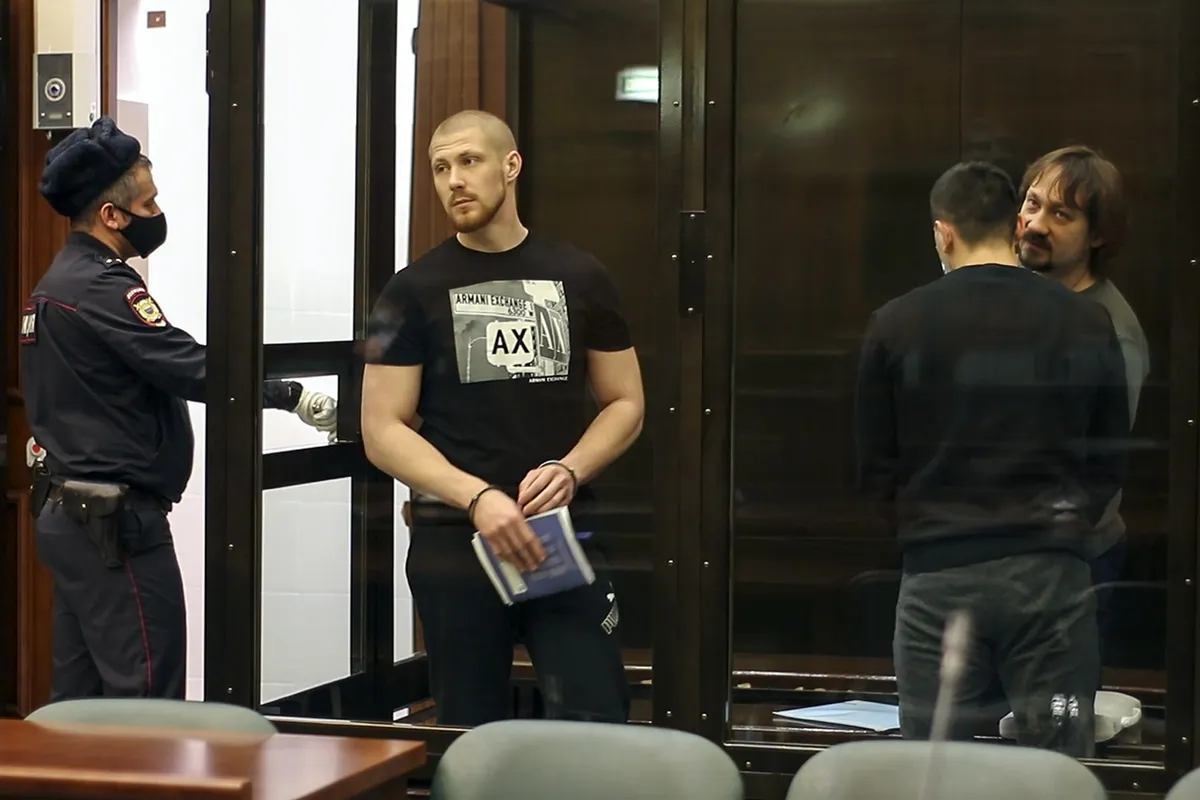
During the first interrogation, the witness Sergei Kuznetsov, who observed the arrest, said that he ended up “at the crime scene” by accident: he just came for a walk in the center of Moscow. But during subsequent interrogations, Kuznetsov gave different testimony. According to him, on June 6, drug control officer Yegor Farmanin, who previously worked as a district police officer at his place of residence, called him and asked to be a witness. “Egor explained that if I act as an attesting witness and spend my time, the police officers will ‘thank me’. The exact amount was not specified. Then, within half an hour, one of the employees called me on my mobile phone and said that I needed to go to the Tsvetnoy Boulevard metro station,” says the interrogation report of Kuznetsov. Already in court, Kuznetsov said that the police gave him “from one and a half to two thousand” rubles for a taxi.
Sergei Kuznetsov is 25 years old. He grew up in a large family and works as a mechanic at Mosvodostok. According to him, he met operative Farmanin five or six years ago. “I have a brother who was visited by an employee from the juvenile affairs commission. On one of the visits, the employee was with Yegor [Farmanin]. He came to check on our family, since my brother and I were registered. Egor then worked at the Maryino police station. After that, Egor called me several times and asked me to participate as a witness during events held by other employees. There were cases when police officers called me a taxi at their own expense.”

Operative Maxim Umetbaev subsequently also admitted during interrogation that he previously knew Kuznetsov. According to him, Kuznetsov took part in the cases that Umetbaev and his colleagues were involved in.
Because of the detention of Ivan Golunov, a large-scale public campaign began: people picketed the Ministry of Internal Affairs building on Petrovka, journalists and activists demanded his release. Reporters from the Dozhd TV channel came to witness Kuznetsov’s home and asked through the door if he knew the operatives. In response, he threatened to call the police.
According to the case file, after the journalists’ visit, Sergei Kuznetsov tried to call operative Farmanin four times. And immediately after that, for some reason, Hakob Khachatryan called him back - the same witness from the Grigoriev case, who answered the “Important Stories” journalists that he was a witness only out of a sense of duty and was not familiar with the police officers. When asked why he called the witness Kuznetsov, Khachatryan said that “this is some kind of misunderstanding” and asked not to bother him anymore. In applications that show how the phone number is recorded for other people, Akop Khachatryan’s phone number is listed as “Akop GNK” ( probably meaning the Main Directorate for Drug Control under the Ministry of Internal Affairs . - Ed. ), “GNK Black Armenian Kemerovo” and “Hakop Oper”.
On June 11, 2019, five days after his arrest, Ivan Golunov was released. The head of the Ministry of Internal Affairs, Vladimir Kolokoltsev, said that the case against him was dropped. And already on June 20, when Vladimir Putin was asked a question about the journalist’s case during his annual direct line, the president replied : “We need to establish control over the activities of law enforcement agencies so that there are no offenses on their part. So that for the sake of reporting and for the sake of “daws” people are not sent to prison. So that there are no cases like the one with the journalist you mentioned.”
It turns out that the only witnesses in the case of Ivan Golunov, as in the case of Nikolai Grigoriev, were operatives and witnesses dependent on them. Golunov discovered that the use of so-called “regular” witnesses is a common practice for the Internal Affairs Directorate in the ZAO.
Our investigation proves that the scope of this problem is not limited to ATC. The police do not care about the direct orders of the president in almost every district of Moscow: they everywhere use people who are dependent on them or simply acquaintances as witnesses.
How we looked for “regular” witnesses
To find suspicious witnesses, it was necessary to find their names in the texts of sentences or resolutions, and then see if they were found in other cases. Moscow courts make most of the texts of sentences, rulings and decisions publicly available on the Moscow City Court website. Journalists from “Important Stories” downloaded 56,860 documents from there for the entire time under 12 so-called narcotic articles of the criminal code: 228, 228.1, 228.2, 228.3, 228.4, 229, 229.1, 230, 231, 232, 233, 234.
The texts of verdicts and resolutions usually include testimony from witnesses, buyers and police officers. Or at least the names of people and their roles are mentioned - if the case was not considered in a special order ( If the defendant fully admits guilt, he can apply for the case to be considered in a special order, that is, without studying the evidence in court. - Ed. ). Also, in most cases, secretaries replace names in the text with Full Name, Full Name1, Full Name2, etc. But not always.
Journalists found 142 “regular” witnesses in the verdicts of Moscow courts (the verdicts were passed on “narcotic” charges)In cases where names were preserved, we extracted them from the texts using programming and found first and last names that appear in documents for various cases. In our Workshop we explained how you can extract names from texts using Python. Such cases indicate that a person participated in various processes in one way or another - all that remained was to understand in what role. Open lists of judges, secretaries, lawyers, prosecutors and their assistants helped us immediately exclude them from the sample. Journalists from “Important Stories” and “Medusa” studied the remaining names manually for three months: they read documents, wrote down dates, areas, circumstances, courts, police departments and their employees, investigators, prosecutors, lawyers and judges. And then they looked for these witnesses and studied their connections with the police officers.
We managed to find 142 people whom the police brought in as supposedly independent witnesses. In fact, these people were witnesses and buyers several times, they could have been convicted under the same “narcotic” articles, be under investigation or suffer from drug addiction.
To ensure that such witnesses are no longer involved by police officers in operational search activities, in addition to this text, we publish a complete list of all suspicious witnesses we have found.
“Do you count how many times per minute you breathe?”
A record number of “regular” witnesses - 18 people - turned out to be connected with the Internal Affairs Directorate for the Joint Administrative District, whose employees detained journalist Ivan Golunov, and before that Nikolai Grigoriev. Immediately after the Golunov case, President Vladimir Putin dismissed the head of the Internal Affairs Directorate Andrei Puchkov, and five of his former subordinates are now being tried for abuse of power, fabrication of evidence in a criminal case and illegal possession of drugs.
In second place is the Internal Affairs Directorate for the Eastern Administrative District (VAO): there, 13 witnesses took part in operational search activities of the same employees more than once or were convicted. If you understand how and in what cases these witnesses were involved, it turns out that almost all of them, like an acting troupe, took turns working on investigative activities together with employees of the Internal Affairs Directorate for the Eastern Administrative District. For example, Oleg Kokorev, judging by the texts of sentences and appeal decisions, was a witness four times, a buyer twice, and was once suspended for three years for purchasing and storing drugs on a large scale.
Kokorev at least three times crossed paths with other “regular” witnesses in various cases conducted by the Internal Affairs Directorate for the Eastern Administrative District. In one case - with Pavel Ilyin, who shortly before this he himself received a year of probation for illegal acquisition and possession of drugs in a significant amount. In another - with two witnesses at once: Victoria Molokanova and Alexey Khrenov. The latter can be seen among the witnesses in the record-breaking case: in it we found four witnesses at once, who were not the first to take part in operational search activities or who themselves had been convicted of “narcotics” charges. Two witnesses from this case crossed paths with each other on at least one other occasion. It turns out that at least seven witnesses were connected to each other in four cases that were handled by the same police officers. Internal Affairs Directorate operative for the Eastern Administrative District Evgeny Matitsyn was involved in three of four of these cases, Alexey Mazin and Vitaly Belikin in two. Important Stories was unable to contact them.
The defendants in these four cases were soon sentenced by Moscow judges to 8–12 years in prison.
Before the responsibility to investigate drug cases was transferred to the Internal Affairs Directorate, this was handled by special services in the districts under the Moscow Directorate of the Federal Drug Control Service ( Federal Service of the Russian Federation for Drug Control. The agency was disbanded in 2016, and is now replaced by the Main Directorate for Drug Control of the Ministry of Internal Affairs of the Russian Federation. - Ed. ). In the Service for the VAO UFSKN, we counted five “regular” witnesses. For example, the same Oleg Kokorev participated in cases that this service also investigated. The other four also crossed paths with each other on various matters.
Almost all witnesses refused to talk to journalists. Having learned what the material was being prepared about, they, as a rule, no longer responded. Some briefly explained that they “don’t want to get into this anymore.” But Ilya Orel, who was a witness at least six times at the request of employees of the Service for the Eastern Administrative District of the Federal Drug Control Service and the Internal Affairs Directorate for the Eastern Administrative District, nevertheless agreed to talk with journalists.
Unlike many other witnesses, Ilya never had a criminal record. He is 30 years old, judging by his profile on VKontakte, he graduated from the Moscow Polytechnic University and worked there as a technician in the protocol department, and was a member of the youth political movement “Nashi”, created by the Administration of the President of Russia.

In the two cases in which Ilya Orel was involved, the composition of the operatives, the prosecutor and the judge, completely coincided. Two more cases with his participation, which were conducted by the same operatives, were considered by the Perovsky District Court on the same day. According to Orel himself, he was a witness even more than six times - and not only in “drug” cases, but also, for example, when “they detained a person in a state of intoxication”:
- How many times have you been a witness?
- I don’t think for sure. Do you count how many times you breathe per minute?
- No, but it's not exactly the same thing.
- What do you mean, not the same thing? Some life matters that envelop you every day - most people do not consider them.
— So you act as a witness every day?
- Not like every day. I don’t count this figure, I don’t worry about it.
Also in a conversation with Important Stories, Orel claimed that every meeting with police officers occurred by chance:
- Well, this is reasonable when you live or have some business near the police station.
- So you just live next to the police station and that’s how it turns out?
- At some points - yes, at some points - I went on business. I live, study, work - I always have a police station nearby.
According to Ilya Orel, he does not personally know any of the operatives. For him, “a police officer is just a police officer.”
Judging only by court documents, then even more often Orel acted as a witness in Moscow and the region by Jacob Cherny. Seven times he participated in the operational investigation of employees of the Internal Affairs Directorate for the North-Western Administrative District (NWAD), the Service for the North-Western Administrative District of the Federal Drug Control Service, and the Service for the North-Western Administrative District and the city of Zelenograd of the Federal Drug Control Service. In total, we found 22 “regular” witnesses at these departments in the North-Western Administrative District.
Subscribe to the "Important Stories" newsletter Be the first to know about our investigationsIn four cases, Yakob Cherny “worked” in tandem with witness Alexey Sukhoparov. They participated together in the same operational search activities.
In 2016, at one of the court hearings on the “drug” case, Cherny directly told the Butyrsky District Court that he had been a witness more than once, and the defense drew attention to this. But then the judge considered that “the participation of the said witness as a witness during other procedural actions with the participation of FSKN officers cannot indicate that he gave testimony that did not correspond to the factual circumstances, as well as that he is a person interested in the outcome of the resolution of the case.” The defendant was found guilty and sentenced to 11 years in prison.
A year later, the case was returned by cassation to the first instance and was considered again by a different judge. This time, Cherny’s testimony stated that “previously, police officers V.V. Gaidukov and F.N. Gorchakov were not familiar to him.” Although, as follows from the texts of the verdicts, at that time he was a witness at their request at least three times. One of the policemen, Gorchakov F.N., even testified that “during the inspection of the buyer, a witness familiar to him, Cherny Ya.A., participated, who shows reasonable initiative and provides free assistance in exposing persons selling drugs. Previously, Cherny Ya. A. participated in 2-3 similar purchases.” These contradictions in the testimony of the operative and the witness did not confuse the judge. The defendant was nevertheless sentenced to 10 years and 9 months in prison. A year later, Cherny again testified as a witness - in a different case, but at a hearing with the same judge.
At the time of publication, the press service of the Main Directorate of the Ministry of Internal Affairs of Russia did not respond to journalists’ requests.
“And the judge hears it all”
As a rule, lawyers draw the court's attention to suspicious witnesses. Nikolai Grigoriev’s lawyer Andrei Tolstykh also tried to do this: “The judge, by his silence, allows the case to be made even worse next time. I said in court that it’s only a matter of time before this becomes a huge problem.”
The lawyers did not remain silent in the record-breaking case for the number of “regular” witnesses, which was handled by employees from the Internal Affairs Directorate for the Eastern Administrative District. In this case, in 2016, five people accused of illegal sale of psychotropic substances by an organized group received 10 to 12 years in prison each. At the same time, at least four witnesses in the case were already involved by employees of the Internal Affairs Directorate for the Eastern Administrative District as witnesses or were convicted under “narcotic” articles. The buyer also had a previous conviction and collaborated with the police on “test purchases” several times. Another witness said during the trial that he didn’t remember anything because he was under the influence of drugs.
All the lawyers tried to draw attention to this, says Vitaly Sych, the defense lawyer of one of the defendants, Manuchar Atayan, who, according to investigators, was the organizer of the criminal group.
Lawyer and former investigator VitalyOwl
 “In my practice, such situations sometimes reached the point of absurdity. The person was asked: “Well, how could you attend this examination if 10 minutes ago you were present at another examination at the other end of Moscow?” And the judge hears it all. But apart from the fact that all this is voiced, nothing else happens. The court accepts such witnesses.”
“We reported that the witnesses are familiar with the investigator, that they may depend on the investigator in other cases. They told the judge that the witnesses were already at his hearings on other cases,” recalls Sych. — As a rule, the court answered that this was not relevant to the case. In my practice, such situations sometimes reached the point of absurdity. The person was asked: “Well, how could you attend this examination if 10 minutes ago you were present at another examination at the other end of Moscow?” And the judge hears it all. But apart from the fact that all this is voiced, nothing else happens. The court accepts such witnesses.”
As a rule, whenever lawyers point out that the witnesses were in a state of drug intoxication, were working on the instructions of the operatives, or had been detained by them the day before, the judge declares that the defense’s opinion is not supported by anything and there is no reason to doubt the testimony of the witnesses. At the same time, the judges themselves often meet the same witnesses at their meetings.
Even in the small volume of court documents where the names of witnesses and purchasers were preserved in the text, we found at least 38 cases when judges saw witnesses not for the first time, but did not react to this in any way.
Most often (according to court verdicts, at least 11 times), Judge Anton Filatov of the Nagatinsky District Court accepted the testimony of “regular” witnesses and then issued a guilty verdict. Thus, Judge Filatov saw attesting witness A.O. Cherkasov at the hearing at least three times. In two cases, Cherkasov was a witness for the same operatives of the Russian Department of Internal Affairs in the Tsaritsyno region. The texts of the verdicts had the same wording: “the guilt of the defendant is confirmed <...> by the testimony of witness A. O. Cherkasov, who about his participation as a witness <...>, gave testimony similar to the testimony of witness [name of the operative officer].”
In the same two cases, together with Cherkasov, another witness, E. S. Degtereva, participated. In one case, she, like Cherkasov, gave “testimony similar to that of [name of the operative officer].”
In the Simonovsky District Court, several judges at once could see the same witness at their hearings in different cases: Alexey Gumbatov appeared in at least six “drug” cases as a buyer or witness. Judges Svetlana Tumanina and Natalia Repnikova saw him at least twice each. The latter is known in connection with the decision to replace Alexei Navalny’s suspended sentence with a real one in the “Yves Rocher case.”
Already in the appeal in one of the cases involving Gumbatov, the defense indicated in its statement that not only Gumbatov, but also the second witness, “who repeatedly took part in operational search activities carried out by police officers, illegally participated in investigative actions as witnesses.” The court decided that the reliability of the testimony of these witnesses and the police officers is not in doubt, since they are “consistent with each other.”
The Simonovsky District Court did not respond to the request from Important Stories. The Nagatinsky District Court told us that “the assessment of the information provided by the witness is given by the court in conjunction with all the evidence in the criminal case, taking into account the rules for assessing evidence established by the Code of Criminal Procedure of the Russian Federation.”
 Illustration: Natalya Yamshchikova
“Have you run out of drug addicts in your area?”
“Regular” witnesses in drug cases are attracted not only by Moscow operatives - this can be called an all-Russian practice. For example, in Samara, six police officers massively falsified criminal cases over the course of two years. In this they were helped by at least 15 witnesses, most of them convicted under the same “narcotic” articles. In order not to receive another sentence, they signed any protocols at the request of police officers.
Now these witnesses are being tried together with operatives: they are accused of falsifying criminal cases, and the police are also accused of exceeding their official powers. Officially, there are 17 victims in this case so far. But, according to Dmitry Yegoshin, a lawyer for the human rights organization Public Verdict, in reality there could be about a hundred victims. Most of the victims are still serving sentences in colonies, several people have already died.
“The police invited drug addicts they already knew. They assigned roles: you will be a witness, you will also be a witness, and you will be a buyer. Then they detained the citizen, filled out documents, and took him for interrogation. And then the materials went to the investigator. And that’s it - the job is done,” says Yegoshin. — Witnesses said that they were repeatedly detained by these police officers or lived in their area. They said during interrogations: "I am a person dependent on this policeman. I was afraid that if I refused, then there would be a case against me."
Many lawyers are convinced that the institution of witnesses in Russia is a big problem. It needs to be changed, like the entire system of evidence in drug cases.
“Cases are fabricated on the knee: interrogation, examination - and the person sat down. I would like to believe that the “[Samara] case” will help somehow influence this issue,” hopes lawyer Dmitry Yegoshin.
“Witnesses are required at almost every operational event, and finding them is also not so easy,” says lawyer and former investigator Vitaly Sych. “And if an honest employee does not provide a single solved case in a month, then the boss will come to him and remind him of the plan: “Are you running out of drug addicts in the area? You have the most revealing one, or what, my friend? You put two witnesses in the UAZ, and let them ride with you. And look for it!” Therefore, cases of abuse of power are very common here. Operatives who deal with the issue of drug trafficking use their own witnesses: those who were previously detained, for example. As a rule, they attract drug addicts who, for a small dose, are ready to tell that they have been everywhere and seen everything. As they say: "Who is the witness? I am the witness!"
With witnesses who can easily be found and are ready to confirm anything, it is very easy for police officers to falsify criminal cases related to drugs - this is confirmed by many lawyers. Not least thanks to the flexible “regular” witnesses, “narcotic” articles become “popular”: according to the Judicial Department of the Supreme Court of Russia, almost half a million people have been convicted under them over the past five years.
We only talked about how the institution of “regular” witnesses is structured in Moscow. But this scheme is applied throughout the country. If you are a journalist or activist and want to find “regular” witnesses in your region, write to us:
alesya.marohovskaya@istories.media (Alesya Marohovskaya)
ivan.golunov@meduza.io (Ivan Golunov)
Editors: Alexandra Zerkaleva, Roman Anin
Support thosewho is telling the truth! You can become our donor by making a one-time or monthly donation. We want to depend only on you - those who want to know the truth, those who are not afraid to be free. Help us tell you the Stories That Matter.Support Important Stories