
Translated material
Voices all
The phenomenon of the Clubhouse social network is easier than it seems: here people here for the first time in a long time talk to each other humanly
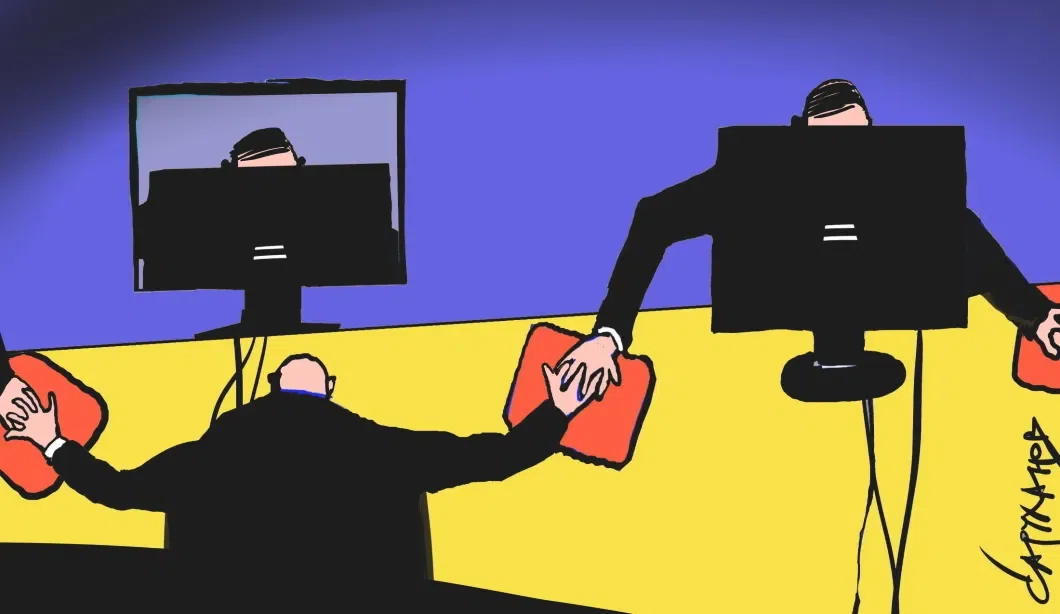
The Clubhouse service (Klabhaus, the “club building” in the direct translation) suddenly escaped at the very tip of the season of the season. In Russia, the number of users of the application increased 20 times in a week. Scientists and figures of show business, entrepreneurs and politicians, journalists and heroes of their investigations - everyone meets and talk in Klabhaus, who, in turn, himself has already become the subject of consideration and discussion both within the service and beyond.
You can get access only by personal invitation, the figures of glamorous crafts began to add the word "clabhausologist" to their business cards. All this is all the more surprising because the service looks very, very simple for a third -party gaze: in it, people talk to people.
Radio, but not radio
“Klabhaus is an“ echo of Moscow ”of a healthy person,” Twitter users write. At the same time, in my application, half a dozen radio, television and printed journalists discuss current political news. Voices are well acquainted, and the texts they pronounced are much more free:
The Sovereign Eye does not follow the conversation in Klabhaus, no one can hear anything offensive by chance, but only from their own choice.
Therefore, journalists say directly and frankly what they think, describe it very simple and somewhat more human words than is accepted on the radio, their sensations and emotions about what is happening.
In the next room, people with diametrically opposite views communicate with the same measure of frankness and seriousness. I quietly look into one or the other room - and gradually understand that they and others say about the same thing: their views and assessments may diverge, and a holistic understanding of the picture of what is happening in Russia is much less. I notice that I am not alone: not only listeners, but also the speakers begin to wander from the room to the room, the conversation becomes more difficult, but does not grow into Swara, as, for example, on Facebook.
It turned out, when two people talk to each other in a living, albeit indirect technology, space, clash of views, is made more productive and less embittered.
This was well noticed by the listeners of the conversation between Louise Vladimirovna Rozova with Andrei Zakharov:
The journalist politely asked if his investigation was the cause of any difficulties in life? And Putin’s likely daughter in a few lightweight, but also courteous manner replied that everything had changed only for the better.
I’m afraid that this can not be imagined not only in textual social services, but even on most radio stations: somewhere they will not call Louise, somewhere Zakharov, somewhere a conversation will not work ... But for some reason it turns out.
Podokasts, but not podokasta
"Arkady, what did you have cultural impressions this week?" - asks the former radio journalist and creator of the answer service to all the questions of Yandex.Q, Tonya Samsonov, the former deputy chairman of the government, and now the chairman of the Skolkovo Foundation Arkady Dvorkovich. Dvorkovich is mumbling something in his elegant manner. “And here I am to you all, and Arkady including, - Hello, Arkash! - Advised an excellent exhibition at the Central House of Sciences. There, completely crushed by the folcom, there is a luxurious kinetic art in Russia, ”the media manager, novelist and poet Demyan Kudryavtsev picked up the topic before wishing everyone good night.
Amazingly, but in the philosophical foundations of technology
Clabhaus is more likely to move backward relative to the general social service industry.
Starting from e -mail and up to numerous Facebook killers, everyone moved to preserve every event and allowing him to endlessly return to it in time. Once for this, the word asynchronism was invented: one participant in the conversation is expressed, and the second is free to answer at any moment.
Then it seemed that, scattered through the time zones, we would better think about every remark, and it is this asynchronousness that would allow you to understand deeper, more slowly, be smarter and filter stupid things. Practice showed the exact opposite: everything that is written can be read incorrectly, everything that is recorded for eternity can be heard incorrectly, the errors are multiplying, resentment is accumulated.
Klabhaus returns the word fleeting - and with it harmlessness. The word again becomes a word - and not a stone in someone else's garden.
Conferences, but not a conference
“And I’ll tell you what,” Oleg Tinkov, a person, a patient, a pelmen and a bank, say with a full mouth. - Russia is a country of opportunities. It is good to live in America, but if you want to really do something, if you want to change something around you, if you dream of achievements, then you have to not leave anywhere, but return and go to us to work. By the way, I can’t hire a million dollars a year for a salary for a salary of a salary in a bank. ” "Oleg Yuryevich, I already send you my resume!" -One of the listeners reacts quickly.
If you look at what Klabhaus’s Russian -language segment is being said, the abundance of discussions of the near -business are the first to catch the eye - they say how to earn their first million dollars, they come up with where to get money for a startup, here is a daily conversation about what will now be with infinitely growing bitcoin.
However, this integrity is deceiving. One has only to go into the room with a clear and clear name, as you find that a free conversation does not quite fit into the framework. For experienced and talented moderators, it is possible to combine topics with a news agenda much wider, and make the conversation itself emotional and honest.
Dating, but not dating
“Good,” says the technological entrepreneur, a multimillion -dollar investor and children's poet Edward Shenderovich, “but can it happen that a person as a three -dimensional creature simply perceives some part of the Torah limited by this three -dimensionality, but in fact there are much more dimensions?” It seems dumbfounded by this formulation of the question, Rabbi Yosef Kherson is silent.
The largest Russian -language community The Dacha allows us to notify about any topic of tens of thousands of listeners, and although Russian -speaking rooms rarely reach a capacity of five thousand people, but this happens more and more often. They discuss absolutely everything: from fashionable manicure to the latest philosophical theories, from the intricacies of Judaism to the most disgusting punctures on dates.
There is no way to exchange notes here, you can only correctly fill the “biography” column and speak out in the communities interesting to you so that you are paid attention to.
Club but not a club
The iPhone trembles with the notifications: “Tina Kandelaki started the room“ What to correct in “Match.”, “Alexander Mamut first went to Clubhouse. Do not want to greet him? ”,“ Slava PTRK and Dmitry Gutov now in the room “Art should be clear to the people?”. Poking a finger: Indeed, the main left-wing theoretician of contemporary art Dmitry Gutov pushes something a couple of hundreds of listeners. “Do you think if the curator wrote something next to the picture, then the viewer understood something that I did not see in the picture?” - asks the artist from Montreal. “Not just something, but exactly what I realized that I had to understand. I, as a representative of a very old tradition that is still from Marx, from Hegel, I believe that the meaning in art should be completely defined, and we must contrast clarity to all this postmodernism! ” - exclaims Gutov. The audience enthusiastically buzzes in response.
Klabhaus is most of all what is called: a club, but not in the sense of night dancing and drinks, but in that original one, which was put into this word Chatsky and Famusov, Pushkin and Griboedov: a place in which anyone who makes sense to meet.
It is funny that the television propagandist Vladimir Solovyov immediately took up the verification of the boundaries of this tolerance: as soon as he entered the club’s space, thousands of its participants reacted almost instantly, telling the administration that they did not want to be with this person in the same club.
The person who invited Solovyov (this is fixed in a personal profile) was expelled from Klabhaus with him.
It is clear that hope is not very strong, but who knows - perhaps this soft, but clear responsibility for itself and its friendship can become the drug that our madly polarized world will heal.
Alexander Gavrilov, especially for "New"