
Translated material
Incomprehensible prophet
In the publishing house "The whole world" the book "Gorbachev. Liberty lesson. " We publish the preface of the compiler and editor of this anniversary collection of a corresponding member of the Russian Academy of Sciences Ruslan Greenberg
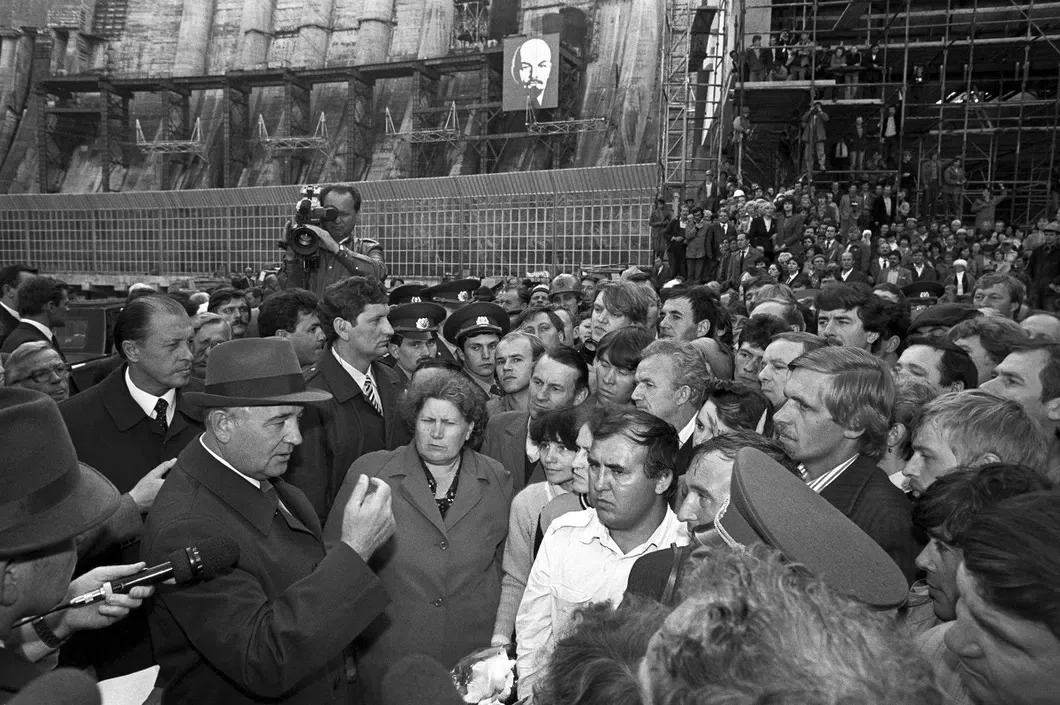
This book is a collection of texts of our contemporaries, famous and simply conscious citizens of the country, written for the 90th anniversary of Mikhail Sergeyevich Gorbachev. On the eve of the event, we asked to speak about the importance of his short rule for the country and the world as participants and eyewitnesses to perestroika, and representatives of subsequent generations interested in the fate of Russia.
Most of the essays presented here were included in the special issue of the World Changes magazine, created with the approval of the initiator of perestroika almost twenty years ago. But to express their point of view wished so many people that we were not able to put all the texts received in the journal. Therefore, it was decided to expand the magazine format to the size of a full -fledged book, including judgments in it and other authors.
The reader will have acquainted with various assessments of Gorbachev’s rule. This is normal and natural. Gorbachev himself took care of this, he gave, in essence, a silent country, famous publicity and pluralism. Everyone has the right to their own judgments, no matter what they, to ours and not only in our opinion, were - true or erroneous. In addition, as one of the greats accurately noted, "there is no flattering praise without freedom."
In this preface, I, as the compiler of the book, consider it appropriate to present my own point of view on the various assessments of Gorbachev’s ideas and acts, as well as indicate the main lessons arising from the practice of perestroika. First of all, I want to emphasize that the conversation about this is not just a discussion about the short final period of life of the USSR, which had gone thirty years ago, which can only be interesting to professional historians. This topic today is not just relevant, it is superior.
Apparently, the current Russia again falls into temptation to look for its future in the past, and in the Stalin past, when the country was “great and prosperous”, until all this began to disappear after the death of the “father of the peoples”. And Gorbachev in this sabotage seemed to play a decisive ominous role.
What to say for it? Gorbachev really played a huge role, as it seemed then, in the final teninization of the country, for which gratitude, honor and respect.
But, apparently, Russia does not want the final decilinization.
Again and again, it is necessary to prove that without dismantling the political system created by Stalin, without creating institutions of political and economic competition, without respect for the right (including the right to private property) and civil freedoms it is simply impossible to form a more or less normal structure of the human hostel.
Today's Stalinists dream of the return of the “hard hand”, without realizing that such an order will be based exclusively on fear, lawlessness and equality in poverty. But only thanks to Gorbachev the current Russia, despite the growing authoritarianism of Putin's rule, is still noticeably different from the country that it was in pre -perestroika times, when even the current space of freedom seemed impossible.
Now about the alleged naive intentions of Gorbachev to reform the Soviet system. In liberal-democratic circles, it is generally accepted that he sought to give socialism the “human face”, but did not understand that it was impossible to combine it with the values of freedom, democracy and legalize personal interest in principle. Stereotypical statement: Gorbachev allegedly did not understand that the socialist system, in principle, was not reformed. But as if his misunderstanding turned out to be so useful that it deserves the highest praise.
I will have to argue here with my friend, outstanding Polish economist Grzhegog, who brought words about the “great mistake” of Gorbachev in the heading of his essay. In fact, there was no mistake. The initiator of perestroika never believed that his policy-and when it was successful, and when something could not be able to-was carried out contrary to his intentions. There was no such thing, Mikhail Sergeyevich said that he wanted one, but it turned out to be another, all the more so that it turned out to be better than the desired.
Supporters of this vision of the situation are still captured by the strongly outdated confrontation of the Izm, which Gorbachev himself refused at the beginning of the reforms. The worldview of Mikhail Sergeyevich, in many respects, the worldview of the Prague Spring of 1968, when in Czechoslovakia (thanks to the appearance of a leader like the future Gorbachev in the country), conditions arose for the transformation of bureaucratic socialism into democratic. But if the Czechoslovak transformation was a success, and the country became a democratic state with a social market economy, would it differ in something, say, from neighboring capitalist Austria? And is there a difference between “socialism with a human face” and “capitalism with a human face”? In fact, no. Gorbachev, with his perestroika, did not come up with anything that the cadar was not before him, and then at Dubchek. All the same desire to combine socialism with democracy, tell the truth about the tragic history of the construction of socialism, legalize market mechanisms and restore private property, retaining the dominance of public. But it would not occur to anyone to blame Kadar, Dubchek and other socialist reformers of “ignorance” or “incompetence”.
It is also ridiculous to talk about the weakness of Gorbachev, supposedly thanks to which the former socialist countries in Europe managed to get rid of the Moscow guardianship. The outstanding and very respected Lech Valens is not, and it will speak out in the spirit-how lucky we are that we began the “velvet revolution” when the Soviet Union was ruled by a weak president. Funny and sad. In fact, everything is exactly the opposite.
Only because Gorbachev was a strong politician, he managed to convince his colleagues in the Politburo to abandon the Brezhnev doctrine of “limited sovereignty” in relations with former social stations.
And only then did they have a road to real sovereignty and system transformation.
As for the “slowness” and “inconsistency” of Gorbachev, perhaps, to find the best answer to this rebuke than the one that Mikhail Sergeyevich himself gave. To the question of the block, why didn’t he go further, at least, as he did in Poland or Hungary, M. Gorbachev answered the question: “Do you even represent the number of nomenclature in the USSR?” He wanted to say that the vast majority of 20 million Soviet chiefs of different ranks were not enthusiastic about the Gorbachev undead. It is easy to imagine with what caution the initiator of the restructuring was to operate, how he was forced to maneuver, so as not to lose the very possibility of reforms that threaten the nomenclature by the loss of familiar privileges.
For all that it is completely obvious that Mikhail Sergeyevich made a large strategic mistake, which played a decisive role both in the termination of perestroika and his own defeat as an acting politician. For various reasons, he could not cope with the elements that he himself gave rise to. Giving everyone freedom, he opened the Pandora's box, giving rise to the phenomenon of the “permitted courage”, which populists instantly took advantage of - passionaries of various ideological pities.
Stalinists, National Secretary, Radical Liberals, all “excellently” worked on the destruction of a single state and the impoverishment of most of its citizens.
But in the early 1990s it seemed that universal happiness was not far off. And only he prevents him from approaching him, allegedly ceasing to understand the course of history and lagging behind the requirements of life. I remember well how the same, and very enlightened people of the liberal worldview, fiercely criticizing Gorbachev for indecision in conducting market reforms and restraining Yeltsin and his team of young reformers, soon began to scold him because he generally allowed them to power. And only the minority understood that after Gorbachev was already different - twice reduced - the country would actually rule the “blind guards of the blind”, greatly discredited in the mass consciousness the great values of freedom and democracy and created the conditions for restoring the usual authoritarian regime in the country.
Another eloquent phenomenon. Two outstanding nonsense of Soviet socialism and worldview opponents - A. Solzhenitsyn and A. Zinoviev - converged in one thing: both believed that the West seemed to lose the “war” to Russian communism forever. And when the opposite happened, both stiffly opposed M. Gorbachev, who, according to the logic of things, had to be only grateful.
Today, Russia and the whole world are on the verge of fundamental changes. And if you really evaluate different options for a more or less decent hostel on our planet, it will become clear: there is no reasonable alternative to Gorbachev’s ideas.
For the world and Russia, nothing better has been invented, except for democracy and a social market economy. Only now it should already be not just social and market, but also environmental. This is extremely important, since humanity now has ceased to be immortal for the second time in its history. The first time nuclear weapons were invented. Now-due to the possible destruction of the environment. The response to these challenges requires the world of solidarity and general efforts, which, alas, are almost not visible. Low is still hope and the arrival of the new “new thinking”.
Now briefly about the lessons that should, in my opinion, should be extracted from an interrupted perestroika. Apparently, Russia is again moving towards a tragic choice: either again overthrow the “hated” power through the next revolution, or still find a way to come to a national agreement and carry out democratic changes “from above”. And here, in my opinion, the usefulness of the experience of the great reforms of Alexander II and, of course, the perestroika of M. Gorbachev, who not only committed the Soviet totalitarianism, but also did everything possible to improve the moral and moral climate in the country, is visible to the country.
The revolution “from below” is almost guaranteed to lead to a national disaster.
So, either self -democratization in the spirit of perestroika, or Pugachevschina, the outcome of which is an even more stringent dictatorship.
Our painful experience of the desired and disappointing changes gives reason to argue that only evolutionary changes are positive and reliable, and impatience and early age are counterproductive and destructive. The murder of Alexander II stopped the reforms just at the moment when the steps were preparing to turn the absolute monarchy into a constitutional one. Gorbachev’s forced resignation was followed by “shock without therapy” and half -Aarchy, the overcoming of which, with underdeveloped democratic institutions, inevitably was to return the usual autocracy.
Another lesson lies in the fact that an ideologized approach to the native reforms, that is, absolutization and direct copying of fashionable theoretical schemes, should be opposed to healthy pragmatism: to take into account someone else's and do it in their own way. And, of course, we must not forget that
Democratic institutions are always more important than political expediency,
Otherwise, rolling to the destructive logic “the end justifies the means”, and this we have repeatedly passed in the post -Soviet time.
Finally, the categorical imperative of the day is the replacement of power through honest elections. In today's Russia there is no more relevant political task. And here it is impossible not to note, maybe the most indisputable achievement of Gorbachev. Today it seems to be a fairy tale, but isn’t the fact that, under his rule, the results of elections and referenda have never been questioned.
He wrote all this and thought: after all, this is almost banality. But as one very non -banal person once remarked: "The most expensive we have to pay for neglect of banalities."
Our restless world again longs for changes in the name of achieving freedom and justice. And no one so clearly and naturally embodies these great values as Mikhail Sergeyevich. Let fate give him many more joys. His ideas and authority are again needed by the country and the world.
After reading the book, you hope to see this. And if not, you will enjoy it anyway.
The author is the editor -in -chief of the magazine "World of Changes"