
Translated material
Immortality in the appearance of failure
This year the world celebrates two exceptional dates: the 100th anniversary of the birth of A.D. Sakharov and the 90th anniversary of the birth of M.S. Gorbachev
When these lines are written, 2021 enters its rights. No matter how important events it will be filled, it is simply doomed to remain historically significant in people's memory. It is this year that the world celebrates two truly exceptional dates. He notes and tries to comprehend their historical, political and, moreover, moral, value value for our country and all mankind. I mean the 100th anniversary of the birth of A.D. Sakharov and the 90th anniversary of the birth of M.S. Gorbachev.
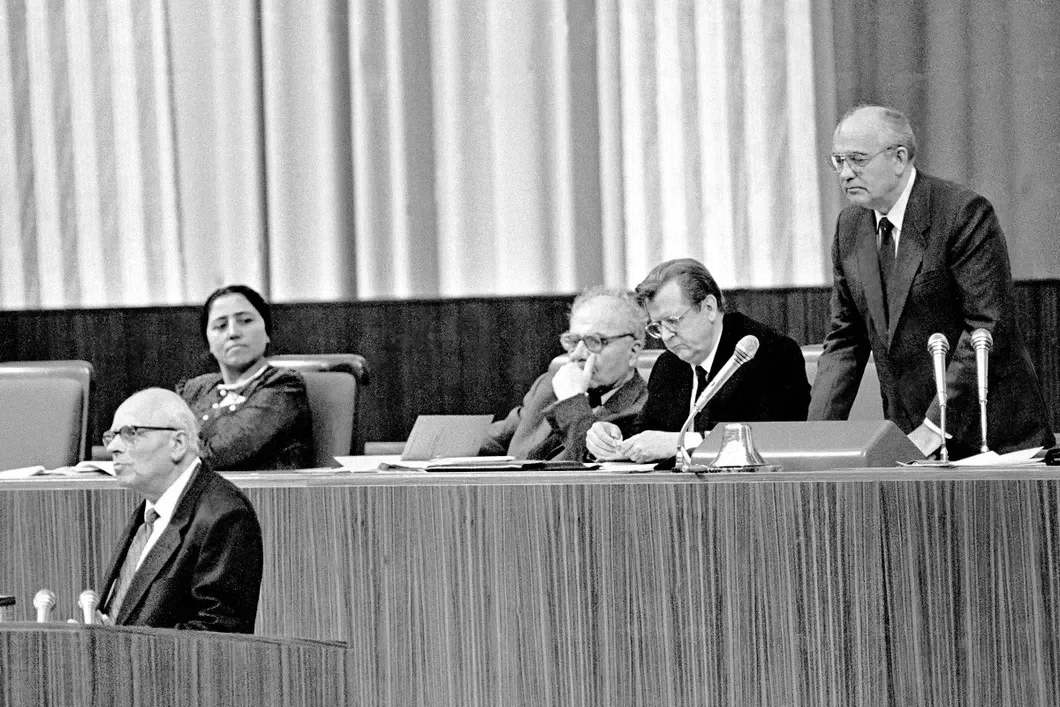
These are very different people, although contemporaries whose life paths intersected in the most sharp, dramatic periods of their life and social activity. They are united, in my opinion, one, but an extremely important circumstance. They, with all their differences, and at times and confrontations, turned out to be the leading figures of that stormy stage of our history, which in essence was the third Russian revolution of the 20th century and marked the beginning of Russia's transition from society and the state of the traditionalist type to society and (let's hope) to the state of the modern type. They also identified the main milestones for the survival of mankind, who found himself in a completely new post -industrial, information and nuclear situation for him.
As very often occurs in such cases, the appearance first on the Russian, and then the World political horizon M.S. Gorbachev was perceived simultaneously both as inevitability and as a miracle.
The inevitability-because the rotting and erosion of the Soviet-communist Goliath has passed from the stage of guessing the few to the stage of the confidence of many, and then to axiomatics for almost everyone, including those who stood directly at the feeding of the authorities. I recall a conversation with my late friend A.E. Bovin at the end of the summer of 1982. As you know, he was very close to Brezhnev and Andropov and was largely their “pen”. This belonged to him a truly historical phrase voiced by Leonid Ilyich: "The economy should be economical."
So, to my banal question: "How are you?" - Boin said gloomily: "My affairs are nothing, but state affairs are disgusting." The need for indigenous changes was felt everywhere and everywhere, including the very tops, as something completely inevitable, although the range of opinions about when they come and what character they would take on was very much. From the options of very radical to purely personality-cosmetic. In the atmosphere, something that at one time was formulated in verses: “The storm would have struck, or what? The bowl with the edges is full! "
It was during this period that at the beginning the barely noticeable star of Gorbachev appeared on the political horizon. In the photographs of the "native Politburo" of that period, it is noticeable
How carefully Mikhail Sergeyevich tries to completely and without a trace to fit into this areopag of half -dead.
But it was not completely possible, with the remainder. The rest was age. But it was the age that was perceived while the main and decisive political factor. In that stagnant, dull, seemingly infinite time, few people knew the line born in 1968 during the Czech "Renaissance":
“I know what will be better, / because our, Soviet Dubchek walks on the ground /, / Soon he will be in the Kremlin.”
I knew this quatrain both because of my personal Prague experience, and because of the story of another of my friend, the famous philosopher M.K. Mamardashvili, who, when he was his student at the Faculty of Philosophy of Moscow State University, visited one of the university dormitories, where he met two legal friends: Russian and Czech. The Russian called Mikhail Gorbachev, and the Czech was Zdenek Mlynarzh. And it was necessary to happen that later this Czech became one of the main political advisers of Alexander Dubchek in the turbulent period of the Prague Spring.
What can I say? The outstanding Russian poet David Samoilov wrote: "You and I do not believe in miracles, because of it they do not have them."
What happened to our country at the end of the 20th century is an undoubted pattern. The idea, the time of which has come, cannot but be realized in one way or another. The fate of consonants with her - leads, and the disagreements - drags. At first, she led our generation, and then dragged it. But how and by whom fate realizes the transition of some historical realities to others - in other words, turns the page, turning the present into the past, and the future - in the present - is almost always perceived by us as something unique and unthinkable. More precisely, like a miracle. One of the most striking personifications of such a miracle for our generation was M.S. Gorbachev. His visit to the UK and conversations with Margaret Tetcher, his appointment by the Secretary General, his meeting directly with Leningraders - all this could happen, but it might not have been. But it happened. Like the rapid rise, the peak of worldwide love and popularity, the short-term presidency of the USSR, the Nobel Prize of the World, the proclamation of the impossibility of nuclear war and the start of the phased balanced reduction of the nuclear weapon with the prospect of its subsequent complete destruction. And the most acute conflict with both (left and right) radical wings of the immature Russian society, which escaped suddenly and violently to the surface, and as a result - the fall of the leader and the crash of the country.
In these brief notes, of course, there is no time and place to talk about our recent history. We are talking about the formation and fate of a separate bright and multifaceted historical personality - the identity of M.S. Gorbachev.
It seems to me that he ended up at the top of a huge state pyramid at the very end of its path measured by history, albeit not yet fully formed person and politician.
Mikhail Sergeyevich possessed early and almost to the level of instinct to the skills of Soviet-Partyan-Komsomol survival in combination with the internal conviction that “the old people have sat down and fall into insanity” and that the leadership should be rejuvenated, and the country should be wake up from stagnant hibernation and accelerate its development along a more or less laid path. And only in the process of an increasingly accelerated movement, he began to realize that the “laid path” is simply gone, and it must be paved by himself, breaking a thick and stupid, although a rotting wall of total stagnation, behind which “neither Zgy is visible”, but there is only a muddy and dangerous infinity. Another would stop at a perplexity and horror. And he did not stop. He went forward: boldly, with a smile and hope, trying to breathe confidence into the minds and hearts of people and thereby - into himself.
At some stage of this run, the choice was faced with fate with fate in front of the leader: preserving and strengthening control over the situation using power impact on the complicated situation or the continuation of the process he had begun, taking into account more and more chaotic disturbances, fraught with losses of control over the political situation.
M.S. Gorbachev after some hesitation made a truly historical choice for our country - he went along the second path. I would call it by heroic non -violence. Non -violence even contrary to the principle of every Soviet leader in the head: power - at all costs and despite any sacrifices. This, in my opinion, has become a decisive factor in the formation of the unique personality of M.S. Gorbachev.
I would venture to assume that in this personal sense, he went much further from the psychotype of “Soviet-party” than another, undoubtedly, large and powerful leader of the third Russian revolution of the twentieth century B.M. Yeltsin is this outstanding ally-rival Gorbachev. For Yeltsin, the authorities meant much more than for Gorbachev, and the use of power to conquer and retained, as the October events of 1993 showed, of course, unacceptable. In this sense, the big question is which of them can be considered more radically dispersed with the Soviet-Bolshevik ideological and political heritage: Yeltsin, who officially turned the last page of the Soviet period from the dissolution of the CPSU to the abolition of Soviet symbols, or Gorbachev, who preferred his own departure from the political arena of direct violence against his opposition forces different areas.
It was Gorbachev’s departure that finally formed his personal historical appearance. His personal failure became a prelude to historical immortality.
The third Russian revolution of the twentieth century differs from the first two, among other things, in that, with all its dramas and cataclysms, it turned out to be significantly more bloodless than the revolution of the beginning of the century.
And this is the undoubted merit of its outstanding figures who, with their lives, with an example of political and social activity, instilled in our society at the turn of the centuries “the“ political non -violence syndrome ”. I'm talking about A.D. Sakharov and M.S. Gorbachev.
This syndrome, unfortunately, is not eternal nowhere, especially not eternal in Russia.
But the memory of him is the most valuable property of Russian history. And in this sense, the effect of the vaccination received will always be with us.
I think that Mikhail Sergeyevich Gorbachev does not doubt it. That is why he so beautifully, calmly and without fuss draws his life cycle from the moment of departure from active political life. It is pleasant to observe how exactly at this time his personality was finally formed - the personality of a free person, a citizen of his great country, in the liberation of which he introduced his most valuable, unique and, ultimately, historical irreversible contribution.
The current anniversary of Gorbachev, like the upcoming anniversary of Sakharov, will hope, will resurrect and return this memory - the memory of two Russian Nobel laureates of the world.
Vladimir Lukin