
Translated material
Primary freezing
75 years ago the Cold War began. We study the Fulton speech of Churchill and the reaction of superpower to her
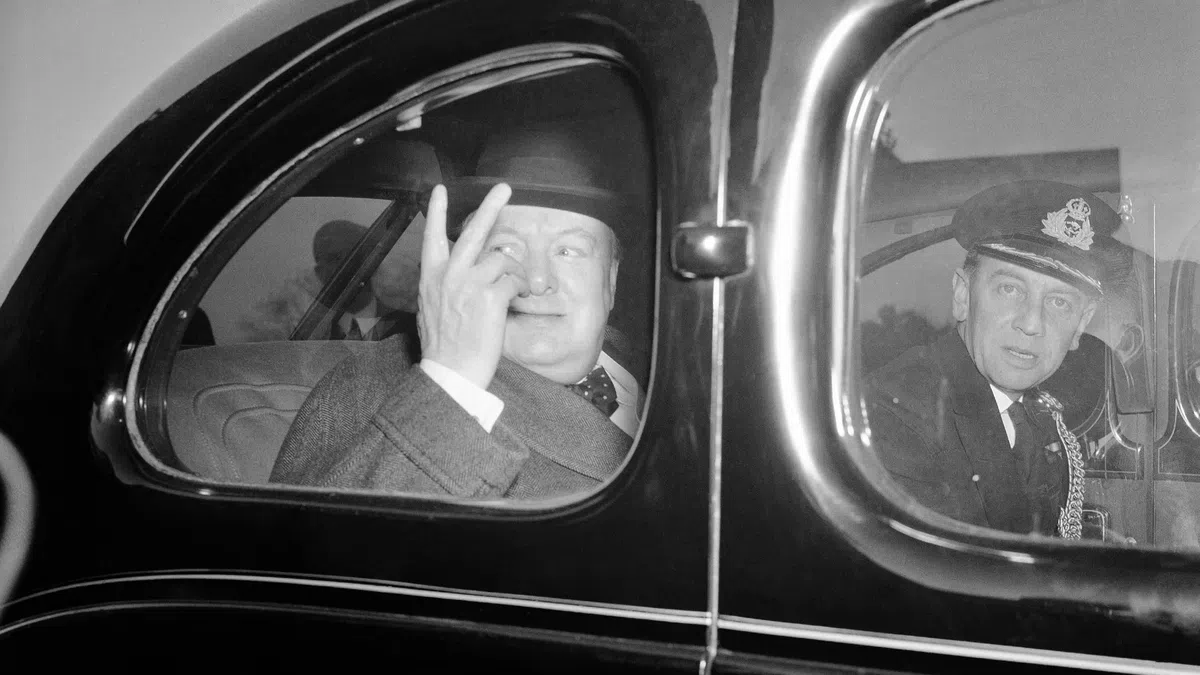
The history of the past Cold War is customary to count from the Fulton speech of Winston Churchill. But when in March 1946, the former British prime minister spoke about the iron curtain that divided Europe and called on the United States to join forces with England to confront world communism and the Soviet Union, the Cold War has already begun. And Churchill first used the concept of “iron curtain” not in Fulton, but much earlier, in a letter to American President Harry Truman on May 12, 1945: “The iron curtain fell over their front. We do not know what is happening behind him. ”
Speech in the gym
In the summer of the 45th, the leader of the British conservatives Winston Churchill lost the election and lost the post of prime minister. After an unexpected defeat in the elections, he seemed a broken man, the pale shadow of the great leader. The environment advised him to leave a big policy. He began serious health problems-due to smoking and drinking. He smoked 8 cigars a day.
Churchill refused to retire to rest.
In the 46th, a crisis arose because of Soviet troops in Northern Iran, which were supposed to return home within six months after the end of World War II. But they did not leave. In the West, they feared that Stalin intends to take control of the oil deposits of Iran. For England, which lived due to oil imports, including Iranian, it was a matter of life and death. Perhaps this was one of the reasons why Churchill made a question of an iron curtain.
In the role of the leader of the opposition, he gathered in the United States. And he received an invitation to visit Westminster College in the small town of Fulton in Missouri. President of Westminster College Frank McKlyer turned to one of his graduates - General Harry Vogan, close to Truman. The general went to Truman. The US President took a letter addressed to Churchill and attributed to below: “This is a wonderful school in my native state. I hope you can come. I will introduce you. All the best. "
Missouri is not the most famous state in the USA,
Fulton is not the largest city, there is not much happening here at all. But once Churchill arrived and made a speech that made Fulton with a historical city.
Truman and Churchill went to Fulton by train. Churchill was in a great mood. Before dinner, I drank five portions of tape. On the morning of March 5, 1946, he made the latest corrections to his speech, which was propagated by rotaprint. The American president read the text and approved.
Thousands of people gathered to see Truman and Churchill. After lunch in the house of the president of the college, the guests went to the gym, which was still existing. There were no other rooms capable of accommodating everyone. In the introductory word, Truman called Churchill one of the outstanding people of the era.
“I deeply admire the valiant Russian people and my comrade in the war years Marshal Stalin,” said Churchill. - We understand that Russia needs to ensure the safety of its western borders, eliminating any possibility of German aggression. We are glad that Russia took a legal place among the leading world powers. We welcome her flag on the seas. But I cannot but say what is happening in Europe. A shadow fell into the world illuminated by the victory of the Allies. No one knows the intention of Soviet Russia and its international communist organization and what are the limits, if any, their expansion.
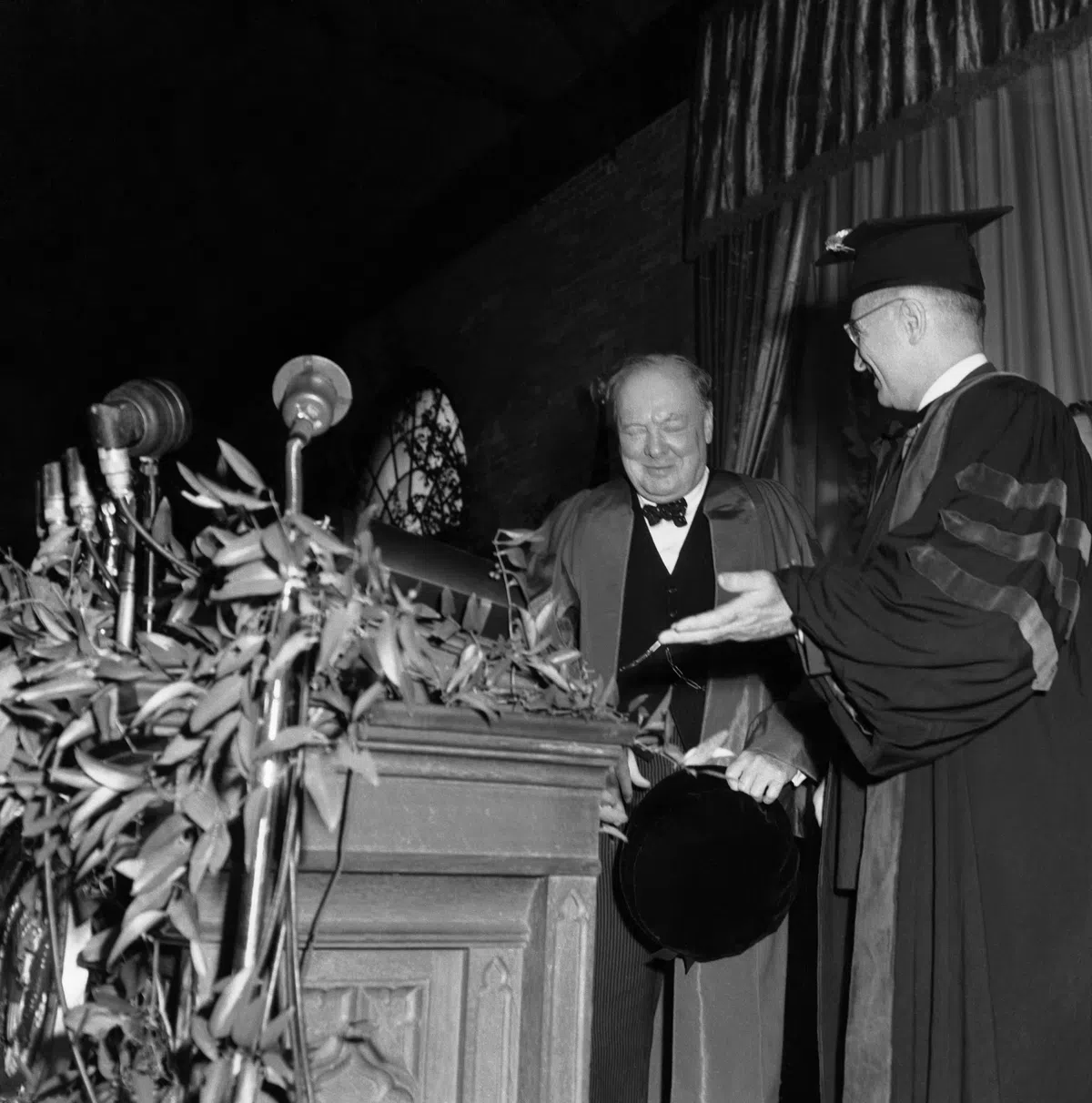
And Churchill said the words that would become famous:
- From Stettin in the Baltic to the Trieste on the Adriatic, the iron curtain sank to our continent. On the other side of the curtain, all the capital of the ancient states of Central and Eastern Europe - Warsaw, Berlin, Prague, Vienna, Budapest, Belgrade, Bucharest and Sofia. All these famous cities and their population were in the Soviet sphere ... Almost all of these countries are governed by police governments, there is no genuine democracy in them ... This is clearly not the free Europe for which we fought. I do not believe that Soviet Russia is craving for war. She longs for unlimited expansion of her power and ideology. From what I observed during the war years, I conclude that our Russian friends and associates do not admire anything more than force, and they do not respect anything less than weakness, especially military weakness.
"You cannot justify Churchill"
The first reaction to his speech was critical both in the West and in the East.
American newspapers accused Churchill of poisoning the already difficult relationship between the USA and the USSR and again was trying to draw their country into European affairs.
Truman hastened to tell reporters that he had not read the text in advance: in a free country, everyone has the right to say everything he thinks. He wrote to Stalin that he also invited him to the United States, promised to take Stalin to the University of Missouri, so that he could, like Churchill, say everything he thinks. Stalin rejected the invitation.
The American General Walter Bedell Smith, appointed by the ambassador to the USSR, stopped in the same hotel in which Churchill lived in New York. Smith did not share Churchill's eyes expressed by him in Fulton, but really wanted to see him. Smith called his number. Churchill invited to go.
The former prime minister was extremely annoyed by pickets on the streets. The Communists and Lefts scolded him in vain, and he was used to the fact that in America they meet him enthusiastically. But he believed that the analysis he made in Fulton is accurate:
-Remember my words-in a year or two, many of those who reproach me now will say: "How Churchill was right!"
Foreign Minister Vyacheslav Molotov and his first deputy Andrei Vyshinsky expressed their indignation to the state secretary James Birns in negotiations in Paris.
“Molotov and Vyshinsky,” the conversation says, “expressed surprise that Churchill chose the United States to speak with his speech, which was nothing more than a call for a new war.
Birns takes under the defense of Churchill, indicating that he did not act as a member of the British government, but under his responsibility, that neither he, Birns, nor Truman saw the speech in advance, etc.
Molotov notes that Churchill undermined his prestige, speaking with such a speech.
Birns says that Churchill's merits in the past war are so great that Churchill will have a lot of fans until his death ...
Molotov replies that it is impossible to justify Churchill, who proclaimed a new racial theory, the theory of Anglo -Saxon domination over the world, with which not everyone will agree. ”
The war is inevitable
Stalin called Churchill's speech "a dangerous step." He saw in it the contours of the military union opposing him, although he greatly counted on the Anglo-American contradictions. A month before Fulton, he spoke to voters in the elections of the Supreme Soviet of the USSR and said that communism and capitalism are incompatible, so the war is inevitable.
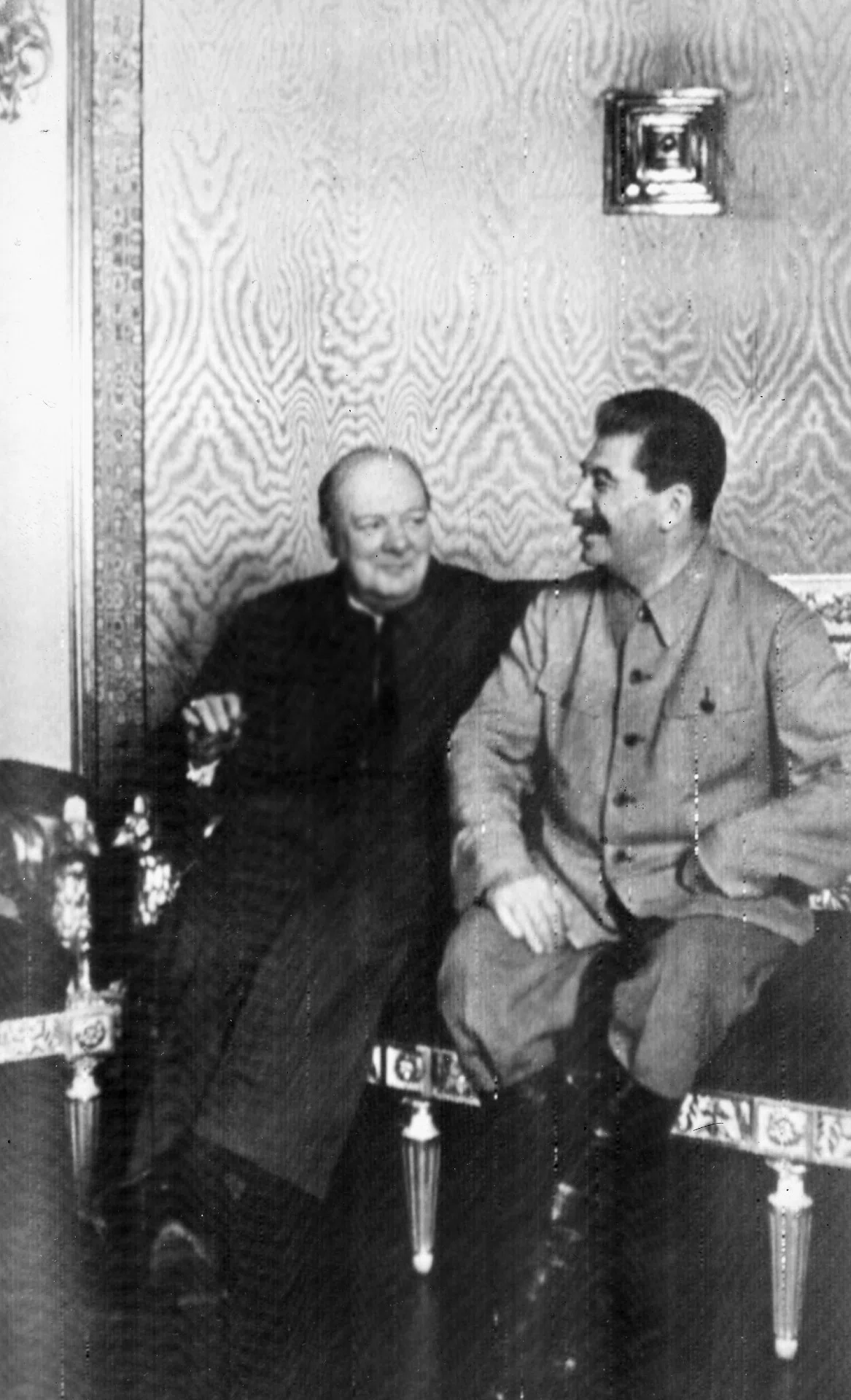
In Washington, they started, deciding that Stalin "declared war on the United States."
Now it’s hard to imagine how popular during the Second World War was the Red Army. The Americans and the British admired Soviet soldiers. Before the war, Stalin was perceived as a strange and demonic figure. During the war, he turned into "Uncle Joe", which was a completely approving nickname. British soldiers wrote on European ruins: "Uncle Joe in kings!" Publishing polls showed that 80 percent of Americans welcome post -war partnerships with Russia. In the summer of the 45th, public opinion was benevolently perceived by Uncle Joe, a hero of victories on the Eastern Front.
The foreign policy situation of the Soviet Union was perfect. European countries could not recover from World War II. The United States quickly reduced their army, their land forces became 10 times smaller than Soviet. There were no enemies. The country would feel in complete security in the post -war years ...
"Who is this Stalin?"
In the West, they were indignant at the fact that Stalin established pro -communist governments throughout Eastern Europe. Stalin reasoned like this: he refused to participate in the management of defeated Italy and Japan. However, in its field of interests, you have the right to do as it considers it necessary. Why are the Americans preoccupied with the situation in Eastern Europe so far from them? Is it because they claim world domination?
In the West, they poorly understood what was happening. One of the foreign correspondents in Moscow noted: "There are no specialists in the Soviet Union, there are only different degrees of misunderstanding."
The US State Department asked the embassy in Moscow to explain the real motives of Stalin's policy: what is behind Stalin's speech? Why is it impossible to agree with the Soviet leaders? The telegram arrived at the US Councilor George Frost Kennan, who remained the attorney in business after the departure of the ambassador Averell Harriman. Kennan, who spoke perfectly in Russian, a connoisseur of Russian history and literature, was among the first American diplomats who came to Moscow in 1933. In the spring of 1944, he was again sent to the Soviet Union.
Unlike the expert on the Russian life of the diplomat Kennan,
Most American politicians had no idea what the Soviet regime is and who is Stalin.
In September 1945, a group of congressmen came to Moscow to meet with Stalin. The Americans were rolled on the subway, then they treated gloriously and took the leader on two limousines. When they drove up to the gates of the Kremlin, Kennan heard someone hoarse and not very sober voice in the car:
- Damn, who is this Stalin? Why should I meet him? I will probably go out.
Kennan firmly told the violator of calm:
- Do not invent! You will sit here and stay with everyone.
The leader accepted American lawmakers on September 14 at eight in the evening. There were also Vyshinsky and translator.
“The big tunic who wore Stalin,” Kennan recalled, “perhaps compensated for the insufficient representativeness of his appearance. Yellow eyes, a mustache, slightly puffing, the squeezes on the cheeks gave him a resemblance to the old tiger covered with scars. Stalin was easy to handle, looked calm and cold -blooded. An unprepared guest might not have guessed what an abyss of prudence, power, cruelty and cunning was hidden behind this unpretentious external appearance. The great ability to pretend is part of the art of managing. "
Sinusitis and depression
In those days of 1946, George Kennan Bolel, lay in bed in the Moscow Spaso House and Handry. He suffered from brutal cold and sinusitis. In addition, his teeth ached. An introvert, often in despondency, he was not one of those who felt well in the hostile and suspicious world of Stalin Moscow, where foreign diplomats were cut off from communication not only with ordinary people, but even with officials.
Kennan believed that in his homeland they did not understand at all who they deal with: “The Soviet regime is primarily a police regime. This circumstance should never lose sight of the assessment of Soviet motives. But the tips do not go to an unnecessary risk. Deaf to the logic of reason, they are extremely sensitive to the logic of power. ”
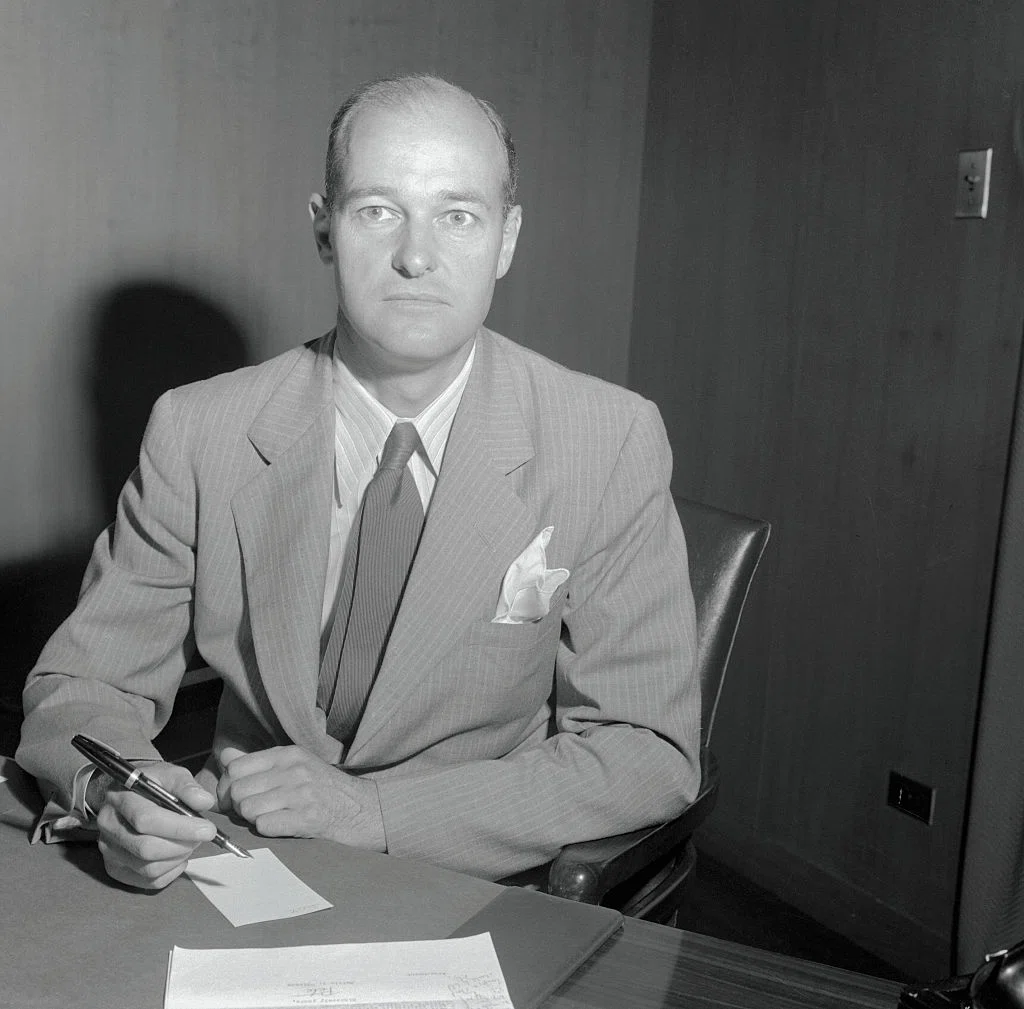
The US Embassy adviser, the US Embassy, pushed officials in Washington: before they can discuss the future of Europe with Stalin, he needs to prove that the United States will not allow the USSR to achieve its goals by applying force, that the West has enough courage, firmness and confidence in its abilities and Western countries will not allow to circle itself around a finger.
“We gave the reason to Stalin to think,” Kennan believed, “that the western part of Europe is in a deplorable state, and the United States proceed from absolutely naive and exaggerated ideas about Soviet power, so he can easily squeeze the Americans from all over the Euro -Asian space and impose his policy to the world.
It was clear to me that while the Soviet leaders think so, we had no hope of effectively doing things with them. Therefore, I urged Washington to tighten the position and dispel Moscow illusions. I was convinced that we must prove to the Russians that they would not achieve anything without cooperation with us. ”
Having received a request from Washington regarding the true meaning of Stalin’s speech, Kennan could speak out openly. He sent to the State Department the so -called "long" telegram:
“I am not able to fit the answers to the questions asked to me at a brief message without risk to present them in too simplified form. I hope the department will not mind if I break the answers to questions to five sections:
Features of the Soviet worldview in the reflection of the official propaganda machine.
The foundations of this worldview.
Implementation of these views in practical policy at the official level.
The implementation of these views in the unofficial policy, which is hidden, for which the Soviet government does not bear any responsibility.
Practical conclusions from the point of view of American politics. ”
Not for life, but to death
Kennan began with a historical excursion:
“The foreign policy of Russia has developed in ways different from the American ... Russian history knew a lot of truce between hostile forces, but it has not a single example of the constant peaceful coexistence of two neighboring states ... The Russians therefore do not have the concept of constant friendly relations between states. For them, all foreigners are potential enemies. ”
In his forecasts, he was quite optimistic:
“Much depends on the health and energy of our society. World communism is similar to a pathogenic parasite that eats only affected tissues ... We must formulate and submit to other states a more positive and constructive picture of how we imagine the world in the future ... Many countries, especially in Europe, are exhausted and intimidated and less interested in universal freedom than in our own security. We must be ready to offer them such help. And we must remain faithful to our principles. The biggest danger that threatens us in solving the problems of Soviet communism is the likening of those with whom we are dealing. ”
George Kennan believed that the Soviet Union is weaker than the Western world, and expressed strong doubts about the strength and stability of the communist system.
“The main goal of the Soviet Union,” he summed up, “is to disseminate its influence everywhere ... We are dealing with political force, which fanatically believes that it is impossible to reach consent with the United States ... In these conditions, it is clear that the main element of the US policy in relation to the Soviet Union should be long -term, patient and vigilant deterrent of Soviet expansionist trends.”
He listed the rules of behavior in relations with Soviet representatives: “Do not familiarize yourself with them ... Do not come up with a community of goals with them, which really does not exist ... Do not make meaningless gestures of goodwill ... Do not be afraid to launch all the means to resolve the issue that may seem secondary to us ... Do not be afraid of the quarrels and traditions of the publicity of disagreements.”
The telegram came to the Secretary of State James Birns, his deputy Dean Aucocon and the Naval Minister James Forrestol, who took hundreds of copies from her and handed them to all prominent officials in Washington.
Kennan set out his ideas in an article entitled “The Origins of Soviet Boarding”, which, signed “X”, was published in the journal Forin Affers in July 1947 and became the property of a wide range of scientists, military, intelligence officers and politicians.
Many Americans who read his telegram or his article had a feeling: finally, everything became clear! Now it is clear how to act in relation to the Soviet Union. George Kennan predicted the confrontation not to life, but to death between two systems.