
Translated material
There is happiness
The authorities did not notice how the Russians stopped enough money for products for the fight against Parmesan and Polish apples. Research of "New" about price growth
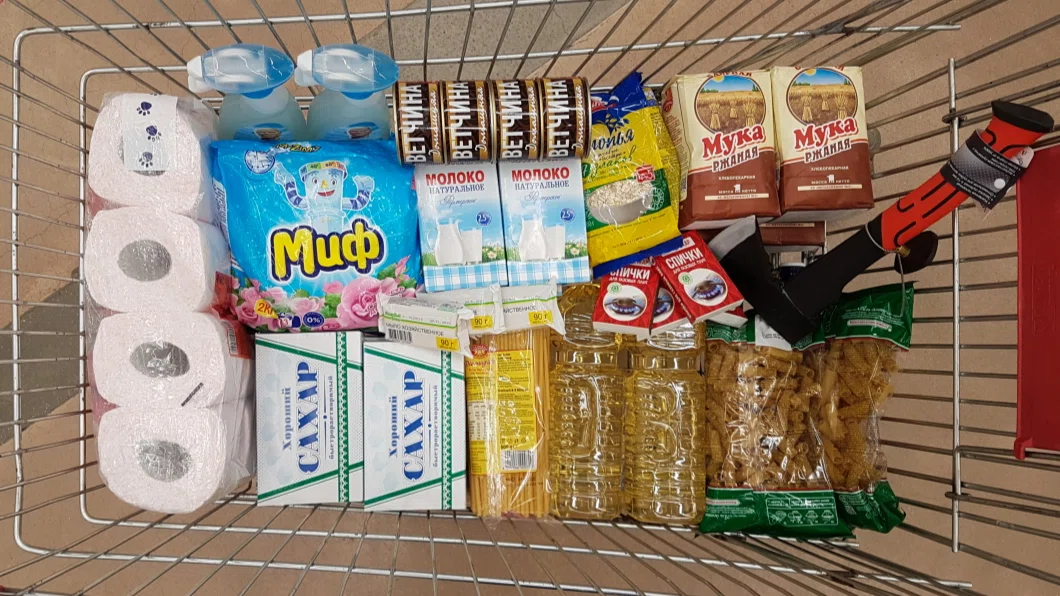
Recently, Bloomberg called Russia one of the “hot spots” on a world map due to a sharp increase in food prices. Inflation can lead to protests, according to the agency. The Ministry of Economic Development immediately hastened to name these statements speculative. But, according to official statistics, prices really increase quickly. During the year in Russia, the cost of products increased by 8.2%. This is 4 times more than last year. And 7.5 times higher than food inflation in the European Union.
Reality given in price tags
Since the summer of last year, world prices for agricultural goods have increased by 20-30%. “In Europe, this is translated into food growth by 1% per year, and with us-by 7-8%. Because in the EU low inflation for decades, consumers and manufacturers know that the prices will fall again next year. And if the inflationary expectation is high, then external shocks can lead to inflationary jumps, ”explains Marseille Salikhov, director of the Center for Economic Expertise of the Institute of Energy and Finance of the Higher School of Economics.
In addition, in Russia, there is a second reason for the rise in price of products - the devaluation of the ruble from 61 rubles per dollar at the beginning of last year to 74 rubles now. On the one hand, the devaluation made prices for our products even more attractive in the world market. On the other hand, due to the growth of the dollar, the costs of production within the country begin to grow: fertilizers, protective equipment, vegetables, amino acids, seeds, and equipment are increasing. As a result, even those products that are not traded in the foreign market are valued.
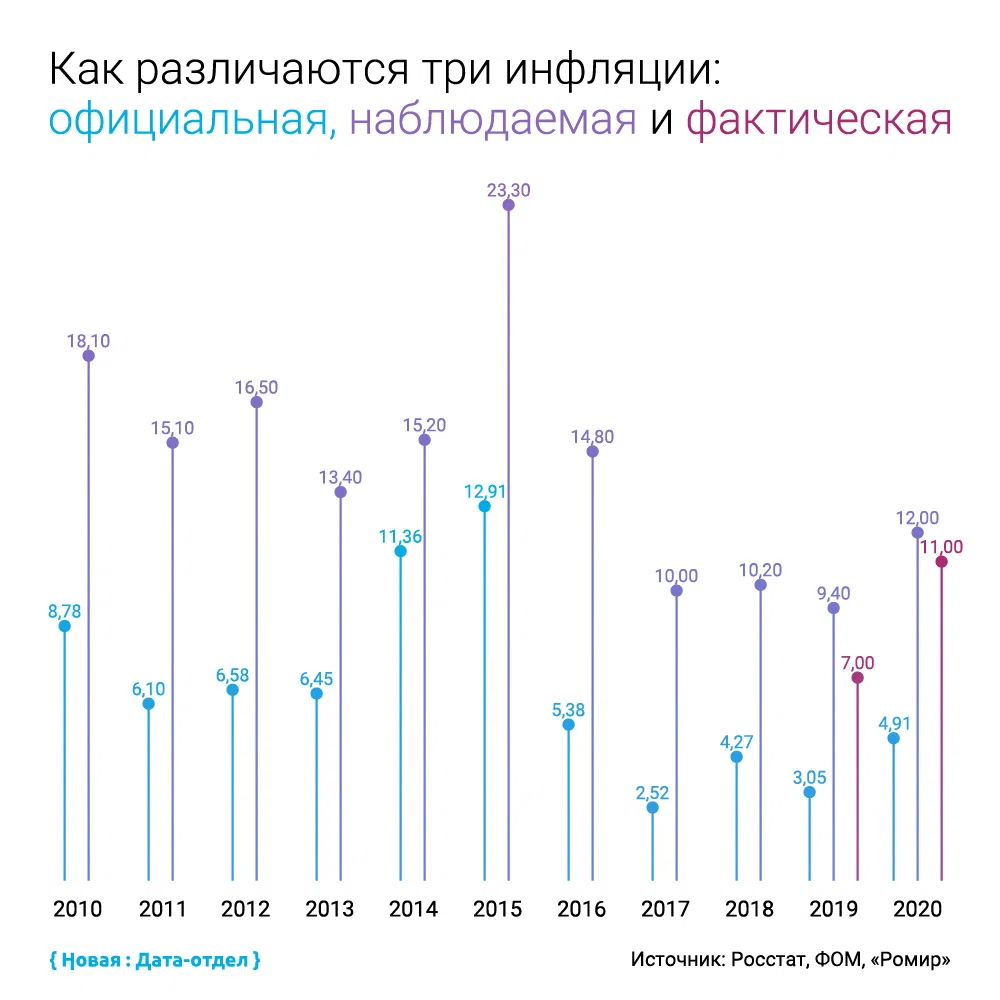
Alternative Rosstat assessment of product inflation is even higher. Romir believes that last year the products went up by 11%. The company monitors prices not on shelves, but in checks. And takes into account not the basic, but the real basket of products that are formed on the fact of purchases. According to the “OFD platform”, which transfers checks from online cash desks to the tax, actual inflation in a number of positions is also significantly higher than Rosstat takes into account. For example, sunflower oil over the year increased in price by 36%, and not by 26%, wheat flour - by 27%, and not by 14%, Darnitsky bread - by 12%.
“In 2020, cucumbers and tomatoes were marked with the most powerful rise in price, and in general, almost every month, prices for amusing categories grew. In addition, in the first weeks of pandemia, an increase in toilet paper prices was noted, ”they added in Romir.
In the fall, sugar and sunflower oil began to rise sharply. So, sugar added 65%in price for a year. The government decided to act administrative measures and in December agreed with retail and manufacturers to limit prices. But in February, the situation again got out of control-chicken and eggs began to rise in price. Now prices are limited to them.
On average, in 2020, the share of expenditure of Russians on FMCG goods, that is, everyday demand, reached 47% of the family budget, follows from the data of Romir.
The company "Platform of the OFD" also recorded a greater increase in prices on a number of positions than Rosstat.
According to Russians, annual inflation in 2020 and completely accelerated to 12%. “In life, each of us has its own personal consumer basket, and it is very different from the average in the country. The problem of the big difference between the feeling of inflation and statistics exists in all countries, ”says Natalya Orlova, chief economist, head of the Alpha Bank macroeconomic analysis center.
Not one buckwheat
Over the past 10 years, even according to the conservative assessment of Rosstat, individual products on the shelves have risen up to three times, that is, they grew three times faster than the middle -level.
More than Gazprom shares, and more than Moscow real estate, cottage cheese cheese increased in price. According to Rosstat, they went up 2.7 times. In the top of the most advanced products, in principle, there are a lot of “milk”: ice cream and butter (price increase by 2.6 times), yogurt (2.4 times), condensed milk (2.2).
In the dairy products segment, the share of imports (9.8%) is still great, and in addition, large manufacturers were replaced by farm farms for the past 10 years.
“The dairy complexes are beautiful, modern,
There are thoroughbred animals and excellent milk yields that were not dreamed of collective farm and household cows of the Soviet era, but milk cannot be produced cheap, ”-
Says Natalya Shagayda, director of the Center for Agro -Volovoltia Policy of the RANEPA.
2–2.5 times in 10 years, fish went up, and all: salmon and herring. Fish is produced in Russia, but is actively sold for export, so prices for it are determined by the external market, in the currency.
Finally, prices rose for imported goods: tea, coffee, chocolate, nuts, olive oil. In 2010, the dollar fluctuated at about 30 rubles. Now it is more than 70 rubles. The price of vodka also increased with excise taxes.
There are no buckwheat or sugar in the top of the most rise in price products. Although it was precisely these names that were most often sounded in the news due to rise in price and panic buying. The fact is that the prices of them change in waves: either they drop sharply, then they grow sharply. Since 2010, the price of buckwheat first fell twice, then rose, fell again by a third and grew up again. In just 10 years
Buckwheat added 33% in price - this is much lower than average.
Sugar has risen in price by 32%.
Sunflower oil - by 78%.
The most amazing thing is that several products in 10 years even fell down. These are potatoes. It costs 2% less than in 2010.
The prices of the onion have not changed. And white cabbage lost almost a third in price - as many as 28%.
It's all about high competition in this market segment. “The main manufacturer of vegetables and potatoes is the farms of citizens. Farmers are very actively developing. Planting products in Russia are cheap and absolutely competitive in price. If you do not take greenhouse vegetables, of course, ”explains Natalya Shagaida.
Breakthrough is not affordable
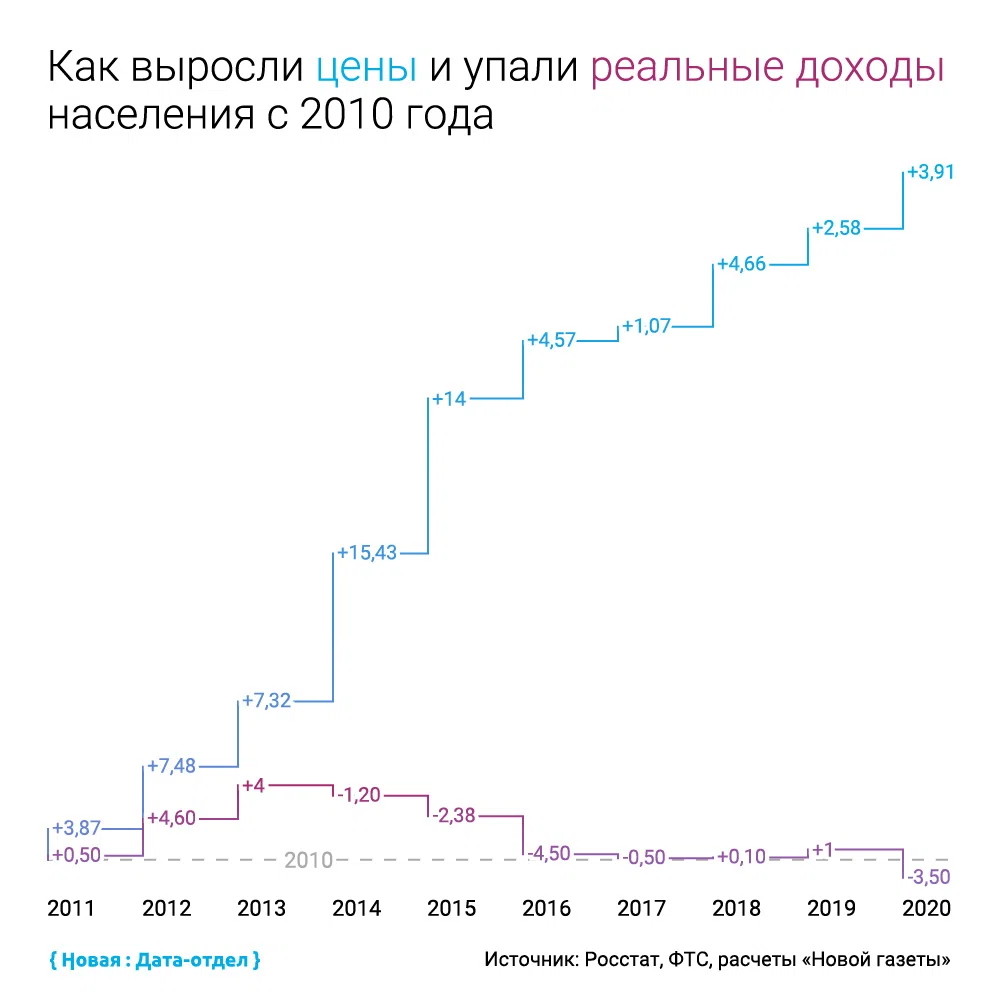
Over the past 10 years, food prices have risen by 86%. Whereas the real disposable income of citizens not only did not grow, but even fell below the 2010 level based on the data of the Federal State Statistics Service. The Russians were badly affected by the consequences of the pandemia Covid-19. 69% of citizens are forced to save, indicate Nielseniq.
“In 2015-2016, food inflation was much higher. Nevertheless, it seems then, then people reacted more calmly to her than now. The acuteness of price growth gives not so much the rise in price of goods as a drop in income, ”says Natalya Shagayda.
The most difficult thing is the poorest.
They spend not a third on food like average Russians, but more than half of the budget-52%, Rosstat reported according to the results of 2019.
“You can’t help everyone, but you can help the poorest segments of the population,” says economist Ivan Starikov, Deputy Minister of Economics of Russia in 1995–2000. He has long been offering to introduce a system of targeted food certificates for the most in need.
According to my estimates, there are about 30 million such people. If on average, allocate 5 thousand rubles per month per person, it will take 1.8 trillion rubles per year. But this will allow you to effectively help the poorest, create a guaranteed demand for the products of domestic manufacturers, for example, pork, chicken that experience a serious consulting restriction. This, in the end, will improve the diet of people, which will affect their health, ”says Starikov.
However, the government so far consistently refuses to introduce food certificates. If at the international level food security is to ensure the availability of quality food for the population, then in Russia food security is understood primarily as the most possible self -sufficiency, independence from other countries, the study of the RANEPA says.
At the same time, funds on supporting domestic manufacturers are still spent. In 2014, Russia announced the beginning of an active import substitution policy and introduced grocery counter -sanctions, prohibiting the import of meat, fish, dairy products, fruits and vegetables from most of European countries and the United States. With Polish apples and Parmesan violating the border, they dealt with a bulldozer.
From 2015 to 2020, the government sent almost 3 trillion rubles to projects to replace imports. About 2.2 trillion were spent by the Russians, overpaying for more expensive domestic products compared to imports, the economists of the RANEPA and CEPHIR counted .
As a result, “agriculture made an incredible breakthrough, which was difficult to imagine,” President Vladimir Putin shared success two years ago. Over 10 years, food exports from Russia grew by 3.4 times, to almost 30 billion US dollars.
Nevertheless, products, even grain, grown by 99% in Russia, continued to rise in price.
The current measures of the government are an attempt to deter prices by administrative methods, the introduction of export duties and (in the future) increase in the key rate - both the elderly and other experts call short -term and ineffective.
“If you fight inflation with administrative methods, it can either accelerate or a deficit will occur. Because it will become unprofitable for manufacturers to engage in these goods. And raising the rate negatively affects the economy, ”says Marcel Salikhov. In a long -term plan with inflation, you need to fight through the creation of effective consumer markets and the development of competition, the expert concludes.
“A measure with the support of the income of the vulnerable layers of the population is considered a measure that least distorting the market and does not have long -term negative moments from all sides. Price restriction, export restrictions are measures with a long negative effect, ”Natalya Shagaida agrees.
In addition, the abolition of counter -sanctions could make more accessible part of the goods: fruits, cheese. In 2014–2016, domestic consumers overpayed 10-14% for food compared to the foreign market. Since then, prices have come closer, but now Russians are overpaying for products, the expert believes.