
Translated material
"There was a feeling that everything would work out and a bright future will come"
Exactly 30 years ago, a rally on Manezhnaya Square gathered 500 thousand people. About how it was, says the organizer of the action Mikhail Schneider
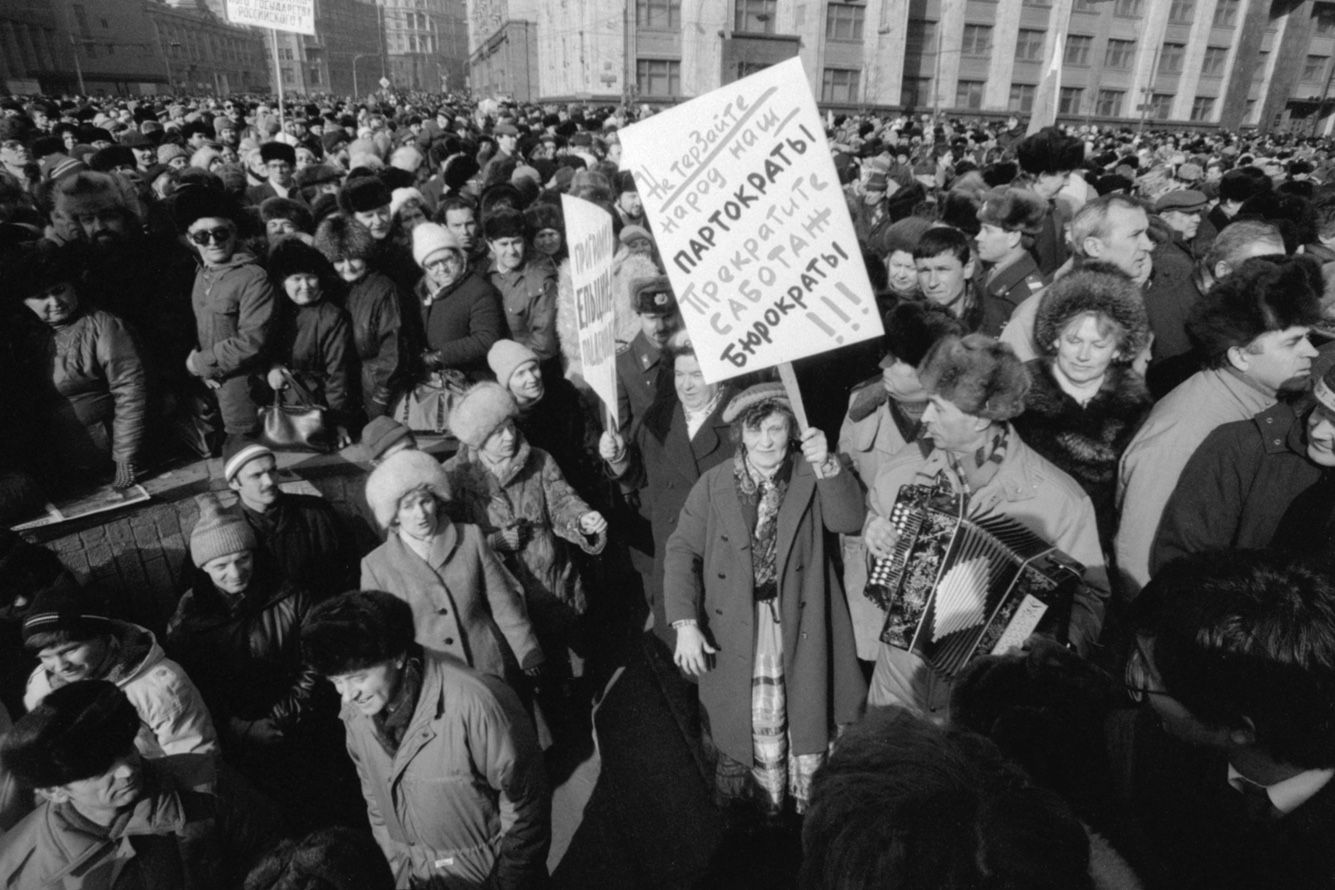
Exactly 30 years ago - March 10, 1991 - one of the largest (if not the largest) opposition rally in the history of the USSR and Russia was held. The person went to Manezhnaya Square then - they demanded the resignation of Mikhail Gorbachev, supported Boris Yeltsin and called for vote “against” on the All -Union referendum on the preservation of the USSR , which was a week later. Medusa spoke about the historical action with one of its organizers Mikhail Schneider.
The rally on March 10, 1991 was held on the eve of the referendum . The question concerned the preservation of the USSR in the “updated format”. No one really imagined what an “updated union” is. We understood that this was just another trick of Soviet propaganda. In addition, it was already clear that the Soviet Union was actually disintegrated. We did not believe that communist power could offer the real reform of the Soviet Union. Therefore, “ Democratic Russia ” agitated citizens to answer “no” to this question. And “Demrossia” at that time was the most authoritative political force, we were really considered with us.
One of the gathering points [rally on March 10] was on Oktyabrskaya Square at the very beginning of Bolshoi Yakimanka. From there, we led a column towards Manezhnaya Square. There were about 150-200 thousand people in it, people still joined us on the way. The speakers were headed at the head, who were supposed to act from the rostrum, and the organizers-at least five to seven people were at least responsible for organizing rallies.
At a distance of 10-20 meters from the column, television cameras shot us. These were journalists of federal channels who critically covered our shares. Their main claim was that the opposition could not offer a positive program. In many ways, it is similar to today, but then there was no such level of lies [as now].
My role - as the organizer - was to safely bring the column to the place of the demonstration. We made sure that the back rows did not push the front and regulate the pace of movement.
But there was no crush, people organized themselves and were very careful about each other. Self -organization was at the highest level. On the way, people shouted topical slogans in support of Boris Yeltsin and demanding the resignation of Gorbachev.
Manezhnaya Square has a rather complicated device, so each time we agreed with the police how exactly the passage will be carried out. The columns that walked from the Tverskaya side went around the square clockwise - this was done so that the people who go at the head of the column be near the rostrum.
At the entrance to the Moscow Hotel, an on -board machine was located in advance - it acted as an impromptu tribune. The sound was good - the Moscow City Executive Committee helped us, he provided special cars for sound amplification.
On March 10, representatives of “Democratic Russia” spoke before the public: Gabriel Popov, Sergey Stankevich, Yuri Afanasyev, Nikolai Travkin. They talked about the political situation - the danger of a military coup, about attacks on Boris Yeltsin [from Gorbachev and other pro -Soviet politicians], and that it must be supported. Standing on the tribune in front of a crowd of thousands, there was a feeling that we would succeed and soon a bright future would come.
At that time, we had a very good relationship with the Moscow police, so there were no provocations on the actions themselves. And after the shares, we announced which metro stations were open and people calmly diverged.
On March 10, many people really came - according to various estimates, from 200 to 500 thousand people. But I can’t say that it was the most numerous rally. At that time, all the rallies of “democratic Russia” were collected by several hundred thousand people. About 250 thousand people were placed on the Manezhnaya Square itself. If the place ended, people filled Tverskaya - there were reproductors who carried the sound along the whole street. Another part of the people was located on the Square of the Revolution, some stood from the Okhotny Ryad.
But the largest rally in my memory took place on February 25, 1990. The rally was distinguished by the fact that it was read out a list of candidates for deputies of the Moscow City Council [in the upcoming elections of 1990]. The fact is that we did not have any special channels for the distribution of information except “Echo of Moscow”, newspapers “MK” and “chimes”, so we decided to just read the list of our candidates from the rostrum - and asked people to record their names so that they knew whom to vote for. Then, according to our estimates, up to a million people participated in the action. People simply got a constant lies [of the authorities], the arbitrariness of officials, a fall in the standard of living, endless queues, the inability to buy the most elementary clothing shoes. Then most people hated the Communists.
I experienced the most vivid emotions when I saw that all the work on the call of people to participate in the action gives their fruits. Then, to organize a large -scale rally, we used a telephone call and leaflets. At that time, the organizers had a kind of pyramid: each district had its own responsible “callist”, he transmitted the information to other activists who distributed the information further. Sometimes “Echo of Moscow” helped, which gave ads and worked very tightly with the Moscow City Council.
The circulation of our leaflets [about rallies] was about a million. They were printed by a small A7-A8 format. Their distribution went to two stages: at first we gathered people in the Kino House, the October cinema or in any other spacious hall of Moscow. Activists of “Democratic Russia”, deputies of the RSFSR and the most famous Newsmakers then performed at such meetings: Yuri Afanasyev, Gabriel Popov, Sergey Stankevich, and Harry Kasparov. Boris Yeltsin came several times.
Such meetings took place two to three weeks before the rally. The hall was always complete. Initially, there were speeches of speakers on the stage, which magnetized the audience, and in the second part we handed out leaflets. They were laid out at the scene in stacks of several thousand. People who were responsible for distribution took them, and then met with the next layer of distributors. They already handed them out to ordinary activists who distributed them in the subway, at events, near shopping and cultural centers. Sometimes the leaflets were stuck, but it was not so effective - they were often torn off the wipers, so we advised them to glue them in the porches.
At that time, it was easy to coordinate the shares themselves, since most places in the Moscow Council were occupied by deputies of Democratic Russia. And the permission was given by the Moscow City Executive Committee - at the head of it was Yuri Luzhkov, who was appointed a decision of the Moscow City Council at the suggestion of its chairman Gabriel Popov.
Then it seemed to us all that we would live like in the West. It is only necessary to get rid of the party nomenclature. Cancel the sixth article of the Constitution [on the leading and guiding role of the CPSU]. Instead of officials of bureaucrats, take real professionals and specialists - and begin economic reforms. At that time, the cooperation law was already adopted in the USSR, the first elements of a market economy began to appear. But the idea of people about the future was very naive: most people believed that it was enough to overthrow the communist regime and introduce a market economy. And then literally in a couple of years the population will live in full abundance.
In the country, a revolution took place then. It began in [19] 85th year with the election of Gorbachev by the General Secretary of the CPSU Central Committee and went into several stages. Her climax fell on the events of August 19-22, 1991 .
At that time was the spirit of absolute freedom. One could say what you think, without fear of being arrested by the KGB or to fall into a psychiatric hospital. The communist opposition arranged its shares - and no one also interfered with them. People read what they wanted, wrote what they wanted, they went out with posters. Workers and miners who were dissatisfied with, went on strike. Nobody pressed them for this or arrest - now it is difficult to imagine.
Over the past 30 years, monstrous changes have occurred. There is nothing similar from that spirit now. Now any political struggle is limited by strict frames. Often, politicians have to choose: tell them something open or keep silent. If you find yourself in the place of those people who are arrested for a comment on social networks, or find yourself in a colony, even a general regime - your actions will not be able to be quite effective.
Now the spirit of freedom is more present among young people. But if a person received proper upbringing and read good books, his taste for freedom cannot evaporate.
Today's power is people who, from my point of view, have a kind of understanding of how the country should develop. In some of them, this is due to the satisfaction of their personal financial interests. And someone can sincerely believe that they do everything right.
It seems to me that we had a return to the level to which the GKChP figures - a market economy, but for our own. Over the past time, no real skills of political struggle and political life have appeared in Russia. And due to the lack of contractual capacity, individual leaders [opposition] have learned to fight and put sticks in the wheels with alternative political associations.
It is very difficult to negotiate. Even if we take “democratic Russia” - then people united to throw the Communists from power in Russia. This was the only effective political coalition. Now there are no such options.
There is no such mass [rallies] as it is then now, because most people are satisfied with the way they live. But the resumption of such mass rallies as in the 91st year is possible in Russia. This has already happened in 2011. The main thing is [to appear] an idea that will affect the deep installations of people.
I am absolutely sure that in the future Russia will become a free country, otherwise there will be complete degradation of both the economy and social life. A person cannot stand this so much. The question is how much time it will take.
Wrote Alexey Shumkin