
Translated material
The Minizh will go to Eurovision from Russia - with the feminist song "Russian Woman"
Her nomination caused a stream of xenophobic and homophobic comments
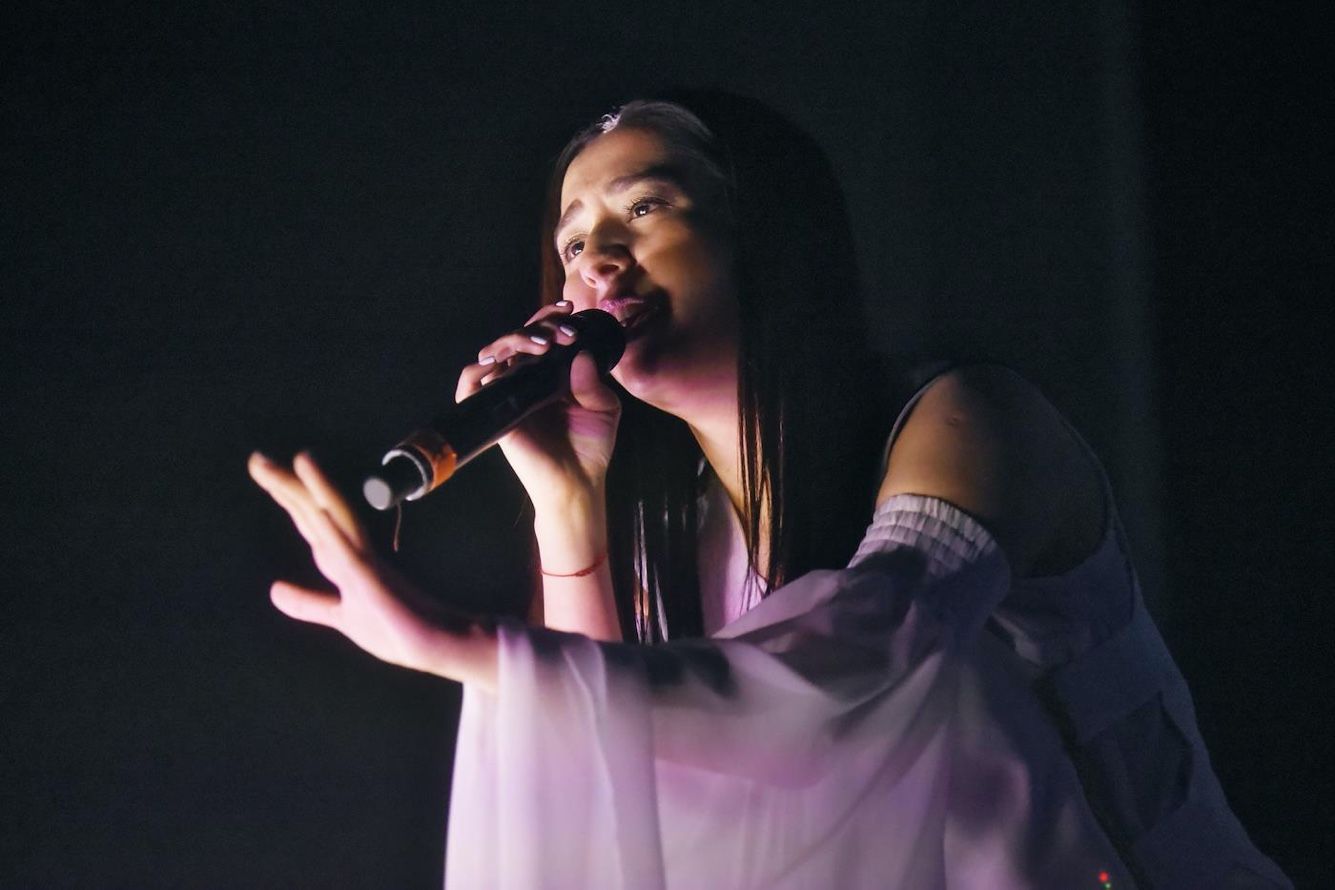
The singer Manizh Sangin - she is just Manizha - will introduce Russia at the Eurovision Musical Competition, which will be held in Rotterdam in May. On March 8, the singer passed the national selection for the competition, winning in the audience vote with the song “Russian Woman” (“Russian Woman”). In addition to her, the duet #2mashi and Therr Maitz claimed to participate in Eurovision. During the show on the First Channel, the shunt received 39.7%of the vote, #2mashi - 35.7%, and Therr Maitz - 24.6%.
The Little Big group, which won last year’s selection for Eurovision (it was canceled due to the pandemic of coronavirus), this time refused to participate in the national selection.
The song “Russian Woman” tells “On the transformation of a woman’s self -awareness over the past few centuries in Russia,” the Manizha said . According to the singer, the song was written on March 8, 2020, but for the first time she performed it only a year later. The text of the composition is inspired by the modern feminist agenda; For example, there are satirical lines there: “You are already over 30, Hello, where are the children? / You are generally beautiful, but to lose weight. "
The singer said that she wanted to demonstrate the generosity and openness of Russia at Eurovision: “For me, participation in Eurovision is a great opportunity to talk with the world about what is really important to me. I am a Tajichka, but Russia accepted and raised me. I would like the world to see our country as I know it: generous, open, bright, not like anything. ”
Manizh is a native of Tajikistan, but she spent almost her whole life in Russia. The Manizha was born in Dushanbe on July 8, 1991. Due to the civil war in Tajikistan, her family moved to Russia when she was two and a half years. In Moscow, she studied at a music school, played the piano, sang in the choir, participated in music competitions. At 16, she began to write her own songs and speak under the pseudonym Ru. Kola. In 2008, her debut album “neglected” was released, as well as a clip with the participation of a comedian Semyon Slepakov.
The singer is engaged in social activities: she is the Ambassador of the Foundation "Give Life", and in December 2020 it became the first ambassador of goodwill in the UN refugees from Russia.
The manifa is opposed to domestic violence and speaks in support of LGBT people. “It is important for me to help girls, women are not afraid to be themselves. I will receive a lot of personal messages from Tajik, Uzbek, Kyrgyz girls on Instagram. They write about violence from men, about their despair. <...> I redirect them to one or another funds, ”the Manizha told in an interview with Kommersant.
In 2019, she launched an application for the victims of domestic violence (he was criticized due to plagiarism) and shot a video for the song “Mom”, according to which the teenage heroine tries to save her mother with the help of superpowers. The Manizha spoke in defense of the Khachaturian sisters accused of killing her father. “I could not believe that they wanted to put them for a long time, and no one thinks that their life was already broken,” she told Hello!
In the same interview, the Mange said that “half of Tajikistan” considers her a lesbian. “They think that if you support the LGBT community, then you are definitely gay. But this is not a fact. I just love people and I love the LGBT community and I consider it cool to support them, ”said the singer. In July 2020, she published a post on Instagram in support of LGBT people, after which several thousand people unsubscribed from her.
The results of the selection for Eurovision caused a flow of xenophobic comments. At the same time, many acted in defense of Maniji. In social networks, as the New Gazeta writes , users asked “what, Russians did not find?”, They complained that “voting was fused”, and put diesels with songs with songs and reactions to it. Some dissatisfied asked to replace the performer, “not yet too late,” and also opposed the Native of Tajikistan to represent Russia at Eurovision, the 360 television channel noted . The pro-government journalist Yuri Kotenka described the manifting as a “migrant who made a career on a LGBT-patch.”
Also, the singer was criticized by the leader of the LDPR Vladimir Zhirinovsky. He condemned her because of the two phrases that sound in the song: “A son without a father, a daughter without a father, but a broken family does not break me”, as well as because of the one that was quoted above-“You are already over 30, Hello, where are the children?” “I’m not sure that this is good for raising the authority of a Russian woman and in general Russia,” Zhirinovsky said .
At the same time, hundreds of posts appeared in social networks in support of Manizhi. “How cool: Anya Rivina on the cover of Time , I and the“ femodachi ” -in the Washington Post , the manage goes to Eurovision with a song about the emphauration! - wrote on Twitter a female and artist Daria Serenko. “In total, the shit that happens with all of us does not cancel it, but it’s so cool that you are not only seen and supported in the Russian Federation.”
The musical producer Joseph Prigozhin said that the song “Russian Woman” “did not understand”. According to him , Manizhi has “very low” chances of victory. At the same time, he noted that "the girl born in Tajikistan sings so cool Russian folklore." The poet Karen Kavalereyan, who wrote the songs of Dima Bilan, Ani Lorak and Dmitry Koldun for Eurovision, called the “strategic mistake” that the Manizh would go to the competition with a song in Russian, and not in English.
Alexander Baklanov