
Translated material
The secret of the ancient carpet from the Hermitage
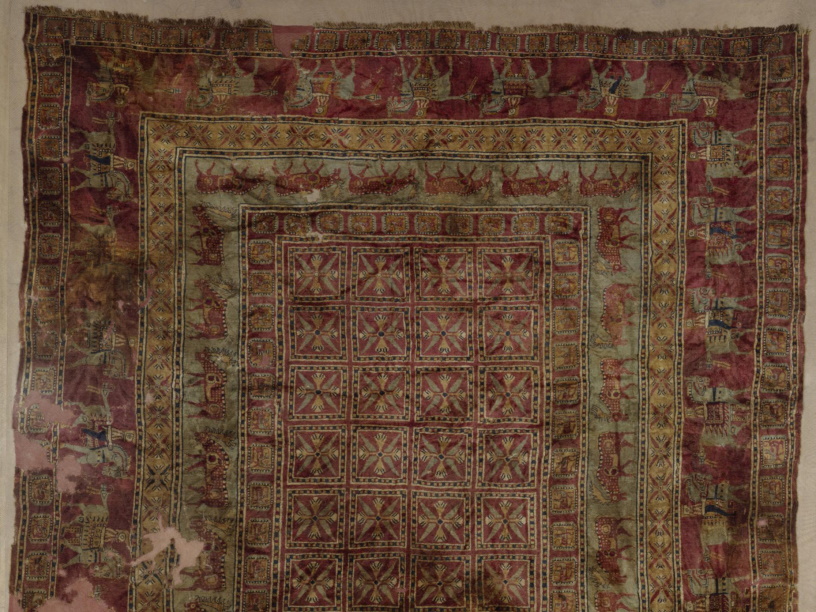
The modern research method - a micro -nine -fuel -free analysis - helped to reveal the secret of the oldest pile carpet in the world, made about 400 BC. e. And now stored in the Hermitage.
The carpet belongs to the monuments of the Pazyryk archaeological culture, common in the VI - III centuries. BC. e. On the territory of Altai. Nowadays, archaeological finds related to this culture are made in Russia, Kazakhstan and Mongolia. She received the name after in the Pazyryk inter -city tract, at the village of Balyktyul, in the Valley of the Altai River Bolshaya Uralan, burials with a rich burial equipment were found. Now these finds are stored in the Hermitage. Read more about this archaeological culture inthe essay on Pazyryk burials.
A carpet of 183 by 200 centimeters was found in 1949 by archaeologist Sergei Rudenko in the fifth Pazyryk mound. It is made of wool with nodular weaving - the so -called Turkish, or symmetrical double knot. The weaving is very dense: there are 3600 knots per square deceeter of the carpet, and in the entire carpet of nodules there are more than 1,250,000. Thanks to the presence in eternal permafrost, the fabric is well preserved. The carpet is covered with a complex pattern, including images of lotus buds in the central part, surrounded by figures of griffins, deer and riders. The fabric is painted in red, yellow and blue.
The origin of the carpet remains the subject of discussions. Representatives of Pazyryk culture did not live in isolation from the outside world, and in their mounds they find products created in other countries: mirrors from China and India, textiles from China, Iran and the Middle East. Existing analogues indicate the Iranian origin of the carpet. However, it could also be made in Central Asia, through which the trade routes that associated Altai with Iran passed, or even created by the nomads-Pazyryks according to Iranian patterns. In any case, this carpet is at least six centuries older than other earliest dated pile carpets.
The authors of the study were interested in the secret of the amazing resistance of pigments on the Pazyryk carpet. One of its possible explanations was the use of wool fermentation before staining. This process serves as an alternative to whitening and consists in the fact that the wool is soaked in suspension of sourdough and wheat bran, which contains the yeast Geotrichum Candidum (they, along with white mold, are also used in the preparation of some cheeses, in particular, Camamber). The yeast maintain a constant pH environment at 4.4, prevent decay and over about three weeks decompose fats inside the cuticle layer, significantly increasing the ability of woolen fibers to absorb the dye and ensuring staining resistance, superior to modern industrial production standards. Fermentation of wool requires experience, since impaired technology will lead to the fact that the wool will simply rot.
Professor Karl MELSLINGER of the University of Friedrich-Aleksandra in Erlangen and Nuremberg, along with the specialist in the oriental methods of staining textiles Manfred (Manfred Bieber), previously learned to determine the wool subjected to a raster electron microscope. The earliest samples in which they discovered the fermented wool came from the 17th -century horse. But the ancient fabric, the more difficult it is to identify traces of fermentation, because this is done according to the characteristic elevated position of the outer layers of the cuticle, and over time the wool fibers lose these layers.
Loss of the outer layers of cuticles with wool fibers. On the left is an example from the Turkish carpet of the 18th century, on the right is the Pazyryk carpet. The loss of external scales of the cuticle as a result of abrasion due to prolonged use is typical for ancient fabrics. Therefore, the direct detection of wool enzyme by the structure of the cuticle becomes impossible for ancient samples.
A fragment of several nodules of the Pazyryk carpet Professor Messlinger received for research back in 1991, but the existing method did not give a reliable answer. Now, X-ray microscopy experts Andreas Späth and Rainer H. Fink from the University of Friedrich-Aleksandra proposed a new methodology. The co -author of German scientists was Lyudmila Leonidovna Barkova (1928–2014), an employee of the State Hermitage, the author of the work on the material culture of the Altai mounds. To study the sample, the X -ray microscope of Phoenix was used at the Paul Sherrer Institute in Willigen (Switzerland).
The new method was to visualize the distribution of pigments along the cross section of individual fibers of the wool using micro -nine -philoral analysis (µxrf). Like the usual radiofluorescence spectroscopy, this method consists in determining the chemical composition of the sample by the radiation spectrum caused by x -rays when it enters it. Photons of high energy in x -rays, falling on atoms, cause the transition of electrons to higher energy levels in them. After the entire millionth fraction of the seconds, electrons return to ordinary positions, and an excess of energy is released in the form of a photon. The atoms of each element distinguish such photons with a strictly defined level of energy, for example, iron atoms emit photons with an energy equal to 6.4 KEV. By the number of selected photons and their energy, the composition of the substance can be determined. The difference µxrf is that with the help of capillary x -rays, you can get information in a scale to several micrometers.
For research, transverse sections of fibers were taken. The resulting picture of the chemical composition throughout the thickness of the fiber was compared with samples from the Turkish carpet of the 18th century from the horse, where the wool was subjected to preliminary fermentation, with wool, which scientists themselves were painted with the help of Marena dyed , as well as with natural unpainted wool. The result confirmed that the wool of the Pazyryk carpet was also fermented before staining. Consequently, the carpet manufacturers, wherever they live, owned this technology two thousand years earlier than, as it was believed, it arose.
The results of the study are published in the journal Scientific Reports.