
Translated material
Price rake
Why in Russia once every six years there is an inflation shock

According to the final assessment of Rosstat, inflation in Russia in 2020 amounted to 4.9%. This, of course, is worse than in 2019, when prices rose by 3%, and almost twice as much as in 2017, when they added minimal 2.5% for all the time of observation - but there is no reason at all to make the price increase in all answers to the question “What bothers you?”.
The post -Soviet man survived the “Pavlovsk Reform of prices” of 1991 and the “liberalization of prices” of 1992, which aggregate the purchasing power of his “Soviet” savings in powder. He survived the crisis shock of 1998, when in 4 months prices rose by 80%, and two less price shocks - in 2008/2009 and 2014/2015, the reason for which, as in 1998, was the ruble devaluation. In turn, in all three cases, devaluation was a consequence of a catastrophic decrease in oil value.
The average age of the Russian is 40 years, that is, hyperinflation of 1991–1992. He may not remember, but he met the crisis of 1998 as an adult and capable of realizing his severity. So, he had to postpone his memory.
So why did the “tiny” 4.9% of 2020 inflation alarmed it?
It should be noted that the same average Russian, receiving a salary and spending it in a store, is inclined to doubt both the average salary and in the annual inflation rate declared by the Federal State Statistics Service, which is declared by the Federal Air Transport Agency. The question is whether he has real reasons for this.
To begin with, let us recall that the emission from the United States, which started in September 2019, from the main central banks of the world by the end of 2020, nevertheless did its job:
sharply, more than 50%, the prices of steel and other metals used by the industry rose (and this is under conditions of pandemia caused by a reduction in demand),
quickly, to a level above the pre -crisis, it has risen in price of oil,
Seriously rose in the world market food.
In Russia, all this was multiplied by:
20 % devaluation of 2020, caused by the next collapse of oil value,
The government’s decision to introduce anti -dumping duties on steel against Ukrainian and Chinese steel (Turkish steel left the Russian market for political reasons),
A sharp jump in housing prices, which resulted in the introduction of a policy of subsidiaries by the state budget of mortgage loans (this policy sees solvent demand for several years ahead, and a long failure of demand will follow).
We must not forget about China that amazed China - a “world factory” - a shortage of containers, which resulted in a four -fold increase in the cost of renting containers for long -range transportation, which ultimately led to an increase in the cost of large -sized imports by 10% or more. But this phenomenon is temporary, caused by the fact that the containers in which the products produced in China are not returned in the United States are not returning. With the end of the US, it will be resolved.
Now we calculate: about 36% of all goods in the retail network are of imported origin. To this we can add that a considerable part of the goods already Russian origin is made using imported components or raw materials.
It is very rude to evaluate the share of imports in the Russian market of 40%. Given the fact that retail sales by about 3.4 times exceed in monetary terms the volume of services acquired by Russians, it turns out that imports account for about 30% of all expenses of Russians, and the ruble devaluation leads to 6% to inflation. More precisely, a little smaller, since part of the losses are taken by sellers - shops and retail chains.
Thus, we have inflation imported into Russia, multiplied by the ruble devaluation at parallel.
You will ask yourself a logical question: why, then in the "developed" countries, inflation is far from so high? Why is the population little worried about it? The answer here is that:
In the same Europe, the euro in 2020 only strengthened in relation to the dollar and other currencies,
In the structure of consumption of Europeans and Americans, there are much less expenses for services on goods, in Russia, as shown above, the situation is directly reverse,
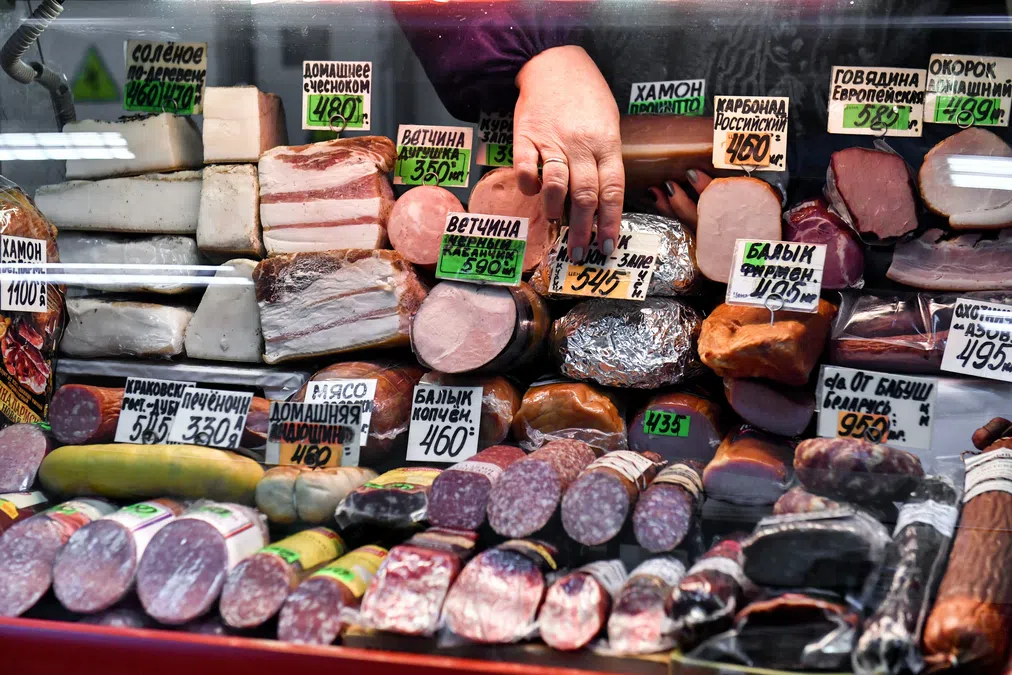
Directly the consumer beats the rise in food, but the share of those in the expenses of Russians is about 40% (the poor and even higher), and in the Western countries - from 10% to 15%. True, taking into account the habit, it is outside the house, but still to Russian indicators far away.
That is, the richer you are, the less space in your expenses occupies spending on food and the lower your personal inflation. This does not mean that the services for the population of the United States and the EU do not rise in price-they rise in price, sellers at Walmart do not eat air, they also need to somehow compensate for the rise in price of goods and products, but later and less.

It is also worth noting that according to the Central Bank of Russia, which recently began to publish data on inflation in the regional context, inflation in Russia depends on the size of the village in which you live: inflation in large cities (Moscow, St. Petersburg, Novosibirsk, Yekaterinburg, Kazan)-below the country in the country.
Apparently, the main reason is the higher competition among sellers presented in Millionnects mainly large retail chains, which, by virtue of their size, are able to squeeze additional discounts from suppliers, which the store cannot afford in some Transbaikal village. Yes, and there are usually shops-one or two for the whole village, so the prices in them are limited only by the purchasing power of its fellow villagers and the conscience of the owner.
As you noticed, inflation is the problem of the poor, which not only suffer from rising prices for products and goods, but also usually store their savings in national currency, which is losing their purchasing power due to inflation.
The rich have a different problem: low and often even negative interest rates around the world led to the fact that the percentage of bank deposits is not very distinguished from zero, and the rich are forced to invest in speculative assets, including those who circle in commodity markets, and these are ... oil, products and industrial metals.
The money seeking their use creates additional demand for them in the world market and pushes up fuel and food prices, also increasing cost of the products that use manufacturing. And steel, for example, is used everywhere - from the microwave and iron to the refrigerator and car. Thus, low interest rates on the global financial market give rise to inflation.
What to do? There are two problems: the poverty of Russians and constant, hitting their pockets of the ruble devaluation. In fact, this is one problem: universities, raw materials, navigated over the past 15 years, the Russian economy, due to low labor productivity, is not able to provide the 146-millionth population with high salaries and pensions, and its raw material orientation guarantees devaluation, entailing skirts of shock inflation.
Moreover, with a fairly high periodicity: in the 21st century - every 6 years. The frequency of this kind of crises makes the Russian economy work in survival mode, and not growth and development.
That is, there is only one solution: the increase in salaries and pensions that entails an increase in labor productivity (the salary of an excavator is always higher than the salary of a worker with a shovel), which requires a policy aimed at helping such an increase and eliminate obstacles in his path. The higher the labor productivity will be, the lower the weight in the economy of its raw material component, the less influence will be affected on the world oil and gas market, the less devaluation and the inflation they cause will be. The growth of salaries and pensions will reduce the share of the expenses of Russians for the purchase of food.