
Translated material
Philip mouth. Conversation with Primo Levy
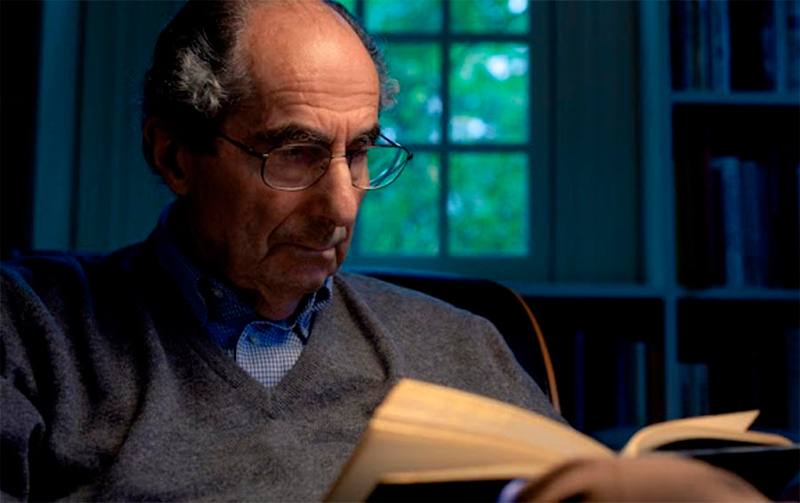
The publishing house "Scribes" has just published an essay book and conversations of the classic of American literature Philip company "Why write?" Translated by Oleg Alyakrinsky. Here are the texts of the company about the writer's case, about the awareness of himself as a Jew; Among his interlocutors are Isaac Bashevis Zinger, Milan Kunder, Edna O'Brien . With the permission of the publisher, Kolt publishes a fragment from a conversation between a company with Primo Levy - a writer, a chemist, a prisoner of Aushwitz - who took place in 1986 in Turin. The conversation mentions a collection of Levy Stories “Periodic System” (1975) and his novel “Divorce Key” (1978).
Philip Rot: In the “Periodic System”, the book about the “strong and caustic taste” of your experience in an industrial chemist, you talk about Julia, an attractive young woman, your colleague with whom you worked at the Milan Chemical Plant in 1942. Julia explains your “manic passion for work” by the fact that you, a twenty -year -old guy, are timid to communicate with women and that you do not have a girlfriend. But I think she was mistaken. In reality, the reasons for your manic enthusiasm are deeper. Labor, as it seems, is the only one of your main themes - not only in the “Divorce Ward”, but also in your first book about the stay in the Auschwitz concentration camp.
“Arbeit Macht Frei” - “Labor releases” - these words were written above the gates of Aushwitz. But the work in Aushwitz is a terrifying parody of work, useless and meaningless, work as a punishment that condemes painful death. In my opinion , all your literary work is devoted to the return of his human meaning to the work of his human meaning, to cleanse the word Arbeit from the contemptuous cynicism that your exploiters in Auschwitz perverted its essence. <...>
Primo Levy: I do not think that Julia was so wrong, connecting my passion to work with the then timidity with the girls. <...>
I never tried to seriously analyze my timidity, but there is no doubt that Mussolini played a significant role in this. My Jewish friends suffered from them, some of the “Aryan” classmates mocked us, they said that circumcision is like castration, and we, at least at the subconscious level, were inclined to believe them, thanks to our Puritan families. I think that at that time, work for me was more likely sexual compensation than a real passion.
However, I am convinced that after the concentration camp my work (or, more precisely, both types of my work - chemistry and writing) played and still plays the main role in my life. I am sure that normal human beings are biologically created for an activity aimed at a certain goal, and that inactivity or aimless work (like Arbeit in Auschwitz) lead to suffering and atrophy. <...>
In Aushwitz, I often watched such a curious phenomenon. The craving for Lavoro Ben Fatto - “regularly completed work” - is so strong that it forces people even slave duties to fulfill “properly”. The Italian mason, who saved my life, was quietly bringing me food for six months, hated the Germans, their food, their language, their war, but when he was instructed to erect a wall from the bricks, he laid a strong even masonry - and not out of humility, but because of professional pride.
Roth: The book “Surviving in Aushwitz” ends with the head of “The History of the Ten Days”, in which you describe in diary form how you managed to hide from January 18 to 27, 1945 among a group of patients and dying, who remained in the camp, after the Nazis went west along with twenty thousand “healthy” prisoners. Your story is read as the life of Robinson Crusoe in hell - and you, Primo Levy, just like a cruzo, make everything you need in random piles of garbage on a wild island so as not to die of hunger. I know what struck in this chapter and in the whole book: to what extent the power of thought turned out to be decisive for your survival - the power of a practical, civilized scientific mind. And it does not seem to me that you managed to survive only thanks to either gross biological power, or incredible luck. The reason for your survival is rooted in your professional character: you are a person who is accustomed to the accuracy of calculation and actions that can control the bold experiments, always looking for the principles of order, accustomed to straightening the malicious perversions of all that he appreciates. Yes, you happened to be a numbered detail of the hellish machine, but you were a numbered detail with systemic thinking, which always strives for understanding. In Aushwitz, you said: “I think too much” to resist, “I am too civilized.” But in my understanding, only a civilized person who thinks too much, and is capable of survival. The scientist and survivor are the same thing.
Levy: Exactly, right in the apple! In those memorable ten days, I really felt like Robinson Crusoe, but with one important difference. Robinson set to work for the sake of his own survival, and I, and my two French like -minded people, deliberately and with pleasure, finally took up work for the sake of a fair and humane goal - to save the lives of our sick comrades.
As for survival, this question I myself asked many times, and I was asked more than once. I insist that there was no general rule for all but one: to get to the camp in good health and know German. And then everything depended on good luck. I saw how smart and stupid, courageous and panties, “thinkers” and madmen, were able to survive. In my case, luck played an important role at least twice: I was lucky to get acquainted with the Italian mason and only once get sick, but at the right time.
But what you noticed - that for me the ability to think and observe has become an important factor in my survival - this is true, although, in my opinion, I owe exclusively luck. I remember that I lived that year in Aushwitz in a state of incredible elation of the spirit. I don’t know how due to my professional experience or persistence that I did not suspect about, or simply by virtue of instinct. I was not tired of fixing what is happening around me - people and their actions - and so used to it that unusually detailed images of all of them are still stored in my memory. I had a strong desire to understand, I was constantly overwhelmed by curiosity that some people later considered cynical: it was a curiosity of a naturalist who suddenly turned out to be transferred to a new environment - a nightmare, but a new, nightmare for him.
I agree with your remark that my phrase “I think too much ... I am too civilized” contradicts this curiosity. But I ask you, give me the right to be inconsistent: in the concentration camp, all our consciousness was instructed, it ranged from an hour between hope and despair. And I think that the coherence and integrity of the plots of my books is an artistic design, this is the result of understanding the events of the post -fact.
Mouth: The book “Surviving in Aushwitz” was first published in English under the name “Is this a person?” - The exact equivalent of your Italian name “SE Questo E un umo” (and your American publisher should save this name). The description and analysis of your terrible memories of the “unprecedented biological and social experiment” carried out by the Germans are dictated by the quantitative scale of the methodology, with which a person can be changed or broken, in the process of which he, as a substance decomposed during a chemical reaction, loses its characteristic properties. The book "Is this a person?" It is read as memoirs of the theoretician in the field of moral biochemistry, which itself was forcibly included in the number of experimental organisms to participate in laboratory experiments of the most terrible property. A creature placed in the laboratory of a crazy scientist turned out to be an exemplary example of a rational scientist.
In a “divorce vein”, which could be called “this man”, you say to Phosson, your shakherezade in the working robe, that you are “a chemist in the eyes of the whole world, feeling ... in yourself a writer's vein”: as if you possess “two souls in one body, and this is too much”. But I would say: you have one soul, very roomy and integral, which you can only envy. And I would say: not only the scientist and the surviving prisoner, but also the scientist and the writer were inextricably connected in you.
Levy: This is not so much a question as a diagnosis that I gratefully accept. I tried to live in the camp as rationally possible, and I wrote “Is this a man?”, Wanting to explain to others and myself the events that I was drawn into, but without a clear intention to create a literary work. My model (or, if you like, my style) was a “weekly report”, which is usually used in factories and factories: the report should be precise, brief and written in a language that is clear to everyone in the industry hierarchy. And, of course, he could not be written on scientific jargon. By the way, I am not a scientist and have never been to them. I wanted to become them, but the war and the camp did not allow. I had to limit myself to the level of technology all my professional life. <...>
Mouth: the continuation of your book "Is this a person?" (“Awakening”, which one of your American publishers awarded the unsuccessful name) in Italian was called “la Tregua” -“respite”. She is about your return from Aushwitz back to Italy. The journey of epic proportions, especially the period of long quarantine in the Soviet Union, where you were waiting for repatriation. What surprised me in the “respite”, which, for obvious reasons, could be saturated with sorrow and inconsolable despair - this is its cheerfulness. Your return to life took place in a world, which sometimes seemed to you primitive chaos. But you converged so easily with people, everyone was extremely interesting to you, and you listened to everyone, so I involuntarily thought: despite the hunger, cold and fear you have experienced, despite the terrible memories of whether you had a happier period in your life than those months that you call an interlyude of unlimited possibilities, a favorable and unique gift of fate ”?
You seem to me by a person who is most necessary for rooting - in the profession, in the ancestors, in your native places, in the language - and yet, when you were completely divorced from your roots and in complete solitude, you considered this state a gift of fate.
Levy: one of my friends, an excellent doctor, told me many years ago: “Your memories of what happened before and after, black and white; But the memories of Aushwitz and your return home are colored. ” And he was right. Family, house, factory - all this is good in itself, but they deprive me of what I am missing now: adventure. Fate decided that I could find adventures in the terrible confusion of Europe, which survived the war. <...>