
Translated material
"Bomb" for the radio
Consumers and advertising channels began to swiftly (by the standards of the last century) to change. On the threshold of the crisis and changes in the industry is FM radio, and they are still trying to take into account its coverage without taking into account the Internet channels. But the spread of radio on the Internet practically lays a bomb under this oldest media industry.

Another study of the Novosibirsk audience of the federal company Mediacoscope was published, which, according to the plan, should be a tool for media planning during advertising campaigns. The study is based on a survey of citizens who should remember what radio and when they listened to yesterday and for a week. It does not provide for an answer to the question "What technical means did the listener use for each contact with a particular radio station?" And this makes the result of polls of the Mediascope suitable for the federals, but not entirely true for local advertisers.
And that's why.
Every year, an increasing number of listeners who have not abandoned the FM radio include broadcasts from smartphones and laptops, music centers are everywhere replaced by various bluetheus systems. What is confirmed by many researchers and media managers. Here are a few results of hundreds ofires and statements of representatives of the radio industry:
According to the fundamental study “Media Refinement in Russia 2020” of the Research Center “Deloyt”, 41% of Russians listen to the radio through car radio, 23% use the traditional radio receiver, and the remaining 36% resort to the services of various devices connecting to the Internet (p. 31), General Director of one of the largest Russian broadcasting corporations, groups of companies “Entertain Radio”, Vadim Tereshchuk in March 2021 argued that 30% of the audience consumes radio via the Internet in Novosibirsk. Sociological studies of the City Hall showed the following: in 2015, 9.1% of Novosibirsk listened to the radio on the Internet, in 2018 there were already 17.2%, and in 2019 - already 24.1% (Fig. 15) Mediacopus itself, as far as I know, indicates the fact that in 2020 there are such students of such students In Novosibirsk there were about 30–35%.
And this means that the local radio blocks of federal radio channels cannot hear the radio on the Internet ... Most of the Novosibirsk radio broadcasters broadcast programs created in Moscow or St. Petersburg, placing local advertising, weather forecasts, sometimes news and congratulations and, very rarely, small interactives. Due to the small amount of their own content, they are not particularly puzzled by the placement and promotion of their Internet channel and the listener, “scoring” the name of the radio station in the search engine, receives a link to the federal stream.
Waiting for the effect of advertising on Novosibirsk radio stations, it is impossible to based on existing measurement results- the number of calculated listeners of local programs and advertising of federal radio stations broadcasting in Novosibirsk should be reduced by about 30% (due to the share of listening to Internet channels) and only among local broadcasters (Radio Uniton, Radio 54 and City Wave), which have in the network in the network The “local” signal, the measurement results should coincide with the real ones.
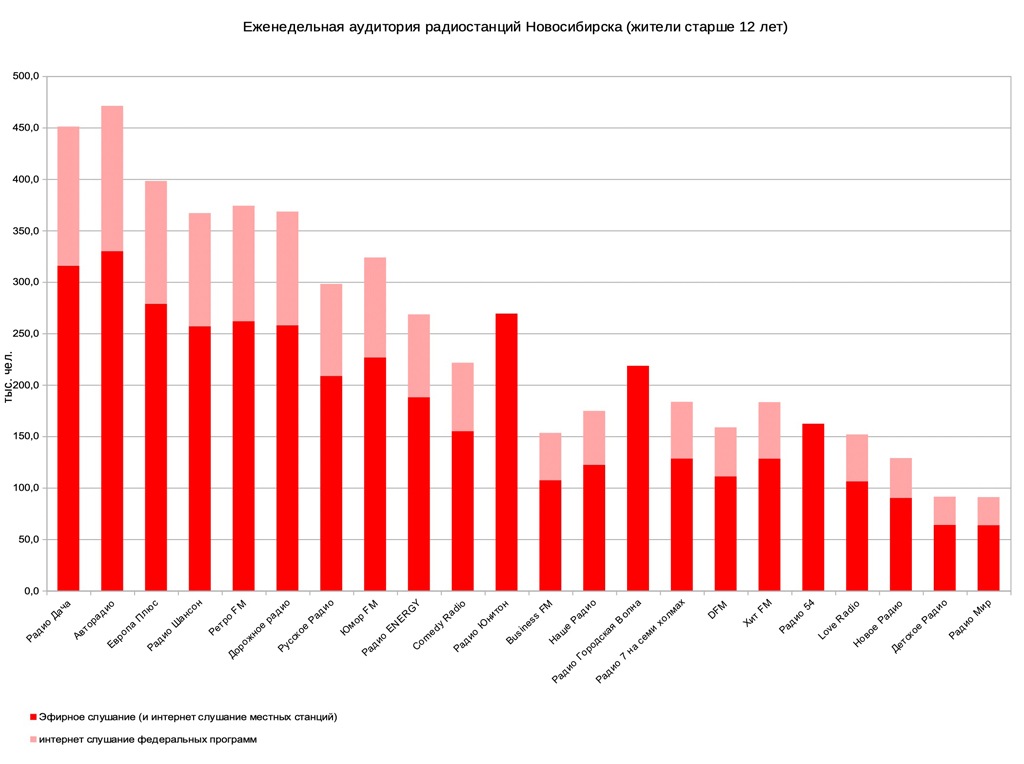
Research by Radio Index Mediacoscope, Novosibirsk, January 2020 - December 2020
Thus, for the local, regional marketing of the radio, some time will remain an effective channel for the dissemination of information, but changing the technical connection of consumers to broadcast flows does not make it possible to more or less accurately assume the coverage of the audience of regional advertising blocks in federal radio programs.
Studies of the regional radio market are useful, first of all, only to federal networks and federal advertisers - since the coverage of local advertising blocks at federal radio stations is most likely less by 25-30%.
For marketers of local campaigns, the transition from large local channels to new ones complicates the work (Internet channels of bloggers with a local audience do not have reliable statistics at all) and the simultaneous launch of advertising campaigns in the old format.
The real threat to musical FM channels are global musical services-Yandex-, Google- and YouTube. Music, adjusting to the tastes of users and forming individual playlists for them. A nauseous musical monotony, which reigned for decades on FM, comes to an end - there is an alternative. On a thousand -kilometer trips to a car around the country, we now prefer to go in silence when 3G disappears than to switch to FM.
For news and “conversational” formats, the threat is the development of Internet feeders and the formative consumer habit of using YouTube as a background broadcasting. Perhaps if the channels begin to make collaborations with bloggers and podcasts, this will lead to a new round of industry development, but so far we can only observe natural extinction (in the literal sense of the word) of the audience.
Alexander Astakhov, marketer