
Translated material
The first transplantation of the whole trachea
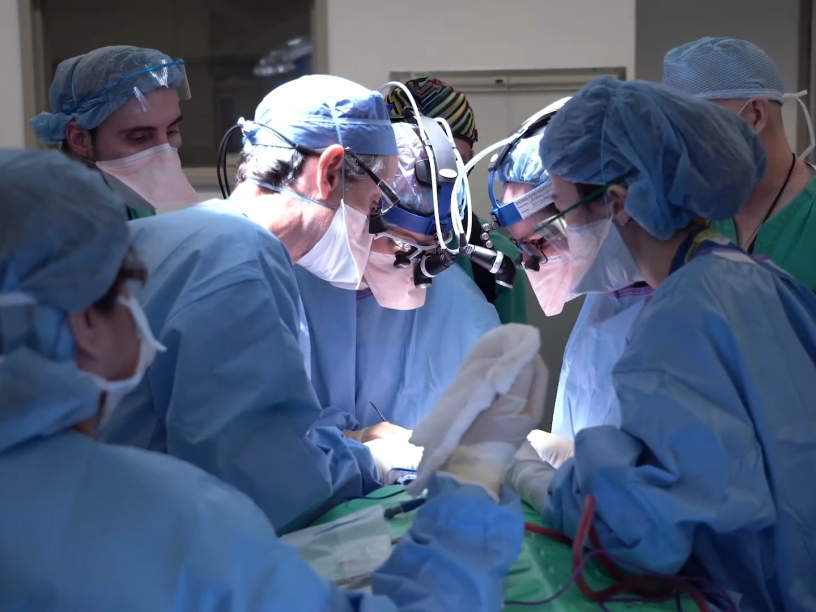
A team of surgeons from the New York Hospital "Mount-Sinai" performed the world's first complete transplantation of the trachea to man. If successful, such an operation will be able to save the lives of thousands of patients with congenital trachea defects, incurable respiratory tract diseases, burns, tumors or severe trachea injuries.
The transplantation of the donor trachea was a difficult task for surgeons, since this organ does not have blood supply through a fairly large vessel, which could be used to restore the blood supply to the donor organ. The arteries that feed the trachea have a very small diameter are located in unstable places, so the imposition of anastomoses between them and the vessels of the recipient becomes an extremely difficult task. And even when the surgeons learned to transplant the donor lungs, the trachea transplant remained unattainable for them due to the impossibility of revising the transplant, that is, to restore blood vessels that feed it.
An alternative to donor trachea could be artificial organs, but even here it has not yet been complete success. Several years ago, Paolo McKianini operations attracted a lot of attention, which implanted trachea created from the patient’s stem cells on a donor or artificial matrix. But then it turned out that in the publications of McKiarini, data on the condition of patients after surgery and the functionality of the new trachea were deliberately distorted. Seven of the nine patients to whom McKayarini transplanted the trachea in 2011-2014 died . In 2018, it was found that McKiarini resorted to a forge in six articles.
Therefore, only transplantations of trachea fragments have been carried out so far. This was first done in 1979, when a short fragment of the cervical detergent of the donor trachea was transplanted to a 21-year-old man with a cicatricial stenosis of the trachea. The fragment was first implanted into the sternum-coat-shaped muscle of the patient, and three weeks later, when a mesh of small blood vessels formed around it, transplanted to a permanent place with these vessels. In the USSR, for the first time, the transplantation of the thoracic trachea department was carried out in 1990 by Yu. N. Levashev in the Leningrad All -Menmonology. Four months later, the patient had signs of tracheal stenosis, so surgeons, to prevent his development, were inserted into the Stent trache, and the patient lived after the operation for more than eight years.
In 2001, Marshall Strum and his colleagues conducted a successful transplant of the larynx, five rings of the trachea and thyroid gland of a forty -year -old woman who suffered in the accident. They managed to combine not only the blood vessels, but also the nerves, which allowed the patient to return the ability to swallow and speak. In 2006, a team of surgeons of the Russian Scientific Center for Surgery of the RAMS, headed by N.O. Milanov and V. D. Penchin, successfully transplanted the trachea and the thyroid gland to the patient with a cicatricious tracheal stenosis.
The current operation in the Mount-Sinai clinic has become, according to the press release, the result of thirty years of research by the biology of the trachea, and especially the problems of restoring its vascular mesh and the provision of blood flow. The operation carried out on January 13 lasted 18 hours. The brigade was led by the surgeon Eric M. Genden, head of the Department of Otolaryngology and Surgery of the head and neck of the Mount-Sinai clinic. The brigade included more than fifty specialists, including surgeons, nurses, anesthesiologists, respiratory tract specialists and residents.
“For the first time, we can offer a viable option for treating patients with life -threatening defects of long trachea segments. And this achievement will change the standards of treatment. It is especially timely, given the growing number of patients with extensive tracheal defects that occur during the intubation of patients with COVID-19. Due to mechanical ventilation and the nature of the disease of the respiratory tract caused by the COVID-19, the number of diseases of the trachea is growing rapidly, and now we can offer their treatment. Our protocol of transplantation of trachea and revascularization is reliable, reproduced and technically simple. For many years, medical and scientific consensus has come down to the fact that trachea transplantation could not be carried out because the complexity of the organ made revascularization impossible, and all previous attempts to transplant the trachea from the donor ended in failure. Our achievement was the culmination of thirty years of research that began when I was a Mount-Sinai medical student, and it was possible thanks to the spirit of cooperation that exists in the clinic, ”says Professor Genden. - Despite the extensive studies of the vascular supply of the organ on humans and animals, there is no real way to fully prepare for the first person transplantation in the history of trachea transplantation. We did not have a guide on how well the transplant tolerates transplantation, so we worked very quickly. Eighteen hours later, it became clear that we did what, according to many, was impossible. In the end, everything went smoothly, because we gathered a strong team with extensive surgical experience in the field of organs transplantation and trachea reconstruction. To see a revived transplant and know that the organ is well vascularized has become an amazing experience. ”
The recipient of the donor trachea was 56-year-old social worker Sonya Sayn from New York. She had a serious trachea damage due to re-intubation after an attack of asthma. Several unsuccessful surgical attempts to restore the trachea led to even greater damage. The woman breathed through the tracheosto-a surgically created hole in the neck-and was subjected to high risk of suffocation and death due to the progression of the disease of the respiratory tract and the likelihood of a collapse of the trachea. The fear of falling asleep and never wake up the main motivator for her in order to agree to an experimental operation.
The surgeons took the donor trachea and the blood vessels associated with it, then they implanted it from a larynx to the bronchi, performing a series of microsyuded anastomoses, that is, connecting small blood vessels feeding the donor trachea, with blood vessels of the recipient. For successful revision, they also transplanted fragments of the esophagus and thyroid gland. Ultimately, the operation made it possible to remove the tracheostomic patient, which gave her the opportunity to breathe through her mouth for the first time in six years. The operation took place without complications, the patient breathes on his own. Now Sonya Sayin is undergoing immunosuppressive therapy to prevent the rejection of the transplanted body.