
Translated material
Uninvited ambassadors
What is behind the Iranian statement on the opening of the representative office of the Shiite combat group "Hezbollah" in Moscow
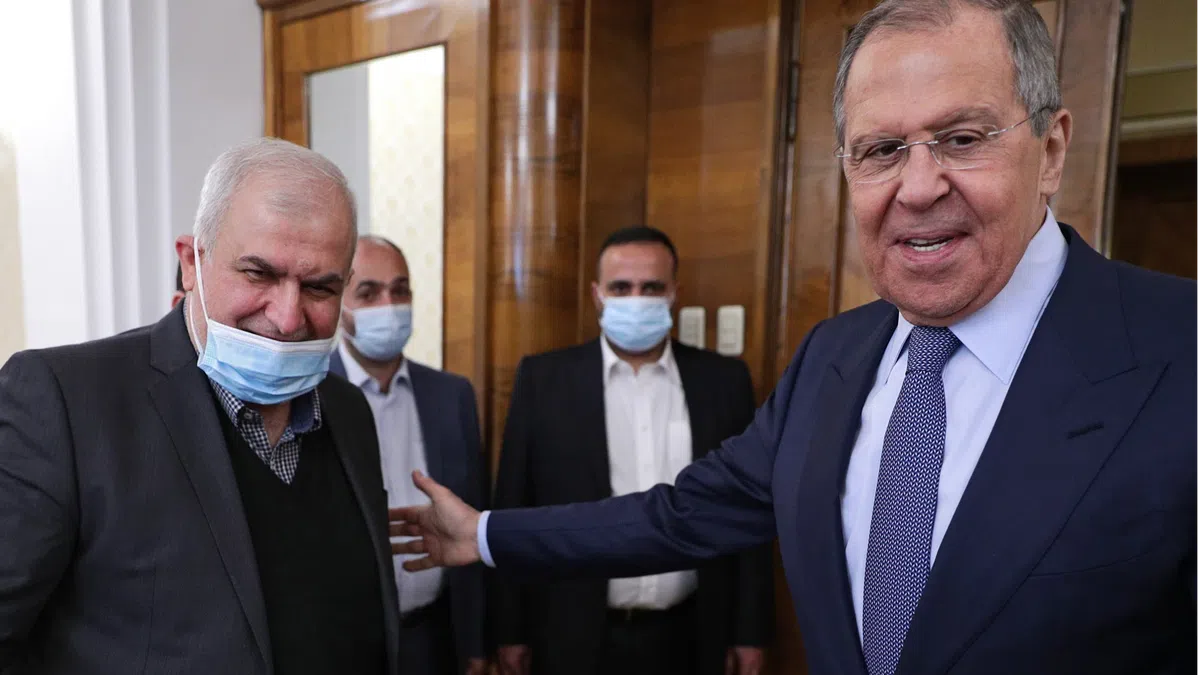
On Tuesday, the Iranian state television channel Press TV reported that the Government of the Russian Federation was discussing the possibility of opening its representative office in Moscow with Hezbollah. The statement made after the recent visit to Moscow by representatives of the Lebanese branch of the projection Shiite Party Hezbollah extremely outraged the Israelis.
Recall that the Lebanese Hezbollah flew on a diplomatic visit to Moscow on March 14. Shortly before this, the Russian Foreign Minister Lavrov in the UAE met with the elected Lebanese Prime Minister Hariri and expressed hope for an speedy overcoming of the crisis in Lebanon "through the formation of a capable government of technocrats." The Lebanese government circles took this unequivocally as the support of the Hariri course, whose political horse is the creation of a technocratic government. Following this, the opposite pole of Lebanese politics - the Hezbollah party was also invited to Moscow.
The question is, what is Hezbollah if official visits are arranged for her along with the first persons of the states?
Hezbollah in the Middle East is much more than a political party. This is the Shiite quasi -state formation, which spreads its influence at once to several countries with a large share of the Shiite population: Iran, Iraq, Syria and Lebanon. Hezbollah has its own armed forces (even more powerful than, for example, the Lebanese Army), it also has other institutions that duplicate state instruments. Own taxation, own police, own courts and prisons. The ultimate goal of its existence of Hezbollah officially declares the destruction of Israel. And for decades it has been going on to this, without constraining herself in means and methods, in connection with which in many countries of the world it is recognized as a terrorist group.
However, in recent years, Hezbollah has been very undergoing - moreover, it is from Russia.
Since 2015, Russia is fighting in Syria on the side of Bashar al -Assad. Iran and Hezbollah also provide Assad with active armed support. However, this does not at all make Russia and Shiites with such sincere allies in Syria. Between them it was many times, sometimes even with blood. But Iran cannot openly fight so many fronts, and after him the Hezbollah cannot afford: American sanctions are already hanging over them.
As a result, Hezbollah sadly watches the influence of Iran in Syria. How huge strategic projects in the country are crumbling, which has been for Iran for many decades as its own. And one of these projects is demographic engineering conducted by Iran in Syria.
Russia is strongly annoyed by the fact that the border areas between Syria and Lebanon Iran populs Shiites,
Thus, creating a massive threat to Israel completely at his side, in a neighboring Lebanon. Russia does not demonstrate tolerance in this regard - and not at the diplomatic level, but by direct action.
And at the diplomatic level, Iran and Hezbollah have to smile mutually smile with Russia.
... But the Hezbollah visited Moscow, and soon after that the Iranians declare that Hezbollah will now have its own representative office in Russia. How to understand this?
The influential Israeli Jerusalem Post appreciated the Iranians' message as “an additional step for Hezbollah to obtain complete legitimacy in Russia”. “And if Russia agrees, this is only because it is trying to get more influence in the Middle East.” The no less respectable ISRAEL HAYOM newspaper wrote: “Hezbollah” is worried that Moscow plans to create a “military council” in Syria, which will include the Syrian opposition, and Iran will leave Syria at the request of Russia. ”
All these assumptions, by the way, are not without reason: there is no doubt that in February the Israelis carefully monitored the course of the Sochi negotiations on Syria in the Astana format. The first violin there was by no means the official delegation of the Syrian regime, but representatives of the Syrian opposition.
Russia, by all means, emphasized its attentive attitude to those who have recently been called terrorists in the Russian Federation. This is a completely new agenda in Syrian politics - and Iran is unlikely to like it.
Russia did not officially react to the Iranians' statement about the opening of the Hezbollah office in Moscow. Unofficially high -ranking diplomatic sources in the Russian Foreign Ministry categorically deny the very possibility of the appearance of an office of the Khzbollah military group in Moscow. And the Israelis themselves probably perfectly understand the price of Iran’s television statements, which rattles with diplomatic weapons, trying to sit on several geopolitical chairs at once and publicly demonstrate intimacy with Russia. But Russia has been looking through the fingers in recent years that Israel bombed Iranian objects in Syria.
And even - that’s an amazing coincidence! -Assad sold in the autumn of 2018, the Russian complex of the S-300 has never worked on Israeli aircraft during their raids on Syrian territory.
The last such raid, by the way, last night, the Israelis bombed the Iranian military facilities in the suburbs of Damascus - and everything as always went completely without consequences for the raiders.
The Israelis probably appreciated a delicate diplomatic joke, when the official visit of the Foreign Minister of Israel Gabi Ashkenazi began to Moscow’s official visit on the day the delegation of the Lebanese Hezbollah flew from the Russian capital. Message is clear even to people without a sense of humor: Israeli safety for Russia in the list of priorities is higher than warm relations with Hezbollah.