
Translated material
"Just think, I did all this!" What you need to know about Euro Robert Mandella's father
This week, at the age of 88, the Canadian economist, Nobel laureate Robert Mandell, who is considered one of the “Fathers of the Euro”, died. Our colleagues from the econs publication tell about his achievements. With their permission, we publish this text.
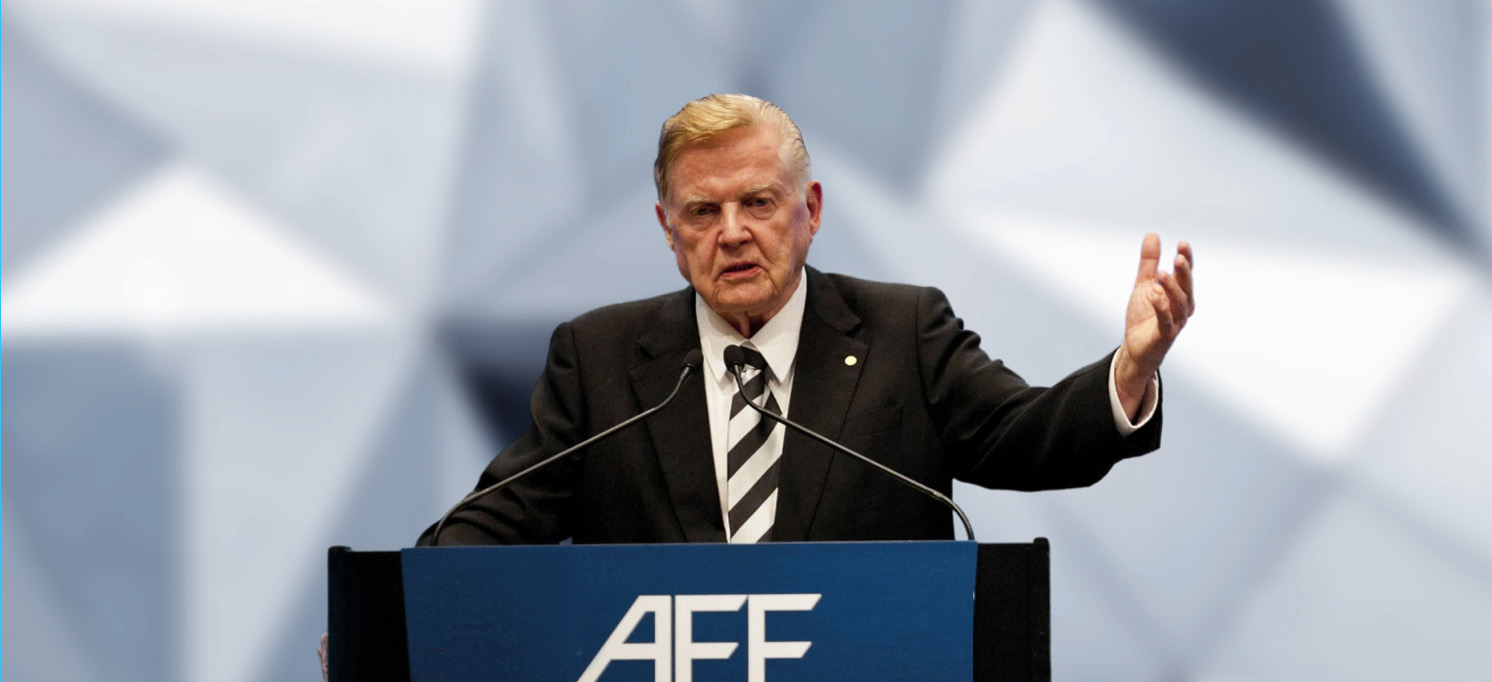
Many ideas and theoretical works of Robert Mandell for decades ahead of his time. But the scale of their subsequent impact on the understanding of the mechanisms of the global economy and the methods of regulation made it one of the influential economists of the 20th century.
“Just think, I did it all! And, I must say, I did not make a shirt, because I am not like that. I did everything in my own way, ”-these words of the famous song by Frank Sinatra My Way Robert Mandell and the chapel sang, breaking the standing ovation, at the end of his speech at the Nobel banquet on the occasion of the Nobel Prize for Economics in 1999. Mandell’s works inspired several generations of researchers, his works form the basis of teaching international macroeconomics. His research combines a formal, academic approach with the possibility of immediate practical application in politics, the Swedish Royal Academy of Sciences noted : Mandell’s work changed the very idea of how the world economy works and the principles of economic policy. One of the most influential economists of the 20th century - “Zeus of Economics”, as Mandella Brian Domitrovich, the historian of the economy and the author of the book about the economy of the proposal, called on April 4, 2021 at the age of 88, called.
All modern economists operate, as a rule, by a model of a small open economy, that is, one where a change in interest rate does not have a significant impact on the world market and where there is to one degree or another the free movement of capital is what Mandell invented. Economists reasoned before him in the paradigm of the internal, autonomous economy - perhaps it was not so unjustifiably, given the size of the US economy (where the main formation and development of economic science took place) and the fact that external factors were not very influenced by it: it was probably that the dominant worldview of Mandell helped that he was a Canadian, thinking The Economist in an article on the article on awarding the Nobel Prize Mandell.
The Mandell economy illustrates the “tyranny of mobility of capital” - in contrast to what, usually speaking of tyranny, they mean governments, writes Domitrovich. Both Keynesianism and monetarism - the concept of macroeconomics competing at the beginning of the second half of the 20th century - proceeded from the fact that governments can manage internal demand and proposal (and therefore economic growth and employment), regulating taxes, budget expenditures, and money supply. Однако что бы ни решили правительства — если их страны хоть как-то интегрированы с внешним миром, трансграничные потоки капитала могут подавить все усилия национальных властей по достижению желаемого результата, «проголосовав ногами» за любые изменения внутренней политики и не обращая внимания ни на что, кроме чистой экономики вопроса, объясняет Домитрович: прибыль после уплаты налогов в валюте, сохраняющей свою стоимость, — это маяк, который It attracts investments with the only capital in the world - global.
However, when Mandell began to develop his ideas in the late 1950s, the global streams of capital were quite small-he predicted the future development of capital markets and international currency mechanisms with prophetic accuracy, the Swedish Royal Academy of Sciences noted. His thoughts on compromises between monetary and tax-budget policies anticipated the idea that the Central Bank should be entrusted with decentralized responsibility for the stability of prices-now this has become a reality in most countries. In the early 1960s, Mandell’s articles were not accepted for publication in leading scientific journals, critics called him an outsider, and university colleagues considered him an eccentric lunatic-to wear long hair for the manner, to mention quietly under his breath and resolutely oppose the mainstream. For a couple of decades, the ideas of the Mandell himself became the mainstream: from the “impossible trinity” of international finances to a single European currency.
Despite this, the highest recognition of his merits in the form of the Nobel Prize, Mandell himself never adhered to the mainstream - and most of his colleagues, in turn, did not support his such ideas, as a return to the gold standard or the creation of universal currency. He always felt comfortable, while remaining in the minority, in 2006 about Mandella the magazine Finance & Development of the International Monetary Fund, in whose research department, Mandell worked in 1961-1963. The grin of his colleagues never cared for him . "How many Christians were there before Jesus Christ?" - He shrugged his shoulders in response when supporters of the economy were called a "tiny sect." Mandell has always been an extremely influential and unorthodox thinker - his contribution to science is partly explained by the readiness to think extraordinary, quoted in the article by the IMF of a student of Mandell, the main economist of the IMF in 1991-2001 Michael Musa.
The advantage of doubts
Childhood and youth spent in Canadian provinces really helped Mandell to formulate the foundations of international macroeconomics. Mandell was born in 1932 in the province of Ontario, his father was an officer of the Canadian army, fought in the First World War, and retired, transferred his family to a remote farm in British Colombia. There, Robert Mandell entered the university, where he said, according to him , a rather tolerable economic education - but based on classical docteinsky theory, since the Keynes ideas have made the revolution, which indicated the exit from the great depression, each dollar of which has the effect of the animator and creates jobs, before the university audience of the Canadian periphery, by that time, by the time reached.
Mandell later called this his advantage: knowledge of classical theory during his subsequent study at Washington University among Keynes's students helped him remain skeptical. Protecting in MIT a doctoral dissertation about international capital flows, written under the leadership of James Mid (received the Nobel Prize for innovative work on the theory of international economic policy in 1977), Mandell entered the University of Chicago at that time at that time at that time at that time. Friedman, who led the “offensive” on the Keynesian macroeconomics. Friedman's dug ideas inspired Mandell, but the experience of life in the Canadian province and then made him doubt one of the postulates of Friedman monetarism - about free exchange rates of currencies as a market alternative to fixed courses.
In 1950, Canada was the first of the largest economies of that period to the floating course, but Ontario and Quebec were gaining a win from the monetary policy reform, and the consequences for the country's periphery - for example, for British Colombia, were much less positive. In countries with many regions differing from each other, the depreciation of currency can help one region to the detriment of another, Mandella reasoned. To prevent this from happening, if the argument about the free courses is true, the British Colombia and Ontario should have different currencies, he suggested in 1957 at one of the seminars at the University of British Colombia, where he returned to the teacher, but it can be made to the point that every resident of the country should have its own currency. It was not about the idea of different currencies for the Canadian provinces - but about the search for a macroeconomic balance, which was embodied in the theory of optimal currency zones developed by Mandell - later it will form the basis of a single European currency.
Cross Eurozones
At the beginning of 1961, having refused two prestigious scientific journals, Mandell finally publishes his article about optimal foreign currency zones in the authoritative American Economic Review. Half a century later, the American Economic Association included this work in the TOP-20 publications of the magazine in 100 years since the beginning of its release. The question that Mandell asked then seemed radical: the scientist was interested in in which cases it was profitable to abandon their monetary sovereignty in favor of a single currency.
Mandell proposed to present a world consisting of only two countries - the USA and Canada - and two regions, the boundaries of which do not coincide with the borders of the countries - the eastern parts of the USA and Canada, where cars are produced, and the western part of both countries where lumber is produced. An increase in productivity in the East will cause an excess supply of cars and the demand for lumber, the result will be unemployment in the east and inflation in the West. The central bank of both countries will be faced with the choice: to increase the money supply in order to reduce unemployment in the East, or to reduce the supply of money to prevent inflation in the West. The flexible exchange rate between Canada and the USA, which will move in order to maintain balance in national balance sheets, will not help rectify the situation, Mandell believed.
According to Mandell, the optimal currency zone (that is, a zone with a common currency) is not countries within their national borders, but regions, that is, groups of countries between which the workforce is high enough to compensate for asymmetric shocks of demand and prices. A high degree of mobility of production factors is a key element of the combined currency zone: if capital and labor can move from a region suffering from a fall in demand and prices, to the region with excessive demand and rising prices, then it can be restored.
In 1970, at a conference in Madrid dedicated to optimal foreign currency zones, Mandell presented a “plan for the European currency”. In his work, he noted the importance of creating an euro as a currency of the region, whose collective economic power is quite comparable to the supercontaneous USA. In 1999, the idea of Mandell became a reality, he himself called the euro unconditionally successful project and the “political glue” of Europe, but the title of “godfather” of a single European currency, which was awarded by his press, rejected, saying that such a status would oblige the well -being of the “godson”.
Although European countries did not fully meet the criterion of the mobility of labor - and despite the problem experienced by the Eurozone, the introduction of a single currency led to impressive results: each citizen of the currency union received a currency that is not inferior to the prestige and stability of the dollar, and each company - access to the Continent’s scale, transferred the mandell of the dignity of the Eurozone. After eliminating the uncertainty of metabolic courses between the economies entering the currency block, hedge funds will not be able to earn a penny on operations between the countries of the eurozone, each of these countries received an effective set of measures of monetary policy, and the two-digit interest rates that existed in many of them fell, Mandell was happy. In order to fully use all the advantages of the currency union, the eurozone needs to eliminate obstacles to labor mobility, while the direction of funds to depressed regions only complicates this mobility, he complained.
It would be good to turn the whole world into one large optimal currency zone, dreamed of Mandell, admitting that this was prevented by political rivalry between countries. Until the countries are at war, the currency union between them is possible only with the “buffer” - a backup asset, which can be used as gold, although in a version that is very different from the gold standard of the early twentieth century, Mandella believed. The United States abandoned the gold standard in 1933, and the post-war Bretton Wood system of the gold-dollar standard, when all the currencies were tied to the dollar, and the dollar to gold, broke up in 1971.
The US President Ronald Reagan sympathized with the idea in 1981 created the Golden Commission, which studied the possibility of returning the gold standard to an analogue. After eight months of work, the commission came to a negative conclusion , noting that gold as goods is subject to strong fluctuations in prices and speculative attacks and therefore the binding to it leads to greater economic instability, unemployment and recessions. Andthe seeming historically stable purchasing power of the “golden” currency is the mean arithmetic alternation of periods of inflation and crushing deflation.
From the Canadian farm to the Italian Palazzo
Mandell’s mother came from a noble family and even inherited the tribal castle, but was forced to abandon the inheritance due to excessively high taxes. In the late 1960s, Mandell bought a palazzo in the vicinity of Italian Siena to save accumulations from the impending inflation: the dilapidated palace , built at the beginning of the 16th century by order of the ruler of the Siensky Republic, was put up for auction for only $ 20,000. "Palazzo Mandell", as the economists called it, became not only an investment, but also his beloved summer The Mandell residence (for the restoration of the palace, where there was no water supply or electricity, a significant part of the Nobel Prize has also been gone), as well as the venue for economic conferences, which have gathered influential economists and financiers to discuss the most daring economic ideas with the owner - up to a single global currency. The dining room of the Palazzo was decorated with knightly armor and masterpieces of painting of the Renaissance, Mandell and was carried away by painting - though in the genre of abstraction. Once his palazzo was robbed, and along with the paintings of the Masters of the Renaissance, thieves carried out several works of Mandell: the economist, laughing, said that he was flattered.
Father Reaganomics
If for Europe, Mandell is “Father Euro”, then on the other side of the Atlantic he became the “father of Reaganomics”, or the Supply-Side Economics economy , the opposite of the Keynesian theory based on the economic growth of demand for demand. In the center of the economy, the proposals lies in stimulating economic growth by creating a favorable climate for business, including reducing taxes and lifting regulatory prohibitions: according to the concept, the business will invest in the expansion of production and create jobs, and higher earnings (due to reducing the income tax) will increase labor to more active participation in the labor market due to reduction of taxes.
In 1962, when Mandell worked in the IMF, he wrote a small job in which he showed that in the conditions of fixed foreign exchange rates and limited mobility of capital, macroeconomic stability can be ensured by tightening monetary policy (in order to adjust the payment balance) and tax reduction. The idea contradicted both the then economic doctrine and the recommendations of the IMF itself, in accordance with which the United States adhered to low rates and budget surplus policies in order to attract investments and avoid the accumulation of excess liquidity, and therefore the growth of inflation. It is not surprising that the expediency of publication caused disputes within the IMF. But at the end of 1962, the idea, which seemed impracticable, unexpectedly found the support of US President John Kennedy, who announced a change in the economic policy course: taxes were reduced, the monetary policy was tightened.
In 1971, the other work of the economist showed that the same recommendations are relevant in the conditions of a flexible exchange rate. The approach proposed by Mandell, or Mundell Mix , which is still being argued about the fairness, in the 1980s, the reaganomies are formed: struggling with stagflation, the Ronald Reagan administration went to a sharp decrease in taxes (the maximum income tax was reduced from 70% to 28%, corporate tax-from 48% to 34%), and Fed - to increase bets. Later, this allowed Reagan to include the offensive in America in the list of his merits: the country came out of the worst recession from the time of the Great Depression, in 1984 the country's GDP grew by 7.2% - to the maximum level in more than three decades. Reducing taxes to stimulate a proposal was used by George Bush in the early 2000s.
The future is on a napkin
It is important not only how the “economic pie” is redistributed, but also how large it is, Mandell explained . In this case, the argument of the economy of the proposal is that the progressive scale and too high tax rates reduce the size of the “pie”, which is divided between the rich and the poor due to the redistribution through the budget: high tax rates are destroyed by entrepreneurial activity and create incentives for caring for taxes. Бедным лучше получить небольшой кусок большого пирога, чем большой кусок маленького, — а рост и расширение налоговой базы, которые должны произойти в ответ на снижение налогов, будут компенсировать это снижение и тем самым увеличивать «пирог». В 1986 году в интервью The New York Times Манделл предлагал ограничить подоходный налог ставкой в 25%, мотивируя это тем, что более высокая ставка заставляет людей искать способы уйти из-под налогообложения. «Стимулы и награды для предпринимателей должны подпитываться», — говорил Манделл, сравнивая предпринимателей с боксерами, которые в случае выигрыша должны получать награду.
Более поздние исследования показывают, что снижение налогов неоднозначно влияет на экономический рост: с одной стороны, оно может стимулировать занятость, с другой — дестимулировать, поскольку, например, при увеличении заработков семьи ей уже не требуется работать в большем и даже в прежнем объеме. Исследование Бюджетного управления Конгресса США в 2010 году показало , что каждый $1 млн снижения подоходного налога создает 3–6 рабочих мест, а налогов на фонд оплаты труда для работодателей — 3–18, в зависимости от условий и положения самих компаний, — так, высвобождаемые ресурсы фирмы могут тратить на погашение кредитов, а не на создание рабочих мест. При снижении корпоративного налога предприятия нередко направляют средства на выкуп собственных акций и повышение зарплат топ-менеджмента, а не на расширение бизнеса, показало исследование 2017 года на данных 92 американских корпораций.
Манделл работал над идеями «рейганомики» совместно с экономистом Артуром Лаффером и журналистом Джудом Ванниски: именно Лаффер и Ванниски в конечном итоге помогли убедить Рейгана снизить налоги, прислушавшись к теоретику Манделлу. Встречаясь в ресторане неподалеку от Уолл-стрит, Манделл и Лаффер на салфетках чертили будущее американской экономики, на одной из этих салфеток появилась и «кривая Лаффера» — график, описывающий зависимость между налоговыми поступлениями и налоговыми ставками и показывающий, что до определенного предела повышение ставок ведет к росту поступлений, но затем доходы бюджета начнут снижаться, поскольку чрезмерная налоговая нагрузка будет дестимулировать бизнес. Манделл вспоминал, что много раз рисовал эту кривую для своего коллеги, но признавался, что не обижается, что она получила имя Лаффера: «У меня и так множество собственных кривых».
Невозможная троица
Сам Манделл одним из своих важнейших достижений считал модель экономики, в которой, помимо рынка товаров, существует рынок иностранной валюты. Это привело к созданию революционной модели Манделла—Флеминга (Маркус Флеминг, коллега Манделла в МВФ, независимо работал в том же направлении), в которой неоклассическая модель товарно-денежного равновесия автономной экономики, разработанная нобелевским лауреатом Джоном Хиксом, была дополнена внешним сектором — чистым экспортом и состоянием счета движения капитала.
В момент разработки, в 1960-х, эта концепция, как и теория оптимальных валютных зон, была скорее теоретической. И до нее моделей того, что сегодня называется международной макроэкономикой, не существовало. «Мое поколение экономистов обязано вам всем, что мы знаем», — признателен Манделлу за это открытие бывший глава Банка Израиля Джейкоб Френкель.
Модель Манделла—Флеминга означала, что эффективность экономической политики зависит от режима обменного курса: она показывает , что при свободном обменном курсе денежно-кредитная политика становится инструментом воздействия на выпуск продукции, а налогово-бюджетная оказывается бессильной, тогда как при фиксированном обменном курсе — ровно наоборот. Из модели следует, что при свободном движении капитала денежно-кредитная политика может быть направлена либо на внешнюю цель — управление обменным курсом, либо на внутреннюю — управление инфляцией, но не на обе сразу. Инвесторы стремятся получить норму прибыли выше, по крайней мере, среднемировой, и если центробанк повышает ставки, они ворвутся и снесут любую валютную привязку — таким образом, когда капитал мобилен, а курс фиксирован, денежно-кредитная политика отражает только внешние условия, объясняет The Economist.
Это правило, вытекающее из модели Манделла—Флеминга, — так называемая «невозможная троица» (impossible trinity), или трилемма международных финансов: она гласит, что страна не может иметь одновременно фиксированный обменный курс, свободное движение капитала и независимую денежно-кредитную политику — только любые две опции из трех. Хотя эта знаменитая трилемма недавно начала подвергаться сомнению , пока она все равно остается мейнстримом в макроэкономике. Модель Манделла—Флеминга — это то бессмертие, о котором ученый может только мечтать, говорил классик экономики, нобелевский лауреат и один из учителей Манделла Пол Самуэльсон.