
Translated material
"Nuclear disbelief"
For the United States to retreat from Ukraine, the intercontinental missile systems in Russia are defiantly displayed on combat patrol routes

Persistent skirmishes interspersed with truce have been continuing in the Donbass for the seventh year, but the control line has not changed in any way since February 15, when, with the substantial support of the Russian military, using the heavy flamethrowers of the Armed Forces, first from the ruins of the Donetsk airport building, and then from the Debaltsevsky protrusion north of Donetsk. The current exacerbation, which began after the New Year, is not very different in itself from the usual Donetsk circle. OSCE observers record the growing result of violations of the ceasefire, both sides are habitually accusing each other, but there is a fundamental difference from the bloody routine of recent years: the Russian Ministry of Defense has begun unprecedented universal mobilization throughout the country from Chukotka to Kaliningrad and the nomination of troops to the borders of Ukraine under the pretext of a “control test of combat readiness after the end of the winter training period”.
After 2014, when it became clear that the conflict in the Donbass was seriously and for a long time, very serious forces and means were put forward and deployed on an ongoing basis. The armed forces of the self-proclaimed republics of Donbass were reduced to two buildings: 1st in the "DPR" with the headquarters in Donetsk and the 2nd in the "LPR" with the headquarters in Lugansk. Formally, the corps are called the "people's police" and are completely independent, including from each other. But the capable military management system cannot function in such a way in combat conditions. Operationally, the corps submit to the headquarters of the 8th Guards Combined Arms Army (8th Guards OA) of the Southern Military District (South Academy of Sciences), which was deployed in Novocherkassk in 2017. Between the Don River and the border with Donbass deployed garrisons recreated in the 16th year of the 150th MSD (motorized rifle division) 8 Guards. OA. The 150th MSD, in fact, is a double division of the six-fill composition, armed with modernized T-72B3 tanks. This is the main, permanent operational reserve of “DPR” and “LPR” in case of any aggravation of the situation. In addition, in the 15th year, the headquarters of the 20th Guards Combined Arms (20 Guards OA) of the Western Military District (ZHO) moved from under Nizhny Novgorod to Voronezh. At the same time, a subordinate 20 Guards was transferred to the Ukrainian border from Nizhny. OA 3rd MSD of the four-fill composition.
In the Crimea in the 17th year, the 22nd Army Corps was deployed. It includes the 126th separate team of constant readiness, armed with T-72B3 tanks, and the 127th special forces brigade. The 22nd Corps is subordinated to the Black Sea Fleet (Black Sea Fleet) and is listed by coastal defense forces.
Compared to 2014, the Armed Forces of Ukraine are much better ready, but the weapons are for the most part Soviet.
Given the qualitative superiority of the Russian military and their total superiority in the air and at sea to tighten any significant additional forces to the Ukrainian border to contain a possible attack of the Armed Forces of Ukraine is too.
The Ukrainian military in any case will be guaranteed to be stopped and discarded. This is perfectly understood in Kyiv, in the Donbass and in Moscow. Nevertheless, in March - April of this year, the movement of additional forces in the Crimea and to the Ukrainian border began. The “control verification of combat readiness” in the South African Science began, including the Black Sea Fleet and the Caspian Flotilla (KF), and on April 6 - in all districts and in the Northern Fleet, in the Kuril Islands, in the Far North and Kamchatka. The total number of those withdrawn "in the field" was not officially announced, it was only said about "holding 4048 exercises in April." But we can talk about more than half a million people.
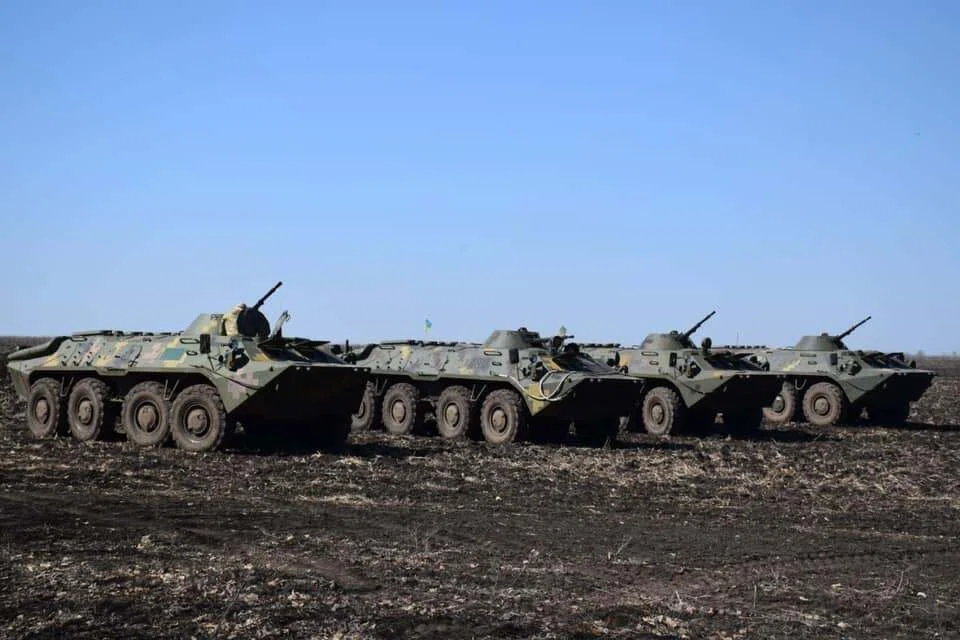
The press service of the Central Military District (CVO) reported that "over 70 thousand people" participate in the "control check" in the Central Hospital. CVO is Siberia, the Urals and the Volga region, the main rear reserve of the Armed Forces of the Russian Federation. It is reported that it is precisely the troops from the composition of the Central Military District to be transferred to the area of Voronezh, Belgorod and Bryansk - obviously, to strengthen 20 Guards. OA. A powerful group unfolds north of Donbass, which can still be strengthened by units of the 1st Guards Tank Army (1 Guards. TA) of the only tank army as part of the RF Armed Forces. More than 15 thousand military personnel 1 Guards. She have already been displayed “in the field” as part of a “control check”, but so far there are no reports about their transfer directly to the Ukrainian border.
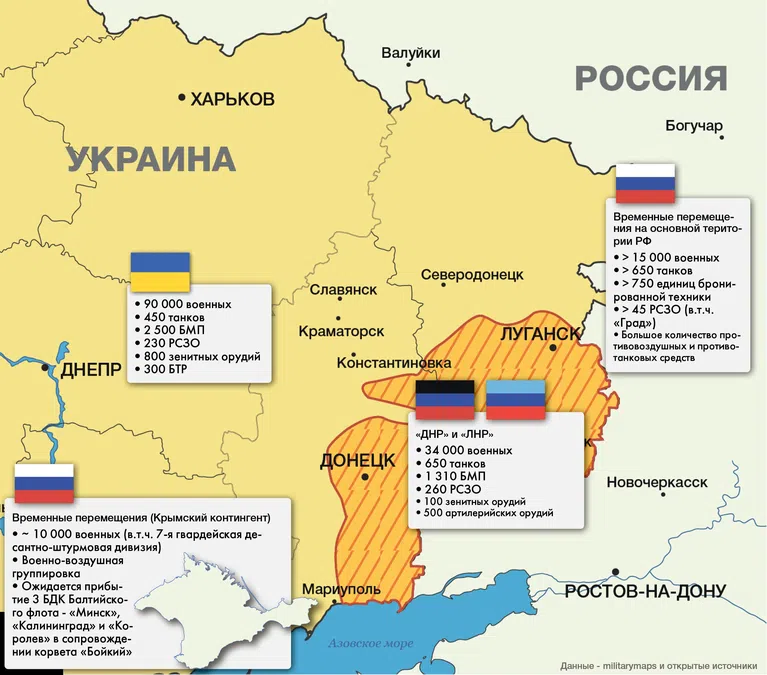
Simultaneously with the formation of a powerful group on the northern (right) flank, the Russian General Staff strengthens the left flank in the south. The paratroopers of the 7th Guards Airborne Rock Division of the Airborne Forces (7 Guards DSHD) were relocated to the Crimea, where they work out parachute landing with the capture and retention of the strategic object (airfield) to the approach of the main forces, as well as the landing from the sea with armored vehicles with large landing ships (BDK). A serious crisis with military transport aircraft (VTA) has been outlined in Russia. The main WTA WTS WTA-the Middle IL-76MD-is equipped with the D-30KP engines of the Zaporizhzhya Motor Sich plant, which are no longer supplied due to war and sanctions. The new IL-76 with the Russian engine PS-90A-76 in recent years has made only a few pieces. In the course of the Syrian operation, VTA planes were mercilessly used to transfer technology, supplies and anything, catastrophically exhausting the Park motorcycle resource. Now you have to get out. In Crimea, on exercises 7 IL-76MD, a total battalion of 350 fighters of 7 Guards was planted with parachutes. DSHD, he took an airfield where they transferred reinforcements, which later captured a piece of the coast, where the paratroopers had already landed from the sea.
Meanwhile, it was reported from London that on March 21, a group of three BDK of the Baltic Fleet, Minsk, Kaliningrad and Korolev, accompanied by the Boyky Corvette, passed through the La-Channel to the south. These are relatively new projects 775, built in the concepts of our fleet, built in the eighties at the Gdan shipyard. Each BDK can take on board and transport to the paratroopers and up to 12 tanks. The British royal Navy believes that there was a landing (Mornshi Baltflot) on board, sent around Europe to the Black Sea, where the Black Sea Fleet contains four more BDK project 775, three older BDK Soviet buildings, as well as small landing ships. On April 8, it was announced that “as part of a control verification of more than ten landing and artillery boats and vessels of the KF, the inter-Flot transition from the Caspian to the Black Sea, the Volga-Don Canal, the Don and the Sea of Azov. Obviously, on board - marines of the KF. It seems that in the Black Sea, a group of up to 25 landing ships of various classes plus dozens of combat and auxiliary ships and ships can gather. This armada is capable of landing on an unequipped reference somewhere between Odessa and Nikolaev more than 10 battalions of marines, paratroopers and special forces only in the first wave. Auxiliary tactical landings from the sea and from the air are also possible.
All this looks like a Russian General Staff is collecting forces and means for a possible “deep” strategic operation.
So far, the 1st and 2nd Corps in the Donbass, with the support of the operational reserve (8 Guards OA), connect the enemy from the front, the flank groups carry out “strategic Cannes”-an operation in the environment, destruction and captivity of the main group of the Armed Forces in the Donbass, just like in the training manual of the Academy of the General Staff. The powerful tank wedge of the right flank, striking to the south-west through Kharkov, dissects a weak Ukrainian defense, breaking through the places where no one has fought with anyone since 1943. Somewhere on the Left Bank, in the lower reaches of the Dnieper, the oncoming southern wedge from Crimea is closed with the northern one. A powerful airborne landing makes an additional element of chaos to the Ukrainian troops control system. The main Russian -speaking cities of the South and the East will be occupied by the victorious and fleet -tac out operation (Blitzkrieg). The rest of Ukraine will be deprived of access to the sea. As has recently been stated, the end of Ukraine will come as a state.
During the current “control verification”, Russian troops are advanced and unfolded almost without masking, and officials hide little. Like, Russia has a sovereign right to move troops in its territory, and on the Ukrainian border they will be kept as much as necessary based on the interests of national security. On April 1, the Minister of Defense of Ukraine Andrei Taran quoted his American colleague Lloyd Ostin, who promised, according to the Ukrainian side that "in the event of an escalation of Russian aggression, the United States will not leave Ukraine in private and will not allow the implementation of aggressive aspirations of the Russian Federation." What is really Washington will help Kyiv - it was unclear, but on April 8 it was announced that Russian strategic forces (Strategic Missile Forces) were brought into the highest degree of combat readiness as part of a “control check”, and mobile intercontinental missile systems were massively “displayed on combat patrol routes”, which Americans should clearly see from space.
Conducting a demonstrative mobilization of forces and means, Moscow sends a clear signal to everyone that is ready for any development of events, including, as announced in the Kremlin, for the worst version of the development of relations with the United States. This is nuclear deterrence: Kyiv must make significant concessions, begin to fulfill the Minsk agreements in their Moscow interpretation, return to the air, for example, pro -Russian television channels of Newsone, Zik and 112 and stop pursuing Viktor Medvedchuk, personal friend Vladimir Putin. The West must exert pressure on Ukraine so that it obeyed, and give solid -firm guarantees of the non -passage of Ukraine either in NATO or in the EU.
Then the already drawn up military plans can remain on paper, and the strike groups collected with considerable labor and expenses will gradually resolve, fulfilling the standards for the “control verification of combat readiness”. But it must be understood that the time for making cardinal decisions is limited. The collected groups cannot wait for the order, being mobilized, endlessly: they must be sent home and demobilized, trained draftees who served the year, must be sent to demobilization and replace with new ones. The “control test of combat readiness” similar in scale can be repeated, if desired, at best somewhere around September.
There was probably no similar to the scale of mobilization, including strategic nuclear forces, since 1973, when in the last phase of the War of Judgment, the Soviet Airborne Forces divisions were already sitting on the WTA planes to land in Egypt to fight, where tactical nuclear charges were allegedly brought up, and the United States in response brought its landing divisions to readiness to readiness. To fly there and fight on the side of the Israelis, and also raised the total level of combat readiness from DefCon 5 to DefCon 3 to two steps. During the Caribbean crisis of 1962, DefCon 2 was introduced for the Caribbean nuclear crisis. DefCon levels were developed in 1959. DefCon 1 - the nuclear war is inevitable or has already begun - has never been introduced into the United States, except for control checks.
The nuclear alarms of the 1962 and 1973 ended with urgent negotiations of the parties and compromises, seriously and for a long time “frozen” regional conflicts, which almost led to the guaranteed mutual destruction of the United States and the USSR. Some elements of those decisions are still holding on both the Middle East and in Cuba - they carried out “frost” so well and thoroughly. There is no regional conflict to risk turning Russia into a uninhabited radioactive desert. There is still time for negotiations. On the Great Russian Plain from the Baltic to the Black Sea, snow is in the Black Sea, there is a thaw, rivers and streams spilled on the Ukrainian left bank, which the chicken will cross in the summer, but which will now have to be forceful with the inevitable delay in the pace of a possible offensive. It is necessary for another month to wait until mid -May, when the fields and dirt roads dry out, and streams and rivers enter the shores. In addition, in the Russian Federation significant forces and funds are busy preparing for the May parade and will be released after the 9th.
But in order to “freeze” Donbass for a long time, you need to at least start a serious bargain. And now, Moscow actually has no contacts with Washington, nor with Kiev, nor with Brussels, and the ambassador Anatoly Antonov is recalled to Moscow. There are contacts with Berlin and Paris, but they have recently become invalid.
Many in Moscow believe that Ukrainian statehood is already breaking up, that a large -scale threat may be enough for it to collapse. And if not, then a powerful but short blow is enough for the chimera of Ukrainian national statehood to crumble to dust. In the 14th year, Ukrainian resistance was ineffective and disorganized. It seems that today the general opinion boils down to the fact that fools or traitors will be commanded by Ukrainians again. The forceful solution of the Ukrainian question, obviously, has influential supporters.