
Translated material
A bag without a bottom
About the novel by Vladimir Sorokin "Dr. Garin"
1
Sorokin writes with concentric circles. Gradually and methodically, he departs from the central grain-stroke and rakes on the sides, expanding the territory seized by the narrative. Filling inventive details (which is worth the inquisitive instrument “Nesmeyan”) The fictional world is growing rapidly and, unfortunately, is rapidly approaching where not only Sorokin’s characters live, but also its readers. In any case, this happened with the story “The Day of the Trap”, which infected not only relatives, but also the neighboring regions, like Belarus.
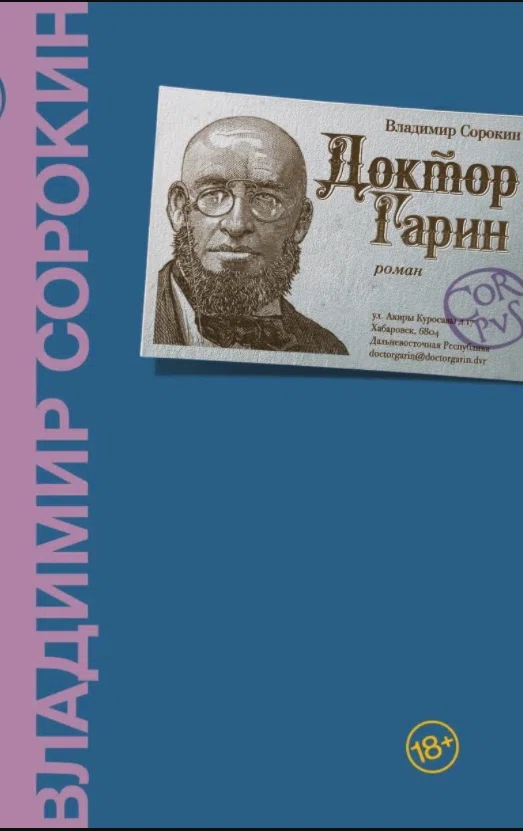
"Dr. Garin" (M.: Corpus, 2021), however, was built differently. This is not the development of previous motives, but their amount, only the prologue to which is the brilliant story “Blizzard”, which presented but by no means exhausting the protagonist.
Garin from the "snowstorm" is a conditional figure and stylized as an intellectual from Russian classics. This is a set of good -natured traditions. True for his medical duty, he is lucky to a vaccine that protects from Mora, turning people into zombies. Along the way, Garin surrenders with fleeting passion, brings with a man, hits him in the face, searches for redemption and finds him in hellish torment, under the influence of psychedelic potion.
About how it all ended, we will learn from the new novel with the new Garin. Here it is no longer on clay, like all extra people, but on titanium legs in return for those that froze in the "blizzard".
This Garin, in essence, is the first positive hero in the work of Sorokin. Mighty and prehistoric, like a mammoth with which he is more than once compared, he has many advantages.
First of all, Garin claims to be in the same extent as the novel itself, who turned out of the matrix of the conceptual school and grew up in epic prose. In a thorny excessively rich, in Sorokinsky-multi-ghost, on it-a branched, this big one in all respects the book is kept on the central image of Dr. Garin.
The profession gives meaning and nobility to its existence. He is a patient and successful doctor practicing "hypermodern" medicine (using a stamper shocker). A fervent lover. An intellectual with a demanding taste preferring Chopin Mozart. Injected to reflection, he is open to the new and accepts endless trials (“Sack without a bottom”) with the stoic courage, which was awarded by tradition. Garin, a worthy heir to such humanists as Chekhov, Bulgakov and Zhivago, is designed to carry their mission: to cure the people and straighten their brains without allowing to turn into a zombie. This, in fact, is engaged in the whole novel by psychiatrist Garin in that post-human world, where “Genetics militarists“ multiply entities without the need ”, creating“ disabled people of the spirit ”and the body.
Sorokin, who, since the time of Blue Sala, discovered genetics as a division of monsters, densely inhabited their new novel. Very small women live here, grown for a harem at the School of Emerald Wives, and very large, the size of a white elephant, personifying a mother-mother. Since the animals were forbidden to show in circuses, they have been replaced by a “human grotesque”: “Warm and cold people, pillows, winged Androgins, priests grown in Chinese gene laboratories, and shmeli boys pollinating these girls, tearing them.”
But the best specimens in this cloning menagerie, “magnificent eight” of world retired politicians who cannot be recognized by names and manners. Donald, for example, Hamit, and Vladimir knows and repeats only one phrase and the mantra: "This is not me." Publishing the Lords of our world torn by the new world, Sorokin returned to his favorite technique of metaphors and created comic creatures consisting mainly of her buttocks: an ass with a pen.
Here with such patients, Dr. Garina has to work. “Anthropomorphism,” he argues with himself, “even after the first war he gave such a crack that it is unlikely that humanity will be able to close it up. Who is responsible for everything human? Psychiatrists. "
2
The Odyssey of Dr. Garin sometimes really resembles the classic, but the author prompted one that could come up with, only “drunk Homer”. Having stringing the adventures on the journey of the hero, Sorokin generously shares the techniques of all adventurous novels, by which we miss from childhood. Here is the camp of the “sweet anarchy” with the miniature goddess “the color of dark chocolate”, and the fortress in the Old Russian spirit with Cossacks and duel, and the “Berendeevo kingdom” like broken-up, and the shelter of the drug dealers with their Buddhist potions, and so much other that a more prudent writer would have been enough for a cycle with regular continuations.
Following the campaign of the hero, who, like many in the last books of Sorokin, strives to the east and the Urals, we simultaneously get acquainted with the story of the future that we came up with - God forbid, guessed - the author. For this, Sorokin uses inserting texts. Like the intelligent, Garin lives in words, first of all, in the sayings with which he reacts to any conflict. “Do not erase hope, hope is not clothing”, “Lunch has not done blue troubles”, “A good shooter is not a creative_g”. The author of a whole book of home-made proverbs, Sorokin shares with his hero these absurd speech, which are introduced into the text in the manner of false backed: since the words rhyme, they must mean something, but it is not known-what. (By the way, there are a lot of such sayings in Chinese.)
In addition to folklore, Garina speaks about the verbal appetite of Garin, that he cannot pass by any and supposedly random text. Fragments of the read are formed in a fugitive, vague, uncertain chronicle of alternative reality - both that which after us and the one from which it grew up.
In this version of Soviet history, the protagonist - avoiding the execution of Beria, who connected socialism with Orthodoxy and began a new NEP. Further, the author prophesies, everything in the world rolls on an inclined plane: three wars with the use of atomic weapons, a fragmented country with the Ural, among others, the republic and Ryazan, among others, the kingdom. Scooters on potatoes. Civil strife and riots, including the rebellion of the “rebel executioners”.
From other apocalyptic visions, Sorokinsky nightmares are distinguished by a corporate bouquet of styles. Gathering a specially broken mosaic, we get facts from outlandishly reflections. The novel gathered excerpts from books that the villagers could write, the tale of Ivan the Zheleznoy “Spring Gryzda Gubukh”, an essay about the crazy Chekist and Evsey Voskov’s prolonged novel “Why do you need America, Johnny,” which tells about the success of the American singer, similar to the “Red Elvis” of Dina Rida, in Beriyevskaya, which he conquered the songs of the song. "I'm a little subush, I flew from Santa Fa."
Gradually, however, the inserting texts go crazy and begin to talk: six bulldozers “completed their heavy, stupe, heroic, but not elegic, incredible, but clear-me-sheet by all.” The inevitable of Sorokin Glossolalia consists of ridiculous rhymoids, stopping the run of a rod plot and forcing him to treat him with suspicion - how to inflate the reader to another way.
The most interesting thing in these different episodes that the assembled together they resemble a car passion. A stubborn fan, like me, who read all the books of Sorokin and wrote about everyone, will recognize techniques from previous opuses in inserting texts. And “norms”, and “queues”, and “thirtieth love of Marina”, and “blue fat”, where the story of the dismemberment and sale of Lenin’s body would go abroad: “The Italian Communist Party bought Ilyich’s right hand, the Communist Party of France - the left hand ...” and so on, and so on, “stored in the near dance of Stalin”.
3
The culmination of Garin’s journey from an independent, but bombed Altai to Japanized Khabarovsk with the “Furgal Street” remaining in the most integral, strong and terrible part of the novel White Raven from heroic times. In it, Sorokin with marginal naturalism and despair described the world of blacks, mutants created "in 1969, when the KGB managed to steal American genetic developments to create a super -soldier."
Based on this city legend, which wanders over all thrillers, Sorokin raised a mighty symbol from it - the last heirs of the empire. In them, “the nature of man overnight collapsed into the dark cellar of a deaf physiological htony, into a wordless interweaving, veins, giblets, mucus and blood clots, turned there, mouse, and she got out of another, with a new face, new values and goals.”
Children of artificial evolution, the Chernysh, escaped from under the role imposed by them, survived a nuclear bombardment and created their own-crooked-civilization with a city without a single straight line, which was lying, as Garin sees it, Bolotnaya Venice. The grandiose and terrible lair depicted with cinematographic clarity and asking for the screen, as if it came from an old joke: about a man who was hardly pulled out of the top, and he resists with the cry of “Yes, I live here”.
The faceless and soulless element, which has turned into the central metaphor of the "blizzard", here turns out to be a swamp, the most hopeless type of space - bottomless.
Having been captured, Garin found out what a swamp gulag is, where in brutal, but familiar to the readers of Solzhenitsyn and Shalamov, hungry, freezing prisoners under a daily threat of death are engaged in meaningless labor. The blacks who have come off from people lost interest in what we have acquired. The only thing that interests them is the mysterious means of communication with the otherworldly and powerful: mobile phones. If the cargo-cult of the savages knocked them out to build aircraft from brushwood, then cell phones from wood are cut in Chernysh’s camp. The sacred object of the main ritual: a huge stone ax, which Garin first takes as a cross. Not the “Icon and the ax”, as the famous book by James Billington about Russian history is called, and a domestic story in the presentation of Sorokin ends with an ax as an icon.
The further we plunge into his book, the less hopes remains for a happy ending. Understanding where he started the reader, the author again changes the genre, moving from a black fairy tale to a magical one. In it, like Proppa, Afanasyev and James Bond, magic objects and animal animals work that bring us to the epilogue. Only a miracle can save Garin, and it happens, for, as the doctor explains with enthusiastic trust, “a miracle is always there. And it is as natural as life itself. ”
We can believe in a happy ending, but we can take it for a hallucination, but this will not change anything. Together with the journey through the huge novel by Sorokin, we completed the revision and path of its author. "Dr. Garin" incorporated the motives of previous books where, through each episode, the character and metaphor shines through the holographic mythology.
Ray Bradbury said: "I wanted not to predict the future, but to prevent it." Sorokin, it seems, no longer hopes for this.