
Translated material
A brief story of treason

This text of Valentin Dyakonov was written as a preface to the collection of works by the art historian and critic Alexandra Novozhenova (1982–2019) “Box with pencils: texts, drawings, design”, which in June will be published in the publishing house of Gleb Napapenko, Valentina Dyakonov and Arseny Zhilyaev. The book is arranged on the principle of the folder and consists of a set of small books, the texts of which are divided into conditional thematic blocks: “Realism (s)”, “On Energy and Error”, “Bended Art and Street Mobilization”, “On photography”, “Media art”, “Collective and artistic production”, “On fidelity and betrayal”, “Institutional melancholy”. The meeting also included design and artistic works that were not previously published. Each book will have its own preface, both textual and graphic.
The theme of betrayal was not for Sasha Magistral and monographically revealed only, perhaps, in the text "Did you betray you?" (Together with Gleb Naprenko, published under the pseudonym "Anonymous ( NN ) in 2016 ). Nevertheless, some articles, where it sounds implicitly, is interesting to consider in the context of understanding betrayal as transgressive practice - wider than the activities of well -known archetypal characters: agents of the historical process (Azef, Vlasov) or images of biblical (Judas) and ancient (skill from megara) myths. This theme of phonit is also in other texts of this publication; The most sharply “school art”, where the “elegant betrayal” is the strategy of the artist Evgeny Branilshchikov. It made sense to talk about betrayal because for Sasha the issue of modern cartography of classes and the position of intellectuals of post -Soviet Russia on a scale of oppression was extremely relevant. It is impossible to develop such a cartography and designate your place on it without understanding betrayal as an instrument of social mobility and clearing political space. The instrument, especially effective due to what emissions of emotions-the traitor and the victims-causes this act, in his mythical head, rich in erotic connotations, both straight (Skill betrays his city out of love for the military enemy Minos), as well as latent (Judas points to Christ not with a finger, but a kiss). Even in the practical context of the loyalty of the creative employee to institutions, Sasha remarks, shines through the promise of sex: “Those who clearly condemn the betrayal of institutions or aggressive attacks against sponsors do not see that this obscene behavior may be a call for relations and at the same time evidence of their impossibility.”
There are many shades of betrayal, but in the field of Sasha’s research and civil interests there were two: betrayal for the sake of the highest goal and profitable betrayal. The historian constantly encounters the betrayal of these types in the history of European time, because with the advent of national states, both the weight of loyalty and its separation from a specific personality have grown. “In a medieval society - at least in Old Russian - there is no identity of the traitor” [1] , ”the historian notes. Without vassalities, personal devotion has only sentimental value. And the weight of devotion increases because it is distributed by millions of citizens, the so -called people who are tirelessly expecting from their representatives of investment in ideological mechanisms for the production of unity.
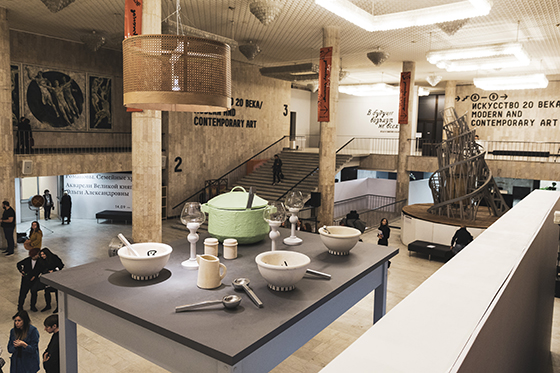 © Natasha Polskaya Alexandra Galkina. I ask under the table. 2018
As a result, almost any interaction with this one distributed by millions of persons for the future threatens a betrayal or chain of betrayal. “Each generation should find its mission in relative uncertainty, fulfill it or betray it,” wrote Franz Fanon in the “curse of the branded”. The outlines of the highest goal depend on the degree of detailing of this mission and the assessment of the efforts that betrayal will require. “Betrayal is treason to something sacred, which certainly requires fidelity,” said the conservative philosopher Leo Skvortsov in 2010. “Such sacred values usually include the family and the Fatherland ” [2] . The philosopher brought up in the atmosphere of nationalism of the 1970s uses the concepts of the Stalin era, which, in turn, was looking for formulas of unity in the 19th century, among theorists of the National State of Western type. For the Decembrists, the historian Vera Bokov notes, the “overthrow of the saint (mother, sovereign) in the name of the Holy - the benefits of the Fatherland” [3] . In a representative of romantic thought, the family fades before the homeland, but its own, that is, hereditary, the Earth still has value as a metaphysical limit, beyond which loyalty turns into betrayal. The French Revolution, invented by the Auguste Comus “Religion of Humanity”, the communism of Marx and Engels set new tasks for restless minds. The Fatherland is not as important as a common horizon - for example, proletarian internationalism. The earth itself is no longer a default resource, but the means of extraction and production, which only the bourgeoisie owns until 1917 . Creative professions are all bourgeois: if you use talents available from birth, then you act as the owner of an artistic or research machine - your speech, hands, brain. After the October Revolution, in the sympathetic communism of Europe, the writer Louis Aragon, close to the Kremlin, states that the revolutionary intellectual “appears primarily to the traitor of his class” [4] . And in the Soviet state, all classes, except for the peasantry and the proletariat, become traitors by default. A class of a alien element should die or perform violent downshift. A fist cannot be a writer, only a worker.
The problem, of course, is that creative means of production cannot be nationalized separately from their owner. This creates fertile grounds for the betrayal of its class and/or its beliefs. But the example with the creative intelligentsia is only a special case of an amazing in the scale of cultural appropriation, to the question of which Sasha was selected in one of her last texts - in the text about the race in American art. Speaking about Russian serfdom, Sasha notes that "the horror of a slave body, whose descriptions are enough and in Russian sources, there are no heirs - everything is too far away, and no one will say that his Edip is constructed through the slave position of their forefathers." And no one present the rights to injury to slavery precisely because in exchange for means of production belonging to the bourgeoisie and aristocracy, the direct heirs of serfs had to make their victim, declaring its redeeming intensive rituals of the “religion of mankind”. This is a victim that was (and remains!) The negative space in political self -awareness and could develop in Servitude (by analogy with the decolonial négritude Leopold Sengor). It is worth noting that in the “Golden Legend” of Yakov Vuragin, a collection of lives of Catholic saints, an apocryphal story about Judas is given, in which the biography of the traitor develops similarly to the life of Oedipus (Judas also kills his father and marries his mother). Perhaps this is a valuable indication of their fundamental similarity: you can structure your Oedipus only by realizing edemature as a betrayal, not an accident. (The injury of the Fatherland and religion freezes like lava at a distance, so Herzen and Joyce better understand the homeland, being beyond its borders.)
 © Natasha Polskaya Alexandra Galkina. I ask under the table. 2018
In addition to the historiosophical issues that Sasha examined in direct connection with the current agenda, the betrayal cannot but talk as part of the institutional criticism - the genre, which in Russian invented it was she (together with Gleb Napapenko). Thanks to them, we see why “inside the capitalist ethics, the desire to create a trade union looks like a betrayal of the employer: after all, the employee must be grateful to the capitalist for the fact that, like the creator God , he“ created ”jobs or sponsored one or another project with his“ giving hand ”.” Neoliberal employer creates a mobile, landless fatherland for hired workers. The trade union here is the highest good. “But fidelity to the trade union - the structure that is opposing the corporation - in turn, can become a new form of pathological loyalty, which will block the transition from the struggle for labor to the struggle for political rights.”
It turns out that “betrayal is necessary for something else-but it is impossible to know why it is actually committed,” writes Sasha. Great questions of the formation of professional and supranational unity have a tendency to dialectical self-destruction again and again, in bad infinity, until some politician forces his asset to stop at one part of the triad (asis or antithesis, if he is a revolutionary, a synthesis-if a conservative). Such a politician will give an oppressed illusion of a straight line, progress. (Late Benjamin in the theses “On the concept of history” will notice, “how expensive it costs our usual thinking, the idea of history, avoids any connection with the representation with which these politicians do not want to part” [5] .) Party, which does not bear the treasury connotations in Sasha, will adhere to this line: “Partyness can be the mental structure that will not allow the subjects of the capitalist Discourse, fascinated by images mediated through the gadgets (own and each other), bog out without a trace in the Lakanov “concentric hallucinations”. ” Sasha does not serve “phallic power” in Sasha, because it does not use narcissistic empathy, which means it excludes the moments when “self -true compassion becomes a native of the sweetest pleasure.”
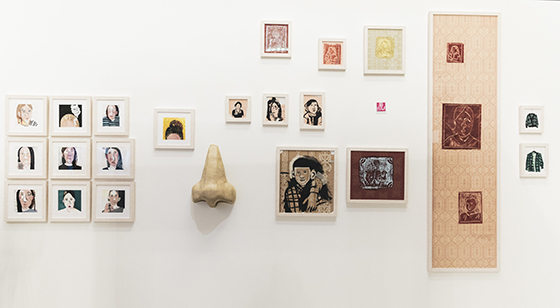 © Natasha Polskaya Alexandra Galkina. I ask under the table. 2018
 The idea of a party community appears in Sasha in situations where institutional construction in Russia creates hybrid forms of loyalty and treason. For example, after a review of the Grisha Bruskin exhibition at the Drummer cinema - the site, which at that time belonging to the publisher of the magazine Arthronika (we publish a review here), Sasha was banned from printing in the journal. The incident without names and details is described in the text “Have you been betrayed?”, But this story has a continuation: under the pseudonym, Sasha was published in “Arthronika” and after the ban. Those who knew about this betrayed the institution with Sasha, but also sabotage the deeply immoral connection of the exhibition and the criticism. If we forget about specific cases, it is necessary to state that it is difficult to separate the commercial community or institution from the spontaneous (the difficulty is that inspiration from a single impulse is not necessarily associated exclusively with the general good, and not with the class benefit from the use of any resource, for example, intoxication, in this fit). It is even more difficult to say that the general good is clear on the explicitly declared principle of assembly of this institution. Suppose there is a commercial institution that claims that it is commercial. And there is another that declares itself as non-profite , but improves the image of the Creator with efficiency, which cannot be achieved by targeted investments in PR. The image of non-profile institutions as those who act as a reputation is also ambiguous. On the one hand, they cut off oilfallars. On the other hand, “the dependence of art on the general logic sometimes-but only sometimes-can not be directly illustrative, gleamal, but to be in antiphase to the forces and systems significantly exceeding the possibilities and strength of art itself.” This antiphase as a virtuosity of the deconstructive community of the representative of the representative is described most vividly in the text of Sasha about the art of Alexandra Galkina (“the most diligent” (2019)): “The meaning that bears the lipstick-monument in the contour is the invention of a woman-resident woman who has learned to jump from the meaning of the meaning of the abstraction-and Back, at the same time “raising” the monument to this female cynicism. ” The feminist betrayal in Galkina, revealing the potentials of the comic in the potency of the comic potency, is also directed against the Fatherland - “phallic power”, which only large narratives about the square as space or insight are useful. In its limit, feminist betrayal becomes environmental treason to all humanity for the sake of the planet. So far, this betrayal exists only in the space of science fiction, in the film Gilliam “12 Monkeys”, where the most feminine and soft character of the second -plan, with the help of the virus, returns to the streets of American cities of bear Grisley and other animals.
[1] O. Tomev. Red Leftsha: The theme of Judas's betrayal in medieval legal discourse // K. Levinson (ed.). Betrayal: experience of historical analysis. - M.: Ivi RAS , 2012. S. 98.
[2] L. Skvortsov. The phenomenon of betrayal: the cultural aspect // Culturology: Digest, No. 4, 2010. P. 227.
[3] V. Bokova. The era of secret societies. -M.: Realities-Press, 2003. P. 247.
[4] Cit. by: V. Benjamin. Author as a manufacturer // The Doctrine of Podoby. Mediaesthetic works. - M.: RSU, 2012. P. 154.
[5] V. Benjamin. About the concept of history // Ibid. S. 243.