
Translated material
A police journalist in the form of a policeman came to a rally in St. Petersburg and made a report “from under the took the regime”. We talked with him
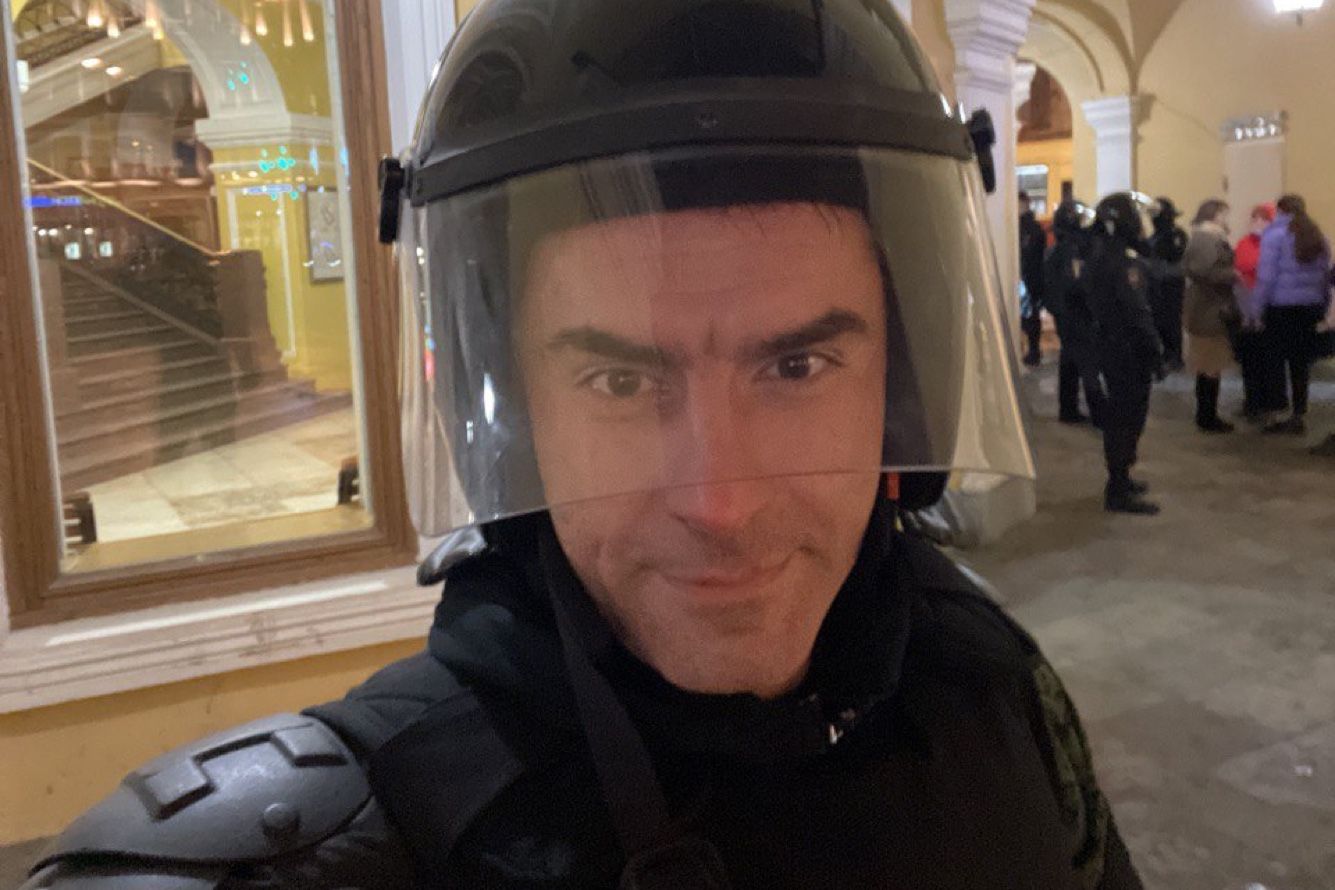
On April 21, shares of solidarity with Alexei Navalny were held throughout Russia, who held a hunger strike in the colony on March 31. In different cities, almost 1900 participants were detained at rallies, more than 800 of which were in St. Petersburg. The most stringent detentionstook place here. The day after the promotion, the journalist of the 47news local site Viktor Smirnov issued a report “Visit from under the took the regime. As a 47news journalist, he turned into a goat and a bastard ”, in which he spoke in detail about a rally from the point of view of the security forces - and the journalist came to the action in the form of an employee of the Ministry of Internal Affairs. Its text does not describe the cruelty from the security forces (for example, the blows of protesters with a stamper), but there are complaints of police officers against inadequate demonstrators. “Medusa” found out from Smirnov how and why he made this report, what she thinks about protests and what reaction to his text was expected from readers.
- How did the idea come to make a report from the point of view of a policeman?
- There are hundreds of thousands of publications, reports and journalism [about protests]. But all of them are from the protesters. I myself went with a crowd at rallies in January, made reports like colleagues from other publications. And then we in the editorial office realized that there was no report from the police. This is just a new topic. We decided to do it in a new way, at the counter.
- What goal did you set for yourself before writing this text?
- The journalist is trying to describe reality - on one or the other. For example, if the policeman has a lace, then this is part of the report. If the protester has untied the lace, this is also part of the report - but already different.
The principles of [journalistic work] did not change. Judges cannot be made, since these are already journalism. You can observe and describe. The purpose of the report, if he is from the protesters, is to place a person in the crowd. From the police side, our goal was to put a man in a cordon.
- How did you manage to agree with law enforcement agencies?
-The policeman of the Ministry of Internal Affairs in St. Petersburg and the Leningrad region, like other departments, has the task of somehow covering their activities. For example, every morning to reporters comes from them a newsletter. If someone is detained, then we are also informed.
But the security forces understand that their presentation is somewhat official. And why not try to do this a professional journalist, and not the one who just stuffs reports about incidents?
I think it's good. Because the more law enforcement agencies will attract [journalists]: “Here is a platform and body armor,” the more equal the opinion will be. Because now we have [in the texts] a continuous "bloody regime and security forces." I actually actually apolitical, and it was precisely to the report.
- That is, you yourself came to them with the idea of “humanizing” the work of power structures?
- If you constantly write the same thing, then the reader becomes less interesting, and the journalist. And here is a new line, the side of how to expand this chubby cube. This is journalism and a new topic. There was a completely pragmatic approach.
- Who exactly did you agree with?
-There are no connections with the police, there is no conspiracyology. We turned to the official press service of the Main Directorate of the Ministry of Internal Affairs [in St. Petersburg and the Leningrad Region]. It came to us the idea, we said: "Guys, you can stand up for the line of cordon and see what is happening?" They thought and decided. We were convincing with this idea, and therefore we managed to agree. Maybe the head of the Ministry of Internal Affairs somewhere in Vologda also wants this, but no one [of journalists] comes to him.
-Have you passed some special preparation for a report?
- This is not a special operation. There was no special training. Yes, and I can’t imagine what preparation should be so as not to get lost at the rally, if you just told you to stay nearby. The only thing is that you should not fall from the weight of the body armor.
I just asked what time to be on Palace. They said to come at 16:00. I reached Palace.
- Hello.
- Hello.
- Are you a journalist?
- Yes.
- Here is a body armor, we will equip you, and then we will attach you to the unit.
- All employees knew that you were a journalist?
- 99.9% of the staff did not know that I was a journalist. On the spot, they showed me which commander and units should be held and be near. Because if a policeman who does not know, guesses that there is not a real policeman nearby, then tough sanctions can be applied, since they do not like “mummers”. I held on to the commander who was in the know.
- What were the sensations during the rally?
- I tried to transfer my feelings into a report. How did everything go? How did it rain? How was the rally? My task was not to evaluate the police or protesters. The task was to show readers how what is happening from the police looked. So, as no one still showed it. I did this for the first time. And I googled and did not find to do something like that.
- What surprised you during work near the police?
- Even before getting into a cordon, I assumed that everything would be like with journalists who are discussing not only working things in the smoking room. As with the cooks who prepare and discuss something of their own. In fact, I heard this - completely everyday things.
The castle commander clearly calls the wife and takes out the brain: "Buy a loaf." The other complains that the uniforms have not been given, or [reasoning] "a mortgage is not a mortgage." Still others are discussing girls. The fourth is the problem of how to accumulate and fix the car. I did not hear from them the discussion of politics: good Navalny or bad.
And we, looking at the "astronauts", see only aggression. Maybe one of them is pathologically “charged” for this, but I think this is an error. For protesting protests, this is an event, but for them it is a job. Not every day these are rallies, but every day they are on duty at night, resolve something and delay [drunk] on Duma street. Here [during a rally] there is simply more movement, more tasks and coordination.
The security forces are not demons who are “charged” in the basements, so that they grab all, beat and kill everyone. Paradoxically, but people go to work and do it. And I tried to show it through everyday.
- Why didn’t you write, for example, about the stun gunners that actively beat the protesters?
- I did not write about the shockers in the report, because I did not see them, and they did not give it to me. I myself wrote two days before the rally that the police were given shockers - about 200-300 pieces. But I myself did not see the application. If I saw, wrote. But this is a report, you can’t invent.
- Those who surrounded you did not use shockers?
- Maybe [this] is due to the fact that I was more in the area of Nevsky Prospekt, and they were not allowed there through the fences. But how can I come up with? Inflap the situation and say: "And I heard, they have stun gunners!" This is not journalism, this is a hype for the sake of hype.
- How do you feel about the actions of the security forces during this rally?
- During the rally, I stepped aside a little. I managed to see the work not only of the units to which I was attached, but also those that were nearby. But there was no rigidity with me.
- What reactions were expected to this text and which one in the end they collided?
- The reader response was both predictable and unpredictable. Extremely oppositioned people said: “Oh, journalist, scoundrel! Where are we going? " And some of the readers were appreciated that they had not yet shown [protests]. I received a lot of responses that it is interesting and unusual. This is the goal for which the report was made. And everything else: “Yes, be cursed, but the journalists of the villains,” is the background and spam, which is inevitable.
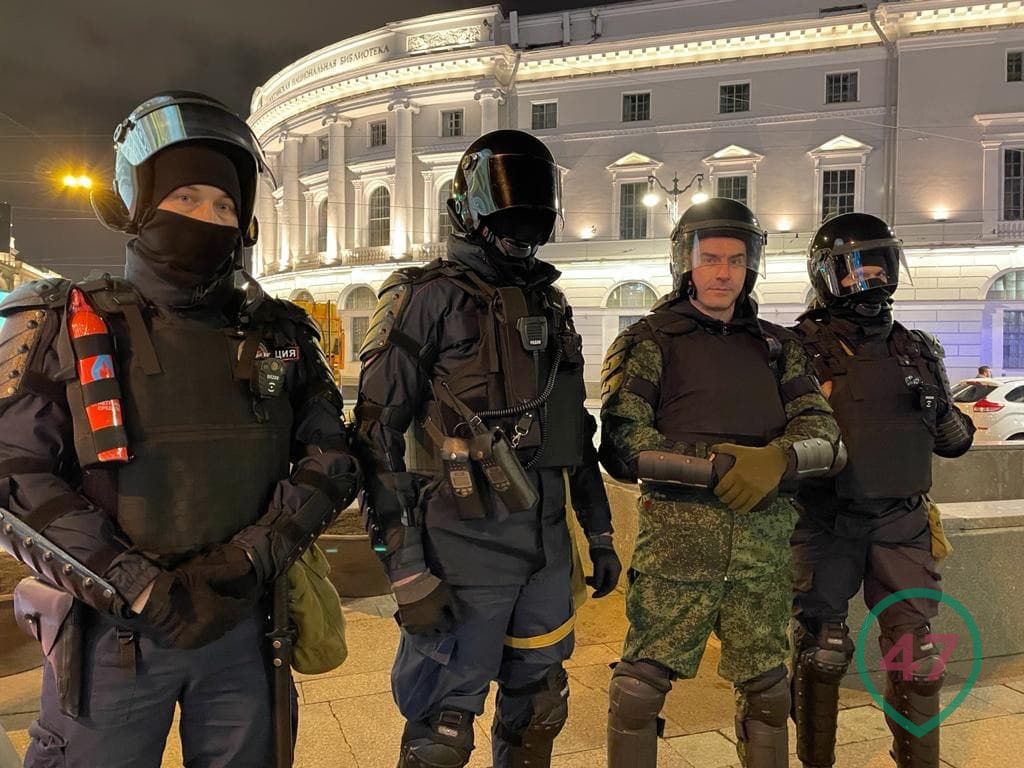
-Because of this, the material, among other things, accuses you that you sided with those who beat both protesters and your colleagues. What do you think about it?
- A person who is passionate about one side or idea is permissible to think so. As a journalist, it is unacceptable for me to be passionate about one idea. I can’t imagine that if we make material about the corporate conflict, we will not call two sides [conflict].
In any material ( political nature, murder, incident), all parties must be asked. From the point of view of protest promotions and rallies, we saw a skew. Yes, we cannot systematically illuminate rallies from the security forces - for this the police should have its own employee. But for the first time it is interesting and necessary. I don't care about other opinions.
- How do you feel about protests?
- At the level of sensations, I am not interested in politics in our country. For example, in the UK, a policy is incendiary, but we are not interested in us - on the one hand or on the other. The journalist who said that someone was good and someone bad-he already ceases to be a journalist. Or when it gives 99.9% [places in publications] only one side - this is the journalism of beliefs. But the belief to the description has nothing to do.
- At the rally on April 21 - in the form of the police - did you feel protected? After all, you will definitely not be detained, since you are on the side of those who delay.
- This time, being in a police uniform, I felt even less protected than on the side of the protesters. Because there were incidents when they delayed the dressed up jokes. And this happens non -hazardous. Therefore, there was a feeling of danger. After all, if it turns out that I was brought into another unit and people with batons and body armor will understand that they are clearly a stranger in their system and, moreover, a stranger - a journalist, then ...
- And before you were not delayed when working at rallies?
- At the last rally in January, I was detained. He shot on the phone as they cheerfully delayed a person, and it seemed to the riot police that I was a participant in the action. Although I had a sleeve with the inscription "Press". I was led to the bus. I was there for an hour - and made a report from there. Ironous report from the bus, without screams, ahi and snot.
So, of course, I would not want journalists to be detained at rallies. But the water is wet, the sky is blue, and the journalists are detained. But journalists do not need to be detained - they do their job as much as their police. After all, it would be strange if the journalists attacked the police and prevented them from doing their job. Everything is mirrored here.
Talked Alexander Sivtsova