
Translated material
Deputy Prime Minister Khusnullin suggested uniting rich territories with the poor
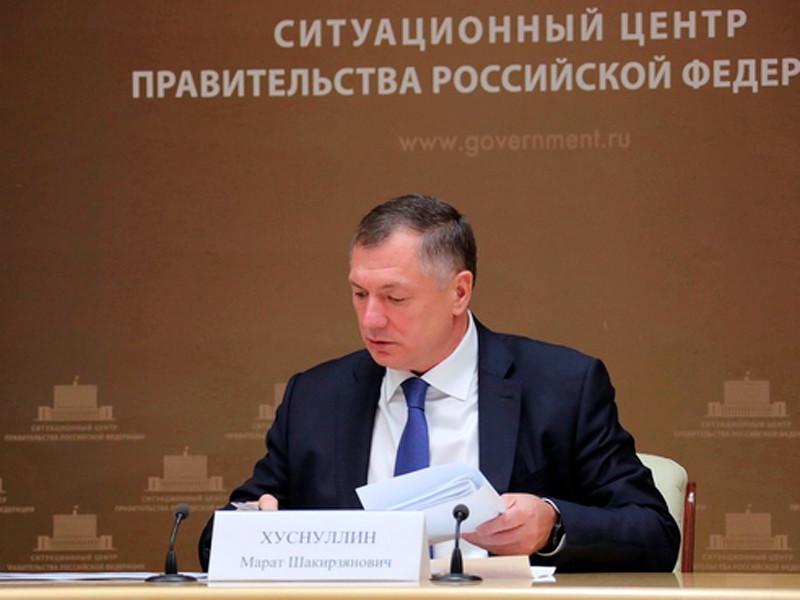
The current principle of the Russian administrative-territorial division is "wrong", so many regions are not needed by the country, Vice Prime Minister Marat Khusnullin said and proposed uniting rich subjects of the Federation with the poor.
“We don’t need 85 regions. I don’t want to deal with the Jewish Autonomous Region, I don’t want a labor cost from the point of view,” the official said at the round table “House, Road, Hailing: Development Scenarios, Councils, Waiting, Risks”, organized by the Higher School of Economics. However, Khusnullin made a reservation that his words were only a “opinion”, and not an official position agreed with the government, RBC reports.
According to Deputy Prime Minister, regions such as a Jewish autonomous region must be united with neighbors, "and let the governors deal with them." "Or Kurgan - why should the Kurgan residents live worse than the Tyumen people? Some have oil revenues, others do not have, do we have residents of another country?" - expressed dissatisfaction with the economic differences of the regions of Khusnullin.
According to him, in Russia "there are a number of regions that are not able to do anything." “But these are the governors, each device has a device, he comes to my meeting, comes to the president, takes our time. Therefore, I think that you need to enlarge the regions,” the Deputy Prime Minister emphasized.
He also cited Tatarstan as an example: “I grew up in the city of Chistopol, it is 100 km from Kazan. And exactly after 30 km, the municipal village begins in which there is oil, but there is no oil in Chistopol. Here in the municipal village due to the fact that there is oil, they do not know where to put money, because they pay even local taxes that the oil company pays for everything - it is enough for everything - it is enough to navigate Streets, schools, and exactly 3 km after 3 km there are not a single ton of oil and residents in the city with a population of 60 thousand live with a budget of 1.8 billion rubles.
The representative of the Deputy Prime Minister said that during the conference, Marat Khusnullin "voiced exclusively options for the development of cities", and "the issue of uniting regions on the site of the Russian government is not worked out."
"Marat Khusnullin calls the" Growth Point ", the agglomerations, the creation of which interferes with the administrative division. As an example, the Deputy Prime Minister was also cited by Kazan and the city of Volzhsk of the Republic of Mari El located 40 km from it: “All the residents of Volzhsk live and work in Kazan, but they have a completely different budgetary provision. Why does Volzhsk should not be in agglomeration? Let it be part of the Republic of Mari, but the budgetary rule, including real estate taxes, need to be regulated not by the administrative principle, not according to the administrative principle, not according to the administrative principle, not according to the administrative principle. And to determine the boundaries - either it should be a district, or agglomeration, or such a municipality, where there really will be a single tax base. "
According to Khusnullin, he will “return after the September elections” to discuss this topic of agglomerations. According to him, also 20 thousand municipalities are also needed: “We are in the strategy of“ aggressive development of infrastructure ”(Khusnullin heads the group of the same name, created on the initiative of Prime Minister Mikhail Mishustin to develop a program of socio -economic development until 2030. - approx. RBC ) was discussed - 21 main agglomeration and growth point and 3 thousand. The supporting points of the interregional.
A year earlier, in February 2020, Khusnullin himself called proposals for the unification of the Russian regions "provocative". “Nothing needs to be united. Today, those who want to work have all the possibilities: there are national projects, there is a management structure. We must find the ways of interaction,” the official said in the first interview given after appointing to the post of deputy prime minister.
In 2016, the speaker of the Federation Council Valentina Matvienko stated the need to enlarge the Russian regions. "There are subjects of the Federation who are definitely not viable independently for objective reasons, and not because there are bad governors," she said. The speaker suggested enlarging the regions on "economic, investment and other" grounds.
The process of an administrative association has already taken place in the Russian Federation in the "zero" years: in 2005, the Perm region and the Komi-Permyak Autonomous Okrug united in the Perm Territory; In 2007, the Krasnoyarsk Territory included Taimyr (Dolgan-Nenets) and Evenki Autonomous Okrugs; In the same 2007, the Kamchatka Territory was created from the Kamchatka region and the Koryak Autonomous Okrug; In 2008, the Ust-Horde Buryat Autonomous Okrug became part of the Irkutsk region, and the Chita region and the Aginsky Buryat Autonomous Okrug united in the Trans-Baikal Territory.
According to the results of the process of unification, the number of regions of Russia was reduced from 89 (at the time of the adoption of the 1993 Constitution) to 83, as six of the ten autonomous districts ceased independent existence. After the accession to Russia in 2014 of Crimea and Sevastopol, the number of constituent entities of the Federation increased to 85.
Aleksey Kudrin, as the head of the Center for Strategic Development, in 2017 proposed to create enlarged agglomerations of Yekaterinburg - Chelyabinsk - Perm or Tomsk - Novosibirsk - Barnaul. In 2020, he repeated his thought, offering to think about the integration of Yekaterinburg with Perm and Chelyabinsk.