
Translated material
Jeff Bezos has challenged the NASA decision to allocate SpaceX $ 2.9 billion to create a lunar landing module
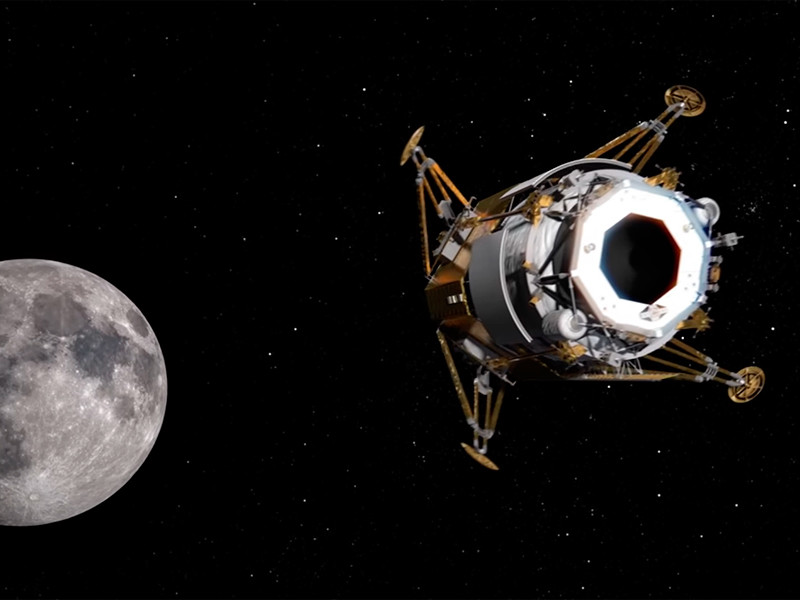
The Blue Origin aerospace company, created by the founder of Amazon, Jeff Bezos, on April 26 challenged the NASA decision to give a contract for the development and creation of the lunar landing module of SpaceX, which is headed by Ilon Musk, the second after Bezos in the list of the richest people in the world.
Recall that about a year ago, NASA allocated to three private American companies $ 967 million for the further development of their lunar landing modules. Then the contracts were received by SpaceX, Blue Origin and Dynetics, and SpaceX was the winner last week, which will receive $ 2.89 billion under the contract. At the same time, it was previously assumed that victory in the competition would be given to two companies to stimulate competition and insurance in case of problems with one of the projects.
The Blue Origin submitted to the Main Control Department of the United States (GAO) of the complaint on 175 pages says that "NASA made an erroneous purchase <...> and at the last minute changed the rules of the game." “In the words of NASA, it made a choice in favor of“ risk of a high degree ”. Its solution eliminates the possibilities for competition, significantly narrows the supply base and not only delayed, but also jeopardizes America’s return to the moon. Therefore, we protested to GAO,” TASS fragment quoted.
It should be noted that the landing of astronauts on the Earth's satellite after a long break is planned to be carried out as part of the Artemis ("Artemis" program) for the development of the moon. The plan provides that the Sls Slogue Supreme Consumer Waste will deliver the NASA Orion ship with four astronauts to the lunar orbit. There, two of them will go to the landing module created by SpaceX (apparently, it will be in advance in the lunar orbit, where it comes to the Orion ship), and will be poisoned to the surface of the moon. They will spend about a week on the satellite, and then return to Orion, which will deliver the entire four astronauts to Earth. NASA emphasized that at least one woman will enter the crew of the landing module.
The exact dates of the landing are not called, but the first unmanned lunar launch of SLS with the Orion ship as part of the Artemis-1 mission is scheduled for the end of 2021, and the first manned launch (Artemis-2 mission) may take place in 2023. In these missions, the ship must fly around the moon and return to the ground. A flight with landing should take place later - earlier it was about the landing of astronauts on the moon in 2024, but most likely it will be possible to implement this plan only after 2024.
SpaceX reported that a special modification of the Starship ship will be used to plant astronauts on the moon. Now the company is actively developing Starship, but the jumping trials of the four prototypes ended with explosions before landing, during it or shortly after landing. The terms of the first launch of Starship into space are unknown and depend on the results of further testing of prototypes. In addition, SpaceX has never experienced Super Heavy - the future reusable first step for Starship.
Blue Origin introduced the project of its Blue Moon landing module in 2019. The device is planned to be equipped with the BE-7 oxygen-water engine, and the company intends to use it for delivery to the moon of both people and goods.
In February of this year, SpaceX received a NASA contract for the launch of the first two modules of the future Gateway International Station, which will be in the orbit of the moon. The creation of the station is part of the Artemis program. The Gateway station is planned to be used to study the Earth’s satellite and the far cosmos, as well as as an intermediate point for manned flights to the Moon and Mars.
Earlier in NASA they were going to use the SLS launch vehicle for launching the Artemis station, but due to the protracted development of the rocket in NASA, they revised the plans and began to involve private companies in the program. The contract with the SpaceX value of $ 331.8 million provides that the company will not launch the PPE energy-motor module and the inhabited Halo module using its Falcon Heavy launch vehicle. Before this, the modules will be interconnected, and to launch SpaceX will require a longer head fairing for Falcon Heavy. Maxar and Northrop Grumman, respectively, are engaged in the development of PPE and Halo modules.