
Translated material
Notes of the fascinated
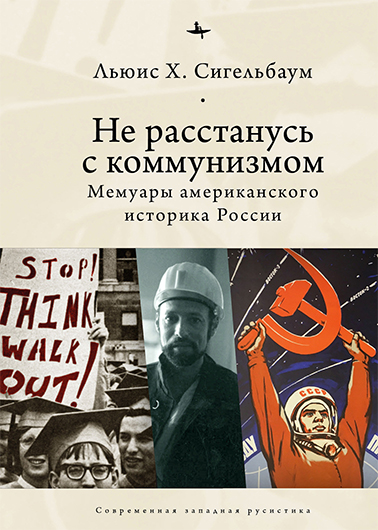
What is interesting for Russian history for a foreign researcher? What determined the development of historiography over the past half century? And can the ideals of communism - even after the failure of the Soviet socialist project, is still relevant? These are only a few of those questions that the famous American historian and researcher of Russia and the Soviet Union Lewis Sielbaum is trying to give an answer in his memoirs. His book is a story at the same time about himself, and about views on the craft of a historian, and about the rapidly changing political and intellectual world of the second half of the twentieth century.
The memoirs of Siegelbaum continue a series of memoirs of famous American Russian historians who have been published in recent years. The dramatic memoirs of Richard Pipe “I lived. The memoirs of the non -disclosure ”(M., 2005), translated, by the way, into Russian, and memories - so far uneathered - shawls of the FICPARIK“ Spy in the archives ”( “ A spy in The Archives : A Memoir of Cold War Russia ” (2013)). Released with a difference of several years, these publications belong to the pen of historians of different generations. In the study of Soviet history, Pipes adjoins the “totalitarian” school, which determined the face of Western Russiastism in the 1950s and 1960s and focused on politics and ideology. Fitzpatrick and Siegelbaum, for their part, are vivid representatives of the generation of “historian historians”, who, as the already established historiographical narrative says, in the 1970s challenged the “totalitarian” school and suffered emphasis on social history, trying to rewrite the history of the USSR from the prospect of “from below”. Siegelbaum memoirs reveal what exactly the views of the historians of his generation were determined and what political and ideological context influenced the change of directions in historical science.
The decisive factor for the development of the views of Siegelbaum was his left political environment. Belonging to a secular Jewish family from New York , the author could well turn to Russian and Soviet history because of an interest in family roots: among his ancestors were immigrants from the Russian Empire. However, according to him, at the first stages, the communist views of his father played a decisive role in choosing the sphere of scientific interests. Belonging to the older generation of the American left-wing and being a member of the US Communist Party since 1939, Siegelbaum Sr. deeply sympathized with the USSR as "the stronghold of the struggle against American imperialism." During the years of McCartism, he even suffered for his beliefs, having lost the place of a school teacher in New York -along with hundreds of other teachers who were cleaned from the school system because of his communist beliefs.
 © Academic Studies Press
The left views of the family motivated Lewis Siegelbaum to the fact that in his student years he himself almost became a revolutionary. As a student of Colombian University, he participated in the protests of 1967-1968 against the war in Vietnam. The author describes how he walked in the ranks of the hundred thousandth student column with a protest march along Washington and was a participant in a riot at Columbia University, during which protesting students organized committees, put up patrols and built barricades against the police around the perimeter of the campus. Combining the story of the past with a critical reflection of himself and about the people surrounding it, Siegelbaum emphasizes the naivety of the then students who risen then (including themselves), who sincerely considered themselves part of the “universal movement against imperialism”, felt their solidarity with Vietnamese peasants, participants in the Prague Spring and protesting students and workers in France and waited Revolution, which “ is about to happen” (p. 50).
In the headline of one of the chapters of Siegelbaum, the fateful question makes a “revolutionary or a scientist?”, Which he already allowed in Colombia during his studies in favor of the second. Nevertheless, left -wing ideas determined the sphere of his scientific interests, in the center of which Russian and Soviet history was: after all, it was the USSR that seemed to the Western left -handed antithesis of the capitalist world. Describing how the topic of his research has changed over time, Siegelbaum notes that at first he turned to a period directly preceding the 1917 revolution. His doctoral dissertation, already defended at the University of Oxford in 1975, was dedicated to the history of the Central Military-Industrial Committee in the Russian Empire during the First World War. The author tried to show that “wartime interclassing” in Russia was doomed to failure, despite the efforts of the “Russian bourgeoisie”, and that this among other factors paved the path of the Russian revolution. Describing the practical circumstances in which he had to work, he also notes the restrictions that the researchers-Russian researchers faced. The archives of the Soviet period until the end of the 1980s remained closed for the vast majority of foreigners, including those who, like Siegelbaum, sincerely sympathized with the Soviet Union. That is why the topic of his research, like many other foreign scientists, was limited by 1917 censorship. To gain access to the documents of the pre -revolutionary period was then much easier.
Directly Soviet social history, Siegelbaum took up seriously later, after the defense of the dissertation. He received a teaching post at the University of La Tob in Australia, and then, in 1983, he moved to the University of Michigan in the USA, with which his subsequent academic career was associated. It was at the turn of the 1970s - the 1980s that the popularity of social history pushed him to study the Soviet working class of interwar time. Under the influence of the epochal book E.P. Thompson, who studied the formation of the English working class, Siegelbaum switched to the labor history and tried to understand what this means to be a Soviet worker. In his book about the Stakhanov movement and in works on social history of the 1920s, he sought to explain, “how the Soviet government tried to teach workers to work better by all means and how the workers reacted to these efforts of power” (p. 145). He found that the workers did not so much try to make a leap into the utopian future, as they completely pragmatically built relations with the authorities, while possessing an essential autonomy in their actions.
The appeal of Siegelbaum to Soviet social history is noteworthy by the fact that it was due by no means that did not open access to the archives, but a changed intellectual context. Not only the archives remained closed, but even the library requirements for the issuance of Soviet newspaper bindings, in particular local and factory newspapers, in the Lenin library regularly returned with the note “stelled”. As a result, the Siegelbaum window into the world of Soviet history of interwar era, as again for many historians of its generation, became the same documents as for the entire American council of the previous period: the materials of the Smolensk party archive captured during the war by the Nazis, and then confiscated by the Americans, as well as an interview of the Harvard project about Soviet social history.
Despite the division into historiography, the division into historians - “totalitarian” and “revisionists”, into generations of “fathers” and “children” in American Russians, Siegelbaum shows that both of them and others not only often relied on the same sources. As follows from his description, it is even more important that he himself adopted a lot from historians of the older generation, and his “revisionism” in many ways was not a break with the former historiographic tradition, but partly its continuation. Siegelbaum describes how, while studying at Columbia, and then at the University of Oxford, he talked with Leopold Heimson, a famous historian of Menshevism and the author of significant articles about Russian social history. On the pages of his memoirs, Haimson first arises as a “red -haired professor” by Colombian University, who “climbed into the department” in front of the rebellious students of Colombia during their performances of 1967-1968 . Referring to his authority of the specialist in the Russian revolution, he tried with fervor to convince them that they were no revolutionaries, but, on the contrary, betrayed their “revolutionary dream” with their actions. Even more Siegelbaum emphasizes the influence of Moshe (or, as he was called, Misha) Levin, who also turned to social plots previously. “A low but tightly built Jew from Eastern Europe”, who fled from Vilna before the Nazis arrived, and then spent to the officer in the ranks of the Red Army, Levin was one of the most authoritative Western historians of the USSR in the 1970s and 1980s . Levin saw in the Soviet Union a force that saved him from the inevitable death. But at the same time, he skeptically spoke about the uncritical hobby of Western observers by Soviet experience. “They know that they don’t like, so they like what they don’t know about,” he remarked (p. 29).
These skeptical remarks, however, did not cool the admiration of Lewis Siegelbaum by the Soviet Union, and until the end of the existence of the USSR he remained a hot fan of Soviet experience. This is especially noticeable on the pages describing his meeting with the “real, living Soviet workers”, with which Siegelbaum managed to closely communicate only once - in 1989 , shortly before the collapse of the USSR. In the summer of that year, he ended up in Donetsk along with the filming group of the Oral History project (not only memories remained from this trip, but also a photograph of Siegelbaum with a miner's helmet on his head, published on the cover of the Russian edition of memoirs). Only shortly before this, a miners' strike ended in the city, covering many regions of the USSR and was the first so large-scale protest of Soviet workers after strikes of the 1920s . Siegelbaum writes with admiration about the "real workers" of the era of perestroika, which required equality and social justice. However, he could not help but notice the difference between his own worldview and the views of the miners. These, according to him, are “very Soviet”, “wonderful people” relied on the arrival of a market economy, to which Siegelbaum himself was extremely critical.
This was not the first time that Soviet people actually behaved at all like them, according to Siegelbaum, had to behave. For example, when in the summer of 1973 he first came to Moscow as part of academic exchange, he was surprised by the complete absence of any ideological zeal among the people around him. For his young Soviet friends, neighbors in a student at the high -rise of Moscow State University, Vladimir Vysotsky was the idols, whose hoarse voice was heard from a tape, and Yuri Lyubimov, to whose performances they went to a cult theater on Taganka. According to Siegelbaum, they treated ideological issues with amazing indifference and demonstrated “indifference to everything that was not directly related to their life” (p. 88). Siegelbaum was amazed at this ideological passivity, but, despite this, and despite the numerous domestic deficiencies that he saw in the Soviet Union, he was confident in the strength of the USSR. With disarming frankness, he admits that up to the very collapse of the USSR, however, like many other Western historians and councils - could not realize that “the country's days were numbered” (p. 149). He needed years to come to the realization that the Soviet experiment was really over - completely and irrevocably.
Perestroika and the subsequent collapse of the USSR have become the most important censorship in historical science. The Archival Revolution opened free access to the documents of the Soviet era, which have been on secret storage for many decades. However, Siegelbaum did not take this chance. When it was finally possible to get those documents about Soviet social history, access to which he achieved in vain for many years, he switched to other plots. And the decisive role in this, as the author explains in his memoirs, again played a changed political and intellectual context.
The opening of the archives paradoxically coincided with a change in the research agenda. A sharp reduction in factory labor and deindustrialization in the West made the formation of a Soviet working class and labor relations in the USSR irrelevant. Meanwhile, the collapse of the Soviet Union and desovetization put forward many new topics and questions, including the nationalities and imperial nature of the USSR, pushing the working and labor history into the shadow. No less importance was a cultural and linguistic turn in historiography. A curious list of books that Siegelbaum and colleagues read and discussed in these years and which changed the worldview of historians of his generation at the turn of the 1980s - 1990s . These were the books of Joen Landis and Linn Hunt about the era of the French Revolution, the book of Methastoria Hayden White and others.
As a result, trying to keep up with the spirit of time, Siegelbaum switched from the history of labor and production into the history of material culture and consumption. The result was his book about Soviet cars. He drew attention to the paradox that personal cars, which were the “most significant capitalist subject of consumption of the twentieth century”, were also widespread in the Socialist Soviet Union (p. 217). Siegelbaum studied the entire “life cycle” of the Soviet car-from production to consumption, from the efforts of the Bolshevik Nikolai Osinsky to develop the automotive industry in the USSR and from the automotive ladies of the 1920s-1930s to the film by Eldar Ryazanov “Bare to the car” and the images of the car in Soviet culture. Following the book about the car was followed by his book about the history of migrations, covering the period from Late-imperial to Soviet Russia and included stories about pre-revolutionary peasants, forcibly evictions and voluntary migrations in Soviet times, as well as all kinds of shabashniki, seasonal migrants, etc.
Talking about the change in the historiographic field and the political agenda, Siegelbaum sensibly notes that with the disappearance of the Soviet Union, the study of Soviet history has lost political crushing. For a foreign observer, she began to mean nothing more than the history of ancient Rome or Florence times the Medici. But, remaining faithful to his left beliefs, Siegelbaum believes that Soviet history is still important, since it concerns not only one country, but also “the whole history of Marxism, socialism and global left-past, present and future” (p. 200). He admits that "communism, which Lenin, and then Stalin tried to build, was a flawed version of his version, defined ... intolerance to themselves and his comrades, an innate rejection of the opposition and a suspicious attitude to the outside world." Nevertheless, for Siegelbaum, the ideas of communism remained a symbol of the egalitarian, anti -racist and antisiest worldview and, following the words of the Rosa Luxemburg, “the only real alternative to capitalist barbarism” (p. 262). It is these ideas that Siegelbaum connects with communism, with which, following the name of the book, he is not ready to part.
The memoirs of Siegelbaum as a whole are a curious commentary on the question of which factors pushing the development of historical science. As his memories show, for Siegelbaum, as well as for most historians of his generation, not access to one or another documents played the most important role, but a changing political and intellectual context. It was this context that initially pushed him to the classes of Soviet social history and made it one of the prominent representatives of the “historian historians”, and then forced him to move away from social history and engage in other plots. At the same time, his memoirs clearly show how the special angle of view of Siegelbaum formed by left -handed ideas on Russian and Soviet history left a lot behind the scenes. His fascination with communism pushed him to study the initiative of workers, and then socialist consumption and Soviet material culture, but left the history of violence, suffering and terror outside the framework of the scope, which were no less characteristic of the Soviet era. His view of Soviet history turned out to be not only interesting, but also one -way.
However, Siegelbaum disarms possible critics with its sincerity and self -criticism uncharacteristic for memoirists. More than once on the pages of the book, he celebrates his former “tendency to dogmatism” and complains to his “stupidity”, proceeding to reproaches from the reader. As a result, the book leaves the impression of a conversation with a thoughtful and interesting witness of an important era in the development of the world and historical science. You can argue and disagree with the author, but this does not read the book less exciting and exciting.
Lewis G. Siegelbaum. I will not part with communism. Memoirs of the American historian of Russia. -Boston/St. Petersburg: Academic Studies Press, 2020.