
Translated material
"Sex" or "sexual intercourse"? The first political correct dictionary of the Russian language
Maxim Krongauz - about the book of Maria Bobyleva "We are talking like that"
Disputes about whether it is necessary or not to get rid of some words of the Russian language, which were previously considered the most common, but now recognized as offensive to a certain circle of people, have been going on for several years, but only recently the first political correct dictionary has been published, which recorded new “sensitive” linguistic norms - the book of Maria Bobyleva “We are talking like that”. About why, with all the imperfections of this publication, its very appearance is an important step towards changes, Maxim Kronhaus wrote.Maria Bobyleva. We say that. Offensive words and how to avoid them. M.: AST, 2021. Content
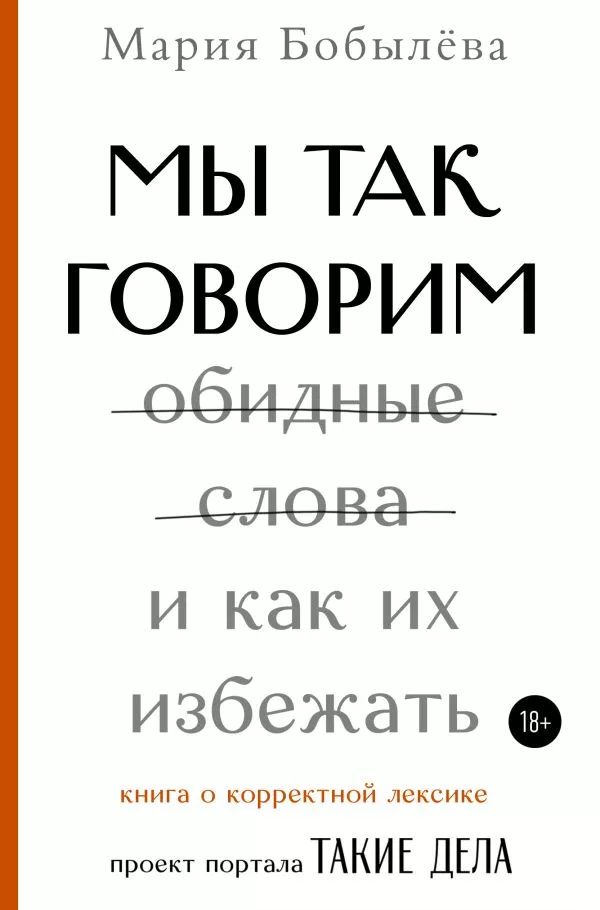 In the film “My Friend Ivan Lapshin”, the main character to the question of his friend Khanin about the new performance “Well, as a premiere?” He answers: "Not everything, of course, is vital, but the thing is necessary." This phrase is fully applied to the book of Maria Bobyleva, but, apparently, requires a certain decoding.
Firstly, it should be said that the book of M. Bobyleva is a political correct dictionary for the Russian language, that is, a dictionary of political correct replacements for non-prostitute Russian words and expressions. To be precise, it is physically a little more than half the dictionary, since it occupies 126 pages (from the 69th to the 195th inclusive), and there are 222 pages in the book.
The remaining 96 pages represent all kinds of discussions about the problem and justification of both the political correctness itself and the political correct dictionary. Actually, here it arises "secondly."
Of course, it is not necessary to explain what political correctness is necessary for the modern reader, but it is still necessary to say that this is a linguistic ideology, that is, an ideology that is realized primarily in the language, but it is inextricably linked with different extra-linguistic social movements, in particular, with feminism and other movements for the equal rights of people of different races, nationalities, ages, etc., as well as with the very new new newly new one. The ideology, which in Russia is somewhat vaguely called "new ethics."
Political correctness in its world production reached the Russian language 5–8 years ago, and this can be evaluated as a recent time, especially in comparison with its application in relation to the English language. The very concept of the Political Correctness (or Political Correct ) has been discussed since the 1970s.
In 1992, probably the most famous political correct dictionary “The Official Politically Correct Dictionary and Handbook” appeared. You can learn about him, as about his authors Henry Birde and Christopher Serf, in particular, from the English Wikipedia, but also from one of the fundamental texts about political correctness written in Russian Maria Buras (“Rightness as a religion of new sensitive” is published in the journal “Domestic Notes” in No. 2 for 2005) and submitted fragments to the Russian-speaking reader Dictionary and one of James Finn Garner * James Finn Garner “Political Correct Bedtime Stories”. . The most important thing is that you need to know about the political correct dictionary of Bird and surf is that he is completely unspoken.
Here's what Maria Buras writes about Bird and Serf dictionary and about the translation of some important terms:
“This recognized bestseller was published in 1992, and to date only in the United States has already withstood 16 reprints (a total circulation of 200 thousand copies, which is very many for the dictionary). The recent editorial review on Amazon.com calls it “The Supervisor in Multi-Great America in Children's 90s” and claims that he offers interpretations, which, “despite its obvious grotesqueness, are fixed in use and will help you protect your thoughts from police intervention”.
In the preface, entitled “Choose expressions!”, The authors call the heyday of the ideas of political correctness “sensitive nineties”. The norms of the language, imposed by the forerunners of the new American religion of universal sensitivity, G. Bird and K. Surf are designated by the word Correct-Speak-by analogy with the Orwell Newspeak (Novoyaz). It would seem that it is correct to translate this term as a right, preserving the structure of neologism, traditional for Orwell’s translations. However, in the Russian word formation, similar complex words look different: slander, glory, judgment, etc. Thus, our language tradition pushes to the choice of another equivalent: rightry. ”
In addition to the word discussed here, rightness should be noted both sensitivity and sensitive as the translation of the English Sensitivity and Sensitive , which today in this stable meaning are translated as sensitivity and sensitive , for example, new sensitivity . The Bird and Serf dictionary could be considered the predecessor of the dictionary of Maria Bobylyva, if not for fundamentally different, I would even say “multidirectional” installations of the authors. The first is emphasized by a parody, filled with humor, and even more with satire. To confirm this, it is enough to quote the dedication that opens the dictionary after Maria Buras:
“The Dictionary of Henry Bird and Christopher Sard, which is mentioned below, has the following dedication: the former Donne Ellen Cooperman, who, after a year of the valiant struggle with the New York Judicial System, became Donna Ellen Cuperperson.”
Maria Bobyleva and the experts cited to her, on the contrary, are extremely serious, and today this is almost the only modus of a positive conversation about political correctness.
The dictionary makes up the second part of the book and includes five chapters on the following topics: chapter 4 “Diseases and restrictions”, chapter 5 “Mental Disorders”, Chapter 6 “Socially Vulnerable Groups”, Chapter 7 “LGBT+”, Chapter 8 “Sex”. To give an idea of the dictionary, you need to start immediately from the vocabulary, that is, for each chapter, give examples of unspoken words that are offered to deduct from the Russian language. For the fourth chapter, this is, for example: sore, sexually transmitted diseases, deaf, down, Downenok, disabled person, stroller, dumb, blind, gestures and others. For the fifth chapter, this is anorexic, autistic, bipolar, moron, paranoia, pedophile, suicide, mental retardation, epileptic and others. For the sixth chapter, this is an alcoholic, a homeless person, a migrant worker, a prisoner, a dysfunctional family, a drug addict, a black man, a criminal, a prostitute, prostitution, sexual violence, old and others. For the seventh chapter, these are homosexuality, homosexual, natural, sex change, sexual minorities, floor change, transvestite and others. For the eighth chapter, this is a vaginal orgasm, vagina, gay, hymen, virginity, contraception, polygamy, sexual intercourse, condom, crotch, seduce and others.
The degree of its “irregularity” is indicated over each “wrong” word: “incorrect” (if the word or expression simply does not actually correspond to the real situation, for example, “the face of Caucasian nationality” or “intersexual”), “incorrectly” (if the word exists, but has become offensive or offensive, for example, “homeless” or “homosexual”) and “in general Normal, but there is a more neutral analogue, for example, “sexual intercourse” or “suicide”).
The following is a political correct replacement, as well as an expert’s commentary, explaining the incorrectness of a word or expression and justifying their replacement. Sometimes an expert’s commentary is absent, and Maria Bobyleva herself justifies the replacement. The articles look like this:
⦁ not worth it: Down ( incorrect )
Better use: a person with Down syndrome
“The word“ Down ”has long become a curse, ceasing to be only a diagnosis, and acquired a negative coloring,” Galina Urmmancheeva, the head of the development department of the St. Petersburg Association of Public Associations of Parents of Children-disabled children (Gaordi).
⦁ not worth it: the language of gestures ( wrong )
Better use: brutal language
The language of gestures is used by absolutely all people - this is part of non -verbal communication (poses, facial expressions, hands). A brutal language is a language that is used by hard of hearing and non -verbal people, this is a separate linguistic system.
⦁ not worth it: blind ( incorrectly )
Better to use: a blind person, a person with visual impairment
“It is imperative to add the word“ man ”so that the adjective remains an adjective, and does not replace the noun,” Tatyana Konstantinova, the executive director of the Co-Union Foundation.
⦁ not worth it: sexual intercourse ( can be different )
Better use: sex
Outdated word. ““ Sexual intercourse ”is from somewhere in Soviet sexology, it sounds very dull and inancial,” Tatyana Nikonova [1] , the journalist and author of the Nikonova.online blog.
Already by these examples it is clear that the relevance and validity of political correct replacements is very different. If the argument of the replacement of the word down is understandable, and the replacement itself in medical speech has actually occurred, then with the expression of sexual intercourse the situation is different. Both sexual intercourse and sex are found in speech, but in completely different communicative spheres, and, say, in police protocols, replacing the first with the second is hardly appropriate. However, this is not a claim to Maria Bobylyva, who sought to collect the maximum vocabulary, but rather a statement of the situation and expert level in different areas regulated by political correctness. The instrument of the “vitality” of the proposed replacement turned out to be a quite effective tool for the “vitality”. So, for example, the litter “can be different” means that the replacement is optional, that is, either not too relevant or not too successful.
It is possible to argue about the need and success of specific replacements endlessly, but this is in no way connected with the assessment of the book, which ultimately solves a very important problem.
When discussing political correctness as a whole and individual replacements, a number of questions have always arisen:
⦁ Who and how assesses the inadvertency of the word?
⦁ Who and how assesses the success of the replacement?
⦁ What are the consequences for violators?
In other words, in disputes about words it was always incomprehensible who exactly declared the word to the wrong, bad, finally, unacceptable and whether it was possible to remain a decent member of society, pronouncing it. Someone said something somewhere, but why should we believe him? After the release of the political correct dictionary, the situation changed. Maria Bobyleva did a great job and actually took on a great responsibility, sharing it with experts. In other words, the norm was recorded. It is still possible to argue with her, but it became possible for her, but in fact it is necessary to refer. Opponents of this norm are now arguing not with air, not with the words “there is an opinion that ...” (or, if you like, with the noosphere), but with a specific dictionary, a specific author and specific experts. And this is important.
As this area stabilizes, a new dictionary will inevitably be required, probably significantly different from the reviewed, but our speech, language and lexicography are arranged. And the book of Maria Bobylyva will forever remain the first political correct dictionary of the Russian language.
[1] From the editorial office: This material was already ready for publication, when the news of the sudden death of Tatyana Nikonova came . Gorky expresses condolences to her relatives and friends.