
Translated material
Mortal intrigues
Why did the propagandists and politicians again talk about the return of the highest punishment after the events in Kazan: the analysis of Lev Gudkov
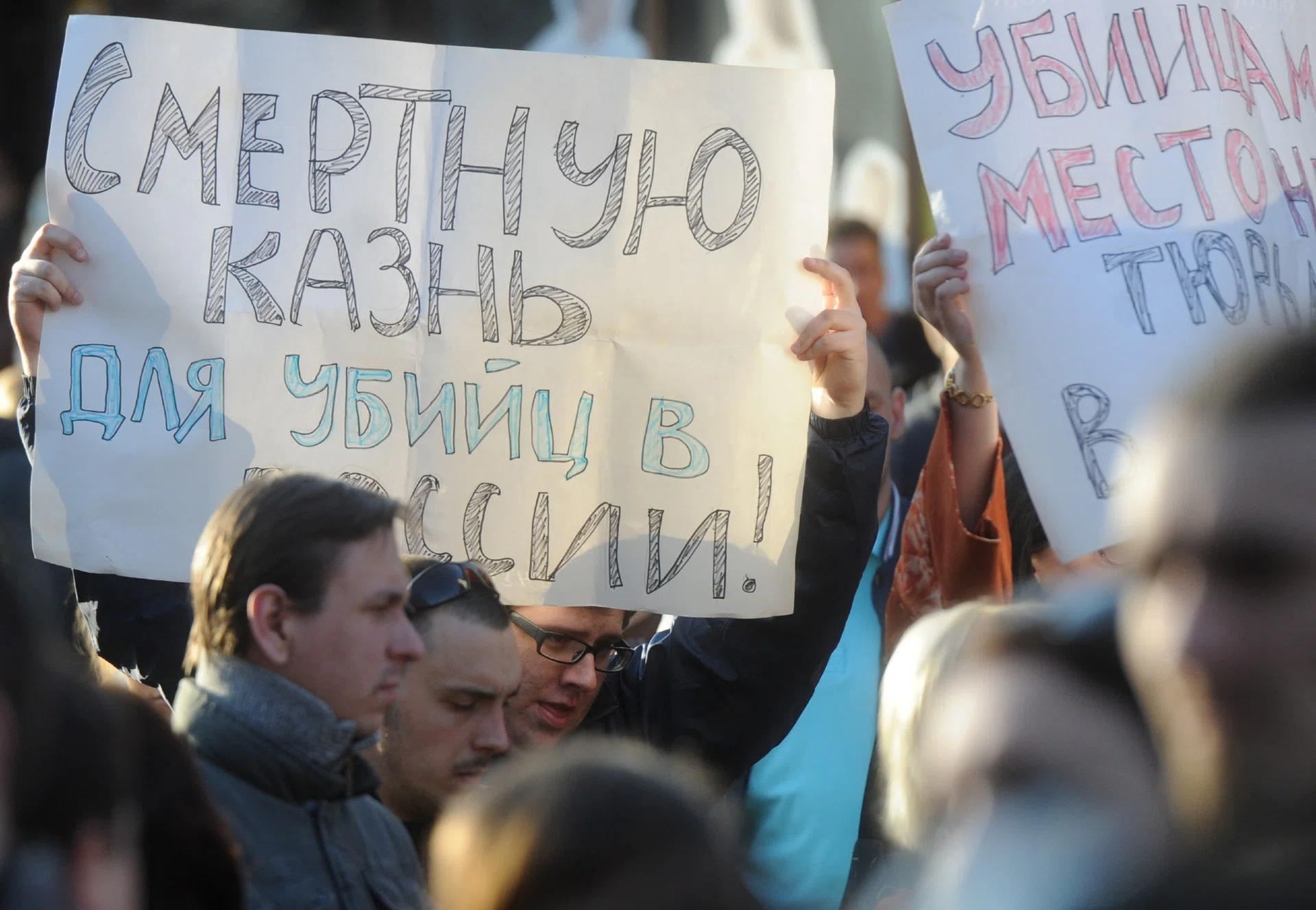
The misfortune in the Kazan school gave rise to the deputies of the State Duma and the court commentators to celebrate the proposals to restore the death penalty as a means of combating crime, terrorism, tightening control on social networks and the Internet, and change the rules for the sale of weapons.
The practical meaninglessness of such sentences is known to any critic specialist: tightening punishment for serious crimes, especially the death penalty, does not affect the level and dynamics of crime. The bulk of severe crimes, primarily murders, is committed in everyday life, for random reasons, using improvised tools. The victims of 80% of cases are familiar or close to the killer people - family members, drinking companions or neighbors. This knowledge available to any educated person is possibly even to our deputies, for them not an argument in order to resist populist rhetoric. A decrease in crime is associated with everything that reduces the potential of violence, fragmentation of society and, on the contrary, strengthening solidarity. And this is possible only with an increase in welfare, an increase in confidence in the police, to judicial and political institutions, with participation in public affairs, which means that with a sense of citizens' responsibility for the situation in the country and specifically where they live, with the humanization of morals, with an increase in education. And directly in practical terms - with the effective preventive work of the police.
Kazan trouble is not the first and, apparently, not the last case. To get rid of the irrational explosions of aggression, violence, serial murders is unrealistic, this even happens in countries with the lowest crime indicators, as evidenced by the example of Norway, where the Brayvik, Nationalist or Nazi, shot more than 80 people who fell by his arm, or the massacre in the New Zealand crust. Crime cannot be eradicated, but it can be kept under the control of the police and social workers based on the trust of society.
Effective is not the severity of the punishment, but its inevitability. But this is where the police are busy with their own business, and not the persecution of critics and citizens dissatisfied with the authorities.
After the cessation of mass repressions and the policy of the decolinization of Khrushchev, the number of deaths in the USSR went down. Over the 27 years of the post-Stalin time (1962–1989), 24.4 thousand death sentences were issued (on average 900 people a year, but this is on average, since this figure decreased from year to year: from 2400 in 1962 to less than 500 in 1983, and every tenth was pardoned). The sentences were sentenced not only by killers, but also by foreign currencies and workshops - for state receptions, espionage, attempts on state leaders and other articles.
In the first six post -Soviet years, from 160 to 140 people were sentenced annually, but the execution of the sentence was carried out only in exceptional cases and was mainly replaced by life imprisonment (which, incidentally, according to the opinion dominant in society, is a more severe punishment than execution).
The ban on the death penalty was an indispensable condition for Russia's membership in the Council of Europe and other European organizations. The Russian leadership signed this agreement in 1993, suspending the execution of death sentences since 1996; Later, the moratorium was turned into a law on the inadmissibility of executions and finally enshrined in 2009 by the decision of the Constitutional Court. Despite the moratorium, the number of registered crimes decreased by a third. Something from this decrease can be attributed to the dishonesty of police statistics, which refuses to register information about the crimes committed. But such an argument can hardly be recognized as serious, since it is about serious crimes, which are difficult to hide. The number of murders from 2000 to 2019 decreased by 4 times, rape - 4.7 times.
The current calls for the restoration of the death penalty have other goals, and the motives of such a self -patient of politicians who lose the trust and support of voters are quite understandable and disgusting. Firstly, this is an occasion to declare that the abandonment of the death penalty is imposed on us by Europe in order to once again demonstrate its “patriotism” and love for the authorities, to publicly announce the need to break with Europe (read: Russian leadership) criticism and undesirable sanctions for foreign policy adventure and killing your opponents.
The second motive for provocations of this kind is to play along with the dark moods of the masses, redirect the rise of dissatisfaction with power, irritation or even contempt for it, to other things that are not related to the crime. In such “package” legislative initiatives, public indignation regarding the tragedy and noisy requirements to tighten punishments for killers, increase age standards for the sale of weapons and all that else are combined with proposals to ban computer games as implerse violence, aggression, alien to us, to strengthen control in social networks, isolate Russian Internet, etc. The fact that this is easily knitting is shown by the example of the Sverdlovsk deputy governor Krekov, who declared Galyaviev as a “Navalny volunteer”.
Under the pretext of the fight against crime, and then - with terrorism, with the alien and decaying influence of the West, it is possible to strengthen censorship, surveillance of undesirable elements,
Having received additional opportunities to neutralize everyone who is dissatisfied with the current authority and its policy.
The abolition of the law on the ban on the death penalty is permissible only with a change in the Constitution of the Russian Federation, which, as the recent experience has shown, is possible, but not in connection with this specific case - it is too troublesome and costly. The editors of the 2020 Constitution also does not allow the return of the highest punishment. In this regard, calls for the return of the death penalty are of the nature of anti -constitutional activity, but no one, of course, is going to hold these demagogues to justice. It is clear that such statements are not so much manifestation of deputy unreasonableness as a game of populism. The Russian leadership is seriously not going to leave European organizations, at least in the near future. Idiocy is restrained by a sober understanding that the gap with Europe will hit mainly in Russia itself and will result in its complete isolation, the final recognition of the “rogue country”.
Such cynical tactics seem to be win -win. This is just the case when it seems that it is easy to get support from the conservative segments of the population. However, the calculations that our population for the most part stands for the return of the death penalty is not as true as it was more recently. Today, opinions in society on this issue are distributed differently than the initiators of such proposals seems. Sociological studies show that the situation is slowly, with difficulty, but still changes, the ratio of supporters of the execution and opponents of the abolition of the ban on the death penalty is different than it was 30 years ago. At the peak of mass fear and bitterness in 1999 and 2002, the ratio was 73:20, in 2017-44:41, later-50:40.
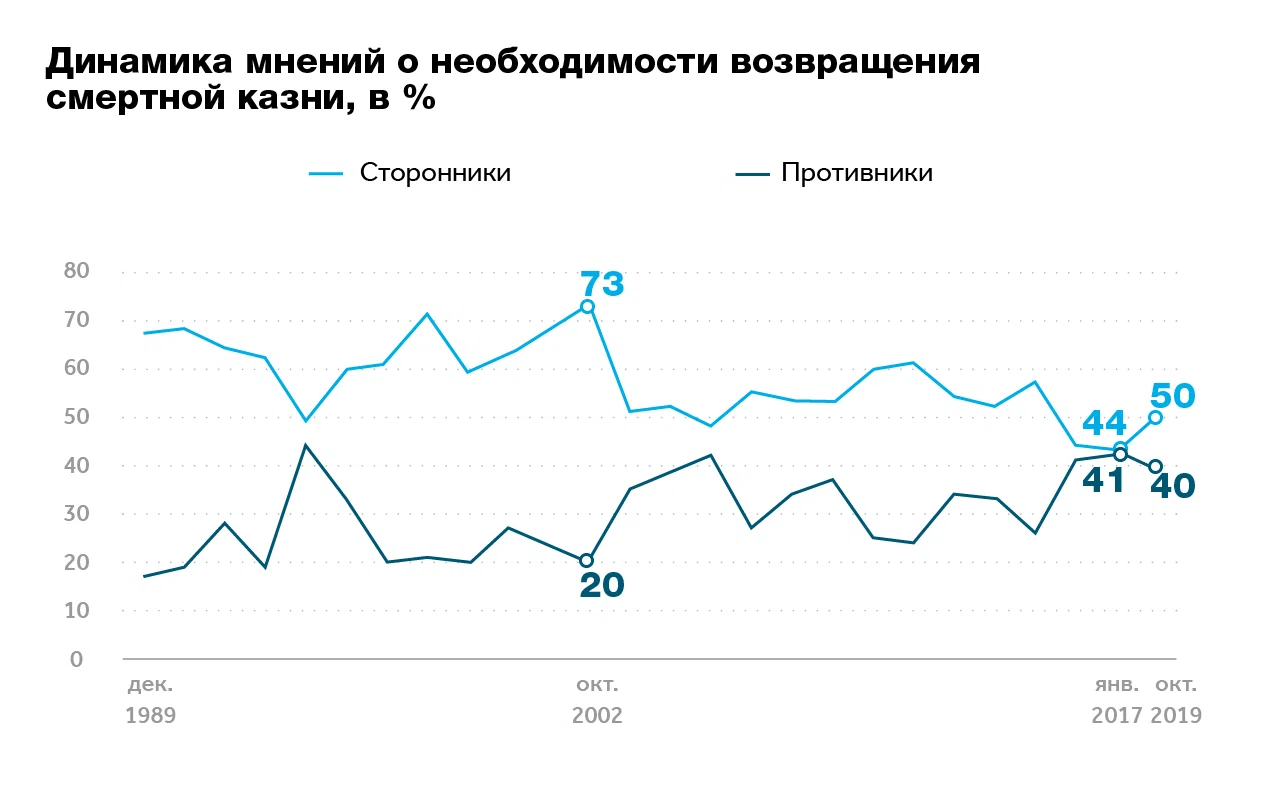
As can be seen from the schedule, the bursts of punitive mood in society follow the general deterioration of the political and economic situation in the country, the growth of crime (especially in the first half of the 90s) or the cases of extraordinary crimes, terrorist attacks (in 1999, 2002 and 2004), or special manifestations of cruelty during the Chechen war. The helplessness or inhumanity of the behavior of the authorities (as it was on Dubrovka or Beslan) provoke the compensatory cruelty of the masses, unsatisfied with the corresponding actions of special forces and the police.
Analysis of these sociological surveys on these problems conducted in 2007 and 2011 shows that the meaning of the mass requirements for returning (or even-expansion) of the application of the death penalty is reduced to three socio-psychological complexes:
revenge covering the main part of the population (55% of respondents are evidenced);
intimidation of those who are inclined to social deviation (in other words: not a very clear idea of social protection, which is shared by 18%);
The idea that execution contributes to the “purification of society” from harmful and dangerous elements (10%).
Only less than 4% of Russians believe that this measure will contribute to the healing of society and the strengthening of morality.
Such a distribution of opinions suggests that we are dealing with the archaic layers of mass consciousness, the manifestation of the pre -Christian, in fact - pagan, understanding of justice as retaliation - “eye for an eye, tooth”, that is, a magical equation of harm, guilt and responsibility. The archaization of mass consciousness is not as simple as it seems at first glance. Respective aggression (“shoot like frantic dogs”) in such cases becomes a symbolic or psychological replenishment of justice impossible in reality, the reverse side of the defenselessness and helplessness of people. Anger, revenge not only with a symptom of traditionalist regression of the population, the trend of primitive thinking, but also an indicator of the insolvency or instability of the universalist, “universal” morality of modern society. I mean here the fact that in the Russian consciousness (unlike the Western) is supplanted or suppressed, the tragic experience of the twentieth century is neutralized: sober, imprisoned by any illusions, that the deprivation of a person of life on behalf of the state may sooner or later turn into restrictions for repressions of a different kind and other scale, justification of terror, criminal wars conducted on behalf of the state. It is not a matter of sentimental pity for killers or rapists, but in the realization of the danger, threats that the appropriation of the state’s sovereign right to the monopoly of violence, not controlled by society, not balanced by society. The lack of democracy turns into the legalization of state arbitrariness. The only moral barrier against this is the universal recognition of human life (any) the highest value.
As always, the devil is hidden in details:
As the experience of Soviet legislation and law enforcement shows, the main articles providing for the death penalty were aimed, first of all, to the “protection of the state” and only then to protect life, security and the well -being of citizens.
And if today the highest measure of punishment is restored, then I have no doubt that its application will be subordinated to the same interests of uncontrolled power as in Soviet times. On the contrary, the population believes, if it is necessary to return the death penalty, then first of all - for crimes against ordinary people: for intentional (mainly serial) murders, rape of minors, drug trafficking, terrorism (accompanied by victims), and not for crimes against the state (espionage, state treason in peacetime, etc.). Question: Is it possible to trust the current court or police, throwing drugs and factory accusations, a state who considers justified without trial to kill their critics and opponents? Based on my experience of a sociologist, I would say that many Russians will answer “yes” (“it is possible, necessary”).
The requirement of death for the criminal in order to prevent crime and prevent future offenses, as well as considerations about the moral significance of the elimination of hopelessly spoiled villains, serve only an additional argument for the thirst for revenge dominant in the collective consciousness. 47% of respondents (against 39%, 2011) said that they would feel calmer if the death penalty will be used in Russia. The calm of these citizens is given not by the real execution of those sentenced to death, but by a sense of restored justice and order, which is not related to reality.
The arguments of opponents of the return of the death penalty, the total number of which has increased over 30 years from 17% to 40–43%, boil down to the following:
The death penalty takes away from a person the opportunity to realize his guilt, repent and change (13%);
Human life is the greatest value for civilized humanity, Russia should be a civilized country and completely abandon the death penalty (12%);
No one, except God, has the right to take life from a person (12%);
The death penalty is useless, the tightening of punishments does not lead to a decrease in crime, but turns only into general bitterness (12%);
Our court will abuse its application (10%);
Compassion for criminals corresponds to Russian traditions, national character, the abandonment of the death penalty follows these traditions (4%).
Clearry to the problem is introduced not so much by the “pros and cons” of the “pros and cons” as anyone, in fact, expresses them, which social groups adhere to those and other opinions. And here the confrontation between opinions begins to acquire clear contours. For the death penalty, elderly, poorly educated, poor, frightened by what is happening, people who do not have a way out for their irritation and fear, in need of moral compensation. Against - mainly young, educated and more wealthy, more humane Russians. It is their views and values that seeks to discredit and neutralize our conservative, more correctly - reactionary, Duma, trying to return Russia to the past, to the times of Soviet totalitarianism.
And the last thing I want to say in this regard: the militarization of society, which begins already from the kindergarten, from primary school, inevitably leads to an increase in the level of collective aggression and violence. The fact that this is already reality is confirmed by recent media reports. In the school near Moscow, third -graders at the parade on May 9 went with toy machines and chanted: “We are Russians! God is with us ”; In the Likhoslavl district of Tver, the pupils of more than 100 kindergartens were going to use the "Malyshki troops" - in military clothing of various military branches and with layouts of military equipment. Somehow it echoes the words of the Kazan shooter, who declared that he is God and hates everyone.