
Translated material
Enjoying memory
Academician Sakharov through the eyes of Russians: Sociology data
In May of this year, the 100th anniversary of the birth of academician Andrei Sakharov, a man who was a symbol of resistance to a totalitarian state for an intellectual environment in the USSR, has been performed. He received general recognition after his speech on June 4, 1989 against the war in Afghanistan, which he called the “criminal” at the First Congress of People's Deputies of the USSR.
In 1991, at the initiative of Yuri Levada, we conducted a survey about the attitude of Russian society to this great man, repeating individual blocks of this study in subsequent years.
In February 2021, the Levada Center ( legislation demanded that the organization recognize the Ministry of Justice as a foreign agent. - Ed. ) As part of a regular monthly all-Russian survey, asked three questions aimed at studying what remained in the mass consciousness of the previous fame of Academician Sakharov after 30 years.
The significance of these measurements is determined not only by a specific interest in the memory of Sakharov, but also by a more common problem: how the so -called historical memory of society is reproduced, in what social environments the knowledge of previous events remains, what significance the social context of the evaluation of events has, which remains in public opinion when the demographic cohort and generations are replaced.
With a change in the political regime that followed after Yeltsin’s departure and the transfer of power to representatives of the special services, the name Sakharov rarely appears in official information channels. It disappeared not only from the rhetoric of the media, but also from the practice of teaching recent history in schools, public discussions in society and interpretations of current social processes. Values and principles that Academician Sakharov defended -
legal state,
peaceful coexistence of countries with various political systems,
democracy,
Freedom,
political responsibility -
were subjected to reproach and discredit.
It is all the more important to understand what has changed in the image of Sakharov, that the current public opinion of Russia retains from the previous meanings of this image. In theoretically, it is important to understand how the symbols work, including legendary figures, large personalities, authority and functions of moral and political model. The meaning of the symbol lies in the fact that it connects disparate associations and meanings into a single complex of ideas, determines the value force field of public consciousness. The erosion of symbolic structures leads to the scattering of the normative components of society and its degradation. Already after the first measurement, the dynamics of the attitude to Sakharov showed that the study of his image in public opinion endows him with the status of the righteous, a secular saint or holy fool, while increasing the distance of ordinary people in relation to him.
He is revered, but to follow him (precisely because he is “special, not like us”) will not, they cannot, do not consider it necessary.
Today, in the wake of imperial and militaristic sentiments raised by state propaganda, the voices of the “patriots” requiring the authorities reassessing the Afghan war are heard from time to time. But at the 1980 fracture, the situation was different: the end of that meaningless war and the withdrawal of troops from Afghanistan were the main and most important events of those years, the memory of which has been preserved over the next decades, up to our time (in 2019 they were called 54% of respondents).
As a 1991 survey showed,
56% of respondents heard Sakharov’s performance at the congress,
55%-shared his socio-political views and assessments,
54% - believed that Sakharov has high moral qualities,
52% - it was believed that Sakharov took up political and human rights activities from a sense of responsibility for what was happening in the country.
Even in 2014 , the respondents who still remember the congress, Sakharov’s performance was noted as the most significant of all, including the speeches of Gorbachev, Yeltsin, Gdlyan and other famous deputies.
Today, the meaning and meaning of the image of Sakharov has changed significantly. The first thing that has to be noted when analyzing the data obtained is a change in attitude towards it: 66% of respondents know about Academician A.D. Sakharov, but of them only 35% are positive about it (26% - “neutrally” and 2% - negatively, 3% found it difficult to answer and determine their attitude to it).
In other words,
Almost half of the respondents (29%) of those who have the name of Sakharov causes some associations are indifferent, indifferent to his activities, to the moral and political principles that Andrei Dmitrievich defended.
Similar sterilization of a public - or, more precisely, civil - morality cannot be attributed only to the change of generations and supplants from the consciousness of young people of such ideas, although it is the young people who, for the mass, do not know anything about the role of Sakharov in the social life of Russia (Table 1).
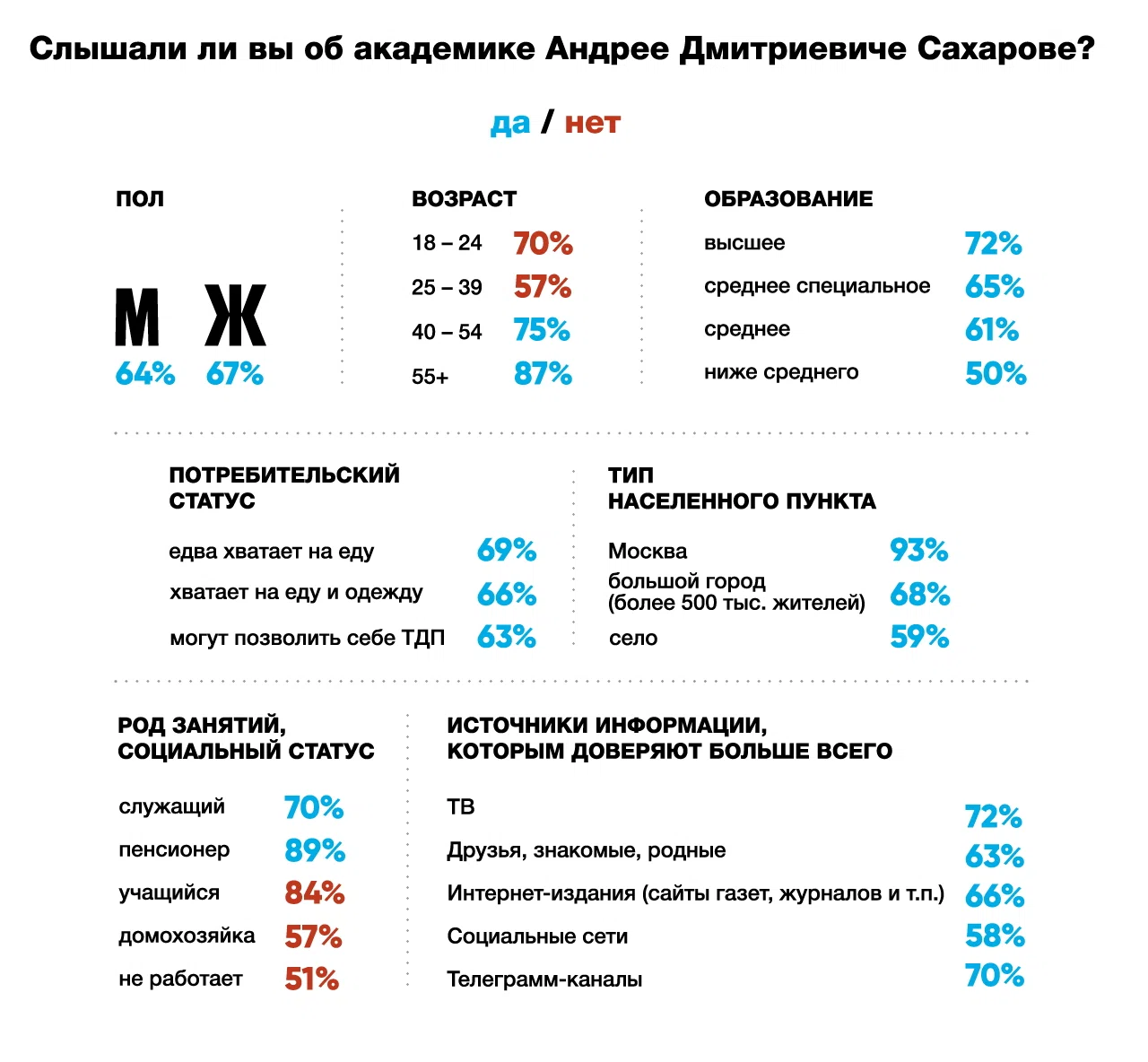
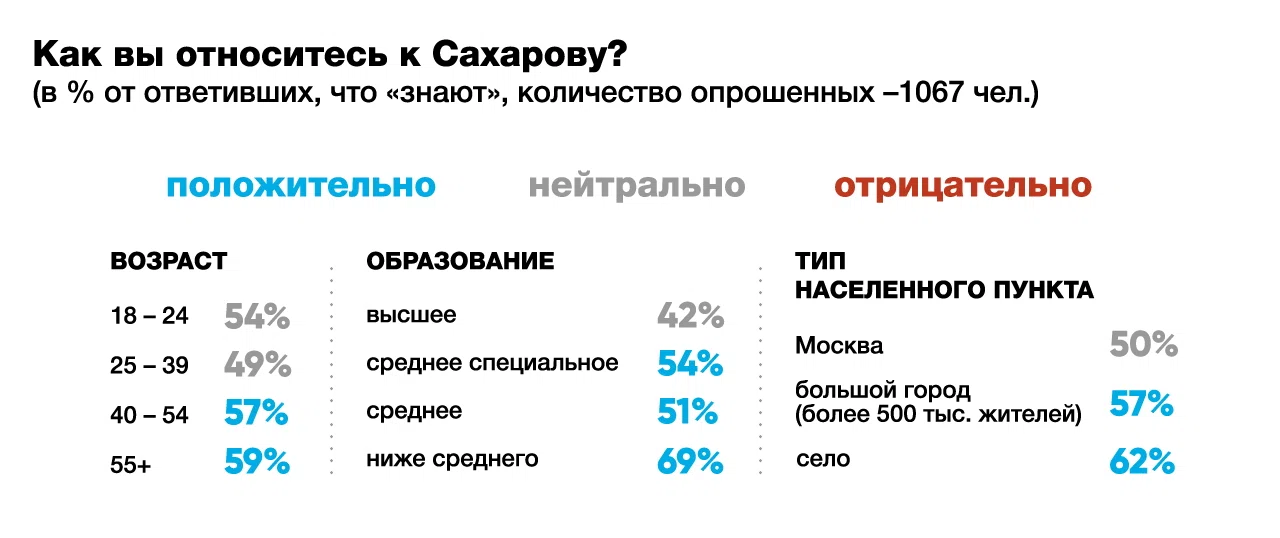
As can be seen from the table. 1 and table. 2, a grateful memory of the academician is mainly preserved in older people who were his contemporaries and witnesses of his activity as a union deputy, among the poor and not too educated respondents, to a greater extent province, that is, where the significance of informal interpersonal relations is maintained, ensuring the reproduction of non -native (and therefore neutral in relation to the current) of the authorities values. It is interesting that Moscow and respondents with higher education not only do not stand out here, but also show the smallest level of inclusion and approval, they have noticeably more detachment from the latent theme associated with the name of Sakharov, with a higher fame about it. The image of Sakharov is the least for young people who know little about him, as well as about this period of our history.
This trend began to appear shortly after V. Putin came to power.
In 2007, in a study of youth on a projective question: “If A.D. was alive today Sakharov and if it were included in the list for voting to the State Duma, would you vote for it? ” Such distributions were obtained: 22% answered "yes, voted." 19% - no, but 59% either did not hear anything and did not know about Sakharov, or could not say whether they would vote for it or not.
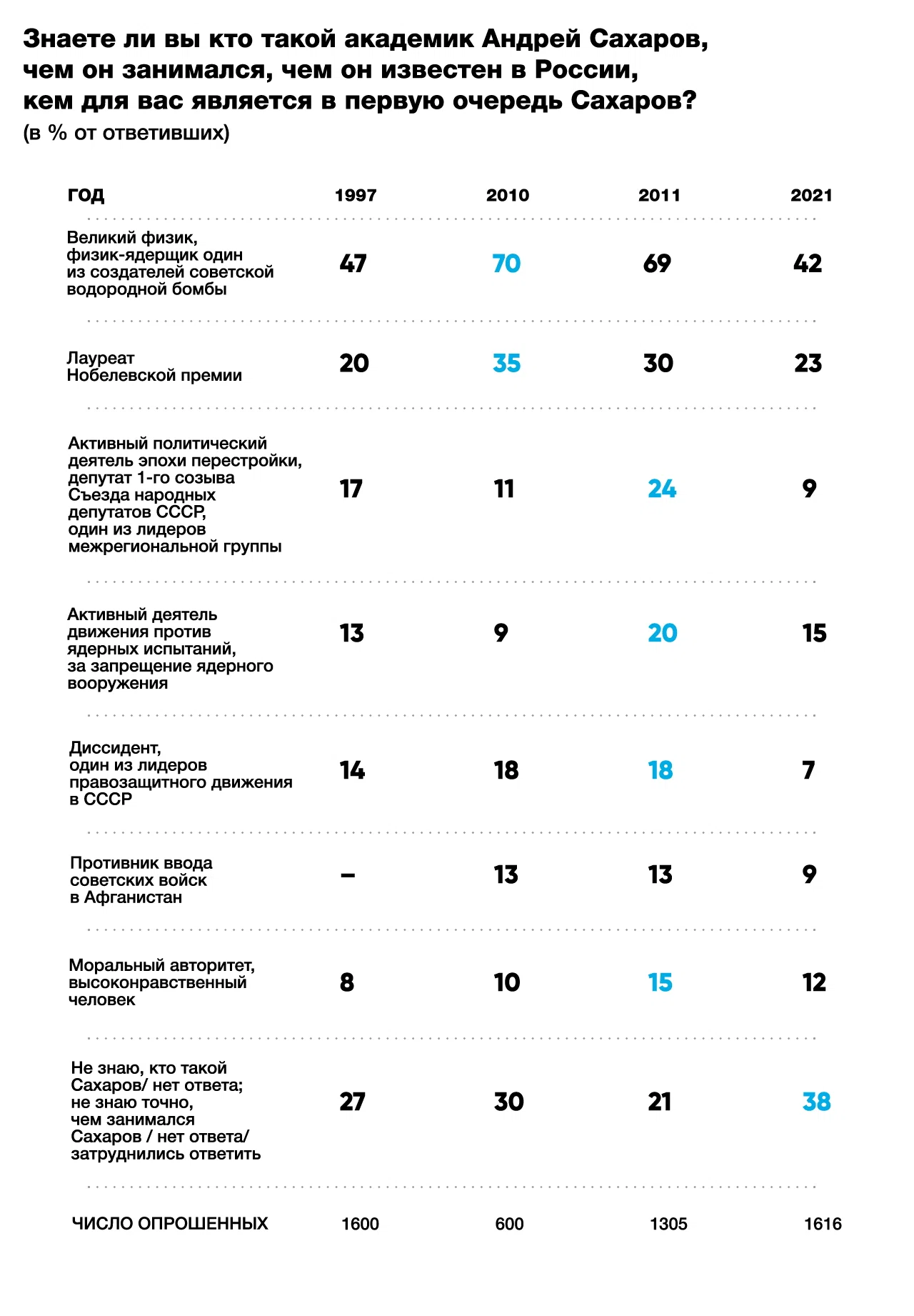
This table contains the results of polls, different in the method and partly formulating the questions themselves. Therefore, they can be compared conditionally by paying attention, first of all, to the rank of appropriate response options.
In polls conducted in different years, the set of answers has changed, since they were supplemented by the respondents themselves.
So, in 1997 (8 years after his death) answers appeared:
“ He became an academician at 30 years old ” (he was chosen by 14% of respondents),
" The leader of democratic forces in the late 80s ." (9% of respondents),
“ Fought for political reforms in the USSR ” (8%),
“O_Tets of perestroika, democratic transformations in the USSR_” (3%),
“ Anti -Soviet who performed with slander for the Soviet system ” (4%),
“ One of the advisers of Gorbachev ” (3%).
In 2021, options arise -
- “ The author of books and articles devoted to the problems of disarmament, democracy and human rights, rapprochement of Russia and the West ” (9%).
All these opinions are optional, additional in relation to the main body of knowledge of the image, except for “sugars - anti -Soviet”. It is important that all attempts to identify how effective the Anti -Sachard propaganda was during the period of perestroika did not give results - the respondents did not agree with the negative cliches in relation to it again, denied its “maliciousness” and the “anti -people” nature of its entries. The maximum value of negative answers of this kind never exceeded 3-8% of respondents. On the contrary, the share of consonants with the fact that “Sakharov did a lot to restore the moral values of the Soviet people” was 59% (2011), that is, at that time was the dominant of public opinion about him.
The results of the 2021 survey indicate the gradual displacement of the meaning of the meaning and values of human rights activity (reduction of answers of this kind from 14–18% to 7%) and the memory of the work of the democratic opposition to Gorbachev at the most acute moment of perestroika (from 17% to 9%), on the one hand, and, on the contrary, the increase in the ideas about the Sakharov as the “father of the Soviet hydrogen bomb” (from 28% in the very first survey up to 69–70% in 2010 and 42% in the last measurement),
What reflects the strengthening of great -power and militaristic attitudes in society under the influence of state propaganda.
In the socio-professional plan, the grateful memory of Sakharov (the amount of positive answers in decrease) non-working and pensioners (61–62%), managers (56%), workers (54%), employees (51%) retained. Below the average, positive answers were given by entrepreneurs, housewives, students, specialists (respectively, 38, 40, 42, 47%), which are not distinguished by a negative attitude, but indifference to this figure.
Separation by sources of information and confidence in them, at first glance, shows paradoxical results: the positive assessments of Sakharov are above all in the socio-political categories of respondents-more conservative viewers (59%) and more advanced users of social networks (57%), least of all among users of telegram channels. However, this effect is explained by the age of the respondents, and not the character of the channel itself.
In other words, Sakharov as moral and public authority leaves the young environment, which remains without authoritative samples of a large personality.