
Translated material
“Our yard” is the terrible and cozy stories of Daria Bobyleva about people and all evil spirits who have to live side by side in the center of Moscow
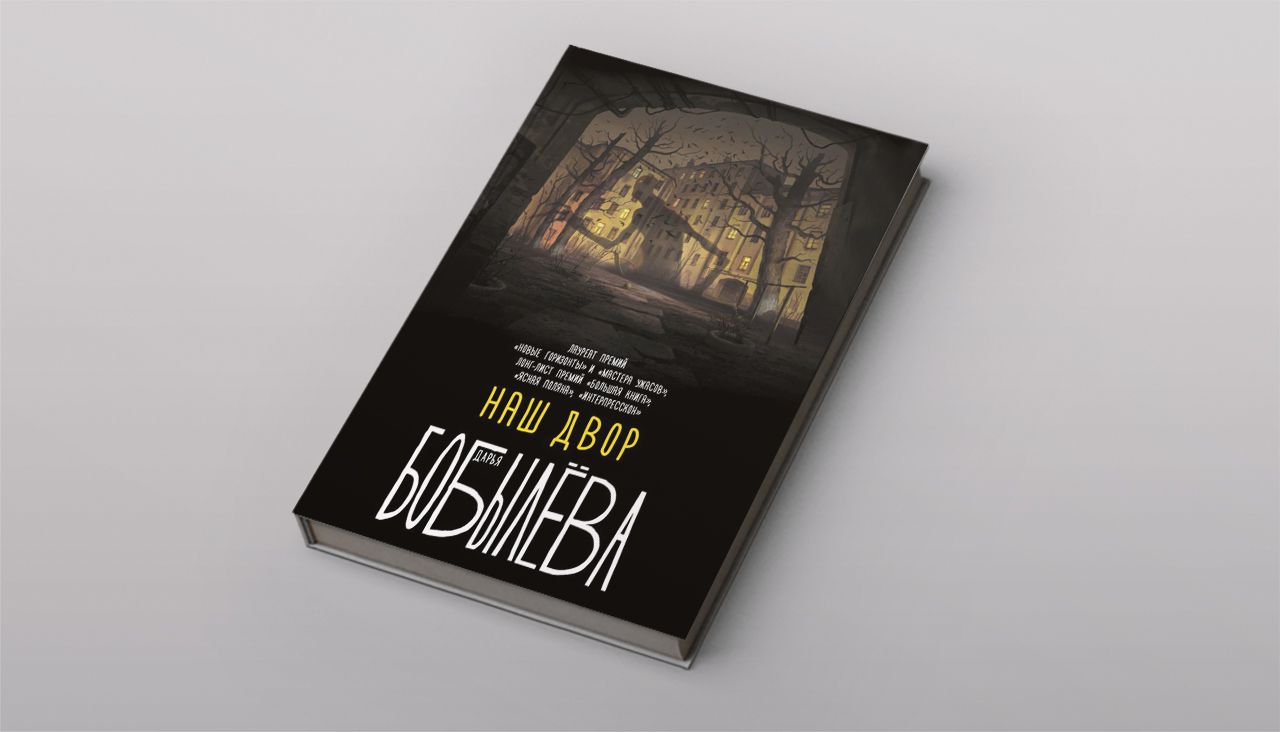
Literary critic Galina Yuzefovich talks about the book "Our Yard" Daria Bobyleva. The heroes of its many stories are residents of the court in the center of Moscow, who now and then have to face otherworldly forces and terrible evil spirits. Or maybe not so terrible - but almost domesticated.
Daria Bobyleva. Our yard. M.: AST, 2021
The genre, in which Daria Bobyleva works (the reader knows her from the novel “Vyarka” and the collection of stories “Night look”) is often defined as “horror”, although, perhaps, our native word “horror story” in this case will be more appropriate. Unlike a horror, which actually “selling” the reader, first of all, the emotion of fear (sometimes with fragrances in the form of compassion, disgust, anxiety, ice transcendental horror), Bobyleva’s texts are based on a much more difficult combination of unmistakable warm recognition, irony - and, well, fear, but, if you can express this, fear of a cozy, impudent, impudent. commensurate with the modern citizen. Mimicating either under urban legends, then for children's “terrible stories”, then under a half -baked and quarterly adult conversation in the next room, the stories of Daria Bobyleva instantly appeal to a feeling of sweet and drunken childish horror, shared at the same time with a reinforced concrete faith in their own protection, inaccessibility for the forces of evil.
The scene of the new book of the writer, as it is easy to guess, turns out to be a city court somewhere in an unnamed Moscow Center-the space is simultaneously open and outlined, separated from a completely external world with a clear natural border. At the top of the courtyard is a bakery, below is a river, in the center there are garages, and near them there is a bird cemetery, in which courtyard children bury pigeons, rats, hamsters, and if you are lucky, then a cat. On the one hand, the courtyard is an elegant, creamy color of Stalin (glorious with their terrible basements, in which no, no, and they will find a corpse), on the other-a pathos house with a rich mosaic (everything would be fine, but the moronic collective farmers and muscular miners sometimes come to life at this mosaic at night, and grief to whom they turn their lubricated skewers. eyes). There are just boring brick nine -story buildings, and an antisanitarian two -story brick hut in which an angry poltergeist rages. Behind the houses is a pond with tadpoles, a boarding school for mentally retarded children (under it, according to rumors, which went into civilian underground, and there, and there, the abbot of the neighboring monastery, still serves its black masses). That's the whole yard of the world - understandable, foreseeable, inhabited.
At the very top of Stalinka, a large and exclusively female family of fortunetellers, led by its omniscient (although disappointingly not almighty) leader Avigeia, lives. Lev Veniaminovich’s subtile elderly and ownerless philosopher, from the first floor on the rights of the housekeeper, lets the home old woman Agafue Trifonovna into his “three -year -old”, and very quickly falls into dangerous dependence on her narcically irresistible cooking, seasoned with an earthly taste (the story “Salt of the Earth”). Lesha Markin, a quiet and nondescript pioneer, who had lost his mother early and living with a strict grandmother, laughter for the sake of locking the ruthless courtyard hooligans in the basement, and going to the surface of Lesha notes that it begins to turn into an unknown, or blind gloom with a small skin and a vertical gap instead of the mouth. ("Lichen").
The pioneer Lucy Volkova finds a newspaper sheet in the trash of a hundred years ago and enters into a risky correspondence with a long time, it must be assumed that the author has taken the author from the section of private announcements (“Great Miner”). The freshly-defered director of the boarding school for children with developmental delays puts terrible experiments on his pupils (“through and through”). The black-haired and curly rose, a host girl in a decent family of Russified Germans, turns out to be a bearer of a terrible and destructive gift (“Rose of Hell”). Fortune-telling in a bosom-bold-bold, boldly undertaken by the younger representative of the Gadalok family, contrary to the prohibition of senior, more knowledgeable relatives, turns into a whole series of troubles for itself and for neighbors (“mummy”).
The main characters of some stories in others arise as episodic characters, flash in the form of a cameo or are simply mentioned, providing a comfortable connectivity created by the beaver world, and a collection of stories is a compositional unity. The same goal is the first person of the plural from which the narrative is conducted: the collective “we” as a hero-story-cabin is united by both the inhabitants of the court and readers, as if involuntarily pouring into the number of fascinated witnesses, or even participants in the events described. The notorious theatrical “fourth wall” separating the viewer from the actor does not collapse in the “our yard”, but gets creeping up, it goes to ripples, it becomes dangerous and exciting permeable-exactly like a mirror, from which an ominous mighty-blessed story from the same story stares at the heroes.
The idea of permeability, the subtleties of the wall separating the world of people from all others, is generally one of the trunk for Daria Bobyleva. Next to us, at the distance of the literal one exhalation, one hair is dark and unknown areas inhabited by mysterious creatures - not even evil, but dangerous for us simply because of our own prohibitive alien. And it is no coincidence that Bobylev chooses the vague and uncertain era of the border of the 1980-1990s as the time of the most part of his stories, when the old life still retains its contours, but something fundamentally different, new, threatening is already clearly emerging through them. The overstrrating worlds become a metaphor for overtaking eras - or, if you like, on the contrary. Through a poorly shut -made seam between different historical formations rushing the flameless hton, and what is primary - a crack between the worlds or the collapse of the USSR, go sort it out.
It is not difficult to build an artistic pedigree Daria Bobyleva. In her texts, the influence of Yuri Mamleev with his painful sense of dark inside, inseparable from the deceptively rational Soviet reality, and Dmitry Gorchev with his cheerful and disturbing absurdity, and the early things of Victor Pelevin. But to call what Bobylev does, the language will not turn secondary. Soft folkloric-afflicted intonation, sympathy and friendly interest in the inhabitants of the adjacent gloomy worlds gives Bobyleva’s prose that is not characteristic of any of the above-mentioned authors, a sense of comforting comfort and a reliable, in general traditional thoroughness of our, in general, rather ghostly being. We always lived side by side with all evil spirits - and we will still live. Thank God, not the first time.
Galina Yuzefovich