
Translated material
A slave mentality is a myth: why the Russians are not doomed to eternal lack of freedom
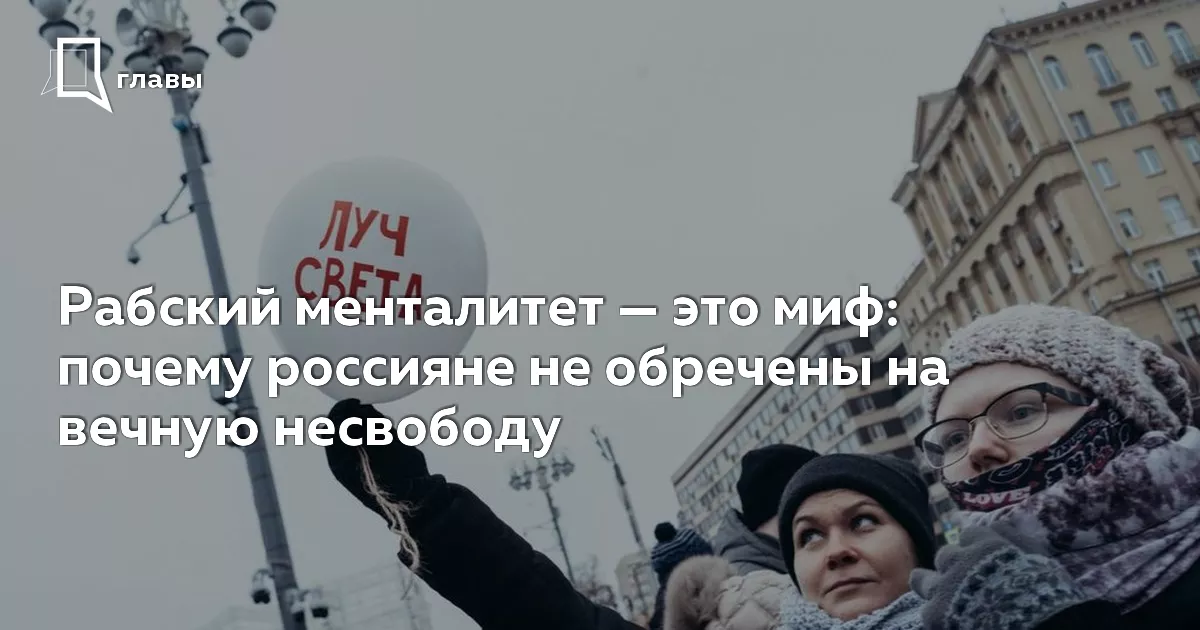
The mentality is often called the main cause of backwardness, dictatorship, corruption, civil spine and apathy in Russia. The inhabitants of our country are supposedly historically, culturally and genetically predisposed to weave in the tail of civilization under the rule of kings and dictators, and therefore it is pointless to try to change anything. But this is not so: Russians are no worse than other peoples who have come to democracy - a high level of education, trust in democratic values and well -being allow you to build a free and prosperous country.
In the book "Who is the power here?" Political scientists Sam Green and Graham Robertson analyze the regime existing in Russia and find out how Vladimir Putin became the synonym for the whole state. We publish a fragment of a study on the prospects of an authoritarian future in Russia: why we are not doomed to eternal autocracy, who can become an engine of democratization, how is the attitude to rights and freedoms among Muscovites and New York and where the root of the problems of Russians really is.
It's not about history and not in society ...
The Russians say that everyone understands the world by virtue of their damage. Although we do not want to blame our critics - and readers - of spoiling (or to argue that damage is not peculiar to us), any author once agrees with this. In the end, the meaning of what we wrote is created not so much on these pages as in the heads of the interpreters written by readers. Usually it is fine - it is a real miracle of literature. But there are also disadvantages, which include an almost inevitable possibility of incorrect interpretation of the written. Given this, we hasten to explain what we do not mean.
First of all, we are not saying that Russia - where there has never been democracy - is doomed to eternal autocracy. This thought is repeated so often that it managed to take root. Like most rooted opinions, it is not without reason. Russia really remained an autocracy for most of the history of its statehood, and history has a significant impact on the choice of the future development of the country. For example, some rightly indicate that after the fall of communism in Eastern and Central Europe, countries that have already gained experience in the past, as a rule, in the interwar period, have already gained the most quickly and successful way. It is also true that countries like the UK and the United States gradually came to today's democratic system, which was based on institutions such as parliament and limited suffrage that existed in pre -democratic times.
Nevertheless, the assertion that Russia has always been and forever remain an autocracy is erroneously in many respects.
First of all, all democracy existing in the modern world have a history of undemocratic, monarchical, oligarchic or elitist regimes. Democracy is a product of the new time. Each country in which democracy has been established today had used to live in another political system.
Of course, skeptics may object that, taking into account the latest history, the transition of Russia to democracy is not too likely. This argument is also not devoid of rational grain. The dominant narrative of Russian history emphasizes the absence of strong institutions independent of the imperial throne, which makes the British and American scenario impossible (although in another presentation in the same story you can find many examples of such institutions that arose at different places in different places of Russia). Russia is also strongly dependent on the exports of oil, gas and other natural resources, and such states (political science call them "state-guarantee"), as a rule, are characterized by the stability of political systems. They remain democracies if they were democracies when they found oil (Norway), and remain autocracies if they were autocracies when they began the operation of natural resources (Saudi Arabia). Democracy can also be established under pressure from abroad. Thus, the European Union had a serious impact on the formation of a democratic agenda in many countries of the former communist bloc. But there are few reasons for optimism. Russia is great and quite capable of taking care of itself in economic and military terms, therefore, connections with the West and foreign incentives can only slightly push it to the choice of a more democratic path. (It is also worth noting that some post -socialist countries, which mostly experienced the direct influence of the West, including Hungary and Poland, have crossed out many of their democratic achievements in recent years.)
Nevertheless, in Russia there are many factors related to the democratization of factors that make the country a very promising candidate for transformation.
Perhaps the most important thing is the fact that Russia has a very high level of education and relatively high welfare, and these characteristics, as a rule, become harbingers of the establishment of a democratic regime. In 2016, according to the World Bank, per capita income in Russia amounted to $ 9720, which allows it to be attributed to a group of countries “with income above the average level” according to the classification of the bank. Russia took 52nd place in the world ranking of countries on per capita income. Among the 51 states, located in higher positions, there are only five - the united Arab Emirates, Kuwait, Brunei, Saudi Arabia and Türkiye - were not democracies.
Moreover, the wealth and education of Russia show the presence of deep structures in Russian society, which are usually considered supports of democracy. Although after the fall of communism in Russia there is a high level of inequality, the scale of poverty has been significantly reduced. In 2016, the share of Russians living in poverty (by the definition of the World Bank) was 13.4%, while in 2000 there were as many as 29%. This means that in Russia there is a large middle class - even if this middle class works to the state to a much greater extent than in most democratic countries - and many scientists consider a large middle class one of the main engines of democratization. At the same time, the Russian civil society, which played an important role in eradicating the Soviet system, also continued to develop in the post -Soviet period. Although it is known that civil society in Russia is faced with a number of difficulties, mind, ingenuity, creativity and courage of active Russians are obvious to anyone who happened to be in Russia.
In this regard, the basic structure of Russian society and the economy does not make democracy either impossible or extremely probable. Russia can go in any way - both through democratization and by preserving autocracy. In the medium -term perspective - in the next ten years - deep social, economic and historical factors will not bring Russia to a democratic camp, but they will not put a cross on the development of democracy. The result will determine the policy.
... and not in culture ...
We also do not say that the Russians in any way-culturally, psychologically, genetically or in any way-are predisposed to life in strong power. As we noted in the fifth chapter, in the past, some researchers argued that Russians (or Soviet people) have a collective and personal anti -democratic orientation, which is indisputable and fundamental for them. It is worth emphasizing that this is nothing more than a myth - and the evidence given on the pages of this book speaks not in his favor. We do not want to say that all Russians are democrats in the soul. Like most peoples, Russians relate to democracy differently, and their views are changing under the influence of the moment and circumstances. However, there is no reason to believe that the Russians in this sense are fundamentally different from Americans, Western Europeans or anyone else.
For decades, Russian and foreign scientists studied the attitude of Russians towards democracy, and, as it often happens in the academic sphere, opinions on this subject are almost as many studies. In general, a complex picture is emerging, where some aspects of democracy are supported more than others, and significant discrepancies are observed between individual citizens. In other words, the degree of support for various elements of democracy in Russia - as almost everywhere - is determined by politics.
This illustrates one of the most interesting studies of the attitude to democracy in Russia. In 1990, two Soviet (then) scientists, Maxim Boyko and Vladimir Korobov, united with the American economist Robert Schiller (thereby writing about the “irrational optimism”, proposed an index of housing Ceyce - Schiller and became a laureate of the Nobel Prize) to trace the evolution of the views of Muscovites and New Yorts over quarter centuries. It was supposed to study the attitude of people to democracy in which they live. For this, instead of abstract questions - "Do you support democracy?" - It was planned to focus on specific issues about such things as freedom of the press, the population tolerance to the political views of minorities and political protests, as well as the attitude to compromises between order and freedom.
Boyko, Korobov and Schiller received amazing results. Despite all the shocks and changes that have occurred in Russia over the past twenty -five years, the views of Russians have changed quite slightly: many Muscovites supported freedom of speech, a fair court and freedom of the press in 1990, and many Muscovites support all this now. Only 6% of Muscovites did not agree with the statement that "a person who adheres to any views should be able to freely express his thoughts." In 2016, this figure almost did not change (8%) and remained comparable with the share of New York, who did not agree with this statement in the same year (4%). In 1990, 18% of Muscovites believed that for a serious crime you could put a person in prison without trial. By 2016, their share has decreased slightly - to 15% - and remained comparable with the share of the New Yorkis shared their opinion - 19%. At the same time, the attitude of Muscovites towards freedom of the press has changed significantly. In 1990, only 2% of Muscovites believed that the law should not protect the press from persecution by the state. In 2016, their share increased to 20%. Nevertheless, it remained much lower than the share of New York, objecting to the legal protection of the press, which were gained as many as 27%.
But it cannot be said that Muscovites and New York citizens agree on everything. Significant differences between them arise on issues of achieving a compromise between order and freedom. In 2016, three quarters of Muscovites believed that "it was better to live in society with strict order than to give people so much freedom that they would have the opportunity to destroy society." Among the New Yorkers, more than half as many people agreed with this statement. In 1990, Muscovites perceived compromises much less negatively. In 2016, almost 60% of Muscovites believed that radical groups should not be allowed to rally because rallies lead to unrest and unrest, while in 1990 only 37% of Muscovites agreed with this statement. The share of consonants with this statement of New York residents was half as much.
Obviously, the support of the main institutions of democracy in Russia remains at a high level, but the fear of unrest compared to 1990 has increased significantly, which is explained by an inappropriate characteristic of Russian culture, but by the policy of the last thirty years.
Similar conclusions are drawn in other studies. The leading Western Russian politics specialist Henry Hale of the University of George Washington in his iconic essay emphasized that the Russians do not agree on democracy, but at the same time support elections and political competition. Nevertheless, the level of support for the "liberal" elements of democracy is much more low. Hale believes that most Russians are important to be able to choose leaders. How these leaders then dispose of their power - the issue is not so important. This basic structure of support for the so -called delegate democracy differs from the democratic ideals of most Western scientists, but such a combination of views is quite widespread in the world.
Thirty years of political science and sociological studies do not give us reason to believe that the Russians are by their nature anti -democratically. Moreover, scientists have long found out that people usually evaluate the importance of democracy based on their own experience, determining how well democracy copes with ensuring economic capabilities and security. In this regard, the 1990s, when the Russians lived in democracy, but suffered from economic hardships and a significant decline in society, cooled the ardor of democrats within the country. Nevertheless, as our surveys and interviews show, most Russians still appreciate freedom and rights identified with democracy.
Nevertheless, it is better to avoid phrases such as "Russians think so." The survey clearly indicates that not all Russians are unanimous in views. On key issues, they are split into camps, and in different chapters of this book, we gave evidence of the existence of political competition and polarization of opinions in Russia. In this regard, it makes no sense to look for a characteristic “Russian” style of politics. Different Russians have different views, therefore, in order to understand Russian policy, you should not try to comprehend the mysterious “Russian soul”, but it is better to follow our example, using the concepts and tools of sociology that are successfully used around the world
... The point is in politics
In March 2018, 41-year-old Vasily, a factory worker from St. Petersburg, with whom we met in the fifth chapter, planned safely-and even willingly-to vote for the re-election of Vladimir Putin for the next six-year term. However, even declaring his devotion to the Kremlin, Vasily seemed upset by the lack of a real opposition.
“I don’t see anyone,” he said. - In general, no one. Even approximately. Whatever it is, even if there is criticism, it is very restrained. And critics are quickly put in place. Yes, we have freedom of speech, everything is allowed. But still at the right time they hint at the right time: if you go too far, you will go to prison. ”
What about Alexei Navalny?
“I have nothing to add,” said Vasily. “I think he criticizes exactly as much as he is allowed.”
Of course, Navalny will not agree if he tells him that the Kremlin limits him. But in the end, of course, he was not allowed to take part in the 2018 presidential election. In the following months, Navalny, Leonid Volkov and the rest of the team - in between short arrests for participating in protests and rallies - made every effort so that the campaign volunteers did not lose enthusiasm. They stated that they want to make their organization double -destroyed in order to take part in the official elections if possible, and the rest of the time to support local protest movements throughout the country.
“The modes like Putinsky are not uncommon,” Volkov philosophized. - There were quite a few of them, and they are all approximately the same. But the history of mankind has grinded them. She grinded Pinochet, Suharto, Franco and others, who was delayed in power. None of them managed to transfer power to the next generation. In order for the regime to be able to transfer power, the people should eat grass, as in North Korea ... Alexey loses the elections. We are not moving anywhere. We did not cease to be right, but they did not cease to be guilty. "
History does not stand still, but Volkov and his comrades - which is not surprising - the pace of change seem terribly low. Volkov loves to say that corruption absorbs 12-15 trillion rubles a year. It turns out that for each next year of Putin’s stay in power you have to pay more than a price
“They steal the future of our children,” Volkov says, echoing all the reformers who run in the elections in all countries of the world. “That's why we want to win as soon as possible.”
But when Volkov speaks of the difficulties that the opposition faces, he does not call Putin Putin.
“ Our main enemy is the lack of faith that the situation can be changed,” he said. - Undoubtedly, this is our main problem. In people there is a feeling that nothing can be changed. This is our most serious problem. Abstinence. A kind of self -isolation from politics ... but it also opens up opportunities. If we manage to wake these people and explain to them that everything depends on them, the situation can change quickly ... Yes, there is the idea “nothing can be changed”, but there is another one - “this cannot continue” ... we traveled around the country, and have seen people. People live without hope, receive 20 thousand rubles each, have neither prospects, no chances, nor hope for a better future. These people are in despair, and there are a lot of them. And in such a situation, on the one hand, nothing can really be changed, because it has been driven into the head of the people for twenty years. On the other hand, something should still change. Настанет день, когда второе перевесит первое».
Наши выводы во многом подтверждают анализ Волкова. В поддержке Путина наблюдается взаимозависимость: часть людей поддерживает его политику и выражает согласие с курсом, которым он ведет страну, но гораздо больше россиян поддерживает его, потому что этого требует общество, потому что доступная им пресса занимается пропагандой и потому что в результате люди просто не видят другого выбора. Это равновесие конструируется политикой. Его сложно нарушить, потому что у людей мало стимулов отказываться от поддержки президента, если только окружающие не начнут высказывать иные мнения. И все же в этой силе кроется слабость Путина. Строительство режима зависит от общественного консенсуса, который однажды разрушится. Когда это произойдет, все случится очень быстро — история России тому подтверждение.