
Translated material
Holy Martyr Sergiy Menyov
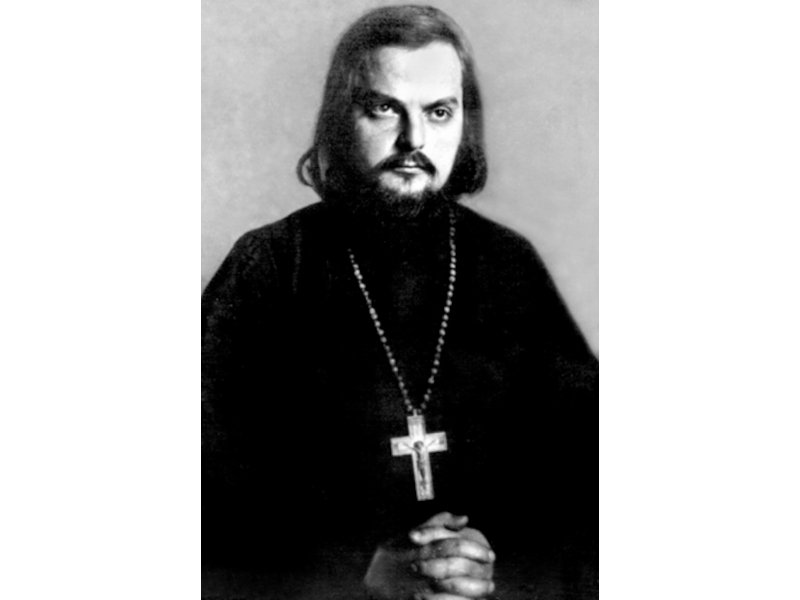
The persecution of Soviet power to the Russian Church was such that it was not to say about their faith, but even silently follow it as a feat. The new martyrs and confessors, glorified in the face of the saints did not come: believed, prayed and meekly went to their Calvarys.
“Polit.ru” recalls those who gave their lives for faith and by whose prayers the Russian Church is alive - even if almost nothing came to us besides the name.
Publications were prepared by Kirill Kharatyan (included by the Russian authorities in the register of foreign agents).
 Holy Martyr Sergiy Menyov
Sergei Mechev is the son of a priest of the righteous Alexy Menyov, the abbot of the Church of St. Nicholas in the Klenniki on Mariyka. Father Father Alexy loved his son Seryozha very much and wanted to have him his successor, but he did not want to put pressure on him and therefore gave his son a secular education to his son. In 1910, 18-year-old Sergei Mechev graduated from a gymnasium with a silver medal and entered the medical faculty of Moscow University. Soon he moved to study at the verbal department of the historical and philological faculty, which he graduated in 1917.
During the war in 1914, Sergei Mechev worked on the Western front a brother of mercy in one of the sanitary trains. There he met his future wife, who also worked as a sister of mercy.
Simultaneously with his studies at the university, Sergei Mechev took part in the work of the Student Theological Circle named after St. John Chrysostoy, organized by the governor of the Monastery of the monastery by Bishop Arseny (Zhadanovsky). At the meetings of the circle, reports on various topics of a theological character were read and discussed. In 1917, a commission was created to demolish the civil authorities of the Russian Orthodox Church with the civil government. Among the members of the commission, Sergey Alekseevich also included. During this period, he often had to visit Patriarch Tikhon, who loved him very much.
The decision to make the priesthood was connected with Sergei Alekseevich with a trip in 1918 to Optina Desert, where he received the blessing of the elders of his father Anatoly and the father of Nectaria.
In 1919, at the end of the historical and philological department of Moscow University, he was ordained a deacon, and then to the priest. He ordained him in April 1919 in the Danilovsky monastery the holy martyr Archbishop Theodore (Pozdeevsky).
The son served next to his father in the temple on Maroseyka. This parish was called the “worldly monastery”-the name is not the monastery walls, but the flock of family, connected by the bonds of love and a single spiritual leadership. Obedience to the spiritual father, cleansing conscience with repentance (“The essence of confession is self -resolution, confession is the suffering of the priest,” said Father Sergius), frequent communion, daily charter (lunch on Maroseyka began at 6 in the morning, and parishioners could get to work during) - all this created the conditions for genuine spiritual life. “Christianity is not a teaching, but life,” Father Sergius often repeated.
After the death of his father, Father Alexy on May 27, 1923, Father Sergius accepted the “repentant and business family” in his pastoral care, as he called his parish, and nourished him until his martyrdom. “You are my way to Christ, how I will go without you,” he wrote in 1930 to his spiritual children.
The worship of Father Sergius differed from the worship of Father Alexy: there was no that dissolution in love, that repentant crying, but still it was fine: it was strict, harmony, and concentration. His sermons were saturated with a strong -willed beginning, so that, listening to them, it was impossible to remain only the listener, but I wanted to act. The spiritual children attracted to him his personality, the fieryness of faith, demanding, sensitive and incorruptible conscience, the absence of any poses, knowledge of patristic teaching, and, finally, kindness and responsiveness.
Anticipating the martyrdom of Father Sergius, the elder Nectarium Optinsky somehow said to his spiritual daughter about him: “Did you know the father of Alexei? All of Moscow knew him, and his father Sergius so far knows only half-Moscow. But he will be more than his father. ”
After the renovationists captured the temples, only single parishes in Moscow retained loyalty to Patriarch Tikhon, among them were the Danilovsky monastery and Maroseyka.
Father Sergius was an uncompromising fighter for the purity of Orthodoxy. After the 1927 declaration, he did not remember Metropolitan Sergius (Stragorodsky), he did not accept church prayer for atheists and God -fighters. In 1929, the priest was arrested and exiled; In 1932, the temple was closed on Maroseyka.
The father was exiled to the north, in the small town of the Vologda region of the personnel. There, in 1933, a second arrest and condemnation of 5 years of camps followed: first on Lake Kubensky on a sawmill, then on the Shelex River, then in the Ust-Pinega. In 1935, he was transferred to Svir camps, to the Lodeynoye Field, after that - a transfer near Rybinsk (Pereborov Station), to the construction of a dam.
In the colony on Shelor, the priest was very starving. He was constantly robbed by criminal. The spiritual daughters who came to visit him noticed that, despite the extreme exhaustion, all irritability disappeared into it, he became very soft, there was not a single reproach.
In 1937, the father freed himself from the camp. He settled in the vicinity of Kalinin and worked in one of the clinics. He secretly performed the liturgy at home. Spiritual children constantly came to him, and he wrote letters to them: “Pray to the Lord, ask him to take off your tightness from you, a closing in himself, so that you get an expanded heart!” - So he instructed them.
At this time, all the bishops unanimous to the priest were in camps and links. He, in the desire to have an archpastoral cover, opened his church position and the illegal position of his community to one bishop. Soon this bishop was arrested: he betrayed Father Sergius, telling in court what was open to him as a bishop. Father Sergius was advised to hide in Central Asia, but he refused to leave his spiritual children. For about a year, the priest wandered without registration. In the summer of 1941, with some spiritual children, he secretly lived in a village near Tutaev. There he served a liturgy every day. In connection with the universal suspicion that arose with the outbreak of war, local residents took them for German spies and issued the NKVD.
On July 7, 1941, the priest was arrested and placed in the Yaroslavl prison. After 4 months of interrogations and torture, on which he behaved very courageously, trying to ensure that no one from the community was injured, on the night of January 6, 1942, the priest was shot in the prison of the Yaroslavl NKVD.