
Translated material
Jeff Bezos flew into space to prove the safety of his rocket for space tourists
But billionaire's ambitions go much further
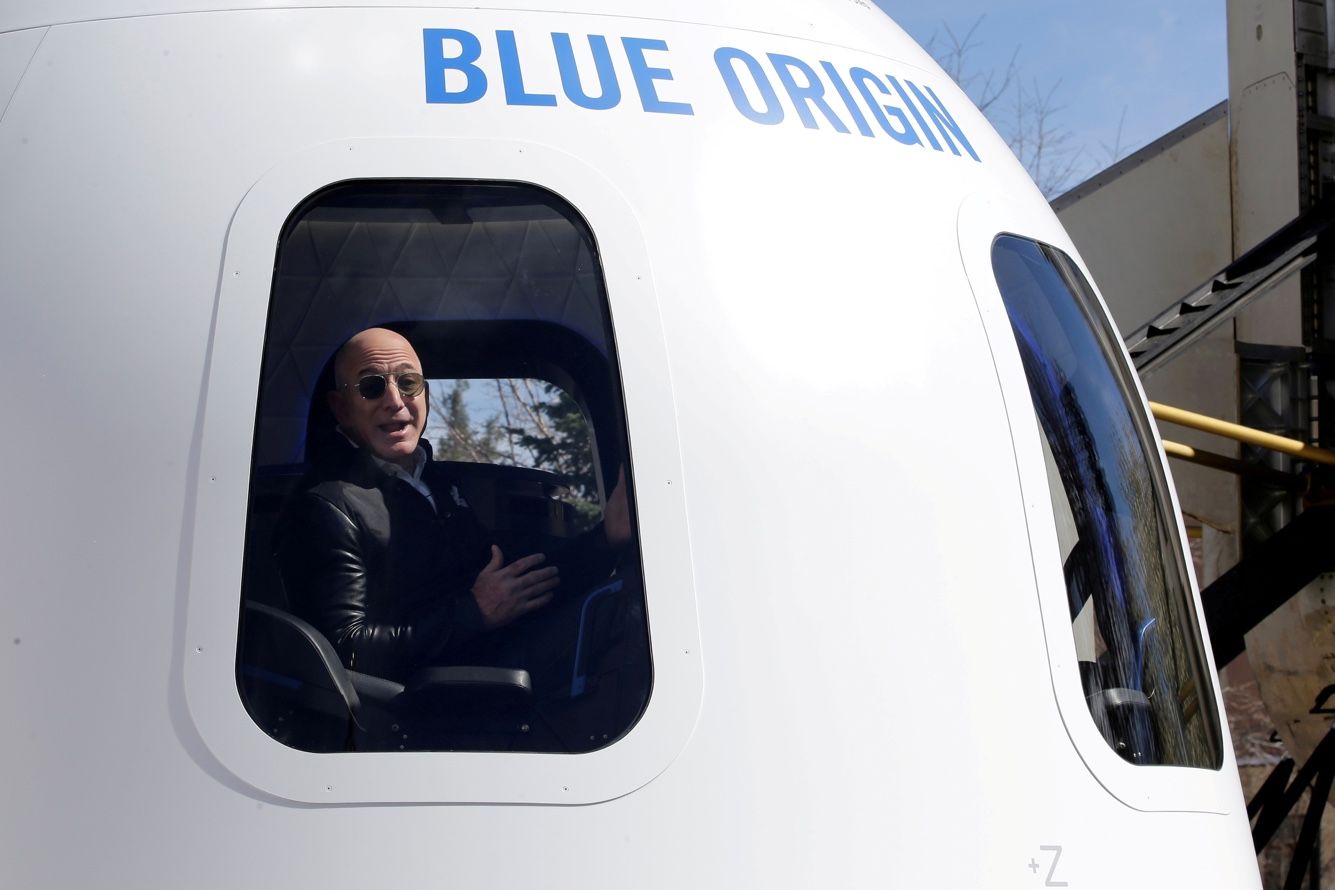
Exactly a month later, on July 20, 2021, the founder of Amazon and one of the richest people of the planet Jeff Bezos plans to make a space suborbital flight in the capsule of the News -based News -developed and built by its company Blue Origin. Together with Bezos, his brother Mark, as well as the winner of the auction, who bought a ticket for $ 28 million. His name is unknown, like the name of another crew member. At the request of Medusa, the Cosmonautics Popularizer Alexander Khokhlov talks about Bezos plans, which are actually much more ambitious than space tourism
Flying into space is Bezos's childhood dream. But bringing tourists to near -Earth orbit too expensive and difficult
Announcing the future flight of Blue Origin on his Instagram, Bezos wrote that he dreams of flying into space from the age of five. This dream accompanies him all his life: back in 2000, the billionaire founded the Blue Origin private space company, allocating for her a place on her own ranch in Texas.
His first goal was suborbital space tourism. The fashionable business of the beginning of the 21st century, however, turned out to be technically difficult for many players. Bezos competitors rely on missileplaces (Scaled Composites, Xcor Aerospace), which require experienced pilots to manage flight and landing. In turn, Blue Origin has chosen an automatic system consisting of a reusable suborbital missile and a reusable inhabited capsule with a parachute landing. The NEW Shepard System received in honor of the American astronaut Alan Shepard-it made the first suborbital, manned space flight in the Mercury-Capsu-3 capsule on May 5, 1961.
For flights with access to low near-Earth orbit, a sufficiently powerful and expensive launch vehicle is required, so tickets for orbital flights cost tens of millions of dollars. And in order to withstand several days in zero gravity and overload during landing, the passenger must meet certain medical requirements. This greatly limits the circle of people who are ready to fly into space at their own expense.
That is why Blue Origin, like many other private space companies, decided to occupy a niche of suborbital tourist flights. In this case, the ship overcomes the international boundary of the cosmos 100 km high ( pocket line ), the crew is in weightlessness for several minutes and enjoys impressive types of land, and then returns to the surface relatively mildly (the flight scheme is on the site ).
How the project developed. A chain of events
2005 and 2006
↓
Charon and Goddard PM1 test prototypes successfully passed tests (rise below 100 meters).
2006
↓
The company buys an additional plot of land in Texas to create a test missile training ground.
November 24, 2015
↓
The first fully successful launch of 100.5 kilometers, above the space of the space. The rocket was successfully landed with a reactive vertical landing; The capsule gently landed on parachutes and soft planting engines on compressed gas.
January 22, 2016
↓
Launching at a height of 101.7 kilometers. The successful return of the rocket and ship used during launch in November 2015. New Shepard receives the right to be considered a reusable space system.
January 14, 2021
↓
Already the fourth version of New Shepard (NS4) has successfully completed the first test flight. The capsule reached a height of almost 107 kilometers.
April 14, 2021
↓
The second and last flight to date NS4. Both the rocket and the capsule successfully landed. There was a man’s layout on board, and four Blue Origin employees before the start and after landing completed the training and leaving capsule by the crew.
An example of Bezos should show: there is no doubt about reliability. The price of the price remains open, and competitors are trying to get ahead of Blue Origin
In the intervals between these “stages of the Great Way” did not do without accidents and transfers, but now the personal example of Jeff Bezos, obviously, should show that the complete confidence of the safety of the rocket and the ship has been achieved.
During the flight of July 20, the same fourth missile and capsule NS4 will be used that were tested this year. The height of the rocket, along with a ship mounted on top, is about 15 meters, the diameter is 6 meters. The capsule is equipped with six seats for the crew, large portholes and three parachutes for landing.
For the flight, the BE-3 hydrogen-acid missile engine is used. Thanks to him, Blue Origin was the first private space enterprise of the New Wave (in contrast to the "old" corporations like Boeing and Lockheed Martin), which independently mastered hydrogen missile technologies.
How much a regular ticket on board Blue Origin will cost is not yet known. The company was going to start selling tickets in May 2021, but in the end they did not call the price. Instead, the flight of Jeff and Mark Bezov was announced, as well as a charity auction, the name of the winner of which was not yet disclosed.
It is expected that the cost of the ticket will be in the region of 200-300 thousand dollars, and the main competitor Blue Origin, Richard Branson Virgin Galactic has already preceded tickets, focusing on this price range.
Having shifted the beginning of tourist flights, Blue Origin was still able to earn money on tests - various experiments were ordered by commercial firms and universities (for example, the deployment of Vaifay on board or experiments with a magnetic field sensor). In addition, several experiments on board New Shepard paid for NASA, including the development of landing systems on the moon as part of the Artemis program .
Meanwhile, Branson carefully monitors the plans of the competitor. On May 22, 2021, the Virgin Galactic suborbital missileplane VSS Unity (project SpaceShiptwo) has completed the first full flight since February 2019. Then the rocket plane started from the base in the Mohava desert, then it was transferred to New Mexico, where the America tourist space was created. There, in December last year, the tests fell off - and now success. VSS Unity lifting height was 89.2 km.
In the near future, Blue Origin competitors plan three more flights. It was assumed that Virgin Galactic employees, the second by Richard Branson, and the third, are already commercial tourists. Now, judging by unofficial information, Branson plans to get ahead of Jeff Bezos and fly to close space on July 4, for which he applied to the Federal Civil Aviation Department (FAA) of the United States.
Bezos ambitions are not limited to cosmic tourism. He is going to build orbital cities
Meanwhile, for Jeff Bezos, suborbital space tourism is only the beginning of the space program; His ambitions extend much further and are in no way inferior in grandeur of the plans of Ilon Mask. Unless the main goal of the founder of SpaceX is the colony on Mars, and the founder of Blue Origin dreams of building orbital cities around the Earth.
In the mid-1980s, Jeff Bezos was a student at Princeton University. One of his teachers was physicist Gerard Oʼnil, who created the concept of human settlements in space. Bezos hopes to realize the ideas of his teacher, so that many thousands of people live and work in open space, and not on the surface of the planets.
In 2015, the company announced the creation of a heavy space-launch vehicle New Glenn (although work on it began in 2012). Like the New Shepard, she was named in honor of the astronaut-John Glenn, who on February 20, 1962 on the ship "Mercury-Atlas-6" was the first among Americans to make an orbital space flight.
It is not directly related to the future project of orbital cities, but it will become a key test of the ambitions of the Bezos for realism. If everything works, then, probably, New Glenn modifications will be used at space construction sites.
The launch pad is created at the launch complex under the number 36 of the US Air Force at Cape Canaveral; Nearby, assembly production for the rocket was built. Like the Falcon 9 launch vehicle, the two-stage New Glenn will become partially reusable: the first step will be returned. The total height of the rocket is 98 meters, the diameter is 7 meters. At the first stage, seven oxygen-methane engines BE-4 of the Blue Origin of their own development will be used. Two BE-3U engines on liquid hydrogen and liquid oxygen will operate on the second. The first start is scheduled for 2022.
For a vertical reactive planting of the first step in the Atlantic Ocean, a ship with a landing site was built. It is called "Jacqueline", in honor of the Mother Bezos.
New Glenn has not yet received profitable state contracts. But the company Bezos won the sanctions against Russia
There are already several commercial contracts for launches using the New Glenn launch vehicle, but the company also participates in competitions for more profitable state ones. True, in 2020, Blue Origin was unable to win an order for launches of defense satellites from the US Air Force, yielding to SpaceX and United Launch Alliance (ULA).
However, ULA will use the new Vulcan Centaur missile instead of its own Atlas v launch vehicle, the first stage of which uses Russian RD-180 missile engines. "Volcano" works on BE-4 from Blue Origin. The fact is that in 2016, Congress banned from 2022 to buy engines produced in Russia.
Moreover, Blue Origin Jeff Bezos received additional state financing for the development of the BE-4, which were originally designed from the company's own funds.
Blue Origin wants to participate in the American lunar program. While this has to be achieved through the court
Blue Origin plans to go beyond the limits of a near -Earth orbit. In May 2019, Jeff Bezos announced the project of creating the Blue Moon lunar landing module. Uniting with Lockheed Martin, Northrop Grumman and Draper to the National Team, Blue Origin received $ 579 million from NASA in 2020 to develop a preliminary landing project for the moon. But on April 16, 2021, NASA declared SpaceX the winner of this competition for the Artemis program.
On April 26, 2021, Blue Origin, together with its second competitor Dynetics, filed a protest to the NASA account, and therefore the contract with SpaceX was suspended . At the same time, the US Congress discuss the bill on the allocation of additional funds to create a lunar landing module. In this case, NASA will be able to conclude contracts with two companies at once - this has become almost ordinary practice in the American manned cosmonautics of the last decades.
Alexander Khokhlov