
Translated material
Canvases and tails
11-year-old Pasha Abramov from Arzamas draws paintings to help homeless animals. His work is appreciated abroad, and in Russia they do not understand
Pasha Abramov is a young artist from Arzamas. He draws portraits of animals to order, and transfers the proceeds to the help of homeless dogs and cats. Over the past three years, the boy transferred to the shelters more than half a million rubles and collected almost five tons of feed. Pasha is well known abroad - most often requests to draw “smaller brothers” come from the United States. And in their hometown, the boy’s work is not understood. "New" asked Ekaterina Bolshakova, Pasha’s mother, to tell how he and his projects live now. At first, she met our proposal with distrust, because "in addition to empty chatter, she sees nothing in Russia." But then she still agreed to meet.
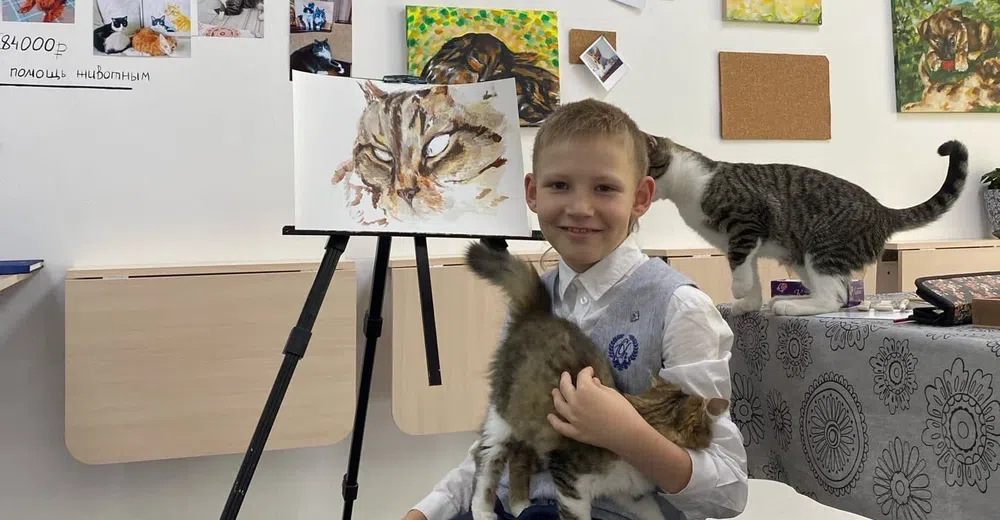
I come to Arzamas a few days after our conversation. On the threshold of the apartment, I am met at once by several pairs of curious cat eyes. A multi -colored, with a sullen gaze, the cat strives to run out into the porch. I hold out a hand to her to stop and stroke.
They pull me: “This is an Astra. We have a lady with a character, so be more careful - she can scratch. ”
Skinny, with soft blond hair and children's smile Ekaterina Bolshakova 33 years old. She invites me to a bright, spacious kitchen. Cats are behind us. They spin under their feet, sniff, look out tasty.
One of the walls depicts a large, branched tree with white colors and family photos instead of fruits. Near the Soviet TV, converted to the aquarium. At every step - drawings. If you look into the next room, you can see an empty easel. But he will not be empty for long.
Catherine pours tea, hand me a mug with a portrait of a cat of astrah, says:
- I was born in Chernivtsi, the heart of Bukovina. This is a very picturesque place in Ukraine, built by the Austrians, but we had to leave it.
When Catherine was small, the city happened in the city. In the summer of 1988, children suddenly began to complain about poor health and bald. The authorities explained the outbreak of alopecia by the release of chemicals, but officially the origin of the poisonous substance was not established. That year, local residents massively took their children out of the city. The family of Catherine also left, to the homeland of dad and grandmother - to the Nizhny Novgorod region.
After school, Catherine went to study at the faculty of public administration, but does not work in their specialty - "did not want to bother in politics." Then she dreamed of becoming an artist-decorator, but did not grow together either.
- We lived well, we had to earn money. While I studied in absentia at the decorator artist, at the same time mastered the work of the master in manicure. I liked that there was live money. I devoted 13 years to this profession, went to contests and international exhibitions. Now I have few customers. In the first place now - children.
The youngest daughter, three -year -old Lisa, is now in kindergarten. Her older brother, 11-year-old Pasha, sits next to us. It is embarrassed and blushing when mom begins to talk about his successes. Round excellent student, laureate of numerous olympiads. What is just not interested in: mental arithmetic, and chess, and karate. Besides
Pasha wants to become an architect, this year he entered the art school. His dream is to build an animal house. Not a shelter. It is the house.
While we are talking, two cats are lazily stretched lazily on the windowsill, warming in the sun. The third, small and black jumps to them. Crack is heard.
- Musya, what a person you are! - Catherine patiently raises a notching vase with lily of the valley for the first time, wipes the spilled water.
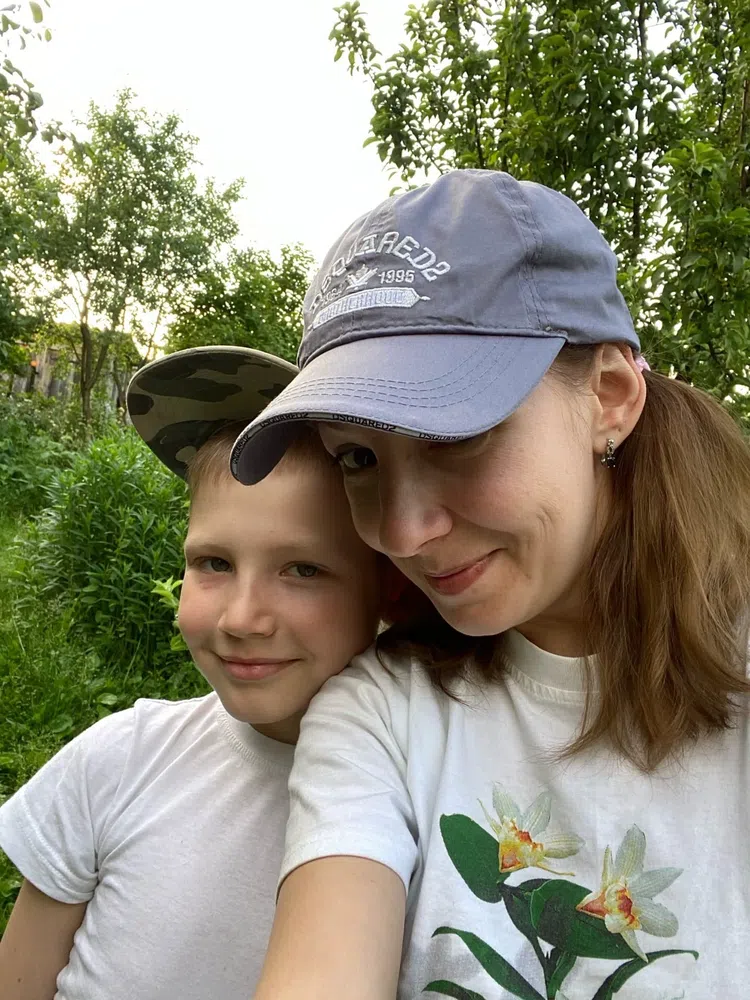
In her family, animals have always been loved. Mom picked up dogs and cats from the streets, treated and nursed. Katya also grew up on this, it was transmitted to her children. Pets, cats and cats are full -fledged family members.
Pasha brings a photograph in a frame from his room, in which he, his mother and a gray-brown cat with striped paws. This is Barsik.
“He was very affectionate, always slept nearby,” Pasha says quietly. “But once in the village there was a misfortune with him.” Barsika hit the car.
- We were very depressed. And then one day Pasha came to me and said: “Mom, and let's do the research work about animals next year and devote it to Barsik.” The project was called: "What can a small volunteer?"
First of all, Pasha decided to find out if there is a shelter for homeless animals in Arzamas. It turned out that one of them is - “life” is called.
- When I arrived there, at first I was even frightened - such a gam stood there. A lot of animals! - Pasha says admiringly about his first trip to homeless dogs.
He admits that the condition of the shelter was "such that I did not even want to go there." Dirt, puddles, "gray, gloomy dilapidated booths." At the same time, the dogs themselves looked "well -fed, beautiful and well -groomed."
Private shelter "Life" opened in 2011. They are in charge of a pensioner Lyudmila Ivanovna Filileeva. One is a hundred dogs.
Catherine says that Lyudmila dispersed the volunteers who used to help her, because "she does not trust anyone."
- They attacked a shelter in social networks. They called it “concentration camp for animals”, and the director “fraud”. But we came there and saw not a fraudster, but a woman who is just very tired. This is a non -state shelter. He does not receive any budget money.
And then Pasha began to think that, in fact, he could make a small volunteer for a shelter?
For example, to arrange a feed campaign in the school at school. Make a fair and exchange home -made Christmas toys for things to warm boots. Organize an art marrafon to draw homeless animals, make postcards from the drawings and hang them in shopping centers along with information about where these animals can be taken.
Pasha did all this with her mother.
“Such small volunteers, but do a big job,” said Lyudmila Filileeva in an interview. - And some say a lot, but do nothing. We would like more such positive people in our shelter, which, indeed, help.
Pasha wanted to present his research work at a large school conference in Sochi, in the Sirius Educational Center.
- But he was “wrapped”: the topic is impenetrable. They sent a safer for the forum - “Arzamas in the Golden Ring of Russia”. Apparently, in the city it was ashamed that our shelter in this state, ”Ekaterina suggests.
When the academic year ended, Pasha and his mother again went to the shelter "Life". There, Pasha had a favorite - a paw.
- We washed her, walked with her. Once they even took the festival: they thought, maybe there she would find a new owner. How much did we survive with her! They became very attached, and Pasha decided to draw her. Soon the paw was taken to a new house.
Catherine shows a portrait of a black-blink of a shirt with a sticky tongue, which now stands in the kitchen. Pasha’s mother laid it on social networks, and then the idea came up with her: suddenly someone wants to get a portrait of her pet in exchange for goodies for shelter dogs. A resident of Arzamas Elmira Banturova responded to the proposal. She has as many as four drawings from Pasha: two portraits of a dog Sonya, a portrait of a cat Vasya and a portrait of ASi and Fox cats.
Elmira handed the shelter 25 kilograms of food.
The Nizhny Novgorod journalists first learned about this action, called the “kind brush”, followed by federal ones. "And everything rolled like a snowball." The requests to draw their favorites rained down from people. Orders even went from other countries.
- Our first foreign order was from the USA. The military asked to draw his gray cat Olivia, - recalls Catherine.
- We correspond with all our customers, we are friends. There is no such person who would receive a portrait and disappeared.
Two years ago, Pasha made friends with the American schoolboy Jason Kimberly. Jason lives in Montgomery (Texas), he is 15 years old, and he also helps homeless animals. His project is called Leave it for the Pooch (literal translation: “Leave it for the mongrel”).
Many public and charitable organizations have clothing with their official symbols. Jason asks shelters to send him two such T -shirts. He wears one instead of school uniforms to attract donations. From other T -shirts sews patchwork blankets and sells them at its own auction. He transfers the proceeds to shelters. A year ago, Jason invited Pasha to put several of his works at the auction. And to share money from the sale of lots equally between Russian and American shelters. Pasha agreed. Four portraits went to Texas: the Dusks of the Dusi from the Arzamas Shelter "Life", the dog Elvis from the Vladimir shelter "Dog for Happiness", the dogs of Martha from the St. Petersburg shelter "Rzhevka" and the horses of Eve (collective image).
Pashins of work raised more than $ 800 at his first auction. Now the boy is preparing for the second.
After this story, Jason and Pasha became the heroes of the book “Young Changemakers Inspiring Others” (“Teenagers who change the world, inspiring others” - the translation of E.K. ) of the children's Canadian writer Steice Bauer. Soon she will be released.
In the first five months of the existence of a “good brush”, Pasha painted about a hundred orders. I had to work in frantic mode: one day - one portrait. It happened that Pasha began the picture, and Catherine finished.
Now in the queue for a portrait there is a thousand people, but in reality the picture is waiting much less. Many were “eliminated” when Catherine decided to change the format of the “good brush”. They stopped exchanging portraits for products. Now they take money for them and distribute it between the shelters and the needs of the project. The money is very small. Catherine says that earlier the lower limit was set for Russian customers - a thousand rubles per portrait. Then the minimum price was raised to three thousand. For foreign customers, the threshold did not exist simply because they did not ask about him.
- It was written on our site in black and white: customers themselves evaluate Pashin's work. As a rule, these are not rich people. In America, the smallest amount that we paid for a portrait is a hundred dollars. The largest is three hundred. But there is another standard of living. Some believe that we are in the paintings “profit”, but I'm already tired of convincing them. If they want, let them think that we transfer all the money to offshore, ”Catherine laughs.
In addition to the "good brush", the Pasha family held more than 20 charitable and educational events. These are boxes for collecting feeds in the shelter "Life", which are installed throughout the city. The very first container in the Orange shopping center Ekaterina ordered for her money. The rest made from foam blocks with her friend.
And there was also a charity concert “Rock in the Defense of Animals”, which was first held in Arzamas in 2019. He was organized by Catherine, she also invested part of her money to pay for the appropriate groups.
You can recall shares on sterilization of stray animals. Pashina's family paid for operations for 35 cats and one dog.
“We have no sponsors and state support, the project contains itself and helps other projects to survive,” the VKontakte group says in Pashina. “This is our work, our work.”
With the advent of fame, the life of Pashin's family has changed. On social networks there were people who were looking for a catch and deception in everything. Pasha’s mother was reproached for being “promoting” to her son.
“Yes, I am Piaru,” Ekaterina is drawing. -Because I do not want to see the news about how some child beat the dog. I do not want tens of thousands of likes about the stories about killed animals. I do not want this to be the norm. If Pasha is popular, then his business, the very idea, will also help homeless animals.
But most of all, says Catherine, Pasha was upset when “investigations” appeared on social networks, in which people demanded to prove whether he really paints the paintings on their own. Catherine says that she never hid that she and Pasha are drawing together, that she helps him. Pasha does not allow the camera to shoot the creative process - it is embarrassed. Mom asks if I can tell me about him. Pasha nods in agreement.
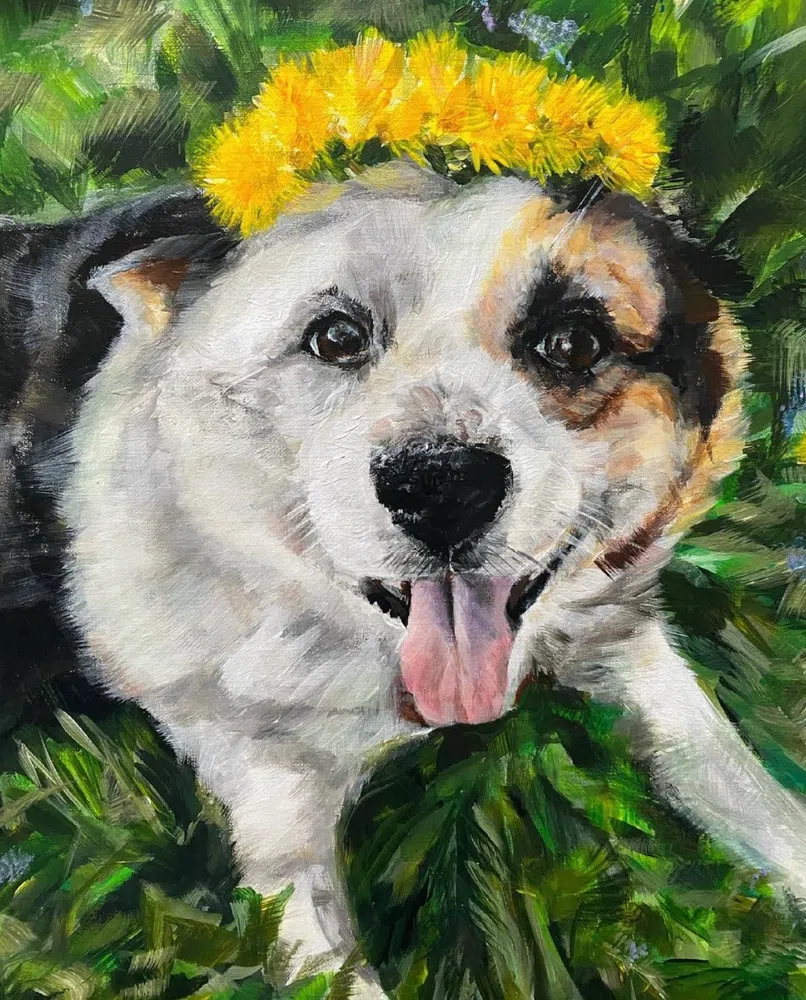
The boy draws without a preliminary sketch, immediately with paints. Pasha shows me one of the last works. On a large sheet of paper is a tricolor smiling dog Pirate with a wreath of yellow dandelions on the head. Almost like real.
Usually, when Pasha writes, he plunges with his head into the history of his hero, talks to him: “Hello! Do you like to play? Do you like to swim? Oh, what is your tail! And what a spot on your ear. "
“I don't want to make a window dressing from this,” says Catherine. - The main thing is that we attracted attention to the problem. After the hype rose, the administration put the asphalt in the shelter and made repairs in the medical room. And then what is the difference who draws.
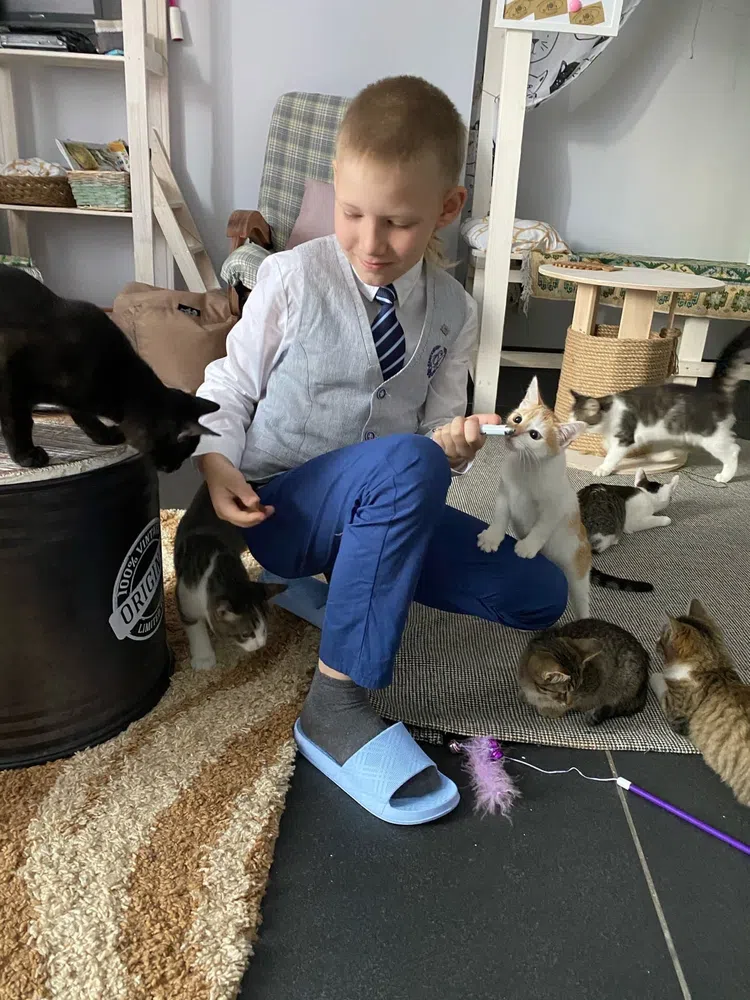
In August 2020, Pasha’s parents opened in Arzamas the creative coastal studio "Art Paste". "Paste" - because Pasha and because "everything is mixed." Cats and cats saved on the street lived in the studio. Visitors could play with them, stroke, chat and - if desired - take it to themselves. So the Pasha family attached 10 cats. Catherine leafing through the photos on the phone and the whole last hour of our conversation with tenderness tells the story of each.
Stories are sad, but with a good end.
Here is the cat’s cat, saved by veterinarians who lived in a cage for up to four months and therefore did not know how to walk. Here is Masha, a cat-gang-gang with torn ears, who was kept separately in Art Paste, because she could death to score others-so her life in the shelter influenced her. Or here is a cat without an eye, a victim of breeders. All three were taken by Gsty of the studio.
“I was once told that cats in Paste are a quality mark,” Catherine smiles. - And everyone who lives now will be happy.
And in “Art Paste” it was possible not only to save cats, but also to play board games, participate in master classes, quests and cognitive lectures, organize an exhibition, arrange a filmmaker, a children's holiday or create a women's club.
And almost all this is free.
-At the peak of popularity, we realized that we need to create some kind of tangible point of connection of all Pashin projects so that you can “come and touch”. - Catherine pauses. “True, I don’t understand why all this was needed.” There was a belief that the inhabitants would support us that we are needed here, because there is nothing similar anywhere.
Pasha, his mother says, wanted his project "to live in the city in which he lives."
“This is a story of disappointment,” Catherine lowers her eyes. -We wanted to show that you can help in different ways: without publishing terrible, free-eyed cats with the signature of SOS or Help, but organizing positive events. But people did not understand this. It turned out to be inaccessible to anyone.
In March, Art Paste closed.
Pasha still draws portraits of animals, but less often. It takes two works a month, and for the most part it is orders from other countries. The boy’s family now communicate so tightly with foreign customers that sometimes in ordinary life they switch into English. Dreaming of moving.
- When we put this business on stream, envy and misunderstanding appeared among the locals. I concluded that in our city they simply do not like animals. Of course, in Arzamas there are people who, too, like us, save animals. There are few of them, and we are very grateful to them.
After our meeting, I asked Catherine to calculate what was done for homeless animals for the entire existence of Pashin projects. Here's what she wrote:
“I am just now starting to understand that we have done not just a big one - but an unbearable job. And we broke. I try to comprehend, calculate and cannot. No sensible person will believe in it. ”
Over the past three years, according to approximate estimates of Catherine, Pasha has painted more than 200 portraits to order and sent them to 15 countries of the world. He collected 4.7 tons of feed, medicines and repair materials for homeless animals, transferred almost half a million rubles to shelters.
He is not going to stop.
Today, June 20, Pasha has a birthday, and he asks readers to “new” to do a good deed. After the closing of the Art Pestrate, cats and cats living in the studio moved to the boy home. But it is difficult for everyone to live together, so Murka, Gini, Kasya, Barsik and Astra are looking for a new house. If you are ready to become a good owner for one of them, write to Catherine on Instagram @Pashabramov1 or by mail Dobro.Project2019@mail.ru