
Translated material
The price of the locaun
Why the authorities are in no hurry to introduce new quarantine
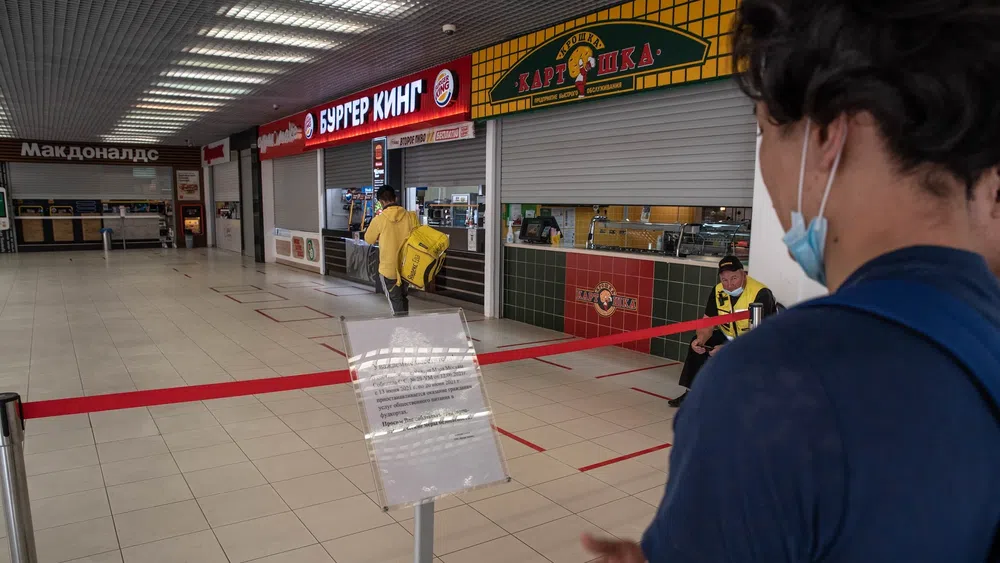
The fight against the epidemic is a difficult matter. Even the most competent and non -other authorities, developing measures of confrontation of the disease, must be drawn literally along the blade blade, at the same time answering many questions.
Close cities? And what to do with the "consumer economy" of these cities, sharpened under the movement of large masses of people, with a huge number of contacts? Let them work from home?
No, this is a bad solution, the studies show that the “remote” is suitable for those who are busy solving routine problems, live communication is necessary for “creative teams”. In addition, the refusal of traveling to work kills the service economy of agglomeration - each highly paid workplace in the office in the city center pulls several jobs easier and cheaper.
But if an engineer or programmer, in the end, can work at a computer in his own house, then a bartender or seller in the store will not be able to: his work is a derivative of the human stream filling the city streets.
Loss of jobs - how serious is this? For Moscow, there are almost no such data - one of the key elements of the Russian quarantine policy was a refusal of dismissal. But there is data according to California - it suits us as an example of a relatively densely populated area. The study "Did self -insulation work in California?" , conducted by scientists of the Center for Research of Economics and Health Policy of the State University of San Diego and the International Institute of Labor Economics (IZA), showed that
One prevented case of infection (in California realities) means a loss of two to four jobs, and each saved life is dismissal from 108 to 275 workers.
In Moscow, employees seemed to be not fired, but you can’t deceive the economy-this meant only that the “salaries” of so many people during quarantine were actually “unemployment benefits”. Within the framework of the “anti -crisis program”, 500 billion rubles were allocated for salary loans, and 460 billion of them “forgave” those entrepreneurs who did not reduce the staff.
This does not mean that henceforth needs to abandon quarantines, this means that you need to correctly evaluate their consequences. The authorities probably have some idea of the scale of costs that they do not want to share with us, but it is clear that they do not want to repeat last year’s experience-with prohibitions on the street, passes, closing shops and restaurants. Perhaps he will have to resort to him, but so far they don’t want to.
There is still a difficult point here: most of the income of local budgets in Russia are direct taxes (personal income tax and tax). For Big Moscow, which has gathered the seventh part of the country's population, this is good - but during growth. And if there is a decline (or Lockdown), such taxes will be reduced in the first place.
In addition, quarantine itself is not a panacea, its success depends on several factors - both the duration and the structure of the economy.
As the economists of the University of Chicago who studied the experience of quarantines in countries with a high level of internal migration (and this experience is also applicable in Moscow), the dependence of the incidence of quarantine is nonlinear. Simply put, “short” (up to 50 days) or “long” (more than 100 days) quarantine work to reduce the incidence.
But the “average in duration” of the elbows rather contribute to the spread of the disease.
How does this work? During a short quarantine, most people will not have time to get sick, during a long one, the majority will have time to recover. But the “intermediate in time” quarantine will create a situation where the sick people are parted “at the place of permanent registration” and make the infection with them.
As for the structure of the economy, there is an iron rule here - the poorer people, the more they depend on the need to earn a living without a break - the less they tend to observe all kinds of restrictions: it seems that the virus is far away and the lack of money - here it is, nearby. Moreover, no one, obviously, plans to pay any payments to people who have lost their earnings.
In addition, world experience showed that “self -isolation” works in combination with good medicine. That is, you need to not only plant people home, but also treat the sick people. In the study “The benefits and costs of social distance for the rich and for poor countries”, economists from Yale University wrote rudely, but frankly that
“The low potential of hospitals and intensive care units means that measures to smooth out the mortality curve are unlikely to prevent hospitals.”
If you have few beds and qualified doctors, they will still be overloaded, and sick help will not wait, even with a quarantine, even without it.
So quarantine is a painful and complex measure that the bosses would like to avoid and which are far from convinced of the effectiveness.
But what about last year's Lockdown? The motive for the introduction of quarantine was not only an increase in the incidence (in the absence of a vaccine and treatment protocols), but also the need to respond to the closure of the global economy and a sharp decline in export and reducing foreign exchange earnings. No one understood how long the Russian authorities would have to live on the accumulated foreign exchange resources, so just in case people were sent home at home - so that they would stock up buckwheat and watch TV, and not buy imports and, God forbid, did not go to withdraw money from foreign exchange bills. As soon as it became clear that Russian exports began to recover, so one could wave his hand and quarantines. Moreover, the “quarantine restrictions” touched the main fetish of Russian domestic policy - government ratings. And now, when the price of oil jumped over $ 75 per barrel, the bosses feel more than confident.