
Translated material
Afghan vinaigrette
Why Taliban* goes north, to the former borders of the USSR
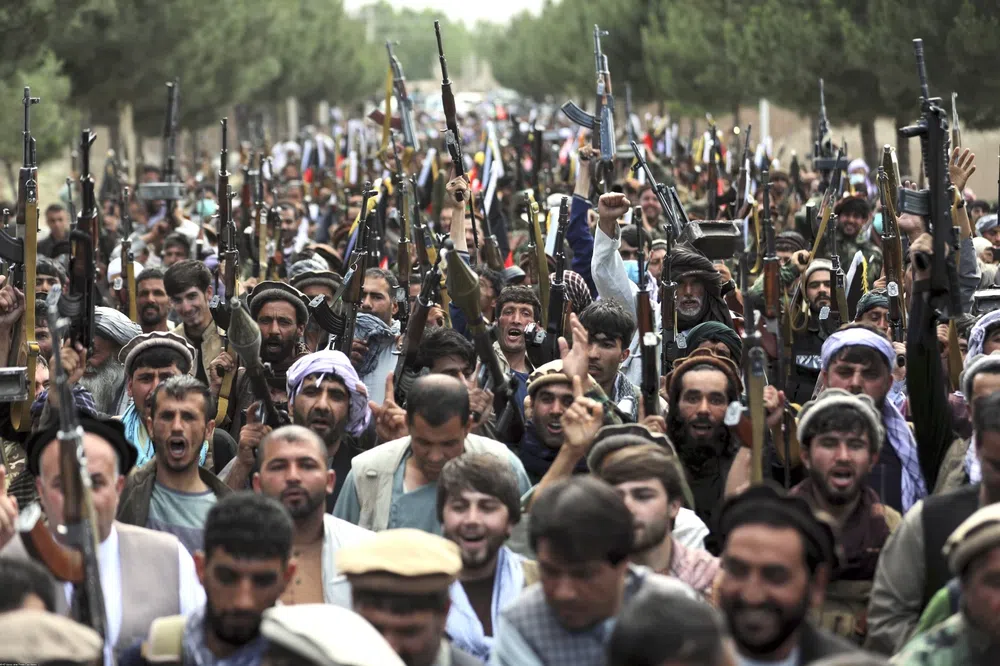
On the night of July 5, 1037 Afghan soldiers and officers and participants in the pro -government militia crossed the Pyanzh border with Tajikistan and moved to the territory of the neighboring republic. They retreated under the pressure of the Taliban, who deployed an offensive in the North-Eastern Afghan Province of Badakhshan.
Tajik border guards put them into the territory of their country, “taking into account good neighborly relations and non -interference in the internal affairs of Afghanistan,” the soldiers retreated, said in Dushanbe, “saving their lives”.
Most likely, the way it is. Although it is clear that here once again we see the features of the Afghans' Civil War, the Taliban do not strive categorically and everywhere destroy the Afghans who are fighting in the National Army and the police of Afghanistan. They prefer to negotiate with them where you can, forcing to pass the weapon and diverge home. And even proposing to join the ranks "Taliban" ...
The fighters of government units of Afghanistan began to be saved in a massive order on June 22, when more than two hundred military moved to Tajikistan in different sections of the Afghan-Tajik border. A few days later, the Afghan military began to swim in boats already border -border with Uzbekistan Amu Darya. Their exact number is not indicated, but there are also significantly more than 200 people. The Uzbek authorities reported that 53 of them, after a thorough check, were deported back to Afghanistan. According to unofficial data obtained from informed sources in Tashkent, Uzbek intelligence agencies seek to identify former jihadists among refugees, immigrants from Uzbekistan who fought in terrorist structures, such as the Islamic movement of Uzbekistan, IS, al-QAID (all are recognized in Russia).
It can be assumed that the same actions are carried out by Tajik security forces. However, in this case, the situation does not look so unambiguous.
The fact is that among those who flee to Tajikistan, Afghan military can also be militants of the former armed Tajik opposition (or members of their families),
Emomali Rahmon who fought with the government of the President of Tajikistan during the civil war in Tajikistan in the mid-1990s. But since the official Dushanbe concluded a peace agreement with the opposition in Moscow in 1997, the status of its former militants is not entirely clear ...
One way or another, the flight of the thousandth detachment of the Kabul troops, and even so, before the eyes of the whole world, occurs for the first time. This is evidence of the collapse of attempts by the Administration of the President of Afghanistan Ashraf Gani to keep the situation in the country after the withdrawal of the US troops and NATO, which today can actually be considered completed.
The Taliban consistently and purposefully replace the faithful Kabula units from the northern provinces of the country. In some counties and provinces, they are armed with armed resistance, in others, as happened in Badakhshan, - no. National mobilization, declared by the Government of President Gani, failed.
The fate of the president himself is now difficult to predict. I must say frankly, he is not the most popular figure among the ruling Afghan elite. Those who especially hate him, and not only within their country, but also beyond, predict the almost sad fate of the last pro-Soviet leader of Afghanistan Najibullah, pulled out by the Taliban from the UN Mission office when they displace the Mujahideen of the Mujahideen of the Rabbani-Masund in 1996 and torn to be torn by the Taliban ...
But today, the times are different, and Ashraf Gani has every opportunity to leave Kabul alive, even if he is occupied by the Taliban ... There is no doubt that these issues were secretly discussed during the recent official visit to the United States of the Afghan delegation, led by the president, in the end, a brilliant educated financier, a nee Afghan Pushtun, Mr. Gani, not so long ago, was a American citizen ...
There were 10 high -ranking officials and 10 of their personal assistants in his delegation. Its composition itself reflected all the complexity and inconsistency of the vinaigrette, which is similar to the Kabul power and the lack of unity in it. Not without scandals. As the Afghan press reported, at the very last moment, women and representatives of the Uzbek minority were included in the delegation, who, however, were not allowed to participate in important meetings in Washington.
Details of negotiations in the presentation of their participants are not known. This can be explained, in particular, by the fact that Ashraf Ghani did not achieve his main goal, to persuade US President Joe Biden to postpone the final withdrawal of troops from Afghanistan. But it was precisely on Bayden’s coming to the White House that Gani was especially counting, being sure that his special relationship with the top of the US Democratic Party would help him keep his power, relying on the shoulders of the American military. Everything turned out to be in vain.
Mr. Gani had no choice but to fiercely thank Joe Biden for the military and multi -billion dollar financial American aid to Afghanistan in the event of the formation of a capable coalition government there.
But it is precisely this task, according to the overwhelming number of politicians and experts in Afghanistan and beyond, that looks absolutely unresolved if Ashraf Gani expects to remain at least in any quality in power. The Taliban categorically does not accept the figure of the current Afghan president in any configuration of future power in his country. Hani’s unacceptable for the Taliban and proposals about the holding of new presidential elections in which he invites Taliban to take part. The world remembers the thousands of victims well, which accompanied the elections in the country where the endless civil gerille continues. And besides, it is known that not a single presidential election in Afghanistan led to a result recognized by all Afghan political groups. Their results were the result of an agreement between them, which very much resemble the nature of the current clarification of relations between government military and Taliban. In Russia, such relations have a gross definition - an agreement.
There is a sequel
The Taliban capture Afghanistan, without waiting for the withdrawal of the troops of the US coalition. How does this threaten Russia?
Gani’s “elected” and other ideas, aimed at pulling the Mezhafgan negotiations with the Taliban, have long caused poorly hidden irritation in Moscow. The Foreign Minister Sergei Lavrov speaks of “irresponsible behavior of some officials in Kabul”, which leads to “unforgivably protracted process of real peaceful negotiations, which allows ISIS* actively master the territories primarily in the north of Afghanistan, right on the borders of the countries that are our allies.”
We draw attention to the fact that Lavrov does not mention Taliban, obviously not wanting to evaluate them with an active armed offensive in the Afghan North, the impression is that today the Igilovs, and not the Taliban, supplant the Kabul military to escape in Tajikistan and Uzbekistan.
But about the Taliban, the official representative of the Foreign Ministry Maria Zakharova discusses - in Moscow "are not inclined to dramatize the exacerbation of the traditional for this period of the year and the movement of the Taliban." “We believe that at the end of the“ battle season ”the military situation in the country is relatively stabilized,” the young lady with Smolenskaya assures.
The deputy Minister of Foreign Affairs of Afghanistan Miroveis Naba, who recently reassured her the other day in Dushanbe, his Tajik colleague, they say, the intensification of the Taliban in the North is a temporary phenomenon and she will decrease when the school year will begin in Pakistani Madrasah ... So I see the Taliban, who are again sitting at the desks after the “battle season” ...
However, the theme of Pakistan here sounds really relevant. I recall how many years ago, in the late 1990s, I heard from the legendary Afghan leader Ahmad Shah Masuda that he did not consider the Taliban to his enemies, they were the same Afghans as we, he said, we are fighting with the Pakistanis standing behind the Taliban.
Since then, little has changed.
The diplomatic frugality of Russian diplomats towards the Taliban is understandable. The Russian leadership was not tired of emphasizing that the Taliban is an exclusively national military-political movement,
representing a significant part of the Afghans and does not have expansionist plans outside Afghanistan, and his claims to power must be reckoned with. Now that the armed opposition in Afghanistan is especially close to returning to power in Kabul, Moscow is special for its emphasized loyalty of recent years to the Taliban, especially noticeable against the backdrop of the skeptical attitude to the official Kabul, headed by Ashraf Gani.
However, God and God protects, the advance of the Taliban in the north forced the Russian Foreign Ministry to temporarily close its consulate in Mazari-Sharif. At the same time, President Putin assured the Tajikistan colleague Emomali Rahmon to assist in the framework of the military-political bloc of organizing a collective security agreement (CSTO) in case of tension on the border of Tajikistan and Afghanistan.
The leadership of Uzbekistan prudently proceeded to deploy camps to accommodate a possible flow of refugees near the Termez border with Afghanistan.
And the President of Tajikistan Rahmon ordered to mobilize 20 thousand reservists in case of a deterioration in the situation on the Afghan border.
At the same time, in Tashkent, Dushanbe and Moscow, they still proceed from the fact that there are no threats to the advance of the Taliban north of the Afghan borders. And it’s hard to disagree with this. That's just the Secretary General of the CSTO, the Belarusian General Stanislav Zsa considers Taliban to be a source of danger. “I saw them in April alive in the optics on the Pyanj River ... They are all in black clothes, fire points everywhere ...”
It remains unclear why the Taliban nevertheless take control of the Afghan North, where the traditional residence of the Pashtuns, which form the basis of their movement, is point in several counties. Are they afraid of the consolidation of the ethnic minorities of Afghanistan, Tajiks, Uzbeks, Turkmen, it is in the north that the majority are component? Strong to prevent their supply of weapons from neighboring countries of Central Asia or from Russia? They want to maintain the integrity of Afghanistan and resist the separatist plans of the Northern Leaders? Are they going to take borders under their guards to control the drug trafficking from Afghanistan?
There is no answer to these questions yet.
* recognized as terrorist and prohibited in Russia
** Igilovtsy - supporters of the Islamic State Terrorist Organization prohibited in Russia