
Translated material
Be a legionnaire
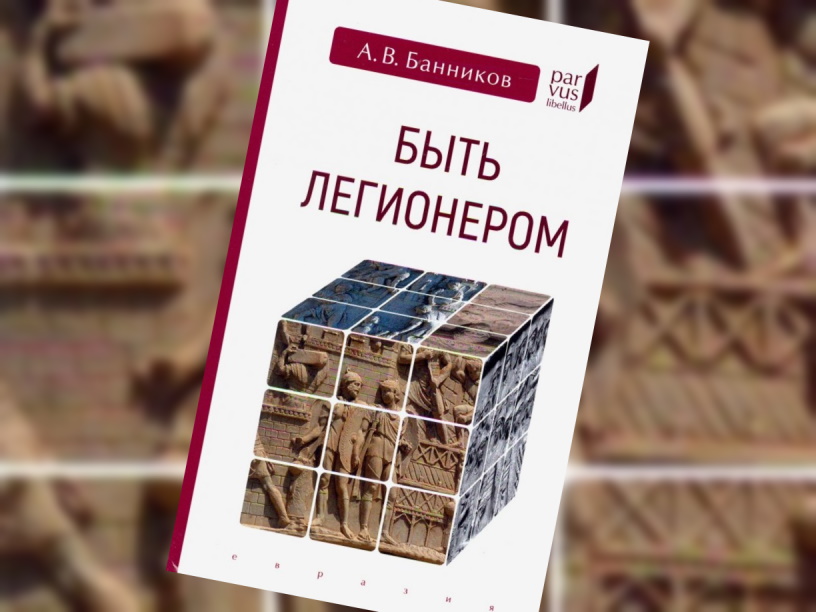
The “Slow Reading” section presents books included in the long list of the Enlightener Prize of 2021. It included 25 of more than two hundred books sent to the competition. In September, finalist books in the categories “Humanities” and “Natural and exact sciences” will be known. The awarding ceremony of laureates of book awards - “Enlightener” and “Enlightener. Transport” - will be held on November 18 in Moscow.
The Eurasia Publishing House represents the book of historian Andrei Bannikov “To be a legionnaire” . In the reader’s attention, there are no descriptions of campaigns, battles and sediment. In general, almost everything related to the direct conduct of hostilities, the author deliberately bypasses, focusing his attention on the conditions of the daily life of legionnaires in the era of the early empire (I - II centuries). In a series of small, but rather informative essays, the path of the Roman warrior is traced from the moment he is a new recruiting to the army, until he receives the status of a veteran and resigned.
We offer to read a fragment of the book, which refers to the nutrition of Roman legionnaires.
The diet of a soldier . Bread ( Frumentum ) has always remained for the military the main type of food. The remaining types of products, with all their importance for a balanced diet, were considered secondary. It is no coincidence that the vegetations recommends that in the event of an enemy siege threat, slaughter all animals and prepare a solonine, “so that thanks to the supply of meat there would be enough bread” (VEG., Epit., IV, 7). To prepare bread, the grain had to be ground into flour [1] . There are numerous instructions that the soldiers had to bake bread for themselves daily. This procedure was probably carried out at the level of the Containe, for which each of them was assigned a small stone mill ( Mola Manuaria ), capable of reset about 4 kg of grain per hour.
The practice of preparing bread for itself was obviously typically military. Even Emperor Karakalla, as the Herodian claims, being in a military camp, the grain was ground for himself: “Exactly as much as one was needed for him, he knead the dough and, baked on the coals, ate” (Herod., Hist., IV 7, 5; Per. A.K. Gavrilov).
However, during military campaigns, after long crossings, the soldiers did not always had the opportunity to bake bread. Therefore, the grain began to be replaced with crackers or some likeness of the galet ( Busllatum ), which, maintaining the calorie value of bread, weighed much less (600 g versus 850 g of grain soldering). Starting from the II century. The troops who went on a campaign had to take crackers with them, not grain. At the same time, the crackers could not compare with fresh bread in their taste. To receive it, the soldiers began to resort to the services of the bakers following the army. However, those of the military leaders who were a champion of harsh discipline prohibited such excesses and demanded that not only soldiers, but also everyone who were under the army, use only BuScellatum (SHA, PESC., 10, 4).
According to the author of the biography of Avidia Cassius, who acted on a campaign, the soldier was supposed to take with him only crackers and aketum ) - sour wine of low quality (possibly wine vinegar) (Sha, avid. Caes., 5, 3).
The usual soldier's drink was a prying ( Posca ), prepared from the water, vinegar (acute) and eggs (Sha, Hadr., 10, 2). Surrender served not only a cheap, common drink, but also a disinfectant for wounds.
In peacetime, the diet of a Roman soldier was, of course, much richer and more diverse. At 60–75 %, it consisted of cereals [2] , other products formed the rest: meat, fish, vegetables, fruits, cheese, eggs, olive oil and wine, which were able to give proteins and vitamins necessary for a balanced diet.
Mostly pork and beef were used from meat. The average norm of meat consumption was approximately half of the Roman pound (about 160 g). Vegetius also advises to grow poultry, since it does not require large expenses and is ideal for feeding patients (VEG., Epit., IV, 7).
The consumption of fish, although it was very difficult to store, was testified thanks to the numerous finds of fish bones and other remains in places of deployment of Roman military units. River fish (mainly trout, pike, sturgeon) was regularly caught near the legion camps, along the coast of the Rhine and the Danube, where the remains of hooks and fishing gear were also discovered. Sea fish (cod, anchovy, tuna), as well as seafood were delivered to local merchants to cities and fortresses, even very remote from the coast.
Of the vegetables, mainly beans, lentils and peas, which provided a modest amount of protein at moderate prices, from fruits (both fresh and in dry form) - apples, pears, plums, grapes, cherries, various types of forest fruits, smokwa, as well as nuts and chestnuts, in the eastern areas you could find peaches and abricks. Vegetius prescribes to breed gardens near the houses and in city squares (VEG., Epit., IV, 7), to always have a supply of fruits that were easily preserved by drying.
The cheese obtained from milk of cows, sheep or goats may have been prepared in the camps by the soldiers themselves. Its daily consumption was approximately 30 g per person.
Olive oil was one of the fundamental components of a healthy diet. It was used as a seasoning, for frying and as a drug.
In peacetime, soldiers usually drank wine ( Vinum ) [3] . Daily wine consumption was supposed to be half a sextarium (0.27 l). The wine could also be taken with them, going on a campaign, but from time to time the command forbade this, demanding that the soldiers be content with only an acute (Sha, Pesc., 10, 3).
On the northern border, already during the principle, beer consumption ( Cervesa ) was very common. In the late era, when the number of Gauls and Germans in the army increased significantly, this drink began to have even more walking in the military environment.
[1] The flour could go not only to cook bread: for example, frequent Pulti preparation ( PULS ) - thick stews or cereal from dummons, water, butter and milk were witnessed.
[2] The great importance that the grain was attached is explained, first of all, by the ease of its transportation and the possibility of long -term storage, that is, characteristics that satisfied the conditions of long -term military marches. In addition to wheat, Polba was very common, but other types of cereals, such as millet and barley, were also used. The barley was considered the food of lower quality, therefore it was issued as a punishment measure (LIV., Hist., XXVIII, 13; Front., Strat., IV, 1, 25) or used for constrained circumstances (Caes., BC, III, 47).
[3] It should be borne in mind that the wine was a real food product: 1 liter of wine with a strength of 12 % contained about 700 calories.
Earlier in our heading the following books were presented from the long list of the Enlightener Award.
- · Arkhipova Alexandra, Kirzyuk Anna. Dangerous Soviet things: city legends and fears in the USSR. - M.: New Literary Review, 2020.
- · Bovekin Dmitry, Chudinov Alexander. French Revolution. -M.: Alpina Non-Fikshn: Postnuka, 2020.
- · Vinarsky Maxim. Gospel from Luca. In search of a genealogy of the animal world. -M.: Alpina Non-Fikshn, 2021.
- · Zotov Sergey. Iconographic lawlessness. - M.: Exmo, 2021.
- · Crom Michael. Patriotism, or smoke of the Fatherland. -St. Petersburg: Publishing House of the European University in St. Petersburg, 2020.
- · Levin Alexey. White dwarfs. The future of the universe. -M.: Alpina Non-Fikshn, 2021.
- · Movchan Andrey, Mitrov Alexey. Cursed economies. - M: AST, 2020.
- · Mokhov Sergey. The history of death. How we fight and accept. - M.: Individual, 2020.
- · Vocabulary Dmitry, Sennikov Egor. They fell off: how and why socialism ended in Eastern Europe. - M.: Exmo, 2021.
- · Parin Sergey. Stress, pain and opioids. About endorphins and not only. - Minsk: Discourse, 2021.
- · Epple Nikolay. Unknown past: the memory of state crimes in Russia and other countries. - M.: New Literary Review, 2020.
- · Yakutenko Irina. The virus that broke the planet. Why SARS-COV-2 is so special and what should we do with it. -M.: Alpina Non-Fikshn, 2021.